AI Generated Quiz
Secondary 3 History Essay Explanation Quiz
Free Sec 3 History Essay Explanation quiz, Kimi2.6 AI version, with questions, answers, and O Level-style practice for Singapore students.
These static practice materials are generated from the site's syllabus and paper-generation workflow, with source and model context shown so students and parents can evaluate the material before use.
Questions
Free quiz and exam paper access
Enter your details to view this paper
Your access is remembered on this device.
Answers
Secondary 3 History Quiz - Essay Explanation: ANSWER KEY
Total Marks: 60 marks
Section A: Short Explanations (2 marks each)
1. Explain why the Treaty of Versailles created resentment in Germany.
Answer: The Treaty of Versailles created resentment because it imposed harsh penalties on Germany: the War Guilt Clause (Article 231) forced Germany to accept sole blame for WWI, reparations were set at 132 billion gold marks (later reduced), Germany lost 13% of its territory including Alsace-Lorraine and Polish Corridor, and the military was restricted to 100,000 troops. These terms humiliated Germans and economically crippled the Weimar Republic.
Marking: 1 mark for identifying any two harsh terms; 1 mark for explaining the impact on German pride/economy. Accept specific evidence such as reparations figure, territorial losses, or military restrictions.
2. Explain how the Great Depression contributed to the rise of extremist parties in Germany by 1933.
Answer: The Great Depression (1929) caused mass unemployment reaching 6 million by 1932, business failures, and banking collapses. This destroyed confidence in the moderate Weimar parties. The Nazi Party exploited economic misery with promises of jobs and national revival, increasing their Reichstag seats from 12 in 1928 to 230 in July 1932. The Communists also gained support, creating fear of revolution that drove conservative elites to support Hitler.
Marking: 1 mark for economic impact of Depression; 1 mark for explaining how extremists (especially Nazis) gained support. Accept reference to specific election figures or unemployment statistics.
3. Explain why the Japanese military was able to expand its influence in Manchuria in 1931 despite international opposition.
Answer: The Japanese military acted independently of civilian government—a rogue Kwantung Army staged the Mukden Incident as pretext. The League of Nations lacked enforcement power: its Lytton Commission took a year to report, and major powers were unwilling to use force or economic sanctions effectively. The USSR was not a League member; the USA pursued isolationism. Japan simply withdrew from the League in 1933 when condemned.
Marking: 1 mark for Japanese military independence/Mukden Incident; 1 mark for League weakness or international unwillingness to act. Accept reference to specific timeline or institutional failures.
4. Explain how the policy of appeasement encouraged Hitler's expansionist ambitions.
Answer: Appeasement—giving in to Hitler's demands to avoid war—demonstrated that Britain and France would not resist force. At Munich (September 1938), Hitler gained the Sudetenland without firing a shot. When Britain and France accepted this, Hitler learned that aggressive demands succeeded. He then broke the Munich Agreement by occupying all Czechoslovakia in March 1939, confident that the democracies lacked will to resist.
Marking: 1 mark for defining appeasement with example (Munich or Rhineland); 1 mark for explaining how it emboldened Hitler. Accept reference to specific events 1936–1939.
5. Explain why the fall of Singapore in February 1942 was significant for British colonial prestige in Asia.
Answer: Singapore was called the "Gibraltar of the East" and symbolised British imperial power. Its fall to a smaller Japanese force in 70 days shattered the myth of European invincibility. Winston Churchill called it "the worst disaster and largest capitulation in British history." Local populations throughout Southeast Asia lost confidence in colonial rulers, accelerating nationalist movements seeking independence.
Marking: 1 mark for Singapore's symbolic importance; 1 mark for impact on local perceptions/colonial prestige. Accept reference to Churchill quote or specific military details.
6. Explain how the Malayan People's Anti-Japanese Army (MPAJA) contributed to resistance during the Japanese Occupation of Malaya.
Answer: The MPAJA, dominated by Malayan Communist Party members with British SOE training, conducted guerrilla operations from jungle bases, attacking Japanese infrastructure, communications, and troops. They gathered intelligence for British forces. Their resistance, while sometimes brutal in killing collaborators, provided an alternative to Japanese rule and later claimed political legitimacy from their anti-Japanese role.
Marking: 1 mark for military/intelligence activities; 1 mark for political significance or specific operations. Accept reference to Force 136 connections or jungle camp systems.
7. Explain why the Potsdam Conference (July–August 1945) increased tensions between the USA and USSR.
Answer: New leaders—Truman (succeeding Roosevelt) and Attlee (mid-conference, replacing Churchill)—were less trusting of Stalin than wartime allies. Truman learned of successful atomic bomb test; dropping it soon after (Hiroshima, 6 August) was partly to limit Soviet gains. Disagreements over Poland's government, German reparations, and treatment of occupied Germany remained unresolved. Stalin already had troops throughout Eastern Europe.
Marking: 1 mark for leadership changes or atomic bomb context; 1 mark for unresolved substantive disagreements. Accept reference to specific dates or decisions.
8. Explain how the Truman Doctrine (1947) marked a shift in American foreign policy.
Answer: The Truman Doctrine committed the USA to "support free peoples who are resisting attempted subjugation by armed minorities or by outside pressures"—explicitly anti-communist containment. This reversed pre-1945 isolationism and the Monroe Doctrine's Western Hemisphere focus. Congress approved $400 million for Greece and Turkey, establishing precedent for global intervention. It institutionalised ideological confrontation with the USSR.
Marking: 1 mark for identifying containment/commitment to resist communism globally; 1 mark for contrasting with previous isolationism or explaining significance. Accept reference to specific funding or countries.
Section B: Structured Explanations (4 marks each)
9. Explain why the League of Nations failed to stop Japanese aggression in Manchuria in 1931.
Answer (mark breakdown):
- Structural weakness: League Covenant required unanimous Council decisions for action; Japan had veto power as permanent member (1 mark)
- Economic and military incapacity: No League army; major powers unwilling to disrupt trade with Japan during Depression (1 mark)
- Great Power distraction: Britain and France focused on European problems; USA not member (1 mark)
- Japanese unilateralism: Military acted independently, then Japan withdrew from League in 1933, making sanctions ineffective (1 mark)
Teaching note: The Manchuria crisis reveals how collective security requires both institutional mechanisms and political will. Without the USA or enforcement capacity, the League could only investigate (Lytton Commission, 1932) and morally condemn.
10. Explain how Nazi propaganda was used to consolidate Hitler's control over Germany after 1933.
Answer (mark breakdown):
- Institutional control: Joseph Goebbels as Minister of Propaganda (March 1933) centralised all media—radio, press, film, rallies (1 mark)
- Technology exploitation: Cheap "People's Receivers" (Volksempfänger) and loudspeakers in public spaces ensured Hitler's voice reached masses; radio ownership doubled 1933–1939 (1 mark)
- Visual spectacle: Nuremberg Rallies, Leni Riefenstahl's Triumph of the Will (1935), uniformed marches created image of unified, powerful Germany (1 mark)
- Message consistency: Blamed Jews for economic problems, celebrated Aryan superiority, portrayed Hitler as saviour; combined with censorship eliminating opposition voices (1 mark)
Teaching note: Propaganda succeeded because it was systematic, technologically innovative, and reinforced by terror (Gestapo, concentration camps). It created passive acceptance if not active enthusiasm.
11. Explain why Operation Barbarossa (June 1941) was a turning point in World War II.
Answer (mark breakdown):
- Two-front war: Germany repeated Napoleon's fatal error, dividing forces when Britain remained undefeated in West; violated Hitler's previous strategic principle (1 mark)
- Soviet resilience: Stalin relocated 1,500 factories east of Urals; "scorched earth" denied Germans resources; Russian winter and vast distances exhausted Wehrmacht (1 mark)
- Resource drain: 80% of German combat deaths in WWII occurred on Eastern Front; elite units destroyed at Stalingrad (1942–43) and Kursk (1943) could not be replaced (1 mark)
- Grand Alliance formation: Brought USSR into Allied camp; convinced Japan not to attack USSR (maintaining neutrality), enabled Lend-Lease from USA to both Britain and USSR; established pattern of cooperation that shaped postwar order (1 mark)
Teaching note: Barbarossa transformed WWII from European conflict to truly world war, and made Soviet victory (not Western Allied efforts alone) decisive in defeating Nazism.
12. Explain how the Japanese Occupation changed political awareness among people in Southeast Asia.
Answer (mark breakdown):
- Shattered colonial myths: Japanese propaganda of "Asia for Asiatics" and quick British/Dutch defeats exposed European weakness; "Gibraltar of the East" fallen in 70 days (1 mark)
- Military service and training: Japanese created local militias (Indian National Army, Pemuda in Indonesia, Burmese National Army) giving military experience and organisational skills to nationalists (1 mark)
- Harsh occupation realities: Forced labour (romusha), comfort women, famines (1944–45 Java), and atrocities disillusioned some about Japanese "liberation," but also demonstrated that Asians could govern (if brutally) (1 mark)
- Postwar momentum: Sukarno declared independence immediately upon Japanese surrender; similarly in Burma; returning colonial powers faced populations no longer acceptant of foreign rule (1 mark)
Teaching note: Japanese occupation was paradoxical—cynically exploitative yet inadvertently accelerative of nationalism. The experience varied greatly: Indonesians gained more administrative experience than Indochinese under direct military rule.
13. Explain why the Berlin Blockade (1948–1949) was a significant crisis in the early Cold War.
Answer (mark breakdown):
- First major confrontation: Direct Soviet-American confrontation in former capital; risk of shooting war if airlift failed or was attacked (1 mark)
- Test of containment: Truman's decision to supply Berlin by air rather than surrender or fight on ground established credibility of Western commitment; 277,000 flights delivering 2.3 million tons over 321 days (1 mark)
- Divorcement of Germany: Blockade made cooperation on German unification impossible; led to creation of separate West and East German states in 1949, cementing division for 40 years (1 mark)
- Institutional consequences: Prompted NATO establishment (April 1949) with mutual defence commitment; demonstrated need for Western military alliance rather than UN reliance (1 mark)
Teaching note: The airlift was both humanitarian achievement and political statement. Stalin ended blockade when Western resolve was proven, but Germany remained divided—perhaps the Cold War's most enduring legacy.
14. Explain how the Korean War (1950–1953) led to increased militarisation of the Cold War.
Answer (mark breakdown):
- Military spending surge: US defence budget quadrupled from 50+ billion; NATO forces expanded from 14 to 35 divisions; permanent US troops stationed in Europe and Asia (1 mark)
- Nuclear escalation: Truman considered atomic weapons for Korea; Eisenhower threatened their use to end armistice negotiations; accelerated hydrogen bomb development and nuclear arsenal growth (1 mark)
- Global alliances militarised: ANZUS (1951), SEATO (1954) created as anti-communist military pacts in Asia Pacific; bilateral US military agreements with Japan, South Korea, Taiwan (1 mark)
- "Never again" mentality: Korean War's indecisive end (armistice, no peace treaty) and Chinese intervention taught US to avoid limited wars poorly supported; influenced later interventions in Vietnam and commitment to overwhelming force (1 mark)
Teaching note: Korea transformed Cold War from diplomatic/ideological competition to armed confrontation with permanent military establishments on both sides.
Section C: Extended Essay Explanations (5 marks each)
15. Explain why the Weimar Republic faced political instability between 1919 and 1923.
Answer (mark breakdown):
Introduction: identify multiple interconnected factors (no mark, but structures answer)
Political structural weaknesses (2 marks):
- Proportional representation with no minimum threshold created fragmented Reichstag—28 parties in 1920 elections, coalition governments averaging 8 months
- Article 48 Presidential emergency powers used 136 times 1919–1923, bypassing democracy; Hindenburg elected 1925 (post-period but symptom of presidential drift)
- "Stab-in-the-back" myth blamed civilians/Socialists/Jews for defeat, delegitimising Republic from birth
Economic crises (2 marks):
- Reparations burden: 132 billion gold marks; when Germany defaulted, French/Belgian occupation of Ruhr (January 1923)
- Hyperinflation: printing money to pay reparations and striking Ruhr workers; November 1923 exchange rate 4.2 trillion marks to 1 US dollar; savings destroyed, middle class radicalised
Violent challenges from extremes (1 mark):
- Spartacist Uprising (January 1919): communist attempt, crushed by Freikorps (right-wing veterans)
- Kapp Putsch (March 1920): right-wing attempt to overthrow government, Berlin occupied, only general strike restored order—revealed army's unreliability (von Seeckt refused to act against right)
- Beer Hall Putsch (November 1923): Hitler's failed attempt, but demonstrated Nazi potential threat
Conclusion: synthesise—institutional fragility, economic vulnerability, and unrepentant anti-democratic forces from both left and right made Weimar permanently crisis-ridden until currency stabilisation (Rentenmark, November 1923)
Teaching note: Emphasise that Weimar's problems were not merely bad luck but structural—designed to prevent tyranny (after Bismarck/Kaiser), but too weak for turbulent postwar conditions.
16. Explain how British colonial rule in Malaya created conditions that both helped and hindered the communist insurgency of 1948.
Answer (mark breakdown):
Introduction: identify 1948 Emergency context, Malayan Communist Party (MCP) drawing on wartime MPAJA networks
Conditions that helped insurgency (3 marks):
- Wartime legacy: MPAJA veterans had jungle experience, weapons caches, and networks among Chinese rural population; British had armed and trained them
- Socioeconomic grievances: Chinese "squatters" on land margins lacked citizenship, education, economic opportunities; tin mining and rubber plantation labour conditions created class resentment MCP exploited
- Political opportunity: Postwar British policy vacillation—initially recruited MCP to administration, then banned party; announced Federation of Malaya (1948) excluding Singapore and limiting citizenship for Chinese, alienating potential moderates
Conditions that hindered insurgency (2 marks):
- Racial division: MCP was overwhelmingly Chinese; Malay population largely loyal to British or Islamic leaders; insurgency never became cross-communal national liberation struggle
- British counterinsurgency sophistication: Briggs Plan (1950) resettled 500,000 Chinese "squatters" into "New Villages" (protected, provided services, cut jungle contact); Templer's "hearts and minds" with citizenship offers; military success without Indonesian-style mass nationalist uprising
- Geographic concentration: Insurgents confined to jungle fringes; never threatened major cities or gained international support comparable to Vietnam
Conclusion: colonial rule provided both organisational foundation (through wartime co-optation) and limitations (racial structure, eventual effective response)
Teaching note: The Emergency illustrates how colonial counterinsurgency succeeded where later American efforts failed—partly through smaller scale, partly through granting eventual independence (1957) that satisfied mainstream nationalists.
17. Explain why decolonisation in Southeast Asia occurred at different speeds in different territories after 1945.
Answer (mark breakdown):
Introduction: identify varying timelines—Indonesia 1949, Philippines 1946, Burma 1948, Malaya 1957, Indochina 1954/1975, Singapore 1965
Cases of rapid decolonisation (2 marks):
- Philippines: USA had promised independence (Jones Act 1916, Tydings-McDuffie Act 1934); war damage made colony costly; Cold War strategic need for anti-communist Asian ally; independence 1946 with military bases retained
- Burma: Pre-war nationalist movement under Aung San strong; Japanese occupation created Burma National Army which switched sides 1945; British Labour government unwilling to hold by force; independence 1948 despite communist and ethnic insurgencies
Cases of delayed decolonisation (2 marks):
- Malaya: British economic stakes (rubber, tin) highest in region; communist Emergency required military commitment; gradual constitutional preparation including Malayan Union failure (1946), Federation negotiations, Alliance Party inter-communal bargain; independence 1957 only when successor state viability assured
- Indochina: French determined to recover "prestige" after 1940 defeat; no pre-war nationalist unity (multiple parties, French divide-and-rule); Ho Chi Minh's Viet Minh fought 1946–1954; Geneva Conference partition at 17th parallel became protracted American intervention; unified independence only 1975
Structural explanatory factors (1 mark):
- Coloniser identity and postwar capacity: American anti-colonial tradition vs French determination; British financial weakness vs strategic Malaya priority
- Nationalist movement strength and unity: mass parties with military experience accelerated; fragmented or suppressed movements delayed
- Cold War dynamics: territories seen as vulnerable to communism received prolonged attention (Vietnam, eventually Malaya); safe anti-communist allies released quickly (Philippines)
Conclusion: decolonisation speed reflected interaction of metropolitan policy, nationalist capacity, economic stakes, and Cold War geopolitics—not uniform "winds of change"
Teaching note: Key contrast is British pragmatism (withdraw when costs exceed benefits, prepare viable successors) versus French emotional/intransigent approach producing protracted wars.
Section D: Source-Based Explanation (5 marks each)
18. Explain what Churchill meant by the "iron curtain" and why he chose this metaphor.
Answer (mark breakdown):
Meaning of "iron curtain" (3 marks):
- Physical/geopolitical reality: Stalin's USSR had established satellite regimes in Poland (1945 communist government), East Germany (Soviet zone), Hungary, Romania, Bulgaria, Czechoslovakia (1948 coup)—all with Soviet-controlled communist parties, secret police, and censorship
- Ideological barrier: Beyond mere territorial division, Churchill described systematised control preventing free information, movement, and political choice—"police governments"
- Threat assessment: Warning that this division was not static; "increasing measure of control" suggested expansionist potential, requiring Western response
Why this metaphor (2 marks):
- Dramatic impact: "Iron curtain" entered permanent vocabulary; Churchill's rhetorical skill as wartime orator ensured attention at a time when many still hoped for postwar Soviet cooperation
- Theatrical appropriateness: Descended—suggesting sudden, heavy, impenetrable barrier; association with stage illusions made it both accessible and ominous; "iron" connoted industrial totalitarianism, prison bars, oppression
- Strategic purpose: Delivered at Fulton, Missouri with Truman present; intended to shift American opinion from temporary to permanent anti-Soviet alliance; "Special Relationship" framing implied British-American partnership necessary to confront this threat
Teaching note: Churchill was not first to use phrase (Goebbels and others had), but gave it definitive meaning. Accuracy of claim debated—Yugoslavia under Tito later broke with Stalin; but core description of Soviet control accurate for 1946–1989.
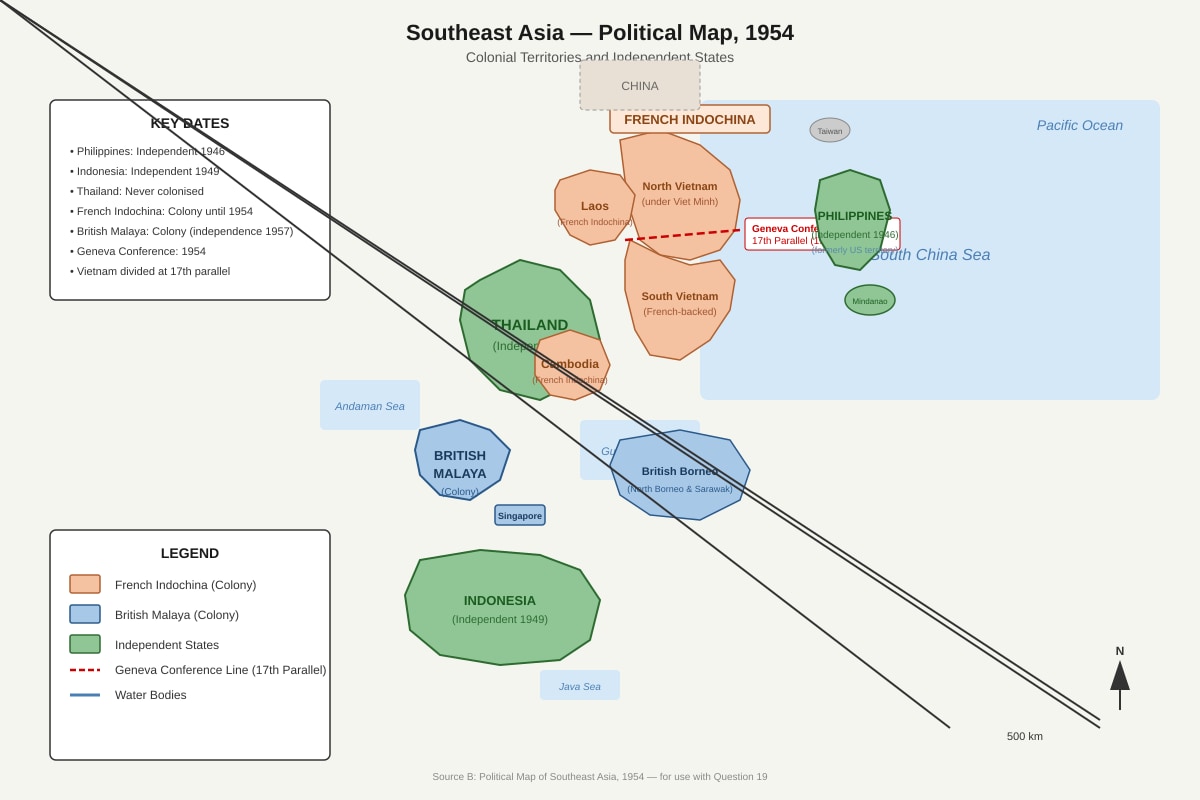
19. Using Source B (the map) and your own knowledge, explain why the Geneva Conference of 1954 was a significant turning point in decolonisation in Indochina.
Answer (mark breakdown):
Map interpretation (2 marks):
- Source shows 1954 division—French Indochina in process of dissolution; Vietnam temporarily divided at 17th parallel; Laos and Cambodia independent; contrast with still-colonial Malaya suggests pace disparity
- Visual evidence of temporary nature: "pending Geneva Conference partitions," "line at 17th parallel"—explicitly provisional, yet became permanent division for 21 years
Historical significance (3 marks):
- End of French colonialism: Defeat at Dien Bien Phu (May 1954) made French position militarily unsustainable; Geneva acknowledged what war decided—800+ years of Vietnamese resistance (Trung Sisters, Trieu Da, 19th-century rebellions, Viet Minh) finally successful
- American succession: Geneva Accords intended reunification elections 1956; USA prevented these in South Vietnam (Diem regime), transforming anti-colonial struggle into Cold War confrontation; SEATO created to protect "free" Vietnam, Laos, Cambodia
- Regional demonstration effect: Inspiring to other nationalists (though American intervention warned of colonialism's possible replacement by neo-colonialism); model both of successful anti-imperial warfare and of great-power limitation of true independence
Teaching note: The map's provisional division becoming permanent illustrates how decolonisation was shaped by Cold War calculations overriding nationalist aspirations. Ho Chi Minh's supposed statement—"I have won my wars, you have lost yours" to French—captures anti-colonial victory; Geneva's limitations show subsequent American war's origins.
20. Using Source C and your own knowledge, explain how the formation of military alliances shaped the nature of conflict during the Cold War.
Answer (mark breakdown):
Source analysis (2 marks):
- Table shows rapid alliance formation 1954–1955: NATO expansion, Warsaw Pact as direct response, SEATO and CENTO as regional extensions
- Numerical stability by 1960 suggests fixed bipolar structure—no new members to Warsaw Pact (despite 1956 Hungarian attempt to leave); NATO only slowly expanding; regional alliances (SEATO, CENTO) never achieved military integration comparable to NATO
Nature of conflict shaped (3 marks):
- Prevented direct great-power war: Mutual deterrence through collective defence made Soviet-American direct conflict too costly; Korea and Vietnam were "limited" wars with proxies rather than NATO-Warsaw Pact confrontation
- Globalised local conflicts: Korean War became UN action (technically) due to Soviet boycott; Vietnam became American commitment via SEATO context; Middle Eastern coups (Iran 1953, Suez 1956) viewed through CENTO/anti-Soviet lens; conflicts everywhere interpreted via alliance logic
- Nuclear arms race institutionalised: NATO's 1957 adoption of nuclear sharing; Warsaw Pact's conventional numerical superiority; both sides justified increased spending by alliance commitment; Cuban Missile Crisis (1962) directly about placement of nuclear weapons in alliance context
- Entrapment risks: Alliances could drag superpowers into unwanted conflicts—USA into Vietnam due to credibility concerns; USSR into Afghanistan (1979) partly to protect satellite commitment; alliance rigidity reduced diplomatic flexibility
Teaching note: Alliances both stabilised (preventing World War III) and destabilised (globalising, militarising local disputes). The institutional form mattered: NATO's integrated command succeeded where SEATO's loose coordination failed, explaining differential American intervention levels.
END OF ANSWER KEY