AI Generated Quiz
Secondary 3 History Conflict International Relations Quiz
Free Sec 3 History Conflict IR quiz, Qwen3.7 AI version, with questions, answers, and O Level-style practice for Singapore students.
These static practice materials are generated from the site's syllabus and paper-generation workflow, with source and model context shown so students and parents can evaluate the material before use.
Questions
Free quiz and exam paper access
Enter your details to view this paper
Your access is remembered on this device.
Answers
Secondary 3 History Quiz - Conflict International Relations (Answer Key)
Section A: Knowledge and Understanding
1. Define the term 'alliance' in the context of international relations. [1]
- Answer: An agreement or treaty between two or more countries to cooperate for specific purposes, often for mutual defense or military support in case of war.
- Teaching Note: Key concept: Mutual obligation. Students should not just say "friends," but specify formal cooperation, often military.
2. Identify one long-term cause of World War I related to military build-up. [1]
- Answer: Militarism (or the Arms Race).
- Teaching Note: Accept specific examples like the naval race between Britain and Germany.
3. State the name of the treaty that officially ended World War I with Germany. [1]
- Answer: The Treaty of Versailles.
4. What was the primary purpose of the League of Nations established after World War I? [1]
- Answer: To maintain world peace and prevent future wars through collective security and diplomacy.
- Teaching Note: "Collective security" is a key term here.
5. Identify the policy of appeasement pursued by Britain and France in the 1930s. [1]
- Answer: The policy of making concessions to aggressive powers (like Nazi Germany) to avoid war.
6. Name the event in 1939 that directly triggered the start of World War II in Europe. [1]
- Answer: The German invasion of Poland.
7. Define 'total war' as it applies to the conduct of World War II. [1]
- Answer: A war in which a nation mobilizes all of its resources (human, industrial, agricultural) for the war effort, and where the distinction between combatants and civilians is blurred.
8. Identify one superpower that emerged as a dominant global force after World War II. [1]
- Answer: The USA (United States of America) OR The USSR (Soviet Union).
9. What was the Iron Curtain? [1]
- Answer: The political, military, and ideological barrier erected by the Soviet Union after WWII to seal off itself and its dependent eastern and central European allies from open contact with the West and other non-communist areas.
10. State the main ideological difference between the USA and the USSR during the Cold War. [1]
- Answer: The USA supported Capitalism and Democracy, while the USSR supported Communism and a one-party state.
Section B: Source-Based and Structured Questions
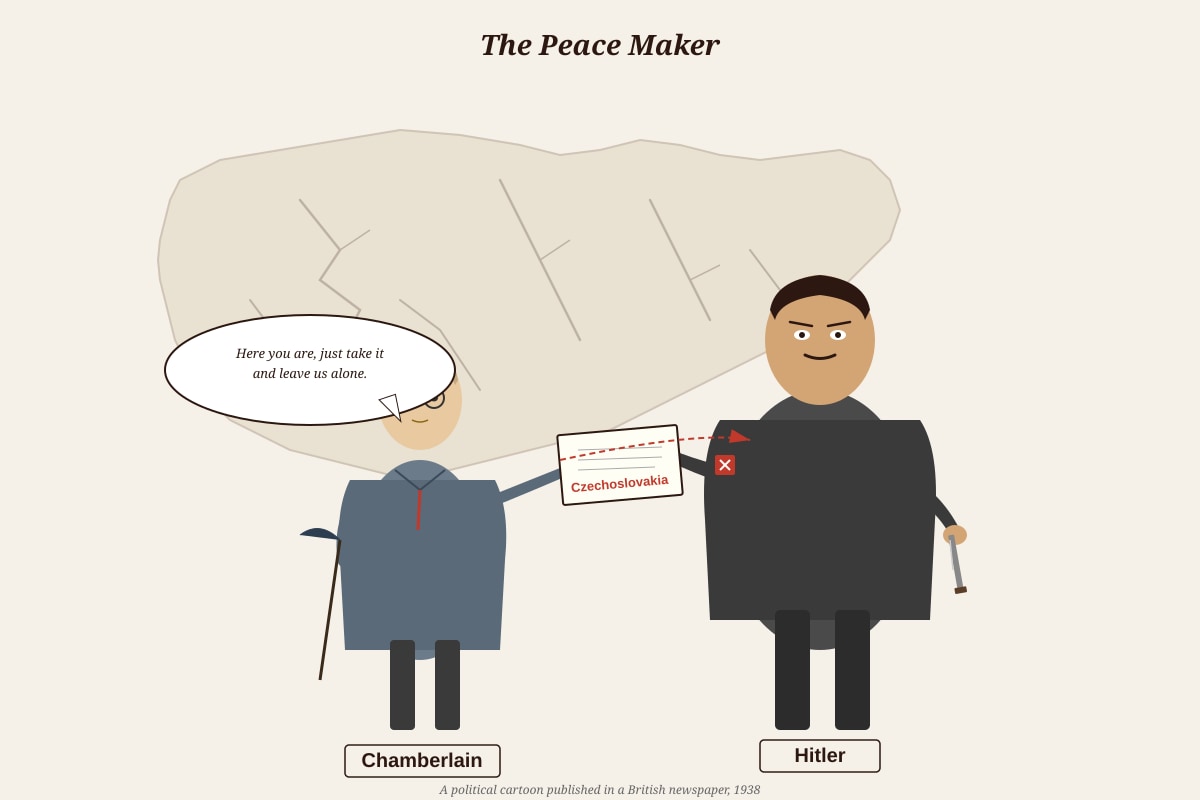
11. With reference to Source A, what message is the cartoonist conveying about British foreign policy in 1938? [3]
- Answer:
- Level 1 (1 mark): Identifies that Chamberlain is giving something to Hitler.
- Level 2 (2 marks): Explains that Britain is giving up territory (Czechoslovakia) to keep peace.
- Level 3 (3 marks): Explains that the cartoonist is criticizing appeasement as foolish or dangerous. The cartoon shows Chamberlain as naive (ignoring the knife behind Hitler's back) and suggests that giving in to Hitler will not stop his aggression but only make him stronger/more dangerous.
- Teaching Note: Students must reference the visual details (the knife, the label 'Czechoslovakia') to get full marks. The message is critical of Chamberlain.
12. Based on Source B and your own knowledge, explain two reasons why the USA adopted this policy (known as the Truman Doctrine). [4]
- Answer:
- Reason 1 (2 marks): To contain the spread of Communism. The USA believed that if one country fell to communism, neighboring countries would follow (Domino Theory). Source B mentions supporting "free peoples" against "subjugation."
- Reason 2 (2 marks): To protect US economic and political interests. A communist Europe would close markets to US goods and threaten democratic ideals globally. The USA wanted to establish itself as the leader of the "free world."
- Teaching Note: Each reason needs a clear explanation linked to the source or own knowledge.
13. Describe the trend shown in Source C for USA military spending between 1948 and 1952. [2]
- Answer: USA military spending increased significantly/sharply. It more than tripled from 45.0 billion in 1952.
- Teaching Note: Must use data from the table to support the description.
14. Suggest one historical event that might explain the sharp increase in USA military spending in 1950 shown in Source C. [2]
- Answer: The outbreak of the Korean War (1950).
- Explanation: The USA entered the Korean War to stop the spread of communism in Asia, requiring a massive increase in military funding and troop deployment.
- Teaching Note: Other acceptable answers: Intensification of the Cold War arms race, but Korean War is the most direct cause for the 1950 spike.
15. How useful is Source C to a historian studying the causes of the arms race? Explain your answer by referring to its content and limitation. [4]
- Answer:
- Useful (Content) (2 marks): It provides quantitative evidence of the rapid increase in military spending, specifically showing the USA's reaction to perceived Soviet threats. It proves that both sides were investing heavily in defense, which is a key feature of the arms race.
- Limitation (2 marks): It only shows spending, not the actual weapons produced or the strategic intentions behind the spending. It also only covers a short period (1948-1952) and does not show Soviet spending trends in as much detail or the broader global context (e.g., alliances). It doesn't explain why the spending increased, only that it did.
- Teaching Note: Students must address both utility and limitation. A common mistake is to say "it is not useful because it is just numbers." Numbers are useful for economic history.
Section C: Structured Essay Questions
16. "The failure of the League of Nations was the main cause of World War II." How far do you agree? [6]
- Marking Scheme:
- Level 1 (1-2 marks): Simple statement agreeing or disagreeing without explanation.
- Level 2 (3-4 marks): Explains one side of the argument (e.g., League failed to stop Japan/Italy/Germany) OR lists other causes without linking them well.
- Level 3 (5-6 marks): Balanced answer. Acknowledges the League's failures (lack of army, US absence, slow sanctions) as a significant factor that allowed aggression to go unchecked. However, also argues that other factors were equally or more important, such as the harshness of the Treaty of Versailles (creating resentment in Germany), the rise of Hitler and his aggressive ideology, and the policy of Appeasement by Britain and France which encouraged Hitler. Concludes with a reasoned judgment.
- Teaching Note: Look for specific examples (Manchuria, Abyssinia) for the League's failure. Look for mention of Hitler's aims for the alternative cause.
17. "The use of atomic bombs was necessary to end World War II in the Pacific." How far do you agree? [6]
- Marking Scheme:
- Level 1 (1-2 marks): Simple statement agreeing or disagreeing.
- Level 2 (3-4 marks): Explains one perspective (e.g., it saved lives by avoiding invasion) OR the other (it was immoral/unnecessary).
- Level 3 (5-6 marks): Balanced answer.
- Argument for necessity: An invasion of Japan (Operation Downfall) would have resulted in massive casualties for both US and Japanese forces. Japan showed no sign of surrendering despite conventional bombing. The bombs forced a quick surrender, ending the war sooner.
- Argument against necessity: Japan was already defeated militarily and economically. The USSR's entry into the war against Japan might have forced surrender. The bombs caused immense civilian suffering and started the nuclear arms race. Some argue it was used to intimidate the USSR.
Section D: Additional Structured Questions
18. Explain two reasons why the Treaty of Versailles (1919) is often considered a flawed peace settlement. [4]
- Answer:
- Reason 1 (2 marks): It imposed harsh reparations on Germany, which crippled the German economy and created deep resentment among the German people, fostering support for extremist parties like the Nazis.
- Reason 2 (2 marks): It redrew the map of Europe based on self-determination but often ignored ethnic realities, creating new minority problems and unstable borders (e.g., the Polish Corridor), which became future flashpoints for conflict.
- Teaching Note: Accept other valid reasons such as the "War Guilt Clause" (Article 231) being seen as a national humiliation, or the exclusion of Germany from the negotiations leading to a "Diktat" (dictated peace).
19. Describe the policy of Containment adopted by the USA during the Cold War. [4]
- Answer: Containment was the US foreign policy strategy aimed at preventing the spread of communism beyond its existing borders. It was based on the belief that if communism was contained, it would eventually collapse from within. This was achieved through economic aid (e.g., Marshall Plan), military alliances (e.g., NATO), and direct or indirect military intervention (e.g., Korean War, Vietnam War) to support non-communist governments.
- Teaching Note: Students should mention the goal (stopping spread) and the methods (economic/military). Mentioning George Kennan as the architect is a bonus but not required for full marks if the description is accurate.
20. Identify one proxy conflict during the Cold War and explain why it is considered a "proxy" war. [4]
- Answer:
- Conflict (1 mark): The Korean War (1950-1953) OR The Vietnam War (1955-1975) OR The Soviet-Afghan War (1979-1989).
- Explanation (3 marks): It is considered a proxy war because the two superpowers (USA and USSR) did not fight each other directly. Instead, they supported opposing sides in a local conflict with money, weapons, and military advisors. For example, in the Korean War, the USA supported South Korea and the USSR/China supported North Korea. This allowed the superpowers to compete for influence without triggering a direct nuclear confrontation.
- Teaching Note: The explanation must clearly link the local conflict to the broader US-USSR rivalry and the avoidance of direct conflict.