AI Generated Quiz
Secondary 3 History Conflict International Relations Quiz
Free Sec 3 History Conflict IR quiz, Kimi2.6 AI version, with questions, answers, and O Level-style practice for Singapore students.
These static practice materials are generated from the site's syllabus and paper-generation workflow, with source and model context shown so students and parents can evaluate the material before use.
Questions
Free quiz and exam paper access
Enter your details to view this paper
Your access is remembered on this device.
Answers
Secondary 3 History Quiz - Conflict International Relations
Answer Key
Total Marks: 40
Section A: Multiple Choice
| Question | Answer | Explanation |
|---|---|---|
| 1 | B | The assassination of Archduke Franz Ferdinand of Austria-Hungary in Sarajevo on 28 June 1914 by Gavrilo Princip, a Bosnian Serb nationalist, triggered the July Crisis and the subsequent chain of alliance obligations that led to World War I. The Lusitania sinking (A) occurred in 1915 during the war; the German invasion of Poland (C) started World War II in 1939; the Russian Revolution (D) occurred in 1917 during the war. |
| 2 | B | Appeasement refers to the policy of making concessions to an aggressive power in order to avoid conflict. Britain and France, traumatised by World War I losses, hoped that satisfying Hitler's territorial demands—such as remilitarising the Rhineland, annexing Austria, and taking the Sudetenland—would prevent another devastating war. The policy was based on the belief that Hitler's demands were limited and reasonable. |
| 3 | C | The Munich Agreement permitted Nazi Germany to annex the Sudetenland, the German-speaking border regions of Czechoslovakia. This was agreed upon by Germany, Italy, Britain, and France without Czechoslovak participation. The agreement sacrificed Czechoslovak territory in the hope of preserving peace. Poland (A) was invaded in 1939; the Rhineland (B) was remilitarised in 1936; Austria (D) was annexed in the Anschluss of 1938. |
| 4 | C | The League of Nations was established by the Treaty of Versailles in 1919 as the first permanent international organisation dedicated to maintaining world peace. It failed to prevent World War II. The United Nations (A) replaced it after 1945; NATO (B) was a Cold War military alliance formed in 1949; the Warsaw Pact (D) was the Soviet counterpart to NATO in 1955. |
| 5 | B | The Cold War describes the geopolitical, ideological, and military tension between the USA (capitalist/liberal democratic) and USSR (communist/one-party state) from approximately 1947 to 1991. It was "cold" because the superpowers avoided direct military confrontation, instead competing through proxy wars, arms races, espionage, propaganda, and economic competition. |
| 6 | B | President Harry Truman's March 1947 doctrine pledged American support for free peoples resisting subjugation by armed minorities or outside pressures. It initially provided $400 million to Greece and Turkey and established the principle of containment—preventing communism from spreading beyond its existing boundaries. The Marshall Plan (A) was the economic component announced in June 1947. |
| 7 | D | All three countries were divided: Korea into North/South at the 38th parallel (1945), Vietnam into North/South at the 17th parallel (1954), and Japan was partitioned into US and Soviet occupation zones, though the latter was limited to outlying islands. Germany and Berlin were also divided. This pattern of division reflected superpower competition for ideological and strategic control. |
| 8 | B | The 13-day crisis ended through secret diplomacy: Khrushchev agreed to withdraw Soviet missiles from Cuba in exchange for a US public pledge not to invade Cuba and a secret US agreement to withdraw Jupiter missiles from Turkey six months later. This demonstrated the dangers of nuclear brinkmanship and established direct communication lines between superpowers. |
| 9 | B | Détente (French: "relaxation") describes the period of reduced tensions from the late 1960s to late 1970s, marked by: the Strategic Arms Limitation Talks (SALT I, 1972), the Anti-Ballistic Missile Treaty, the Helsinki Accords (1975), and increased trade. It reflected mutual recognition that nuclear war was unwinnable and economic cooperation was beneficial. |
| 10 | B | The Soviet economy suffered from: inefficient central planning, excessive military spending (up to 25% of GDP by the 1980s), the Afghanistan war burden, failed economic reforms, and inability to match Reagan's military buildup. Gorbachev's reforms (glasnost and perestroika) inadvertently accelerated dissolution. The space programme (A) was actually a source of prestige; the EU (C) was not a direct cause; Vietnam (D) was an American defeat. |
Section A Total: 10 marks
Section B: Source-Based Questions
Question 11a (2 marks)
Expected answer: Chamberlain argues that the Munich Agreement has preserved peace in Europe (1 mark) and that ceding the Sudetenland to Germany is a worthwhile sacrifice—"a small price to pay"—to achieve this peace (1 mark).
Teaching note: Chamberlain genuinely believed he had prevented war. His phrase "peace for our time" echoed Disraeli's 1878 return from the Congress of Berlin. Chamberlain's argument rests on pragmatism: territorial concession to avoid bloodshed. Students should identify both the claim (peace achieved) and the reasoning (territory sacrificed is acceptable).
Question 11b (2 marks)
Expected answer: Any one valid reason, developed:
- Chamberlain believed Hitler's demands were limited and reasonable (self-determination for German speakers) (1 mark), and that once satisfied, Hitler would have no further territorial ambitions (1 mark).
- OR: Chamberlain was deeply affected by memories of World War I and wanted to prevent another generation from experiencing trench warfare and mass casualties (1+1 mark).
- OR: Britain was militarily unprepared for war in 1938; appeasement bought time for rearmament (1+1 mark).
Common mistake: Stating simply "he wanted peace" is too vague for full marks—must explain why he thought appeasement would achieve this.
Question 12 (3 marks)
Expected answer: Chamberlain's optimism proved completely mistaken because Hitler violated the Munich Agreement: in March 1939, Germany invaded and occupied the remainder of Czechoslovakia, not just the Sudetenland (1 mark). This demonstrated that Hitler's ambitions were not limited to uniting German speakers but aimed at eastward expansion (Lebensraum) (1 mark). By September 1939, Germany invaded Poland, triggering World War II, proving that appeasement had failed to preserve peace and had instead emboldened Hitler by revealing Western weakness (1 mark).
Teaching note: This question tests chronological understanding and causation. The "peace for our time" lasted only eleven months. The breach of Munich destroyed faith in Hitler's promises and led Britain to guarantee Poland's independence, setting the stage for war.
Question 13a (3 marks)
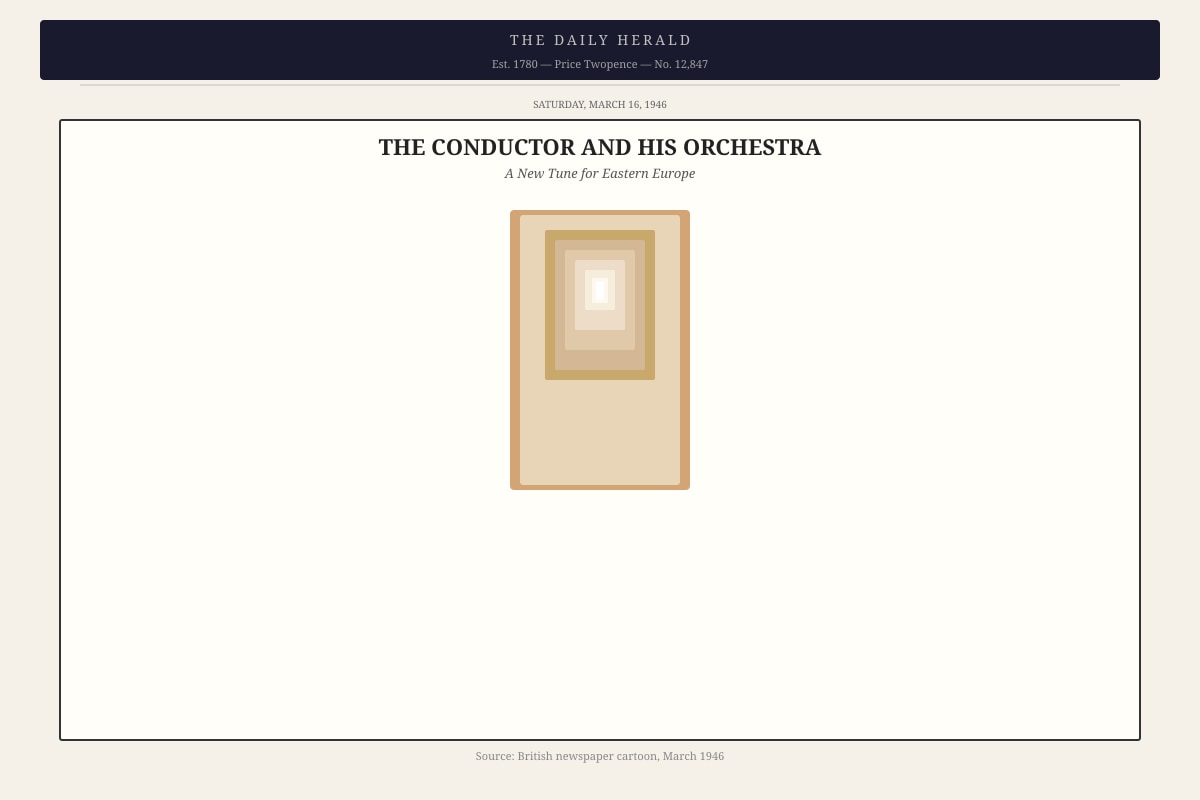
Expected answer: The cartoonist conveys that Stalin exercises complete control over Eastern European states, depicted as musicians who must follow his direction (1 mark). This suggests these states lack independence and are forced to conform to Soviet wishes, comparable to an orchestra playing the conductor's chosen composition (1 mark). The image implies expansionist Soviet ambition and the creation of a Soviet sphere of influence in Eastern Europe against the will of these peoples (1 mark).
Marking descriptor:
- Level 1 (1 mark): Identifies Stalin as controlling/some states following him
- Level 2 (2 marks): Explains the metaphor of the orchestra/conductor showing imposed control
- Level 3 (3 marks): Connects to the broader historical context of Soviet domination/sphere of influence in Eastern Europe by 1946-1948
Question 13b (3 marks)
Expected answer: The cartoon is partially accurate but simplistic (1 mark for judgment). By 1948, the Soviet Union had indeed established communist-dominated governments in Poland, Hungary, Romania, Bulgaria, and Czechoslovakia (the February 1948 coup), with Soviet troops stationed to ensure compliance (1 mark). However, the cartoon exaggerates by suggesting willing, coordinated submission; in reality, some Eastern European communists and populations resisted, and Yugoslavia under Tito broke from Soviet control in 1948 (1 mark).
Marking descriptor:
- Level 1 (1 mark): Simple agreement or disagreement with limited evidence
- Level 2 (2 marks): Partial assessment with some accurate details of Soviet control
- Level 3 (3 marks): Balanced evaluation acknowledging both the reality of Soviet domination and the oversimplification/counter-examples
Question 14 (2 marks)
Expected answer: Together the sources illustrate the transformation from interwar to post-war international relations: Source A shows Western democratic states attempting cooperative diplomacy to manage aggression (1 mark), while Source B shows the complete breakdown of cooperation replaced by superpower domination and ideological division, with the West now viewing Soviet expansion as the new threat requiring containment (1 mark).
Teaching note: The sources are a generation apart but connected: the failure of appeasement discredited cooperative diplomacy with dictators, shaping harder Western attitudes. However, students should note limitation: neither source explains the Grand Alliance's wartime cooperation (1941-1945) or the specific decisions (Yalta, Potsdam) where strains emerged.
Section B Total: 15 marks
Section C: Structured Essay Questions
Question 16a (2 marks)
Definition: Collective security is the principle that an attack on one member of an international organisation is considered an attack on all, requiring collective response to deter aggression (1 mark).
Application: The League of Nations Covenant (Articles 10-16) committed members to: respect each other's territorial integrity, submit disputes to arbitration or the League Council, and apply economic sanctions (and potentially military force) against aggressors. In the 1930s, this was applied weakly: sanctions were imposed on Italy after the 1935 Abyssinian invasion, but were incomplete (no oil embargo) and failed to stop Italian conquest (1 mark).
Question 16b (2 marks)
Any two valid ways (1 mark each):
- USA non-membership: As the world's strongest economic and military power, America's absence deprived the League of credibility and enforcement capacity. Without US participation, collective sanctions lacked bite and the League appeared as a European club.
- USSR late entry and expulsion: The Soviet Union joined only in 1934 and was expelled in 1939 after invading Finland, depriving the League of another major power and demonstrating ideological divisions.
- Germany and Japan withdrawals: Both withdrew (1933 and 1935 respectively), becoming international outlaws willing to use force, while the League lost members whose inclusion might have constrained their aggression.
- British and French dominance with limited commitment: Britain and France led the League but were often unwilling to enforce decisions when their own interests were not directly threatened.
Question 17 (5 marks) — OR — Question 18 (5 marks)
Question 17 marking scheme:
| Level | Marks | Descriptor |
|---|---|---|
| Level 1 | 1-2 | Simple assertion that containment caused/agreed/disagreed with limited evidence; may list events without explaining causation |
| Level 2 | 3-4 | Explains containment (Truman Doctrine, Marshall Plan, NATO) as cause AND identifies at least one other factor (ideological differences, wartime disagreements, Soviet expansionism); some balanced assessment |
| Level 3 | 5 | Balanced argument weighing containment against other factors; clear judgment with sustained reasoning; specific examples throughout |
Expected content points:
- Containment as cause: Truman Doctrine (1947) declared ideological hostility; Marshall Plan created division by excluding Soviet bloc; NATO (1949) militarised confrontation; all convinced Stalin the West sought to undermine communism.
- Alternative causes: Ideological incompatibility (capitalism vs. communism) made cooperation unnatural; wartime disagreements over Poland, Germany's future, reparations; Soviet expansion in Eastern Europe 1945-1948 created Western fear; Churchill's "Iron Curtain" speech (1946) also escalated.
- Judgment: Containment was a Western response to perceived Soviet aggression, so Soviet actions were equally or more fundamental; OR containment transformed latent hostility into active confrontation.
Question 18 marking scheme:
| Level | Marks | Descriptor |
|---|---|---|
| Level 1 | 1-2 | Simple assertion about economic factors without explaining how; limited range |
| Level 2 | 3-4 | Explains economic factors (Marshall Plan division, competing economic systems, resource access) AND ideological differences (communism vs. capitalism); some assessment of relative importance |
| Level 3 | 5 | Sustained argument connecting economics and ideology as intertwined; understands ideology shaped economic policy and vice versa; clear judgment |
Expected content points:
- Economic factors: USA feared closed Soviet economic spheres; wanted open markets for trade; Marshall Plan required capitalist reform, forcing European choice; Soviet control of Eastern European economies for reparations/security; resource competition.
- Ideological factors: Communism (state ownership, one-party rule, classless society) vs. capitalism (private enterprise, democracy, free markets); each saw the other as existential threat to their way of life; ideology shaped how economic problems were interpreted and addressed.
- Judgment: Economics and ideology were inseparable—capitalist democracy and communist planned economy were defining features of each ideology. Economic conflict was the manifestation of ideological hostility.
Question 19 (3 marks)
Expected answer: 1 mark for each valid reason, developed:
- French defeat at Dien Bien Phu (1954): The Geneva Accords temporarily divided Vietnam; the USA feared communist victory in elections would spread across Southeast Asia (domino theory).
- Domino theory: Eisenhower and subsequent administrations believed that if Vietnam fell to communism, other Asian states (Thailand, Malaysia, Indonesia, even Japan/Australia) would follow, threatening US strategic and economic interests.
- Gulf of Tonkin Incident (1964): Alleged North Vietnamese attacks on US destroyers led to Congressional resolution authorising escalation; by 1965, US combat troops were deployed.
- Commitment to credibility: Having supported South Vietnamese governments since 1954, US presidents feared that withdrawal would damage American global reputation and embolden communist movements elsewhere.
Question 20 (3 marks)
Expected answer: Requires assessment of both positive and negative effects for full marks.
Negative effects (1-2 marks):
- Escalated fears and tensions: nuclear arms race created hair-trigger alert systems, near-misses (Cuban Missile Crisis 1962), and massive expenditure that distorted both economies.
- Proxy wars intensified: superpowers armed rival factions globally (Afghanistan, Angola, Central America), prolonging and intensifying local conflicts.
- Mutually Assured Destruction (MAD) created existential risk of civilization's destruction.
Positive effects (1 mark):
- Deterrence: nuclear weapons arguably prevented direct superpower war, as both sides recognised no victory was possible (stability-instability paradox).
- Arms control agreements: SALT, ABM Treaty, INF Treaty emerged from recognition of shared interests in limiting weapons.
- Some argue arms race spending crippled Soviet economy, ending Cold War without hot war between superpowers.
Judgment: The arms race was primarily destabilising and dangerous, but its very destructiveness may have imposed caution.
Section C Total: 15 marks
QUIZ TOTAL: 40 MARKS