AI Generated Exam Paper
Secondary 3 History Practice Paper 5
Free Sec 3 History Practice Paper 5, Qwen3.7 AI version, with questions, answers, and O Level-style practice for Singapore students.
These static practice materials are generated from the site's syllabus and paper-generation workflow, with source and model context shown so students and parents can evaluate the material before use.
Questions
Free quiz and exam paper access
Enter your details to view this paper
Your access is remembered on this device.
Answers
Answer Key - TuitionGoWhere Practice Paper (Version 5)
Subject: History Secondary 3
Topic: Source Based Skills
Section A: Source-Based Case Study
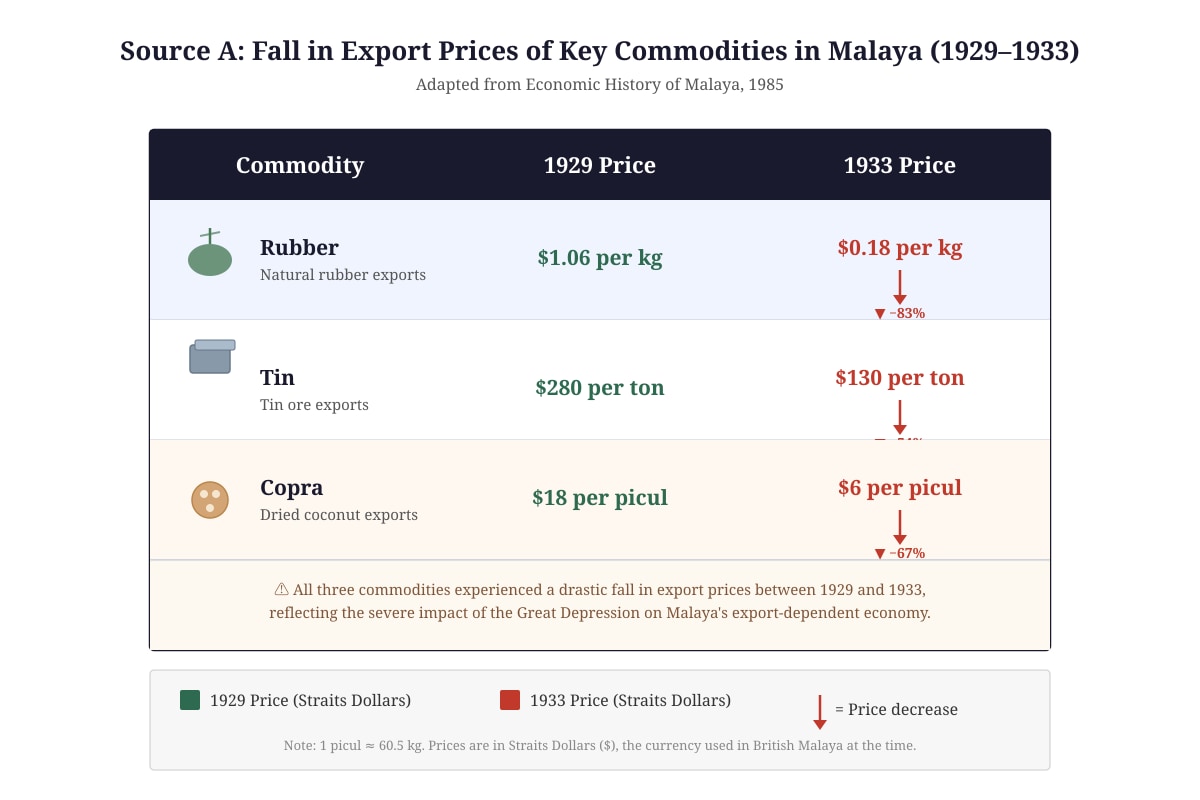
1. Study Source A. What does Source A tell you about the impact of the Great Depression on Malaya’s export economy? [4]
- Level 1 (1-2 marks): Identifies simple facts from the table without comparison or inference.
- Example: "It tells us that the price of rubber dropped."
- Level 2 (3-4 marks): Uses data from the source to describe the extent of the impact, showing the severity of the economic decline.
- Answer: Source A tells us that the Great Depression caused a catastrophic collapse in the value of Malaya’s key exports. For instance, the price of rubber fell drastically from 0.18 per kg in 1933, which is a drop of over 80%. Similarly, tin prices more than halved from 130 per ton. This indicates that the export economy, which relied heavily on these commodities, would have suffered a massive loss in revenue, leading to widespread economic hardship for producers and the government.
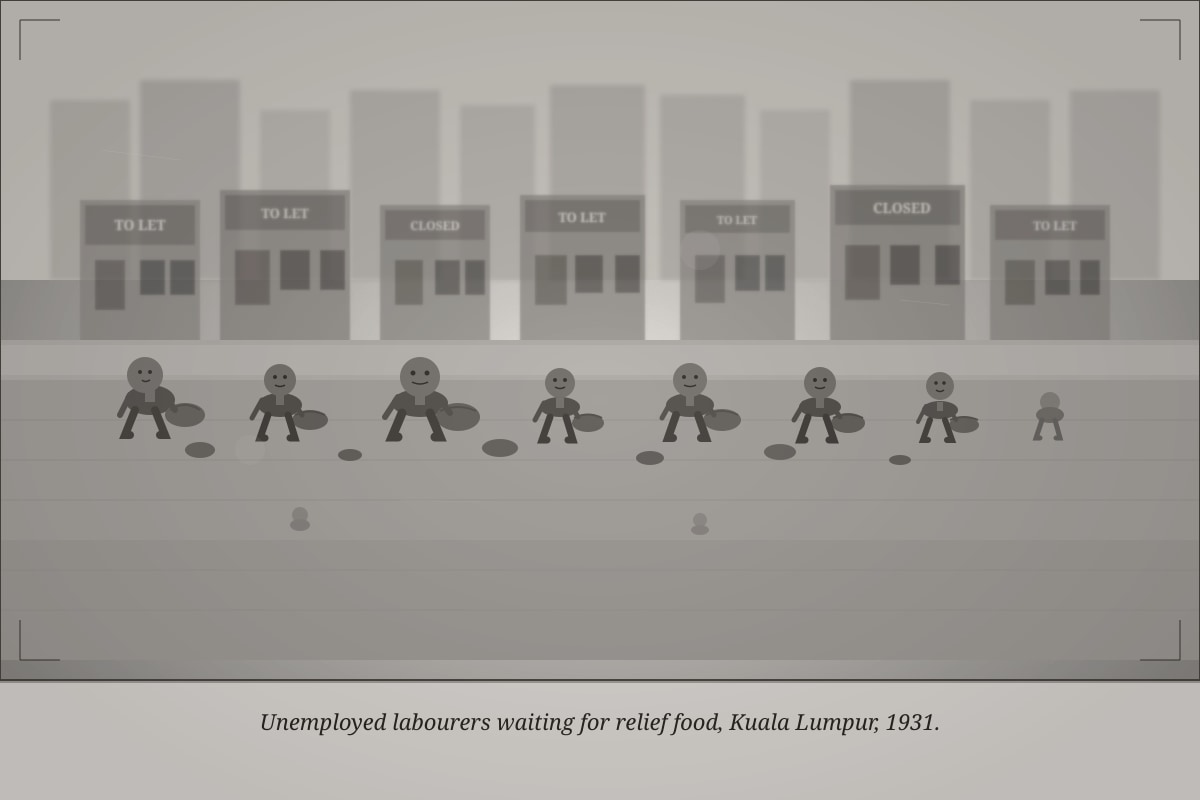
2. Study Source B. What is the message of Source B? Explain your answer using details of the source and your own knowledge. [6]
- Marking Criteria:
- 1 mark for identifying the message.
- Up to 3 marks for using details from the source.
- Up to 2 marks for relevant own knowledge.
- Answer:
- Message: The message of Source B is that the Great Depression caused severe unemployment and human suffering, leaving people helpless and abandoned.
- Source Details: The photograph shows men sitting on the roadside with their belongings in bundles, suggesting they have been evicted or have lost their homes. Their weary and thin appearance indicates malnutrition and exhaustion. The 'To Let' signs in the background show that businesses have closed down, highlighting the widespread economic shutdown.
- Own Knowledge: During the Great Depression, demand for raw materials like rubber and tin plummeted. Plantations and mines retrenched thousands of workers. Many migrant workers were repatriated, but those who remained, like the ones in the photo, faced destitution as there was no social welfare system in place. The image captures the despair of a workforce that had no safety net.
3. Study Sources C and D. How far does Source D contradict Source C regarding the responsibility for the suffering caused by the Great Depression? [8]
- Marking Criteria:
- Level 1 (1-3 marks): Identifies surface-level similarities or differences without evaluating the extent of contradiction.
- Level 2 (4-6 marks): Explains how the sources differ in perspective but may miss the nuance of 'responsibility'.
- Level 3 (7-8 marks): Evaluates the extent of contradiction, noting that while both acknowledge suffering, they assign blame differently (Corporate/Global vs. Colonial Government).
- Answer:
- Source D contradicts Source C to a large extent regarding who is responsible for the suffering, though both agree that suffering exists.
- Contradiction: Source C, written by a plantation manager, places the responsibility on global market forces and the necessity of business survival. He argues that cutting wages and laying off workers is unavoidable to "protect the interests of the shareholders" and keep the plantation running. He implies the suffering is an unfortunate byproduct of economic reality. In contrast, Source D, from a local community leader, explicitly blames the colonial government. He argues that the government is responsible because they continue to tax the locals heavily ("rice we grow is taxed heavily") to pay colonial debts, while officials live in luxury. He rejects the idea that it is just a "global problem" and sees it as exploitation.
- Agreement/Nuance: However, they do not completely contradict each other on the fact of suffering. Source C admits workers are "restless" and have "nowhere to go," acknowledging the hardship. Source D acknowledges the "price of our coffee has collapsed," which aligns with the economic reality Source C faces.
- Conclusion: Therefore, Source D contradicts Source C significantly on the issue of moral and political responsibility. Source C deflects blame to the market, while Source D assigns blame to colonial policy and inequality.
4. Study Sources A, B, C and D. Which source is the most useful to a historian studying the social impact of the Great Depression on ordinary people in Southeast Asia? Explain your answer. [12]
- Marking Criteria:
- Level 1 (1-4 marks): Chooses a source with simple reasons, focusing only on content.
- Level 2 (5-8 marks): Compares sources, discussing content and origin/provenance, but may lack depth in evaluating 'utility' for 'social impact'.
- Level 3 (9-12 marks): Evaluates the utility of the chosen source against others, considering content, origin, purpose, and limitations, specifically focusing on the "social impact on ordinary people."
- Answer:
- Choice: Source B is the most useful.
- Reasoning for Choice (Content): Source B is a photograph, which provides direct visual evidence of the human condition. It shows the physical state of the unemployed (thin, weary) and their displacement (bundles, roadside). This directly illustrates the social impact—homelessness, hunger, and despair—in a way that statistics (Source A) or managerial letters (Source C) cannot. It captures the emotional and physical reality of ordinary people.
- Reasoning for Choice (Origin/Provenance): As an archival photograph from 1931, it is a contemporary record. It was likely taken by a journalist or official, providing an unbiased visual record of the scene, unlike Source C which is biased towards protecting business interests.
- Comparison with other sources:
- Source A is useful for economic data but tells us nothing about how people felt or lived day-to-day. It is too abstract for "social impact."
- Source C is useful for understanding the employer's mindset, but it is biased. The manager views workers as costs to be cut. It does not give the perspective of the ordinary person.
- Source D is very useful as it gives the voice of the ordinary person. However, it is from Java (Indonesia), while the other sources are Malayan. If the study is strictly "Southeast Asia," it is valid, but Source B is more immediate. Also, Source D is an oral history recorded in 1990 about 1933, so memory bias might be an issue. Source B is a primary visual source from the exact time.
- Limitation of Source B: It does not explain why they are unemployed, only that they are. It lacks the political context of Source D.
- Conclusion: Despite this, for social impact (the lived experience), the visceral evidence of Source B makes it the most powerful and useful source for a historian to illustrate the human cost.
Section B: Structured Response Questions
5. "The main cause of the rise of authoritarian regimes in Europe was the economic instability following World War I." How far do you agree with this statement? Explain your answer. [20]
-
Marking Descriptors:
- Level 1 (1-5 marks): Simple statements, lacks explanation.
- Level 2 (6-10 marks): Explains one side of the argument (either economic or other factors) with some detail.
- Level 3 (11-15 marks): Explains both economic and non-economic factors. Shows balance but may lack deep evaluation.
- Level 4 (16-20 marks): Comprehensive explanation of multiple causes. Evaluates the relative importance of economic instability versus other factors (political, social, ideological). Clear judgment supported by evidence.
-
Suggested Answer Structure:
- Introduction: Define authoritarian regimes (e.g., Nazi Germany, Fascist Italy, Stalinist USSR). State thesis: While economic instability was a major catalyst, it was not the sole cause; political weakness and ideological appeal were also critical.
- Argument for Economic Instability (Agree):
- The Great Depression (1929) caused mass unemployment and hyperinflation (in Germany earlier, then globally).
- People lost faith in democratic governments (e.g., Weimar Republic) because they seemed unable to fix the economy.
- Authoritarian leaders promised economic recovery, jobs, and stability. Hitler’s promise of "Work and Bread" appealed to the desperate masses.
- Argument for Other Factors (Disagree/Nuance):
- Political Weakness: Democratic institutions were new and fragile in many countries (e.g., Italy, Germany). Proportional representation led to weak coalition governments that could not make decisive decisions.
- Fear of Communism: The middle class and elites supported authoritarian right-wing regimes (like Mussolini and Hitler) because they feared a communist revolution like the one in Russia. They saw strong leaders as a bulwark against chaos.
- Nationalism and Treaty of Versailles: In Germany, resentment over the Treaty of Versailles (war guilt, reparations) fueled nationalism. Hitler exploited this anger, promising to restore national pride, which was an ideological rather than purely economic appeal.
- Charisma and Propaganda: Leaders like Mussolini and Hitler were skilled orators who used propaganda to create a cult of personality, appealing to emotions rather than just economic logic.
- Conclusion: Economic instability was the trigger that created the conditions for authoritarianism to rise, as it delegitimized democracy. However, it was not the only cause. Without the pre-existing political fragility, fear of communism, and nationalist sentiment, economic hardship alone might not have led to totalitarianism. Therefore, it was a necessary but not sufficient cause; it interacted with political and ideological factors.
6. "The policy of appeasement was the main reason for the outbreak of World War II in Europe." How far do you agree with this statement? Explain your answer. [20]
-
Marking Descriptors:
- Level 1 (1-5 marks): Simple statements, lacks explanation.
- Level 2 (6-10 marks): Explains the role of appeasement or other factors with some detail.
- Level 3 (11-15 marks): Explains both appeasement and other causes. Shows balance.
- Level 4 (16-20 marks): Comprehensive explanation. Evaluates the relative importance of appeasement versus Hitler’s aggression, the failure of the League of Nations, and the policy of isolationism. Clear judgment.
-
Suggested Answer Structure:
- Introduction: Define appeasement (giving in to aggressive demands to avoid war). State thesis: Appeasement emboldened Hitler, but it was not the main reason; Hitler’s aggressive ideology and the failure of collective security were more fundamental.
- Argument for Appeasement (Agree):
- Britain and France allowed Hitler to break the Treaty of Versailles (rearmament, Rhineland) without consequence.
- The Munich Agreement (1938) gave Hitler the Sudetenland, convincing him that the democracies were weak and would not fight. This encouraged him to invade the rest of Czechoslovakia and later Poland.
- It wasted time for the Allies to rearm while Germany grew stronger.
- Argument for Other Factors (Disagree/Nuance):
- Hitler’s Aggression/Ideology: Hitler’s goal was Lebensraum (living space) and racial domination. He intended to go to war regardless of appeasement. Appeasement only delayed the inevitable. His invasion of Poland was a premeditated act of aggression, not a result of misreading appeasement.
- Failure of the League of Nations: The League failed to stop earlier aggressions (Manchuria, Abyssinia). This showed that collective security was a sham, encouraging dictators to act aggressively.
- Isolationism (USA): The USA’s refusal to get involved in European affairs meant that Britain and France felt they had to appease Hitler because they lacked the strength to fight alone.
- Nazi-Soviet Pact: The non-aggression pact between Hitler and Stalin in 1939 ensured Germany would not face a two-front war, making the invasion of Poland possible. This diplomatic move was crucial to the timing of the war.
- Conclusion: Appeasement was a significant factor because it allowed Germany to grow stronger and convinced Hitler of Allied weakness. However, it was not the main reason. The main reason was Hitler’s aggressive expansionist ideology and the failure of the international community (League of Nations) to check aggression early on. Even without appeasement, Hitler’s goals likely would have led to war, though perhaps at a different time or under different circumstances.