AI Generated Exam Paper
Secondary 3 History Practice Paper 5
Free Sec 3 History Practice Paper 5, Kimi2.6 AI version, with questions, answers, and O Level-style practice for Singapore students.
These static practice materials are generated from the site's syllabus and paper-generation workflow, with source and model context shown so students and parents can evaluate the material before use.
Questions
Free quiz and exam paper access
Enter your details to view this paper
Your access is remembered on this device.
Answers
TuitionGoWhere Practice Paper - History Secondary 3 — Answer Key
Version 5 of 5
SECTION A: Source Comprehension and Inference (20 marks)
Question 1 (2 marks)
Answer:
The cartoonist conveys that Britain was overburdened by its colonial responsibilities and struggling to maintain control of its empire in 1947.
- Detail 1 (1 mark): The figure "British Raj" is shown staggering under the weight of the backpack, suggesting Britain was physically and financially exhausted from trying to maintain control over multiple territories.
- Detail 2 (1 mark): The backpack contains multiple territories (India, Burma, Palestine, Greece), showing the extent and weight of Britain's imperial commitments; OR the crutch offered by the US indicates Britain needed external support to sustain its position; OR the storm cloud over Southeast Asia suggests further troubles ahead.
Teaching note: Political cartoons use visual metaphors. The "staggering" posture indicates weakness; the backpack symbolises responsibilities that have become burdensome. The American crutch represents the shift from British to American dominance in the post-war period.
Question 2 (3 marks)
Answer:
Nehru means that India's independence was a long-awaited, almost inevitable fulfillment of historical purpose (1 mark).
Evidence and explanation (2 marks):
- "Long years ago we made a tryst with destiny" — independence was not accidental but the result of a planned, promised commitment made long ago, suggesting historical inevitability
- "Now the time comes when we shall redeem our pledge" — independence fulfills a solemn promise, giving it moral and historical weight
- "The soul of a nation, long suppressed, finds utterance" — independence allows India's true identity to emerge after colonial repression
Marking breakdown: Identification of meaning (1 mark); two pieces of evidence with explanation (2 marks).
Teaching note: "Tryst" = a private, prearranged meeting; here metaphorical. Nehru presents independence as both romantic destiny and fulfilled promise, elevating it beyond mere political change to national rebirth.
Question 3 (4 marks)
Answer:
Source B both suggests and complicates the idea of a complete break.
Evidence supporting complete break (2 marks):
- "Step out from the old to the new" — explicit language of departure and new beginning
- "An age ends" — colonial period definitively concluded
Evidence qualifying/nuancing this (2 marks):
- "Not wholly or in full measure" — Nehru explicitly states independence is incomplete, continuity with problems of the past remains
- "Long suppressed" — acknowledges colonialism's lasting damage that won't immediately disappear
- "When the world sleeps" — India begins its journey while others are unaware, suggesting vulnerability and incomplete transformation
Teaching note: Nehru's rhetoric is carefully balanced between triumphalism and realism. The phrase "not wholly" is crucial — it shows awareness that political independence doesn't instantly solve structural problems created by colonialism. Students should avoid seeing sources as simple; skilled leaders use nuanced language.
Question 4 (5 marks)
Answer structure and content points:
Introduction: Acknowledge that decolonisation involved formal transfer of power but argue it was complex due to multiple pressures, incomplete outcomes, and continued foreign influence.
Source A evidence (1 mark):
- Britain was financially exhausted and needed American aid (Marshall Aid crutch), showing decolonisation was partly forced by circumstance, not voluntary generosity
- Multiple territories leaving simultaneously created regional instability
Source B evidence (1 mark):
- Nehru's "not wholly or in full measure" shows political independence didn't bring complete transformation
- "Long suppressed" suggests colonialism's lasting psychological and structural damage
Source C evidence (1 mark):
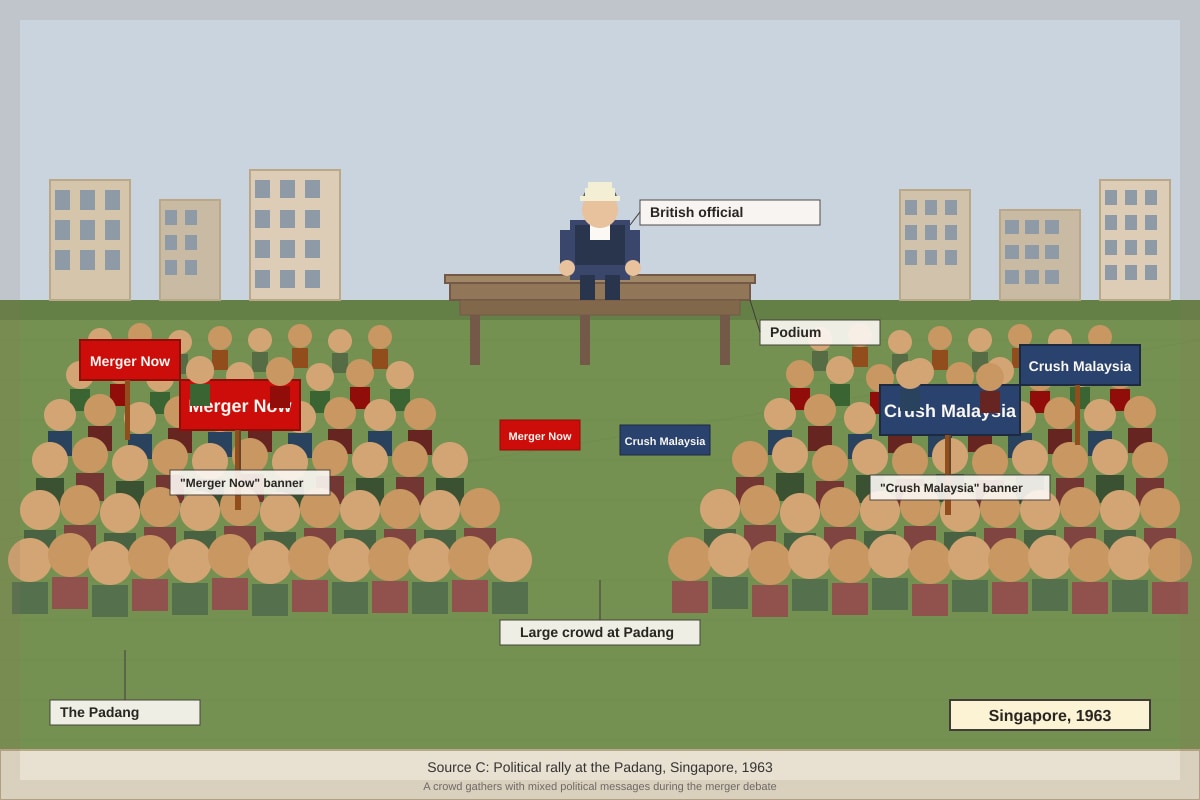
- Singapore's "Merger Now" and "Crush Malaysia" banners show decolonisation created new conflicts rather than simple liberation
- British official still present on podium shows colonial authority structure persisted during transition
Own knowledge (2 marks):
- Examples: partition of India and Pakistan (1947) with mass violence; French Indochina leading to prolonged wars; Indonesia's revolution (1945–1949) involving armed struggle; continued economic dependence on former colonial powers (neo-colonialism); Cold War superpower interference replacing direct colonial rule
Conclusion: Decolonisation was politically transformative but socially, economically, and internationally complex, with colonial powers often shaping the terms of departure and Cold War dynamics adding new layers of external control.
Marking descriptors:
| Band | Marks | Description |
|---|---|---|
| High | 5 | Integrates all three sources with detailed own knowledge; explains multiple dimensions of complexity |
| Middle | 3–4 | Uses some sources with some own knowledge; limited range of complexity explained |
| Low | 1–2 | Mostly description of one or two sources; little own knowledge; simplistic view |
SECTION B: Source Comparison and Evaluation (20 marks)
Question 5 (3 marks)
Answer:
Source D reveals three concerns:
- Weakened French position (1 mark): The Japanese occupation has "gravely weakened" French colonial control, creating a power vacuum
- Rise of nationalism (1 mark): The Viet Minh has gained support by positioning itself as "resistance fighters," making colonial restoration difficult
- British strategic dilemma (1 mark): Britain must calculate whether supporting France or seeking "negotiated settlement" better serves British interests — showing colonial powers were making pragmatic rather than principled decisions
Teaching note: This source reveals imperial calculations behind decolonisation. Britain's concern for "British interests" shows how colonial powers negotiated transitions based on self-interest, not anti-colonial principle. The "negotiated settlement" hints at possibility of recognizing nationalist governments.
Question 6 (4 marks)
Answer:
Similarity (2 marks): Both sources recognize weakened European colonial control and rising nationalist challenge as central post-war dynamics in Southeast Asia. Source D notes French position "gravely weakened"; Source E acknowledges "famine, illiteracy, and lack of modern weapons" but emphasizes popular support and anti-colonial resistance. Both see the war as a turning point that strengthened nationalist movements.
Difference (2 marks): Sources differ in perspective and emphasis on outcomes:
- Source D (British/external): Presents situation analytically, assessing options for great powers; concerned with whether colonial restoration is feasible; sees nationalism as problem to be managed
- Source E (Vietnamese/internal): Presents situation from active participant seeking liberation; emphasizes people's support and moral/historical tide ("triumph of democratic forces"); sees nationalism as legitimate struggle requiring continued sacrifice
OR
Sources differ on means of resolution: Source D considers negotiation or restoration; Source E explicitly accepts "protracted struggle" as likely necessary, rejecting compromise with colonialism.
Teaching note: Comparison requires identifying both structural similarity (what both see) and perspectival difference (how they see it differently based on position). Always attribute perspectives to source origins.
Question 7 (6 marks)
Answer structure:
Introduction: Sources D and E together are somewhat useful but have significant limitations for understanding the outbreak of the First Indochina War.
Usefulness (3 marks):
- Source D reveals great-power calculations: British awareness that French restoration would face armed resistance; hints at possible alternative paths not taken
- Source E provides insight into Viet Minh strategy and self-perception: willingness for "protracted struggle," awareness of material weaknesses, confidence in popular support and international democratic trends
- Together they show both sides' calculations in 1945–1946, demonstrating war was not inevitable but resulted from French refusal to negotiate and Viet Minh determination for full independence
Limitations (2 marks):
- Source D limitations: British perspective, not Vietnamese; written before war began (March 1946), so doesn't show escalation; "British interests" filter distorts analysis of Vietnamese motivations
- Source E limitations: Viet Minh propaganda/self-presentation; minimises own weaknesses (weapons gap); doesn't explain French decision to fight or American emerging involvement
- Missing from both: French sources showing why restoration was attempted; economic motivations (Indochina's resources); role of other powers especially emerging US anti-communist concern; military details of how war began
Own knowledge for evaluation (1 mark):
- War began when French naval forces bombarded Haiphong (November 1946), killing 6,000; Ho Chi Minh called for general resistance (December 1946)
- French sought to restore pre-war colonial federation; Ho had briefly cooperated with OSS (American Office of Strategic Services) during WWII, raising US concerns about communist alignment
Conclusion: Sources are useful for understanding pre-war positions but insufficient alone; need French and American sources, military records, and longer-term economic and ideological context for full explanation.
Marking descriptors:
| Band | Marks | Description |
|---|---|---|
| High | 5–6 | Balanced assessment of utility and limitations; specific own knowledge; evaluates both sources thoroughly |
| Middle | 3–4 | Some assessment of utility OR limitations; limited own knowledge; uneven coverage |
| Low | 1–2 | Mostly description of sources; little evaluation; no own knowledge |
Question 8 (7 marks)
Answer structure:
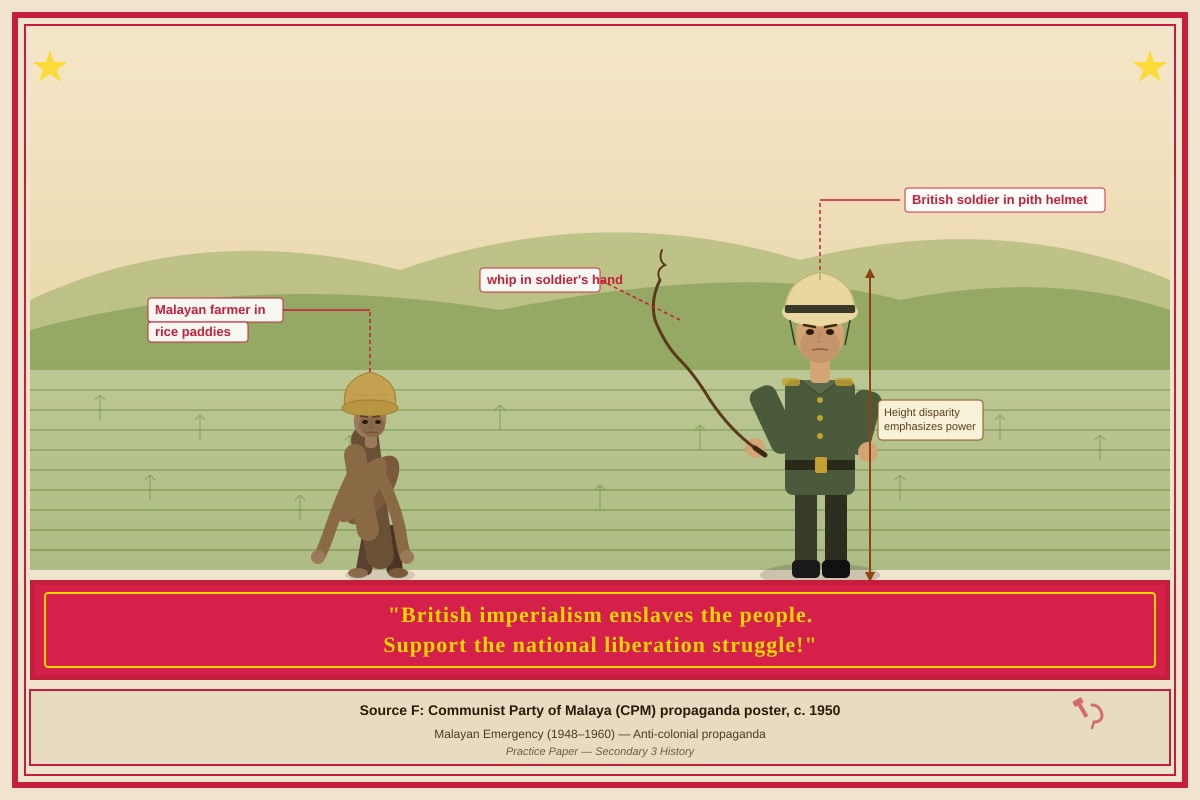
Introduction: Source F has partial reliability with significant limitations due to its purpose as CPM propaganda during the Malayan Emergency.
Reliable elements (2 marks):
- British military presence in Malaya was substantial during Emergency (1948–1960)
- Economic exploitation existed: rubber and tin profits largely repatriated; wages low; British interests dominated
- British did use coercion: mass detention without trial (Operation Cold Store precursors), forced resettlement of 500,000 "squatters" into New Villages, use of informer networks
- Emergency regulations gave extraordinary powers to authorities
Unreliable/distorted elements (2 marks):
- Exaggeration of individual brutality: Whip imagery is anachronistic and symbolic, not documentary evidence of specific whipping practices
- Typical communist propaganda technique: Presents complex counter-insurgency as simple colonial exploitation; ignores Malayan government participation (UMNO, MCA in government from 1955); ignores communist violence against civilians
- Oversimplification: British policy combined military action with "hearts and minds" (Briggs Plan, development); categorical "enslaves" ignores variations in British rule and rising Malay political participation
Purpose and limitations analysis (2 marks):
- Purpose: To mobilise support for communist insurgency by demonising British as brutal exploiters; aimed at Chinese-educated Malayan population and international anti-colonial opinion
- Creator: CPM — banned organisation using armed struggle, so highly motivated to delegitimise opponent
- Intended audience: Potential recruits, sympathisers, international observers
- Bias: Selection (only negative aspects), interpretation (all British action framed as exploitation), language ("imperialism," "enslaves")
Own knowledge for contextual evaluation (1 mark):
- British actually negotiated independence: Malaya independent 1957 with Tunku Abdul Rahman as leader; this undermined CPM argument that only armed struggle could achieve freedom
- Compare with British withdrawal from India, suggests pattern of negotiated transition rather than enslavement
Conclusion: Source F is useful for understanding communist propaganda techniques and some genuine grievances about colonial economic relations, but unreliable as objective evidence about British rule. Must be corroborated with British administrative records, economic data, and Malayan nationalist sources.
Marking descriptors:
| Band | Marks | Description |
|---|---|---|
| High | 6–7 | Sophisticated analysis of reliability/unreliability; explicit purpose analysis; detailed own knowledge; nuanced conclusion |
| Middle | 3–5 | Some analysis of purpose and limitations; some own knowledge; tendency toward description or one-sided assessment |
| Low | 1–2 | Mostly assertion of reliability/unreliability; little analysis of purpose; no own knowledge |
SECTION C: Source-Based Case Study — The Cold War in Southeast Asia (20 marks)
Question 9 (2 marks)
Answer:
Two temporary provisions:
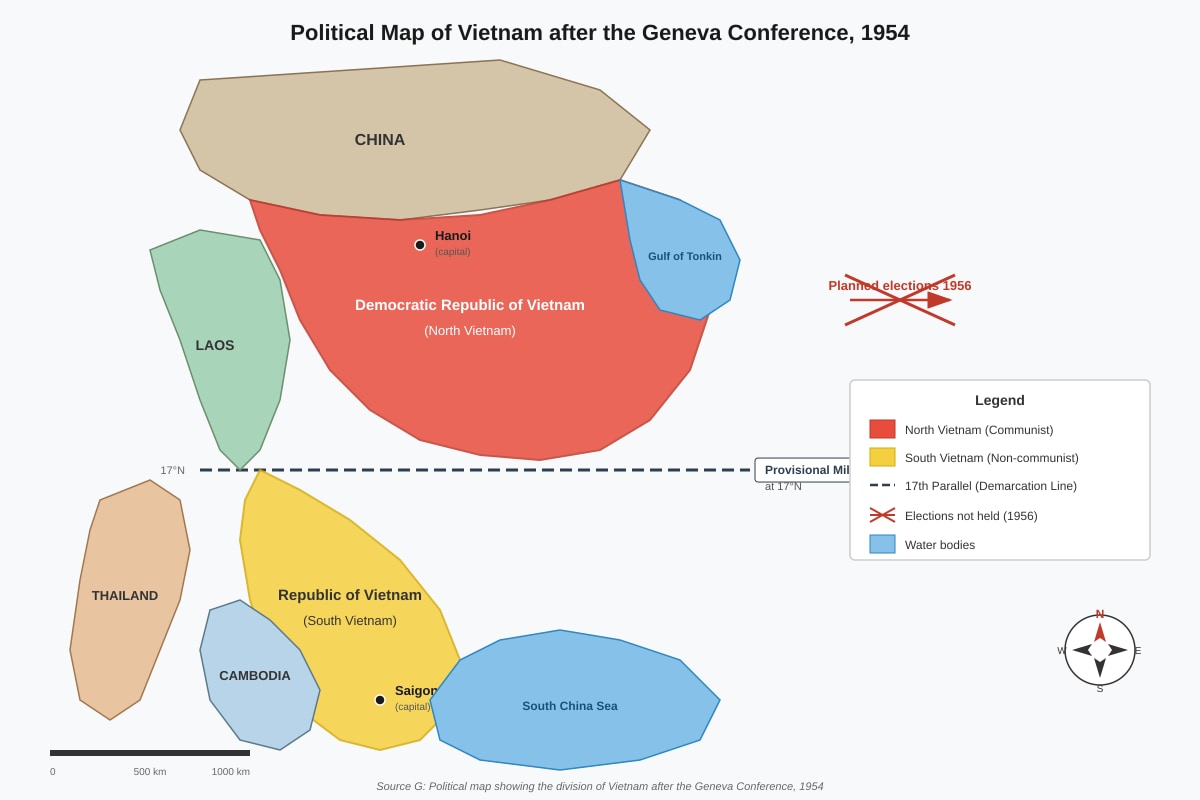
- The division at the 17th parallel (1 mark): The "Provisional Military Demarcation Line" was explicitly temporary, intended only until unification elections
- The planned elections in 1956 (1 mark): Intended to allow Vietnamese people to choose their government and reunify the country; "planned" and crossed out shows this was not fulfilled
Teaching note: The Geneva Conference (July 1954) intended the division to last approximately two years. The language of "provisional" and "planned elections" was designed to maintain Vietnamese unity in principle while accepting temporary separation after French defeat at Dien Bien Phu.
Question 10 (3 marks)
Answer:
The crossed-out "Planned elections 1956" suggests:
- Elections never took place (1 mark): The visual symbol of crossing out indicates cancellation or prevention
- Division became permanent (1 mark): Without elections to reunify, the provisional military line hardened into a political boundary between two states
- Failure of Geneva framework (1 mark): The international agreement was not honoured, leading to prolonged Cold War division; this violation contributed to subsequent Vietnam War as both sides claimed legitimacy
Teaching note: South Vietnam under Ngo Dinh Diem, with American backing, refused to participate in 1956 elections, arguing (not entirely without reason) that free elections were impossible under communist control in the North. This American-supported cancellation violated the Geneva Accords and provided justification for Northern-supported insurgency in the South.
Question 11 (4 marks)
Answer:
SEATO connection to American Vietnam policy:
- Anti-communist alliance framework (1 mark): SEATO (Southeast Asia Treaty Organization) extended American security commitments to Southeast Asia, treating communist advance as collective threat requiring collective response
- Vietnam's anomalous position (1 mark): South Vietnam was not formally a signatory but was covered by Protocol extending protection to states in treaty area, allowing American intervention without formal treaty obligation
- Replacement for French role (1 mark): After French withdrawal (1954–1956), SEATO provided institutional framework for American assumption of anti-communist commitment in Vietnam
- Political justification (1 mark): SEATO membership allowed American policymakers to present Vietnam intervention as collective security rather than unilateral neo-colonialism; "aggression by means of armed attack" language from Source H shaped how America interpreted NLF/Viet Cong activity
Teaching note: The Manila Pact created "Eisenhower Doctrine" extension to Southeast Asia. Crucially, it was signed before South Vietnam government fully established, so protocol extension was necessary. This institutional arrangement shows how America multilateralised its bilateral commitment to create legitimacy.
Question 12 (5 marks)
Answer structure:
Introduction: Sources G, H, and I suggest American involvement was significantly, but not exclusively, driven by anti-communism.
Evidence supporting anti-communist motivation (3 marks):
- Source G: The 17th parallel division represented Cold War logic — separating communist North from non-communist South; the map's colour coding (red/yellow) reflects this binary; the crossed-out elections show American preference for maintaining anti-communist South over democratic unification if communist victory likely
- Source H: SEATO's "armed attack" language and collective security framework was designed against communist expansion; Vietnam was inserted into anti-communist alliance structure; "endanger its own peace and safety" reflects domino theory thinking
- Source I: CIA concern about "Viet Cong will exploit the period of transition" frames situation in Cold War terms; "prevent collapse" means prevent communist takeover; "increased American involvement" follows from need to maintain anti-communist government
Evidence suggesting other/complicating motivations (2 marks):
- Source I also shows: Concern about "instability" and "political experience" — broader nation-building concerns beyond mere anti-communism; "Buddhist grievances" indicates awareness of Diem's political failures were religious/social, not purely communist
- Source H structure: "Constitutional processes" suggests formality and procedure; SEATO was also about establishing American-led regional order, not merely repelling communism
- Own knowledge: American credibility concerns — defeat in Vietnam would damage global American reputation; domestic political pressures (McCarthy legacy, "who lost China?" debates); economic interests in regional stability for trade and investment
Conclusion: Anti-communism was the principal stated and structural motivation, but American policy combined ideological opposition with concerns about credibility, regional order, and domestic political survival. Sources show anti-communism as framework; own knowledge reveals additional pressures.
Marking descriptors:
| Band | Marks | Description |
|---|---|---|
| High | 4–5 | Balanced use of all three sources with own knowledge; recognises anti-communism centrality while noting complexity |
| Middle | 2–3 | Uses most sources; some own knowledge; may be one-sided or descriptive |
| Low | 1 | Limited source use; little own knowledge; simplistic assertion |
Question 13 (6 marks)
Answer structure:
Introduction: Evaluate whether American Vietnam strategy served Singapore's regional interests — argue partial consistency but with significant tensions and evolving perspectives.
Evidence of consistency with Singapore interests (2 marks):
- Source J: Lee Kuan Yew explicitly states that American withdrawal would cause "the whole of Southeast Asia" to "give way" — Singapore perceived domino effect as real threat; American presence as regional stabiliser
- Source G context: Communist North's expansion would directly threaten regional non-communist states including Malaya/Singapore (geographic proximity shown on map)
- Source H framework: SEATO created multilateral security architecture that Singapore (not yet independent but anticipating separation from Malaysia) would later value for regional order
- Own knowledge: Singapore's security doctrine emphasised "poised and ready" deterrence; American regional presence reduced need for immediate Singapore self-sufficiency; 1967 context is crucial — Singapore newly independent (1965), vulnerable, seeking great-power guarantor
Evidence of tension or divergence (2 marks):
- Source I suggests: American strategy created instability — Diem overthrow produced "immediate instability"; Singapore sought stability, not perpetual conflict; American methods (covert action, escalation) risked wider regional war
- Source J's "big battalions" language: Reveals anxiety about dependence on external power; Lee's statement is conditional ("if Americans were to withdraw") not endorsement of particular American military strategy
- Own knowledge: By 1970s Lee privately expressed doubts about American military approach; Vietnam War's economic distortions (inflation, commodity price swings) affected Singapore; eventual American withdrawal (1973–1975) required Singapore to adjust rapidly to self-reliance
Evaluation of "consistent" (2 marks):
- Short-term, narrowly defined: Yes — American containment prevented immediate communist expansion; bought time for Singapore's development and nation-building (1965–1975 crucial decade)
- Long-term, broadly defined: No — prolonged war destabilised region, created refugee flows, demonstrated limits of American power, forced eventual Southeast Asian self-reliance (ASEAN regionalism, 1967 founded partly in recognition that great-power guarantees were insufficient)
- Singapore's real strategy: Not consistent with any single great power, but sought to engage multiple powers (American, British, later Chinese, Japanese) to prevent any single dominance; Vietnam was one component of diversified security approach
Conclusion: American Vietnam strategy was tactically consistent with Singapore's immediate survival interests but strategically inconsistent with its long-term vision of stable, diversified, self-reliant regional order. Lee's 1967 statement reflects contingent necessity, not endorsement of American military approach.
Marking descriptors:
| Band | Marks | Description |
|---|---|---|
| High | 5–6 | Sophisticated evaluation of "consistent"; uses all four sources; detailed own knowledge; recognises temporal/strategic distinctions; nuanced judgment |
| Middle | 3–4 | Some evaluation; uses most sources; some own knowledge; may lean to one side without full consideration |
| Low | 1–2 | Descriptive or assertive; limited source use; little own knowledge; simplistic "yes" or "no" |
Paper Total: 60 marks
Section mark verification:
- Section A: 2 + 3 + 4 + 5 + 6 = 20 ✓
- Section B: 3 + 4 + 6 + 7 = 20 ✓
- Section C: 2 + 3 + 4 + 5 + 6 = 20 ✓
- Total: 60 marks ✓
Duration verification:
- Section A: 20 marks ≈ 20 minutes
- Section B: 20 marks ≈ 25 minutes
- Section C: 20 marks ≈ 30 minutes
- Review: 5 minutes
- Total: 80 minutes ✓