AI Generated Exam Paper
Secondary 3 History Practice Paper 4
Free Sec 3 History Practice Paper 4, HY3 AI version, with questions, answers, and O Level-style practice for Singapore students.
These static practice materials are generated from the site's syllabus and paper-generation workflow, with source and model context shown so students and parents can evaluate the material before use.
Questions
Free quiz and exam paper access
Enter your details to view this paper
Your access is remembered on this device.
Answers
TuitionGoWhere Practice Paper — History Secondary 3 (Version 4) Answer Key
Total Marks: 40
Paper: Practice Paper (Source Based Skills)
Section A: Understanding Sources (Q1–5) [10 marks]
Q1 [1]
Answer: Primary source / official report / colonial record.
Teaching note: Source A is a report written by a person present in 1890; it is a primary source produced by the colonial administration. Mark awarded for identifying type correctly.
Q2 [1]
Answer: The officer may present British rule positively / has bias supporting colonial control.
Teaching note: Origin shows the writer was part of the system; students should note possible bias, not assume neutrality.
Q3 [2]
Answer: To persuade Germans to support the Nazi Party / to build national pride and mobilise support.
Marking: 1 mark purpose (persuade/support), 1 mark specific context (Nazi rally / Germany Awake).
Teaching note: Posters are propaganda; the words signal awakening nationalism.
Q4 [2]
Answer: Primary source; it is written at the time (1910) by a person experiencing events.
Marking: 1 mark primary, 1 mark explanation with date/perspective.
Teaching note: Diary = contemporary account = primary.
Q5 [4]
Answer: To place event in chronology; to see if cause/effect fits; to check if source matches period; to avoid using source from wrong time.
Marking descriptors: 1 mark per valid point (max 4).
Teaching note: Date tells when source was made; using wrong date breaks causation and chronology.
Section B: Inference and Message (Q6–10) [10 marks]
Q6 [2]
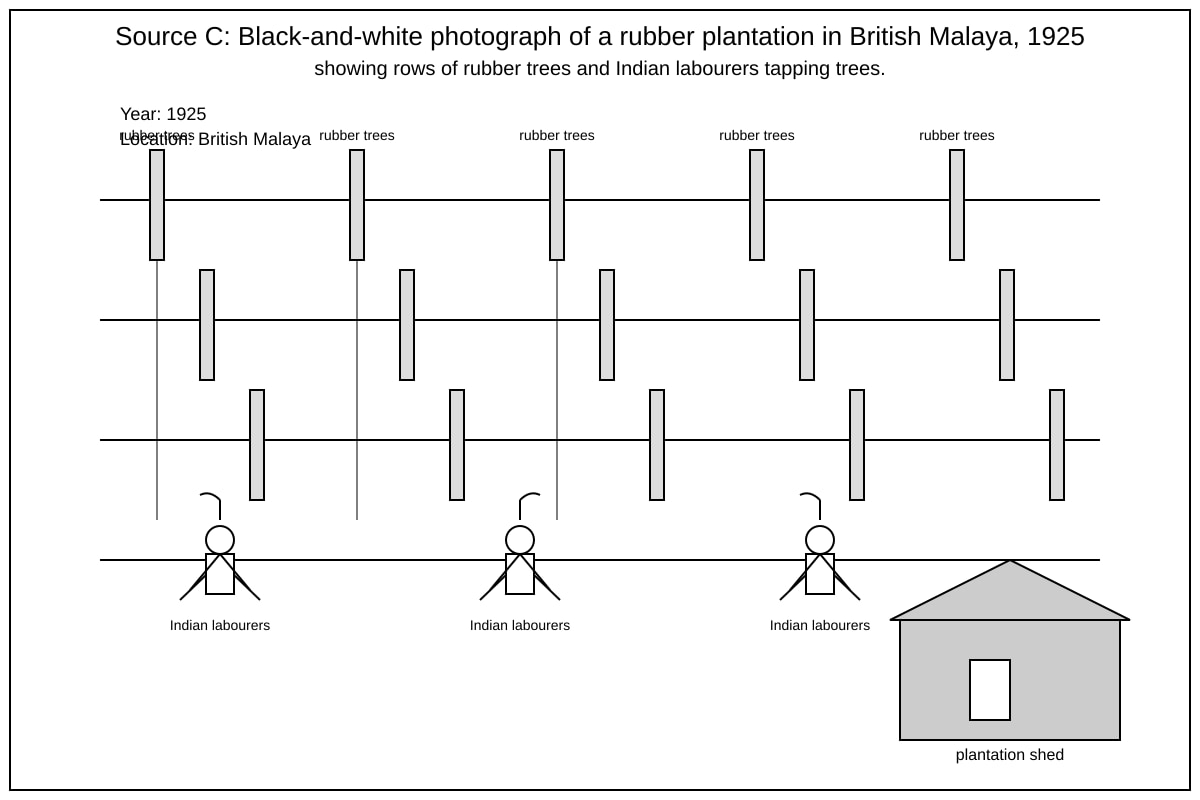
Answer: Indian labourers were brought to Malaya to work plantations; migration built multi-ethnic population.
Marking: 1 mark inference on Indian labour, 1 mark link to migration/plural society.
Visual needed: photo shows Indian labourers in plantation; supports inference of migrant workforce.
Q7 [2]
Answer: That Japan's invasion was a liberation, not conquest / positive view of expansion.
Marking: 1 mark message of liberation, 1 mark Japanese justification.
Q8 [2]
Answer: That appeasement was naive / gave false peace / Chamberlain trusted paper not action.
Marking: 1 mark cartoon criticises appeasement, 1 mark explanation of symbol (paper=peace).
Q9 [2]
Answer: Fear / hopelessness / exclusion under Nazi persecution.
Marking: 1 mark feeling, 1 mark link to context (lost job due to Nazi policy).
Q10 [2]
Answer: British brought Indians for rubber, Chinese for trade; different groups settled, creating plural society.
Marking: 1 mark migration reason, 1 mark plural society outcome.
Section C: Reliability and Usefulness (Q11–15) [10 marks]
Q11 [2]
Answer: Neither fully; British text favours coloniser, pamphlet favours nationalists. OR one point: textbook biased to justify rule.
Marking: 1 mark choice, 1 mark reason.
Q12 [2]
Answer: No; bias shows views of group; still useful with other sources.
Marking: 1 mark no, 1 mark explanation of careful use.
Q13 [2]
Answer: Limited; shows Nazi claim not real condition / useful for propaganda not facts.
Marking: 1 mark limited usefulness, 1 mark reason (propaganda).
Q14 [2]
Answer: Both show British controlled/local rulers reduced power.
Marking: 1 mark similarity, 1 mark evidence from sources.
Q15 [2]
Answer: To cross-check facts / see different views / build balanced account.
Marking: 1 mark use with others, 1 mark purpose (balance/check).
Section D: Source-Based Structured Response (Q16–20) [10 marks]
Q16 [1]
Answer: Critical / angry / anti-colonial.
Q17 [1]
Answer: For native welfare / to civilise / ethical policy.
Q18 [2]
Answer: Source I says benefit; Source J says exploitation.
Marking: 1 mark each contrast.
Q19 [3]
Answer: Source J; it is local voice showing resistance view.
Marking: 1 mark source, 2 marks reason (local/nationalist perspective).
Q20 [3]
Answer: By comparing both, see Dutch claimed welfare but locals saw control; historian gets both intent and impact.
Marking: 1 mark use both, 2 marks explanation of learning (intent vs impact).