AI Generated Exam Paper
Secondary 3 History Practice Paper 3
Free Sec 3 History Practice Paper 3, Kimi2.6 AI version, with questions, answers, and O Level-style practice for Singapore students.
These static practice materials are generated from the site's syllabus and paper-generation workflow, with source and model context shown so students and parents can evaluate the material before use.
Questions
Free quiz and exam paper access
Enter your details to view this paper
Your access is remembered on this device.
Answers
TuitionGoWhere Practice Paper - History Secondary 3
Answer Key and Marking Scheme
Version 3 of 5 – Source-Based Skills
SECTION A: SOURCE ANALYSIS SKILL DRILLS
Total: 20 marks
Question 1 – Source Purpose and Provenance
(a) Purpose of photograph; why this purpose matters [2 marks]
Marking descriptors:
- 1 mark for identifying a valid purpose (e.g., to document/report war atrocities; to influence American public opinion against the war; to capture evidence of brutality)
- 1 mark for explaining why this purpose matters to understanding the Vietnam War
Model answer: The photograph was taken to document and publicise the brutal reality of the Vietnam War to American and global audiences (1). This matters because such images undermined official US claims about the war's moral purpose and helped shift American public opinion against continued involvement, contributing to the eventual anti-war movement and pressure for withdrawal (1).
Teaching note: War photography in Vietnam was notably uncensored compared to earlier conflicts. Images like this (Eddie Adams' Pulitzer Prize-winning photograph) circulated widely in American media and are credited with accelerating the 'credibility gap' between government statements and observable reality.
(b) Provenance and reliability [2 marks]
Marking descriptors:
- 1 mark for a valid point about provenance (American correspondent; wartime conditions; single moment captured)
- 1 mark for developed explanation of how this affects reliability
Model answer: The provenance affects reliability in two ways (1). As an American correspondent's work, the photograph may reflect Western media narratives and selection of shocking moments rather than typical experience; however, the photographer's professional reputation and the photograph's verifiable authenticity (it documents an actual execution) make it reliable as evidence that such killings occurred, though not necessarily representative of all military conduct (1).
Common mistake: Do not award marks for vague 'it's biased because it's American' without explaining how this specifically affects what the source can/cannot tell us.
Question 2 – Source Comparison
(a) Similarity and difference [2 marks]
Marking descriptors:
- 1 mark for one valid similarity
- 1 mark for one valid difference
Model answer:
Similarity (1): Both sources discuss the bombing of North Vietnam and its political implications (international opinion in B, American public support in C).
Difference (1): Source B is critical of the bombing, emphasising civilian casualties and urging restraint; Source C is defensive/supportive, claiming careful targeting and military effectiveness.
(b) Equal usefulness for studying American military strategy [4 marks]
Marking descriptors:
| Marks | Descriptor |
|---|---|
| 1 | Simple judgement with limited support |
| 2-3 | Balanced consideration of usefulness with reference to purpose/context/perspective of at least one source |
| 4 | Developed evaluation weighing usefulness against limitations, considering nature of sources and what historian wants to know |
Model answer:
Both sources are somewhat useful but not equally so (1). Source B, as a private diplomatic communication, reveals genuine allied concerns about strategy and the political constraints on American action—valuable for understanding why escalation faced limitations (1). However, it reflects British, not American, military thinking. Source C offers official American strategic justification directly, useful for stated aims, but as a public defence, it minimises problems and cannot reveal private doubts (1). Source B is thus more useful for understanding strategic constraints, while C illustrates official narratives; neither alone gives complete picture of actual military strategy (1).
Teaching note: Cross-reference with McNamara's later memoirs (1995) where he admitted the bombing's limited effectiveness—this retrospective account confirms the gap between public statements and private assessments visible in these sources.
Question 3 – Source Inference and Cross-Referencing
(a) Why statistics might be unreliable [2 marks]
Marking descriptors:
- 1 mark for identifying pressure to inflate figures/commanders needing 'good numbers'
- 1 mark for explaining the mechanism (reported vs. verified kills; distinction between reported and actual deaths)
Model answer:
Source E suggests the statistics are unreliable because military officers pressured units to report high enemy death counts to demonstrate progress to superiors in Saigon and Washington (1). The sergeant describes discrepancies between reported and verified kills—47 reported versus approximately 12 confirmed bodies—which were systematically inflated to create appearance of success (1).
(b) Inferences about measuring 'success' and why problematic [4 marks]
Marking descriptors:
| Marks | Descriptor |
|---|---|
| 1 | Simple identification of body-count as measure |
| 2-3 | Developed explanation with use of both sources, identifying the mismatch between quantitative and qualitative assessment |
| 4 | Fully developed analysis connecting measurement methods to strategic failure, using both sources critically |
Model answer:
Together, the sources suggest the US military measured success through quantitative body counts of enemy dead (1). Source D's annual tables show this metric was systematically tracked and reported, with dramatic figures like 181,000 enemy deaths in 1968 presented as evidence of progress (1). However, Source E reveals this was methodologically flawed: counts were inflated through unverified reports, motivated by desire to demonstrate progress and justify continued deployment (1). The measurement became problematic because it ignored political and strategic realities—high body counts did not translate to control of territory, population support, or achievement of war aims, leading to credibility collapse when apparent military 'success' failed to produce political results (1).
Teaching note: This body-count strategy was known as the 'attrition strategy'. Its failure illustrates a key historical concept: military metrics disconnected from political objectives become self-defeating. McNamara's later quantification obsession ('systems analysis') has been critiqued by historians like H.R. McMaster in Dereliction of Duty (1997).
Question 4 – Bias and Perspective [4 marks]
Marking descriptors:
| Marks | Descriptor |
|---|---|
| 1 | Simple identification of bias/limited usefulness |
| 2-3 | Developed explanation of limitations with some recognition of potential use |
| 4 | Balanced evaluation considering perspective, purpose, and alternative usefulness |
Model answer:
This source has limited direct usefulness for studying American public opinion because its Vietnamese communist perspective focuses on domestic and international 'peace-loving' audiences, not specifically American opinion (1). Its overtly propagandistic tone ('glorious victory,' 'American imperialism,' 'heroic sacrifice') reflects Hanoi's narrative needs rather than neutral assessment of US domestic reactions (1). However, it is indirectly useful: the claim that the offensive 'awakened the conscience of peace-loving people worldwide' implicitly acknowledges global opinion impact, which included American opinion (1). An historian could use this to corroborate other sources about Tet's global resonance, but must cross-reference with American media/polling data for direct evidence of US public opinion shifts (1).
Teaching note: The Tet Offensive's actual impact on American opinion is well-documented: Walter Cronkite's February 1968 broadcast ("it seems now more certain than ever that the bloody experience of Vietnam is to end in a stalemate") and subsequent polling showing President Johnson's approval ratings collapse.
SECTION B: SOURCE-BASED CASE STUDY
Total: 30 marks
Question 5 [4 marks]
Marking descriptors:
| Marks | Descriptor |
|---|---|
| 1-2 | Basic identification of Munich Agreement's immediate outcome |
| 3-4 | Developed explanation connecting 'peace for our time' to Chamberlain's beliefs, the agreement's terms, and implicit tension with later events |
Model answer:
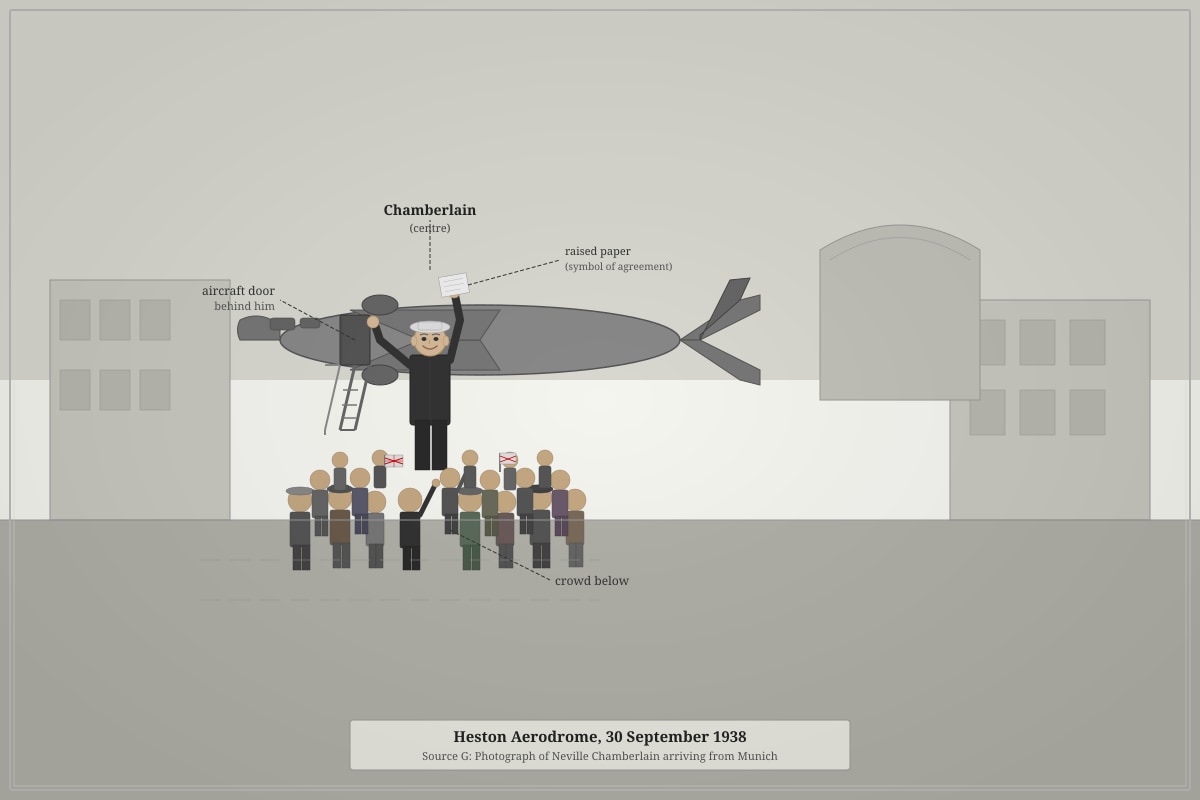
Chamberlain meant that the Munich Agreement had averted war between Britain and Germany by resolving the Sudetenland crisis diplomatically (1). He believed that Hitler's agreement to the negotiated settlement, his personal promises during their meetings, and the four-power signature created a binding framework for European stability (1). The phrase reflected his genuine conviction that his personal diplomacy had succeeded where military threat had failed, and that engagement with rather than opposition to German grievances was validated (1). The image in Source G—the raised paper, the triumphant return—symbolises this belief in the efficacy of negotiation and his own agency in preserving peace (1).
Teaching note: The phrase deliberately echoed Benjamin Disraeli's 1878 return from the Congress of Berlin ('peace with honour'). Chamberlain's self-conscious historical citation reveals his understanding of how he wished to be perceived. The gap between this confidence and the reality of March 1939 remains one of history's most studied miscalculations.
Question 6
(a) Process of transfer [2 marks]
Marking descriptors:
- 1 mark for identifying timeline (1 October start, 10 October completion)
- 1 mark for identifying mechanism (Czechoslovak government evacuation; League of Nations registration)
Model answer:
The transfer process involved Czechoslovak government evacuation beginning 1 October and completing by 10 October (1). The agreement was to be registered with the League of Nations, suggesting formal international oversight (1).
(b) Multilateral solution [3 marks]
Marking descriptors:
| Marks | Descriptor |
|---|---|
| 1 | Simple identification of four signatories |
| 2 | Some development of who participated and what this suggests |
| 3 | Full analysis connecting format to multilateral nature with recognition of limitations |
Model answer:
Source H partially supports the multilateral view (1). The four-power format—Germany, Britain, France, Italy—and the League of Nations registration suggest collective international negotiation rather than bilateral deal (1). However, Czechoslovakia's absence from the signatories and the language of 'Czechoslovak government will' being ordered to evacuate without its consent reveals imposition rather than genuine multilateral agreement (1). The source thus shows formal multilateral appearance masking great-power dominance.
Question 7 [6 marks]
Marking descriptors:
| Marks | Descriptor |
|---|---|
| 1-2 | Limited use of sources; one-sided or descriptive |
| 3-4 | Uses both sources with some cross-reference; begins to evaluate challenge |
| 5-6 | Developed analysis weighing how far sources G and J challenge Churchill, recognising degrees and limitations |
Model answer:
Sources G and J challenge Churchill's view partially but not fundamentally (1). Source G's triumphant imagery—Chamberlain's raised paper, cheering crowd, celebratory return—shows the immediate presentation of Munich as success, contrasting with Churchill's 'total defeat' (1). This official narrative of achievement, widely circulated in British media, dilutes Churchill's absolutism by showing contemporary perception of gain (1). Source J further challenges by presenting Halifax's genuine belief in Hitler's trustworthiness and the potential for broader settlement, suggesting rational calculation rather than naive surrender (1).
However, the challenge is limited (1). Both G and J ** hinge on Chamberlain's personal interpretation** rather than objective assessment; Source J's emphasis on Hitler's 'sincerity' appears misjudged with hindsight, while G's celebration proved temporary and performative (1). Neither source addresses the strategic reality Churchill identified: Czechoslovakia's military dismantlement, the emboldenment of Hitler, the exposure of British guarantees as hollow. Thus while they show alternative contemporary perspectives, they do not refute Churchill's underlying claim about actual consequences (1).
Teaching note: This question tests the crucial skill of distinguishing between contemporary perception and historical assessment. Good students recognise that sources can be 'challenges' to a view without fully disproving it—nuanced judgement is rewarded.
Question 8 [6 marks]
Marking descriptors:
| Marks | Descriptor |
|---|---|
| 1-2 | Identification of basic difference without developed comparison |
| 3-4 | Systematic comparison of views with some support from sources |
| 5-6 | Developed comparison analysing how and why views differ, with attention to context and inference |
Model answer:
Churchill and Halifax held fundamentally opposed views of Hitler's trustworthiness (1). Churchill assessed Hitler as absolutely untrustworthy, using moral and historical language ('bitter cup,' 'supreme recovery of moral health') to frame appeasement as corruption that would invite further aggression—implying Hitler's word was worthless because his nature was expansionist (1). Halifax, by contrast, accepted Hitler's sincerity based on personal contact, describing his desire for 'an end to territorial revisionism' as 'genuine' (1).
The sources reveal different bases for their judgements: Churchill relied on pattern analysis of dictators and principled opposition to yielding on threats; Halifax privileged face-to-face diplomatic assessment and the desire to believe in negotiated solutions (1). Their institutional positions shaped this: Churchill as backbench critic free to oppose; Halifax as Foreign Secretary invested in making diplomacy succeed (1). These differences are not merely personal but reflect broader Conservative Party divisions about how to respond to German resurgence—divisions that would reshape British government policy only when events proved Churchill correct (1).
Teaching note: Halifax's assessment in Source J is particularly striking given his later role in continuing appeasement as Foreign Secretary until 1940. His private papers confirm genuine belief in engagement; his 1957 memoirs Fulness of Days remained defensive about Munich while acknowledging errors.
Question 9 [5 marks]
Marking descriptors:
| Marks | Descriptor |
|---|---|
| 1-2 | Basic identification of territorial loss without developed geographical reasoning |
| 3-4 | Developed explanation of two geographical vulnerabilities with use of map |
| 5 | Fully developed analysis connecting geography to military/strategic vulnerability |
Model answer:
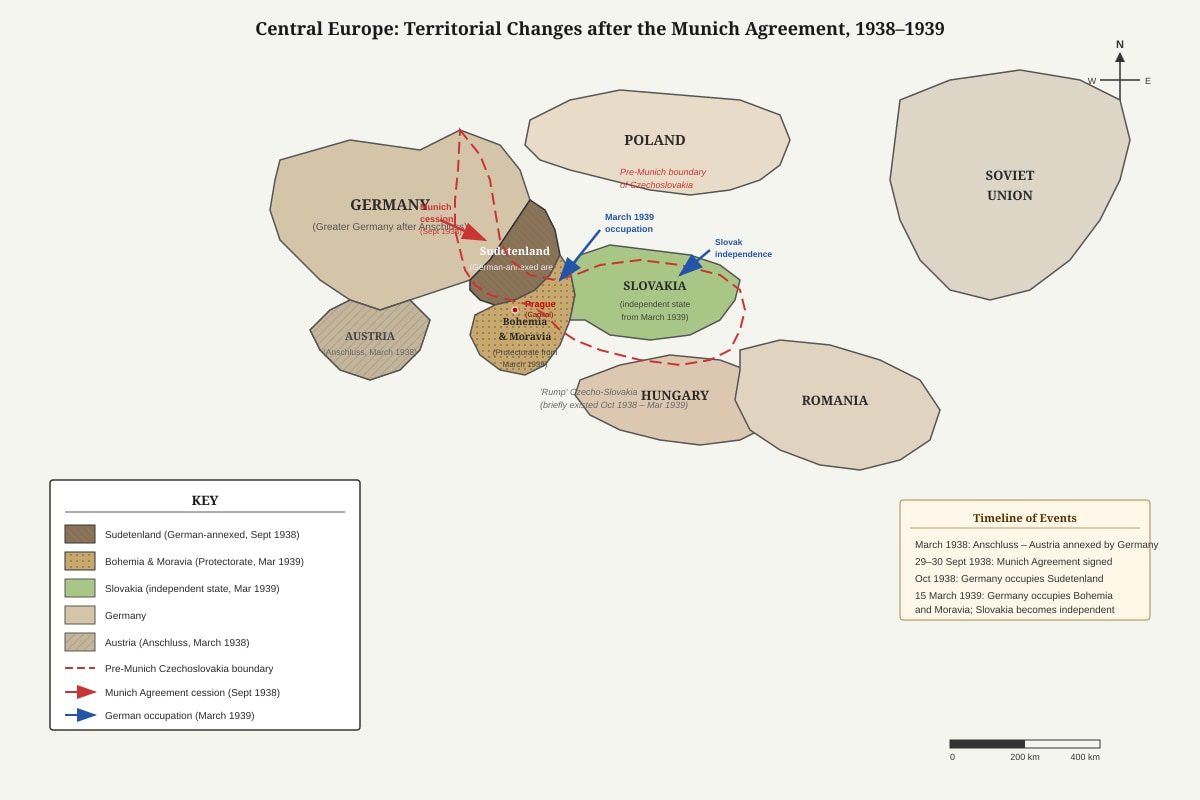
Source K helps historians understand Czechoslovakia's increased vulnerability in two key ways (1). First, the loss of the Sudetenland removed Czechoslovakia's mountainous western border,which had been its natural defensive frontier against German expansion (1). The map shows the Sudetenland as a continuous belt along the German border with elevated terrain; without it, the remaining Czechoslovak state lay exposed on the plains of Bohemia (1). Second, the map reveals how German annexation encircled Czechoslovakia's remaining territory,with Germany now bordering along the entire west and north-west, and the displayed March 1939 changes showing subsequent ability to penetrate directly to Prague without geographical obstacle (1). The visual representation of truncated, irregular boundaries replacing compact 1938 borders demonstrates strategic indefensibility that made military resistance practically impossible by March 1939 (1).
Teaching note: The Sudetenland contained Czechoslovakia's fortified border (the 'Little Maginot Line'). Its cession without compensation was strategically disastrous—this was Chamberlain's 'unmitigated defeat' in practical military terms, not merely moral ones.
Question 10 [4 marks]
Marking descriptors:
| Marks | Descriptor |
|---|---|
| 1 | Simple agreement/disagreement without source use |
| 2-3 | Supported judgement using some sources with some balance |
| 4 | Developed evaluation weighing 'genuine desire' against 'cowardice/miscalculation', using sources and own knowledge |
Model answer:
The sources permit partial agreement with significant reservation (1). Sources G and J clearly show genuine desire for peace: Chamberlain's exhausted jubilation, Halifax's invested belief in Hitler's trustworthiness, the four-power negotiation format all reflect sincere commitment to avoiding war (1). Source H's careful terms and League registration suggest procedural rigour rather than reckless surrender (1).
However, the sources and own knowledge reveal miscalculations that shade into culpable failure (1). Chamberlain's misreading of Hitler's intentions (Source J's 'sincerity' proved disastrously wrong by March 1939), the exclusion of Czechoslovakia from its own fate, and the military destruction of an ally demonstrate errors beyond mere peace-seeking. Churchill's Source I, validated by events, identifies the moral and strategic collapse involved. Own knowledge of 1930s British rearmament delays, public war-weariness, and elite class-based assumptions about dictators suggests complex motivations where desire for peace intertwined with unwillingness to rearm and willingness to sacrifice Eastern Europe. The statement thus overstates 'genuine desire' as explanation and understates the structural cowardice and specific miscalculations involved (1).
Teaching note: Historiographical debate on this remains active: traditional 'Guilty Men' narrative (1940) versus revisionist emphasis on military unpreparedness (e.g. Fresco 1986, Aster 1989). Recent scholarship (e.g. Bouverie 2019) restores culpability while acknowledging constraints. Students mentioning any of these approaches demonstrate advanced historical understanding.
MARK SUMMARY
| Section | Question | Marks |
|---|---|---|
| A | 1 | 4 |
| A | 2 | 6 |
| A | 3 | 6 |
| A | 4 | 4 |
| A TOTAL | 20 | |
| B | 5 | 4 |
| B | 6 | 5 |
| B | 7 | 6 |
| B | 8 | 6 |
| B | 9 | 5 |
| B | 10 | 4 |
| B TOTAL | 30 | |
| GRAND TOTAL | 50 |
Expected timing: Section A approximately 30 minutes; Section B approximately 45 minutes. Prepared students should complete with 10-minute review buffer.