AI Generated Exam Paper
Secondary 3 History Practice Paper 3
Free Sec 3 History Practice Paper 3, HY3 AI version, with questions, answers, and O Level-style practice for Singapore students.
These static practice materials are generated from the site's syllabus and paper-generation workflow, with source and model context shown so students and parents can evaluate the material before use.
Questions
TuitionGoWhere Practice Paper - History Secondary 3
TuitionGoWhere Practice Paper (AI) — Version 3
Subject: History
Level: Secondary 3
Paper: Practice Paper (Source Based Skills)
Duration: 1 hour 15 minutes
Total Marks: 40
Name:
Class:
Date:
Instructions
- This practice paper tests Source Based Skills for Secondary 3 History.
- Read all sources carefully before answering.
- Answer all questions in the spaces provided.
- Marks for each question are shown in brackets [ ].
- Section marks and question marks add up to 40.
Section A: Understanding Sources (1–5)
Total: 10 marks
1. Study Source A below.
Source A: A British newspaper report from 1910 stating, "The tin mines of Perak bring great wealth to London investors, while local chiefs retain ceremonial power under British advice."
What is the origin of Source A? [1]
2. Source B is a diary entry of a Malay villager in 1925 describing "new rubber estates taking our farmland."
State one purpose of Source B. [1]
3. Source C is a Nazi propaganda poster from 1934 showing Hitler with children and the words "Germany's future."
Is Source C a primary or secondary source? Give a reason. [2]
4. Read Source D: a 1942 Japanese military order promising "freedom from Western colonisers."
State the tone of Source D in one word. [1]
5. Source E is a history textbook paragraph from 2020 explaining the causes of WWII.
Give one way Source E differs from a 1940 speech by Chamberlain. [1]
Section B: Reliability and Usefulness (6–10)
Total: 10 marks
6. Source F is a letter from a British Resident in 1895 praising the Resident system.
Give one reason why Source F may be biased. [2]
7. Study Source G (a 1933 German election poster) and Source H (a 1933 newspaper critical of Nazis).
Which source is more useful for understanding Nazi popularity? Explain. [2]
8. Source I is a photograph of a Singapore bombed building in 1942 with no caption.
State two things you would need to know to use Source I reliably. [2]
9. Source J: a memoir of a Japanese soldier published in 2001.
Explain why a memoir may have reliability issues. [2]
10. Source K is a British colonial report from 1912 on tin output.
Give one reason it is useful for economic impact study. [2]
Section C: Inference and Cross-Reference (11–15)
Total: 10 marks
11. Source L (1931 Japanese report) says Manchuria was liberated; Source M (Chinese report 1932) calls it invasion.
What can you infer about different perspectives? [2]
12. Source N: Weimar government record showing 6 million unemployed in 1932.
Infer one reason Nazis rose to power using Source N. [2]
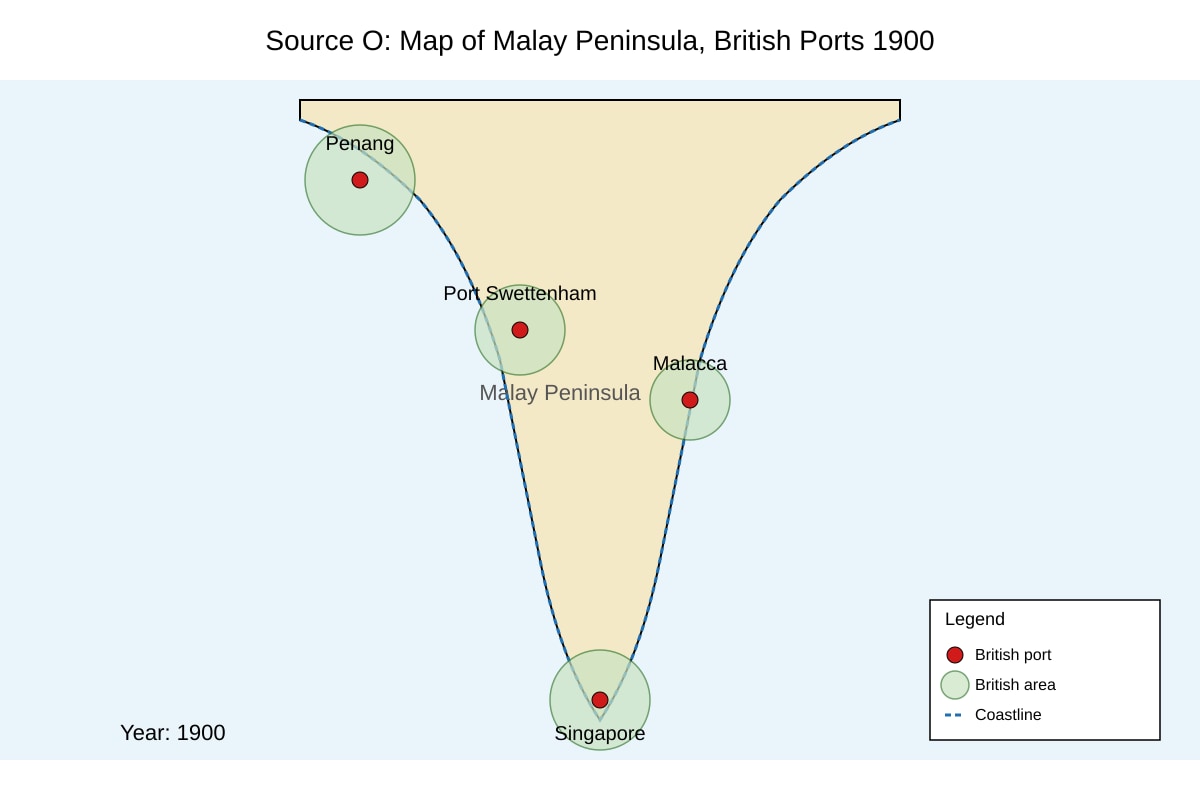
13. Source O is a map showing British ports in Malaya 1900.
Image pending generation: map for 13.
Using Source O, infer one reason for British control expansion. [2]
14. Source P (treaty of Versailles 1919) and Source Q (Hitler speech 1936).
What contradiction can you identify? [2]
15. Source R: a 1945 photograph of atomic bomb destruction.
Infer its usefulness for studying war ending. [2]
Section D: Structured Source-Based Question (16–20)
Total: 10 marks
Study Sources S and T.
Source S: 1938 British cartoon showing Chamberlain with umbrella and Hitler smiling, caption "Peace for our time."
Source T: 1939 newspaper headline "Germany invades Poland; Britain declares war."
16. What does Source S suggest about British policy? [1]
17. How does Source T prove Source S's policy failed? [2]
18. Compare the usefulness of Source S and T for studying appeasement. [2]
19. Using both sources, explain one consequence of appeasement. [2]
20. Suggest one limitation of using only cartoons and headlines to study WWII start. [3]
Answers
TuitionGoWhere Practice Paper Answers - History Secondary 3 (Version 3)
Total Marks: 40
Section A: Understanding Sources
1. [1] Origin: British newspaper report (1910). Teaching note: Origin means who created it and when; here it is a British newspaper from 1910.
2. [1] Purpose: To record personal experience / express impact on villagers. Teaching note: Diary = private record of daily life.
3. [2] Primary source. Reason: It was produced in 1934 at the time of the event by Nazis. Marking: 1 for primary, 1 for correct reason.
4. [1] Tone: Reassuring / propagandistic. Accept one word like "promising".
5. [1] Difference: Textbook is written long after with hindsight; speech was contemporary. Teaching note: Secondary vs primary distinction.
Section B: Reliability and Usefulness
6. [2] Biased because he was a British official benefiting from system. Marking: 1 reason + 1 explanation.
7. [2] Poster more useful for Nazi self-presentation; newspaper for opposition view. Explain: poster shows Nazi message, newspaper shows limits. Marking: 1 for choice, 1 for explain.
8. [2] Need: date, location, photographer. Marking: 2 points.
9. [2] Memory may be inaccurate after years; author may justify actions. Marking: 2 issues.
10. [2] Useful as official data on output. Marking: 1 reason + 1 link to economy.
Section C: Inference and Cross-Reference
11. [2] Different perspectives: Japan saw liberation, China saw invasion. Marking: 2 sides.
12. [2] High unemployment made Nazis appealing. Marking: 1 infer + 1 link.
13. [2] Ports show strategic trade control. Image must show ports marked; answer uses map features. Marking: 1 infer + 1 from map.
14. [2] Versailles restricted Germany; Hitler defied it. Marking: 1 each.
15. [2] Useful as visual evidence of destruction. Marking: 1 useful + 1 reason.
Section D: Structured Source-Based Question
16. [1] Suggests appeasement policy.
17. [2] T shows invasion despite S's peace claim. Marking: 1 link + 1 fail.
18. [2] S shows contemporary view; T shows outcome. Marking: 1 each.
19. [2] Consequence: war broke out. Marking: 1 from sources + 1 explain.
20. [3] Limitation: cartoons simplify; headlines lack detail; no statistics. Marking: 3 points descriptors.
Free quiz and exam paper access
Enter your details to view this paper
Your access is remembered on this device.