AI Generated Exam Paper
Secondary 3 History Practice Paper 2
Free Sec 3 History Practice Paper 2, Kimi2.6 AI version, with questions, answers, and O Level-style practice for Singapore students.
These static practice materials are generated from the site's syllabus and paper-generation workflow, with source and model context shown so students and parents can evaluate the material before use.
Questions
Free quiz and exam paper access
Enter your details to view this paper
Your access is remembered on this device.
Answers
TuitionGoWhere Practice Paper Answer Key - History Secondary 3
Version 2 - Source Based Skills
Section A: Source Comprehension and Interpretation
Question 1 [2 marks]
Expected answer: Source A suggests that Gandhi viewed British rule as morally corrupt and illegitimate. He describes it as "unscrupulous, immoral and unjust" and calls it a "satanic government," indicating his belief that the British administration was fundamentally wicked and oppressive. He also implies that British rule depended on Indian cooperation, which could be withdrawn.
Marking guidance:
- 1 mark for identifying that Gandhi viewed British rule negatively/critically
- 1 mark for specific evidence of this view from the source (e.g., "unscrupulous, immoral and unjust," "satanic government," or the idea that Indians should withdraw cooperation)
Teaching note: Gandhi's strategy of non-cooperation rested on the idea that British rule in India existed only because Indians participated in it. This is a key concept in understanding decolonisation—imperial power often relied on collaboration from colonised peoples.
Question 2 [2 marks]
Expected answer: Any two from: (i) It gave them a sense of dignity/pride in participating in the resistance (the old woman smiled while making illegal salt) (ii) It affected the poorest most directly by challenging the salt monopoly that burdened them financially (iii) It mobilised thousands of ordinary people to join the movement (iv) It transformed a simple economic act (making salt) into political participation
Marking guidance:
- 1 mark each for any two valid points, supported by reference to Source B
Teaching note: The Salt March (1930) was deliberately chosen because salt was a necessity that the British taxed heavily. By breaking this monopoly, Gandhi made imperial exploitation tangible to even the illiterate villager.
Question 3 [2 marks]
Expected answer: Both sources present Gandhi's methods as non-violent but powerful. Source A describes non-cooperation as "a weapon of the strong," while Source B describes the Salt March as a "powerful symbol" made through "simple act[s]." Both emphasise that his methods derived strength from moral conviction rather than force.
Alternative valid similarity: Both sources suggest his methods required ordinary people's active participation.
Marking guidance:
- 1 mark for identifying a valid similarity
- 1 mark for supporting evidence from both sources
Teaching note: This is the concept of satyagraha—soul-force or truth-force. Gandhi believed that moral power could defeat physical power. This distinguishes anti-colonial movements in India from violent uprisings elsewhere.
Question 4 [3 marks]
Expected answer: Source C partially supports this view but largely contradicts it. On one hand, the source claims the movement "does not represent the wishes of the silent majority of loyal Indians," suggesting many Indians accepted British rule. However, the detail that British textiles saw a "40% decline in imports," students abandoned schools, and 15,000 activists were arrested suggests widespread resistance. The need to arrest so many and ban the Congress indicates the movement had substantial support.
Marking guidance:
- 1 mark for identifying the source's claim about loyal majority/accepted rule
- 1 mark for identifying evidence of resistance from the source
- 1 mark for explaining the tension/contradiction in the source
Teaching note: This is typical colonial source bias—officials often minimised opposition to justify their continued rule. Students should always read "against the grain" of official sources, looking for evidence that contradicts the stated position.
Question 5 [3 marks]
Expected answer: Source C has limitations as evidence about Indian attitudes:
- Nature: It is an official government report, likely based on colonial administrators' observations rather than systematic surveys of Indian opinion
- Origin: Produced by the British government, which had a vested interest in portraying the movement as unpopular and itself as legitimate
- Purpose: To reassure London that the situation was under control and to justify repressive measures (arrests, banning Congress)
The source may contain some factual information (trade statistics, arrest numbers) but its interpretation of Indian attitudes is suspect. It generalises about "the silent majority" without evidence. A historian would want to cross-reference with Indian sources, newspaper reports, or oral histories.
Marking guidance:
- 1 mark for identifying one appropriate factor (nature, origin, or purpose)
- 1 mark for explaining how this affects reliability
- 1 mark for additional factor or developed explanation
Teaching note: Source evaluation uses the NOP framework: Nature (what is it?), Origin (who made it?), Purpose (why was it made?). Always apply all three to assess reliability.
Section B: Source Comparison and Cross-Referencing
Question 6 [3 marks]
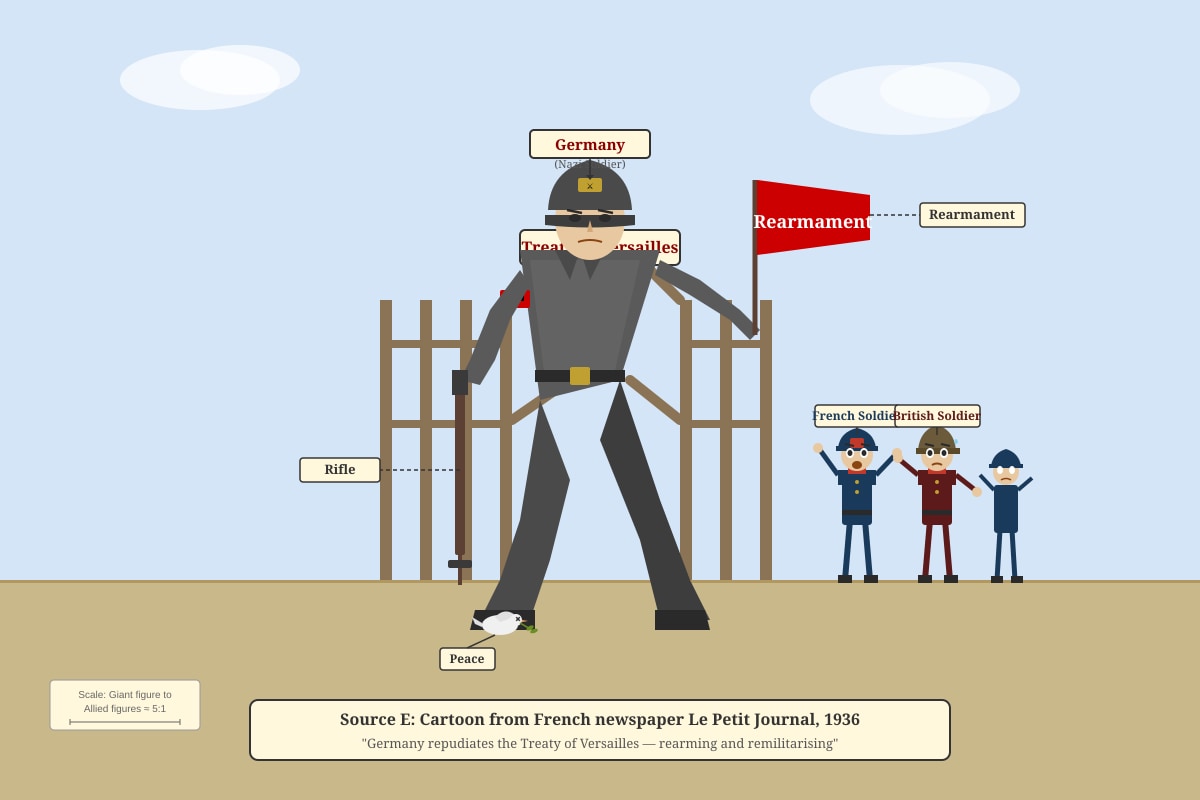
Expected answer: The cartoonist presents Hitler's rearmament as aggressive, threatening, and destructive to peace. The giant Nazi soldier trampling the "Peace" dove shows that rearmament kills peace. His size relative to the small Allied figures suggests he has become overwhelmingly powerful. The swastika and military equipment indicate this is specifically Nazi militarism, not general German self-defence. The broken Versailles fence shows contempt for international agreements. The cartoonist likely feared that Hitler's actions would lead to war.
Marking guidance:
- 1 mark for identifying the cartoonist's negative view of rearmament
- 1 mark for specific visual evidence from the source description (e.g., trampled dove, giant size, broken fence)
- 1 mark for developed interpretation of the cartoonist's message
Teaching note: French opinion in 1936 was particularly alarmed because the Rhineland remilitarisation directly threatened French security. The Maginot Line was designed against this very scenario.
Question 7 [3 marks]
Expected answer: Source D explains Source E because Hitler's speech in Source D provides the rhetorical justification that the cartoonist in Source E is responding to. Hitler presents rearmament as defensive ("right to defend themselves," "laid down arms in good faith"), but Source E shows how this justification appeared to others—as aggressive expansion. The phrase "diktat" and rejection of war guilt in Source D demonstrates the Nazi narrative that the cartoonist visually contradicts. The cartoonist translates Hitler's words into visual proof of aggression: if Germany only wanted equality, why the massive military buildup shown by the giant figure?
Marking guidance:
- 1 mark for identifying the connection: Hitler's justification in D provokes the critical response in E
- 1 mark for specific content link (defensive rhetoric vs. aggressive imagery)
- 1 mark for explaining the interpretive gap between Hitler's claims and outside perception
Teaching note: This is crucial for understanding appeasement—British and French leaders heard Hitler's justifications (Source D) but also saw his actions (Source E). The gap between rhetoric and action is a key historical problem.
Question 8 [2 marks]
Expected answer: Source D presents Hitler's response to Versailles as a justified demand for equality by a wronged nation ("diktat," "lie," "equal rights"). Source F presents the British response as pragmatic and cautious, emphasising military weakness and public opposition rather than principle. Source D is aggressive and demanding; Source F is defensive and conciliatory.
Alternative valid difference: Source D actively repudiates the treaty; Source F considers accepting/fudging the breach.
Marking guidance:
- 1 mark for identifying a valid difference
- 1 mark for supporting evidence from both sources
Question 9 [3 marks]
Expected answer: Source D supports the statement strongly: Hitler explicitly argues that Versailles was unjust ("diktat," "lie"), that Germany acted in good faith, and that fifteen years of negotiation failed. He frames rearmament as exercising "equal rights."
Source F partially supports but mainly undermines the statement. It notes that "the Rhineland is, after all, German territory," suggesting some sympathy with Hitler's position. However, it also shows Britain avoiding confrontation due to military weakness and public opinion, not because it agrees with Hitler. The "firm diplomatic protest" indicates disapproval.
Overall: The sources show that while Hitler claimed justification, Britain's response was driven by practical constraints rather than acceptance of his argument.
Marking guidance:
- 1 mark for analysis of Source D
- 1 mark for analysis of Source F
- 1 mark for balanced judgment/comparison
Teaching note: This is the appeasement debate. Traditional view: Britain was naive; Revisionist view: Britain was buying time. Source F supports the revisionist view—military unpreparedness was genuine.
Question 10 [3 marks]
Expected answer: Source F is limited because:
- Narrow perspective: It only reveals British official thinking, not French, German, or public opinion
- Self-justifying: It may excuse inaction by emphasising military weakness; historians would want independent military assessments
- No outcome: Written in March 1936, it doesn't show the consequences of this thinking (Hitler's further expansion)
- Missing context: Doesn't mention that the Rhineland remilitarisation violated both Versailles and the Locarno Treaties—Britain's own guarantee
For a full understanding of appeasement, historians need German sources, French reactions, later British policy documents, and evidence of whether military advice was accurate.
Marking guidance:
- 1 mark for identifying a limitation
- 1 mark for explaining why this limits usefulness
- 1 mark for additional limitation or suggestion of other needed sources
Teaching note: Single sources are always partial. Good historical practice requires triangulation—comparing multiple sources from different perspectives.
Section C: Source Evaluation and Synthesis
Question 11 [2 marks]
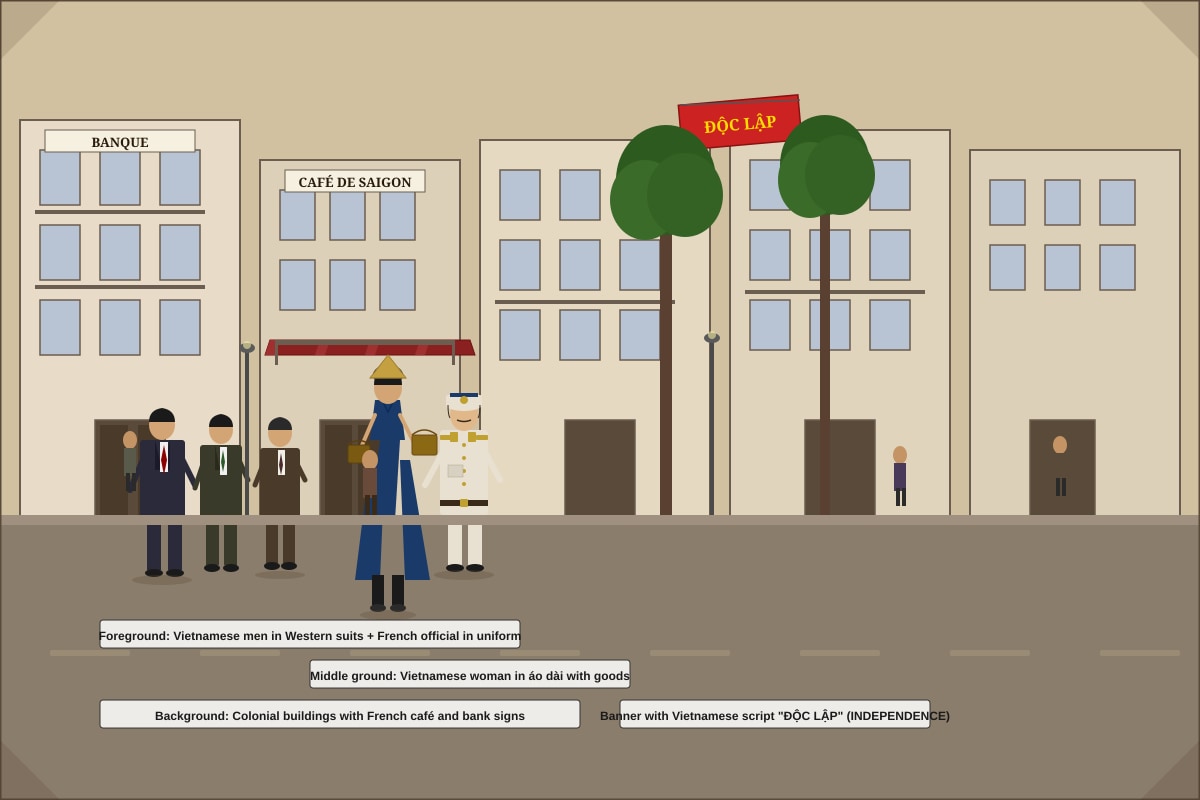
Expected answer: Any two from: (i) French-colonial architecture visible in the buildings (ii) French commercial signs (café, bank) indicating French economic presence (iii) French official in uniform interacting with Vietnamese (iv) Vietnamese men wearing Western suits (cultural influence) (v) French language on signage
Note: The "INDEPENDENCE" banner would not be accepted as evidence of continuing French influence—it suggests resistance to it.
Marking guidance:
- 1 mark each for two valid points
Teaching note: The áo dài and independence banner hint at Vietnamese national identity persisting despite colonialism—continuity beneath change. This is the change and continuity concept.
Question 12 [3 marks]
Expected answer: Source H is partially useful but limited. It shows that Geneva intended reunification through elections by 1956, which never happened—explaining why conflict continued. The "provisional military demarcation line" at the 17th parallel, meant to be temporary, became permanent. However, Source H doesn't explain why elections failed (US and South Vietnamese refusal, fear of communist victory). It doesn't show the Cold War context that made powers undermine the settlement. A historian needs sources on US policy, Diem's government, and communist strategy to fully understand the continuing conflict.
Marking guidance:
- 1 mark for identifying useful content (elections promised, demarcation meant to be temporary)
- 1 mark for identifying limitations (doesn't explain why elections failed, missing Cold War context)
- 1 mark for specific own knowledge about why Geneva failed (US refusal, Diem, Cold War)
Teaching note: The Geneva Accords are a classic case of intention vs. outcome. The gap between what was planned and what happened reveals how external power dynamics (Cold War) overrode local solutions.
Question 13 [3 marks]
Expected answer: Both sources partially support this view but with gaps.
Source H indirectly supports it: the international supervision and emphasis on "fundamental freedoms" reflect Western democratic/anti-communist framing. The US would not have accepted Geneva without this language.
Source I more directly supports the view: Ho Chi Minh explicitly states "Americans and their puppets in the South refuse to hold [elections]," framing US intervention as blocking Vietnamese self-determination. His use of "puppets" suggests the US installed and controlled an anti-communist regime.
However, neither source fully explains US domino theory fears or the broader Cold War context. Source I is clearly partisan—Ho Chi Minh's perspective needs balancing with US sources.
Marking guidance:
- 1 mark for Source H analysis
- 1 mark for Source I analysis
- 1 mark for balanced assessment/recognition of limitations
Teaching note: The domino theory—that if Vietnam fell to communism, all Southeast Asia would follow—was central to US thinking. Neither source fully articulates this, showing the value of combining sources with broader historical knowledge.
Question 14 [2 marks]
Expected answer: Any two valid trends: (i) Rapid increase in military advisors: from 342 (1955) to 3,164 (1960)—nearly tenfold growth, showing deepening military commitment (ii) Escalation of equipment sophistication: from transport aircraft to combat aircraft, armoured vehicles, and patrol boats—indicating preparation for combat, not just advice (iii) Economic aid fluctuations then sharp rise: fell 1955-1956, then rose to $1,000 million by 1960—showing increasing financial investment (iv) Acceleration after 1958: the steepest increases occur 1959-1960, coinciding with the communist insurgency
Marking guidance:
- 1 mark for each identified trend with supporting data
Teaching note: The 1960 figure is crucial—John F. Kennedy's election year. The data shows US "mission creep": what began as limited aid became major commitment before most Americans knew Vietnam existed.
Question 15 [4 marks]
Expected answer:
Support:
- Source H shows Geneva intended Vietnamese reunification, but the 1956 elections never occurred
- Source I explicitly blames "Americans and their puppets" for blocking elections
- Source J shows massive US military build-up in South Vietnam during precisely the period when elections should have led to reunification
Partial challenge/complication:
- Source I is partisan (Ho Chi Minh's perspective) and doesn't acknowledge North Vietnamese violations or communist refusal to cooperate with international supervision
- Source H doesn't mention who undermined it, just what was intended
- Own knowledge: The US supported Ngo Dinh Diem's refusal to hold elections; Diem was anticommunist and feared Ho would win. Neither side fully respected Geneva—communists also prepared for continued struggle.
Judgment: The sources substantially support the view that external powers (primarily the US) undermined Geneva, but a complete answer should note that North Vietnamese communists also never accepted permanent partition and were preparing insurgency. The "failure" was overdetermined—both Cold War superpowers and both Vietnamese regimes contributed.
Marking guidance:
- 1 mark for evidence of US undermining from sources
- 1 mark for use of Source J (military build-up as evidence of intervention)
- 1 mark for own knowledge development (Diem, domino theory, or North Vietnamese actions)
- 1 mark for balanced judgment recognising complexity
Teaching note: This is synthesis—the highest-order historical skill. Good answers don't just list source points but weigh them against each other and against broader knowledge to reach a nuanced conclusion.
Mark Summary
| Question | Marks | Section |
|---|---|---|
| 1 | 2 | A |
| 2 | 2 | A |
| 3 | 2 | A |
| 4 | 3 | A |
| 5 | 3 | A |
| 6 | 3 | B |
| 7 | 3 | B |
| 8 | 2 | B |
| 9 | 3 | B |
| 10 | 3 | B |
| 11 | 2 | C |
| 12 | 3 | C |
| 13 | 3 | C |
| 14 | 2 | C |
| 15 | 4 | C |
| Total | 40 |
Common errors to avoid:
- Q4: Accepting the source's claim about "loyal majority" without questioning it
- Q5: Forgetting that "nature" means what kind of source it is (report, letter, cartoon, etc.)
- Q6: Describing the cartoon without interpreting its message
- Q10: Saying a source is "useful" or "not useful" without explaining for what question
- Q15: Listing points from sources without weighing them against each other