AI Generated Exam Paper
Secondary 3 History Practice Paper 1
Free Sec 3 History Practice Paper 1, Kimi2.6 AI version, with questions, answers, and O Level-style practice for Singapore students.
These static practice materials are generated from the site's syllabus and paper-generation workflow, with source and model context shown so students and parents can evaluate the material before use.
Questions
Free quiz and exam paper access
Enter your details to view this paper
Your access is remembered on this device.
Answers
TuitionGoWhere Practice Paper - History Secondary 3
Version 1 of 5 — Answer Key and Marking Scheme
Total Marks: 60
SECTION A: SOURCE COMPREREHENSION AND ANALYSIS [20 marks]
Question 1(a) [2 marks]
Expected answer:
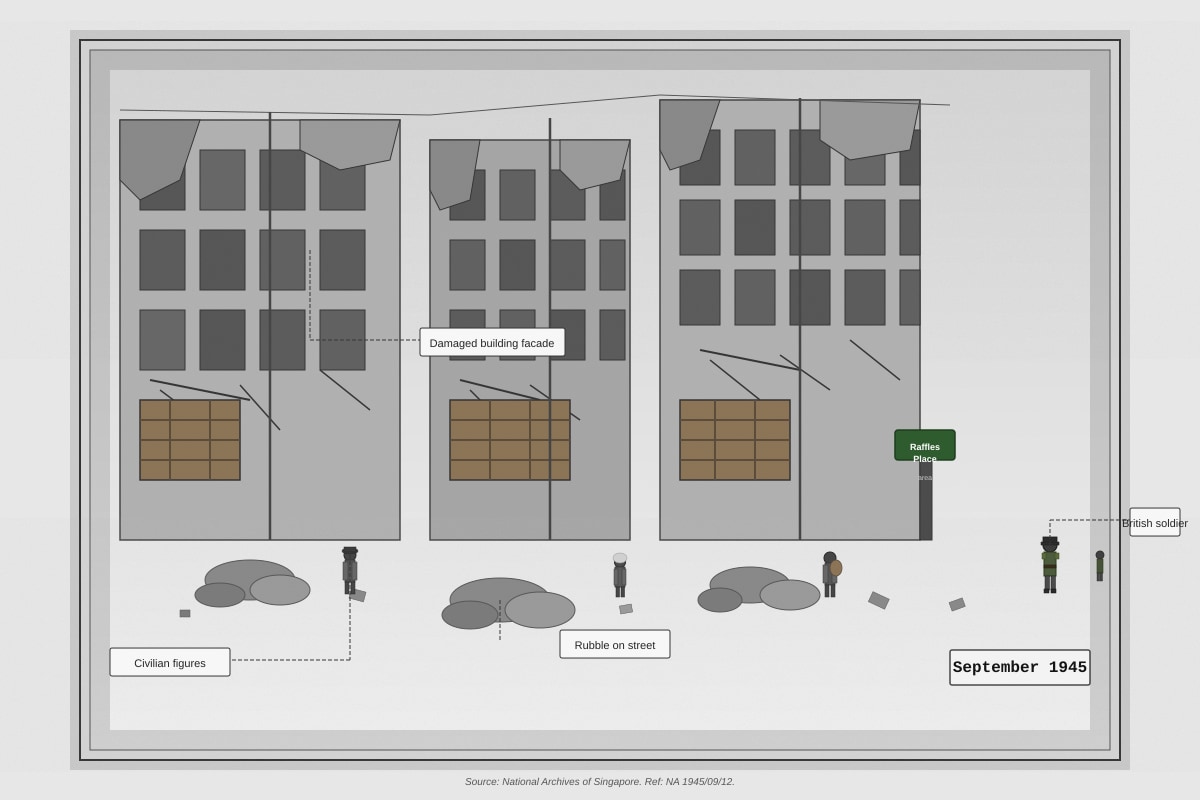
- Source A shows widespread physical destruction in Singapore after the Japanese Occupation (1 mark) — evidence of bomb damage, rubble, and ruined buildings
- The scene suggests disruption to civilian life and economic activity (1 mark) — few people visible, damaged infrastructure, boarded-up shops
Marking guidance:
- 1 mark for identifying visible condition (destruction/damage)
- 1 mark for inference about impact on life/conditions
- Accept: references to British military presence indicating colonial return, limited restoration of order
Teaching note: The Japanese Occupation (1942–1945) involved significant bombing during the war's final phase. The British return in September 1945 found infrastructure severely damaged after Japanese military operations and Allied bombing.
Question 1(b) [2 marks]
Expected answer (any two points):
- "grievances surfaced regarding employment" — unemployment dissatisfaction
- "housing shortages" — inadequate living conditions
- "slow pace of reconstruction" — perceived British inefficiency
- "speak openly of 'self-determination'" — political demands for independence
- "question the legitimacy of our continued rule" — direct challenge to colonial authority
Marking guidance:
- 1 mark per valid piece of evidence (2 marks total)
- Must quote or closely paraphrase from Source B
- "Short-lived" relief alone is insufficient — must identify specific grievance/challenge
Teaching note: The British returned expecting gratitude but faced a transformed population. The war had created economic hardship and politicised many Singaporeans, particularly those who had joined resistance movements or witnessed Japanese propaganda against colonialism.
Question 1(c) [4 marks]
Reliability assessment:
Strengths (up to 2 marks):
- Tan Kah Kee was a prominent community leader with direct experience of both Japanese Occupation and British return — eye-witness credibility
- His position gave him insight into community sentiments across social classes
- The source date (1946) is close to events, reducing memory distortion
- Content is plausible and corroborated by other sources (Source B mentions "political consciousness")
Limitations (up to 2 marks):
- Perspective bias: Tan was a Chinese community leader with anti-colonial sympathies; his views may not represent all ethnic communities (Malays, Indians)
- Selective emphasis: He acknowledges Japanese "brutality" but stresses political lesson; may downplay genuine relief at British return
- The source is a retrospective interview (recorded 1946, published later?), potentially shaped by subsequent political developments
Overall judgment (1 mark):
- Reliable for Chinese community/anti-colonial perspectives but should be cross-referenced with sources representing other groups
Marking breakdown:
- 1–2 marks: Identifies one strength and one limitation with brief explanation
- 3 marks: Two sides developed with specific source references
- 4 marks: Balanced evaluation with clear overall judgment on reliability for specific purposes
Teaching note: Source reliability depends on purpose. Tan Kah Kee (1874–1961) was a prominent philanthropist and nationalist leader. His memoirs are valuable for Chinese community perspectives but less representative of Malay or Indian Singaporeans who had different wartime experiences.
Question 1(d) [6 marks]
Agreement (up to 3 marks):
- Both sources identify changed political attitudes after Japanese Occupation
- Source B: "political consciousness" awakened, people "question the legitimacy of our continued rule"
- Source C: "no longer content to be treated as second-class in our own land"
- Both suggest the British underestimated post-war changes
Disagreement/difference in emphasis (up to 3 marks):
- Source B (British official): Presents problems as manageable grievances that could be addressed; maintains colonial framework; views demands as concerning but not necessarily legitimate
- Source C (Tan Kah Kee): Framed as fundamental, irreversible shift in consciousness; "everything had changed"; challenges colonial legitimacy directly
- Tone: B is analytical/problem-focused; C is assertive/declarative about Asian empowerment
- Causation: B emphasises wartime suffering leading to grievances; C emphasises political lesson of Japanese success in displacing British
Overall judgment (up to 2 marks):
- Sources agree on surface phenomenon (changed attitudes) but disagree on nature and implications — B sees temporary challenge, C sees permanent transformation
- This disagreement reflects their provenance: colonial official vs. anti-colonial leader
Marking breakdown:
- 1–2 marks: Identifies basic agreement with one superficial difference
- 3–4 marks: Multiple points of agreement and disagreement, some provenance analysis
- 5–6 marks: Sophisticated analysis of how same evidence supports different interpretations; clear provenance linkage
Teaching note: This is a classic "how far do they agree" question. The key is recognising that sources can agree on facts while disagreeing on interpretation or significance. The British official (B) filters observations through colonial maintenance perspective; Tan (C) through nationalist liberation framework.
Question 1(e) [6 marks]
Source-based evidence (up to 3 marks):
- Source A: Physical destruction left population dissatisfied with slow recovery; war damage created hardship
- Source B: British insensitive return; employment, housing grievances; political demands for self-determination
- Source C: "Japanese taught us a harsh lesson" — racial humiliation of British, Asian self-governance demonstration
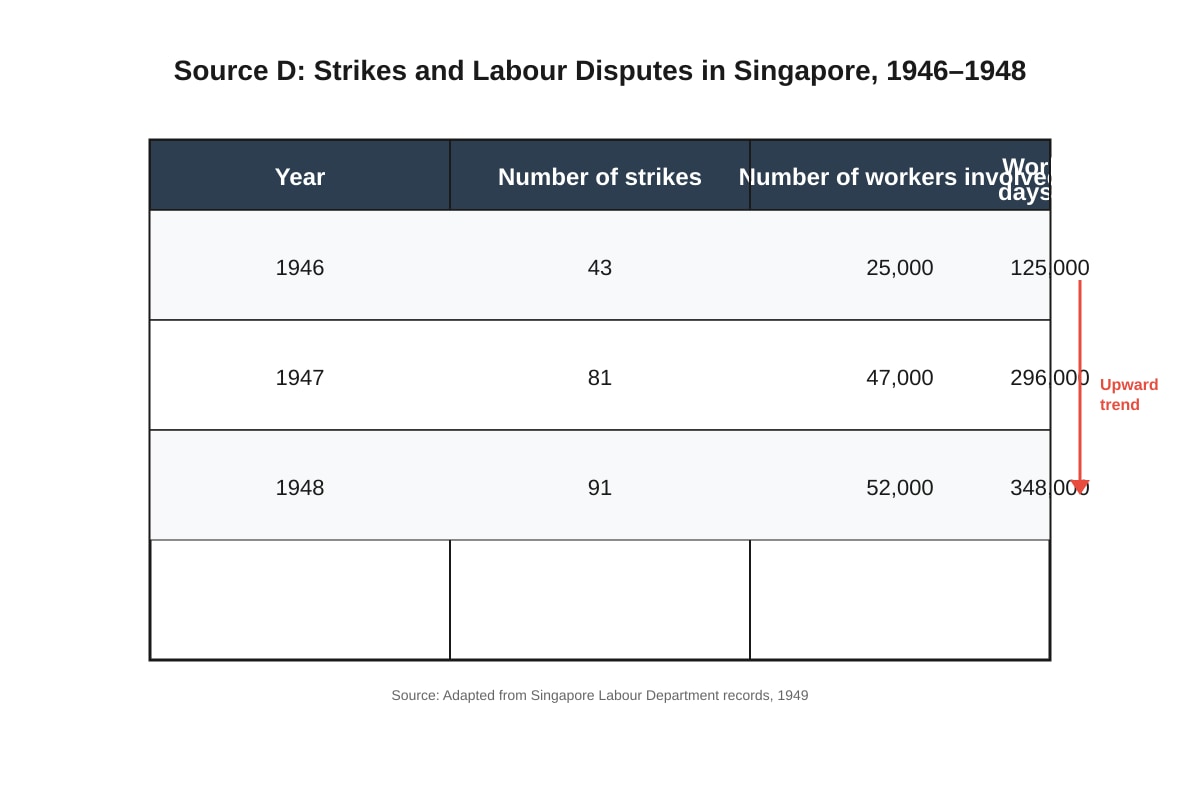
- Source D: Escalating strikes 1946–1948 show organised labour militancy and economic discontent
Own knowledge (up to 3 marks):
- War experience: Japanese propaganda of "Asia for the Asians"; exposure to Japanese administrative efficiency (despite brutality) shattered myth of Western superiority
- Education and social change: English-educated elite expanded; war veterans radicalised; Indian National Army influence; Indonesian independence struggle nearby
- Economic factors: Post-war depression; wages failed to keep with inflation; British companies prioritised profits over reconstruction
- Regional context: Decolonisation momentum India 1947, Indonesia 1949; UN Charter promoting self-determination; rise of communism as anti-colonial force
Synthesis guidance:
- Stronger answers connect economic grievances to political demands (B+D+own knowledge)
- Best answers explain why war transformed consciousness (C + Japanese Occupation impact) rather than merely listing factors
Marking breakdown:
- 1–2 marks: Lists factors with weak source integration
- 3–4 marks: Several developed factors with some source use and own knowledge
- 5–6 marks: Well-structured argument showing interconnection of factors; balanced source and own knowledge; clear causation chains
Teaching note: This question tests the "Change and Continuity" concept. The crucial argument is that anti-colonial sentiment was not merely wartime grievance continuation but qualitative transformation in political consciousness — understanding this distinction distinguishes stronger answers.
SECTION B: SOURCE COMPARISON AND CROSS-REFERENCING [20 marks]
Question 2(a) [3 marks]
Message identification (1 mark):
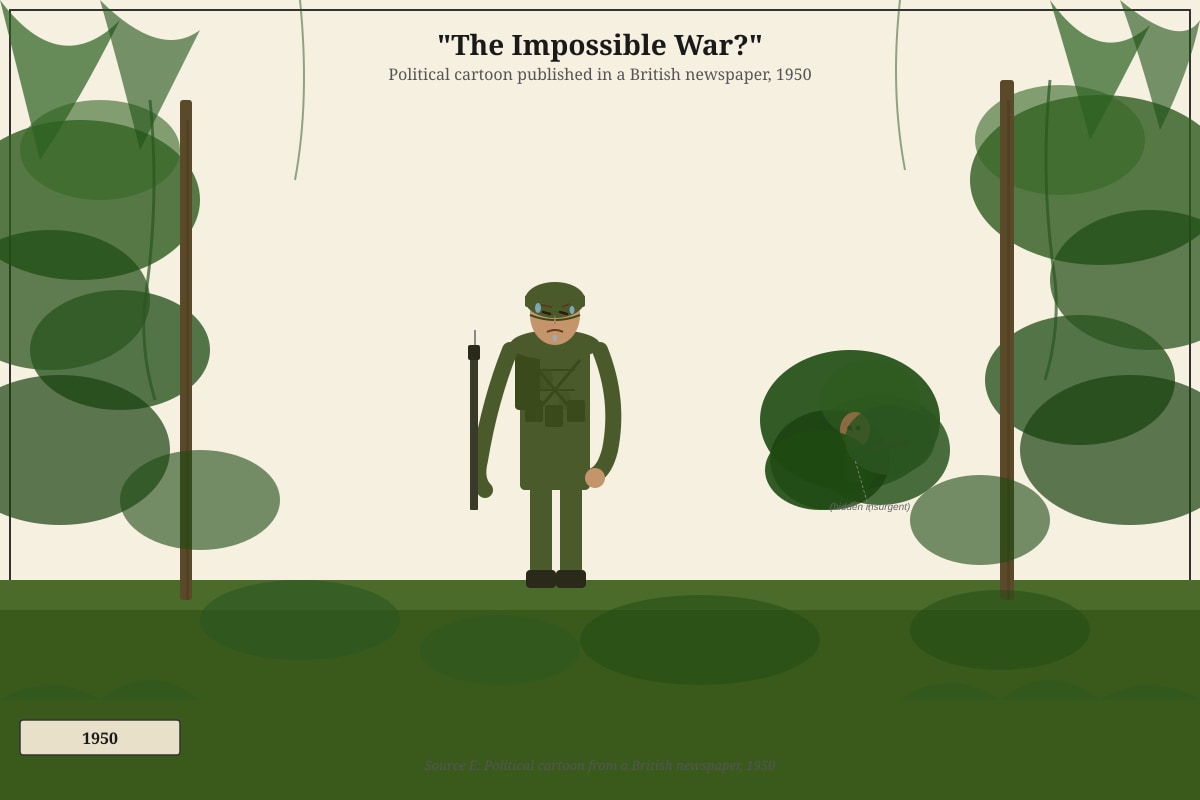
- The cartoonist suggests British military efforts against communist insurgents are futile or frustrated
Supporting evidence (2 marks):
- British soldier is heavily equipped but appears weary, hot, uncomfortable — superior resources not translating to success
- Communist figure is concealed, small, elusive — enemy cannot be effectively targeted
- Jungle environment dominates — terrain favours insurgents, not conventional army
- Title/question "The Impossible War?" — direct editorial comment on futility
Marking breakdown:
- 1 mark: Basic message identified
- 2 marks: Message with one developed visual detail
- 3 marks: Message with two or more specific visual elements explained
Teaching note: Political cartoons require reading symbolism. The jungle represents both literal challenge (Malaya's terrain suited guerrillas) and metaphorical invisibility of communist ideology among population. The soldier's equipment contrasts with insurgent's minimal visibility — critique of military-heavy approach.
Question 2(b) [4 marks]
Similarity (2 marks):
- Both sources recognise conflict's serious nature and stakes involved
- Both use loaded language to characterise opponents (F: "colonial oppression"; G: "cowardly methods")
- Both claim moral high ground / just cause for their side
Difference (2 marks):
- Source F (Chin Peng): Presents communists as legitimate liberation fighters; "not bandits or terrorists"; "our cause is just"; emphasises popular support ("peasants and workers")
- Source G (British government): Presents communists as criminals; "terrorists"; "cowardly"; "murdered," "disrupted"; denies political legitimacy, frames as economic destruction
Difference in framing:
- F: Anti-colonial war of national liberation with political objectives
- G: Criminal/terrorist threat requiring law enforcement and military suppression
Marking breakdown:
- 1 mark: Basic similarity identified
- 2 marks: Similarity developed with source quotes
- 3 marks: One side of difference (either F or G) developed
- 4 marks: Both sides of difference clearly contrasted with specific evidence
Teaching note: This tests "Accounts" concept — same events generate opposing narratives. The British used "terrorist" framing to delegitimise political demands; MCP used "liberation" framing to legitimise armed struggle. Both are propaganda sources requiring provenance awareness.
Question 2(c) [5 marks]
Usefulness assessment:
Strengths (up to 3 marks):
- Eye-witness testimony: Tan Ah Kow experienced "New Village" resettlement directly — specific detail on curfews, searches, forced relocation
- Perspective of ordinary person: Most sources focus on leaders/military; this gives ground-level civilian experience
- Reveals unintended consequences: British measures designed to protect/ isolate population actually generated resentment ("Some people joined the communists because they were angry")
- Recognition of complexity: "confusing time," differing reactions — nuanced rather than partisan
Limitations (up to 2 marks):
- Retrospective nature: Recorded 1985, recalling 1950s — memory may be shaped by later political developments, nostalgia, or subsequent knowledge
- Single perspective: One rubber tapper cannot represent all civilian experiences; may be unrepresentative
- No corroboration in source: Cannot verify specific details independently from this extract alone
- Interviewer influence: Oral history format — questions may have shaped responses
Overall judgment:
- Useful for understanding civilian impact and British counter-insurgency limitations, but best used alongside contemporary documents and multiple oral testimonies
Marking breakdown:
- 1–2 marks: Basic strength or limitation identified
- 3 marks: Both sides with some development
- 4 marks: Balanced evaluation with specific source references
- 5 marks: Sophisticated assessment of usefulness for specific historical questions, with clear limitations acknowledged
Teaching note: The "Briggs Plan" (1950) relocated 500,000 rural Malays into 450 "New Villages" with barbed wire and curfews. Intended to cut guerrilla food supply, it generated significant resentment. This is crucial own knowledge for contextualising Source H.
Question 2(d) [8 marks]
Sources supporting "primarily military conflict" (up to 3 marks):
- Source E: Military imagery dominant; British soldier vs. insurgent; jungle warfare setting
- Source G: Emphasises "military operations"; describes insurgent "methods" as violent; government emphasis on "defeating" threat through force
- Own knowledge: British deployed 40,000 troops; aerial bombing; Operation Ginger (1951); Briggs Plan's military-security dimensions
Sources challenging/complicating (up to 3 marks):
- Source F: Insurgents frame as political struggle for "liberation"; "supported by peasants and workers" — ideological/social movement
- Source H: Civilian experiences of non-military measures (curfews, resettlement); "hearts and minds" in G implies political/psychological dimension
- Source E (alternative reading): Cartoon title questions military approach — implies military alone insufficient
- Own knowledge: Briggs Plan combined military with political (village elections, food control); Templer's "hearts and minds"; political wing of MCP; Cold War ideological context; British concern with Malayan moderates
Overall judgment (up to 2 marks):
- Sources present conflict as military in execution but political in nature — military means to political ends
- Strongest argument: Military conflict label insufficient; it was politico-military conflict where political legitimacy and population control were as important as combat operations
- G's "hearts and minds" concession reveals awareness that military alone inadequate
Marking breakdown:
- 1–3 marks: One-sided argument with limited source range
- 4–5 marks: Some balance with basic source use; may lean too heavily to one side
- 6–7 marks: Well-balanced with developed provenance analysis; clear judgment on complexity
- 8 marks: Sophisticated argument that military/political distinction itself is problematic; recognises interplay of dimensions; excellent source interrogation
Teaching note: Sir Gerald Templer's arrival (1952) shifted from purely military to integrated politico-military strategy: "The answer lies not in pouring more troops into the jungle, but in the hearts and minds of the Malayan people." This is crucial own knowledge for top-level answers.
SECTION C: SOURCE INTERPRETATION AND SYNTHESIS [20 marks]
Question 3(a) [2 marks]
Expected answer:
- Lee Kuan Yew supports independence but with caution/pragmatism (1 mark) — "not merely a word to shout at rallies"; "step, but only a step"
- He emphasises responsible preparation (1 mark) — "discipline, unity, and a clear vision"; multiracial "common future"
Alternative acceptable readings:
- Recognises self-government as immediate achievable goal, not full independence
- Stresses process over simple demand
Marking breakdown:
- 1 mark: Basic attitude identified (supports but cautious / wants independence with conditions)
- 2 marks: Both elements — support for goal and emphasis on preparation/responsibility
Teaching note: 1959 was Singapore's first full self-government election. PAP won decisively. Lee's rhetoric reflects strategic patience — wanting genuine autonomy but recognising Singapore's vulnerability (no natural resources, limited defence, communist threat, need for economic development).
Question 3(b) [3 marks]
Usefulness:
- Contemporary source: Date 1 September 1962, immediate to event — reduces memory distortion
- Specific data: Provides exact referendum results (71.1% Option A, etc.); 90% turnout shows high engagement
- Newspaper format: Published account accessible to public; reflects official reporting
Limitations (for balanced answer):
- The Straits Times had pro-mer editorial stance; may not reflect opposition arguments fully
- "Singapore Votes for Merger" headline presupposes positive outcome; could frame as endorsement rather than choice among options
Marking breakdown:
- 1 mark: Identifies basic usefulness (contemporary/specific data)
- 2 marks: One strength developed with source detail
- 3 marks: Balanced assessment with provenance awareness
Teaching note: The 1962 referendum offered three merger options, all PAP-favourable — opposition "Solidarity" group wanted union without conditions but lacked option. This manipulation is important own knowledge for assessing source usefulness.
Question 3(c) [5 marks]
Differences:
Source K (Tunku):
- Presents separation as reluctant, necessary — "heavy heart," "irreconcilable" differences
- Emphasises threat to unity/avoidance of bloodshed — pragmatic, defensive framing
- Passive construction: "agreed to" — suggests joint decision, mutual responsibility
- Concern for "both our peoples" — maintains claim of shared concern despite separation
Source L (Lee):
- Presents as deeply personal anguish — emotional, individual response
- "All my life... I've believed in Malaysia" — expresses ideological commitment betrayed
- Acknowledges prior commitment to merger that Tunku downplays
- Forward-looking: "multiracial nation... will survive" — turns to future construction
Provenance explanation:
- Tunku as Malaysia's leader must justify decision to Malaysian parliament; cannot appear to have expelled Singapore arbitrarily
- Lee as Singapore's leader must explain reversal to Singaporeans who supported merger; must convert setback to opportunity
Marking breakdown:
- 1–2 marks: Identifies one difference with basic explanation
- 3 marks: Two differences with some development
- 4 marks: Both authors' perspectives clearly contrasted with specific quotes
- 5 marks: Provenance analysis linking differences to audience/position; sophisticated reading of rhetorical strategies
Teaching note: The actual 1965 separation involved acrimonious PAP-UMNO racial politics; UMNO's Malay chauvinism vs. PAP's "Malaysian Malaysia" equality campaign. Tunku's account sanitises; Lee's "anguish" is partly genuine, partly strategic for domestic audience needing reassurance.
Question 3(d) [10 marks]
Interpretation: "Political failure"
Evidence supporting (up to 4 marks):
- Sources K+L: Both express regret — "heavy heart," "anguish" — shared sense of loss
- Lee's "all my life... believed in Malaysia" shows abandoned vision
- Original purpose of merger (security, markets, racial balance) unfulfilled
- Own knowledge: Racial riots 1964; PAP-UMNO conflict; economic disputes; Singapore's expulsion rather than voluntary departure — loss of agency
Evidence challenging (up to 4 marks):
- Source L (alternative reading): "will survive" — resilience, determination to succeed
- Own knowledge: Separation enabled independent economic policy; EDB 1961 (pre-separation), but acceleration post-1965; port development; financial centre growth; no federal constraints on foreign investment; avoidance of Malay nationalist domination
- Strategic necessity: Singapore's vulnerability (no natural resources, water dependence, defence) made merger desirable, but political incompatibility made it unsustainable — not failure of concept but recognition of reality
Sophisticated arguments (up to 2 marks):
- Definition of "failure": Short-term failure of federation, but long-term successful transition to independence
- Counterfactual: Continued merger might have led to worse outcomes — racial conflict, economic constraint
- Singapore's subsequent success (not in sources but relevant own knowledge) suggests separation was enabling condition
- Sources' expressions of regret reflect political positioning, not objective assessment — both leaders needed to manage domestic audiences
Judgment:
- Partially true as short-term political setback; false as long-term historical assessment
- Better framing: "Crisis that became opportunity" or "Necessary transition rather than failure"
Marking breakdown:
- 1–3 marks: Simple agree/disagree with limited source use
- 4–5 marks: One side developed with some source evidence and own knowledge
- 6–7 marks: Balanced argument with good range of sources and own knowledge; some assessment of "failure" definition
- 8–9 marks: Well-structured with clear line of argument; sophisticated provenance awareness; strong own knowledge integration
- 10 marks: Exceptional analysis that questions premise itself; recognises sources as constructed narratives; deep historical understanding of 1965 as pivotal but not terminus
Teaching note: This is the paper's most demanding question, requiring synthesis of sources with extensive own knowledge. Top answers recognise that "failure" is teleological — judged from outcome. Contemporaries could not know Singapore would succeed. The question tests "Significance" concept: how we assess historical importance with hindsight while respecting contemporary uncertainty.
MARK SCHEME SUMMARY
| Question | Marks | Section Total |
|---|---|---|
| 1(a) | 2 | |
| 1(b) | 2 | |
| 1(c) | 4 | |
| 1(d) | 6 | |
| 1(e) | 6 | Section A: 20 |
| 2(a) | 3 | |
| 2(b) | 4 | |
| 2(c) | 5 | |
| 2(d) | 8 | Section B: 20 |
| 3(a) | 2 | |
| 3(b) | 3 | |
| 3(c) | 5 | |
| 3(d) | 10 | Section C: 20 |
| TOTAL | 60 |
Common errors to flag:
- Source 1(e): Listing causes without explaining how war transformed consciousness
- Source 2(d): Treating "military" and "political" as mutually exclusive rather than intertwined
- Source 3(d): Using post-1965 success as sole argument without engaging with contemporary uncertainty; or failing to use sources at all
Historical concepts tested:
- Section A: Evidence, Change and Continuity, Causation
- Section B: Accounts, Evidence, Historical Empathy
- Section C: Significance, Accounts, Change and Continuity