AI Generated Exam Paper
Secondary 3 History Practice Paper 1
Free Sec 3 History Practice Paper 1, HY3 AI version, with questions, answers, and O Level-style practice for Singapore students.
These static practice materials are generated from the site's syllabus and paper-generation workflow, with source and model context shown so students and parents can evaluate the material before use.
Questions
Free quiz and exam paper access
Enter your details to view this paper
Your access is remembered on this device.
Answers
TuitionGoWhere Practice Paper Answers — History Secondary 3 (Version 1)
Total Marks: 40
Level: Secondary 3
Topic: Source Based Skills
Section A Answers (1–10) [10 marks]
-
The Resident [1]
Teaching: In the British Resident system, the Resident was the adviser with real power; the Sultan was symbolic. -
Tin [1]
Teaching: Source A states tin exports tripled; rubber is not mentioned here. -
Chinese migrants [1]
Teaching: The source explicitly says Chinese migrants worked the mines. -
They remained in villages / not in mines [1]
Teaching: Malays are described as remaining in villages, showing limited economic role change. -
Primary [1]
Teaching: A report written at the time by an officer is a primary source. -
Hitler [1]
Teaching: Source B headline says "Hitler appointed Chancellor". -
1933 [1]
Teaching: Hitler became Chancellor in 1933; context implies this year. -
Propagandistic / triumphant [1]
Teaching: Words like "nation awakes" show positive tone for Nazis. -
Political opponents / Jews (implied enemies) [1]
Teaching: "Enemies of state" in Nazi context refers to opponents and minorities. -
Yes [1]
Teaching: As a contemporary Nazi paper, it shows their self-presentation.
Section B Answers (11–16) [18 marks]
-
(a) Responsibility for causing loss/damage [1]
(b) Saar under League control / territorial loss [1]
Teaching: Source C explicitly states both. -
Resentment from war guilt and reparations [2]
Marking: 1 mark cause (reparations/humiliation), 1 mark explanation (felt unfair).
Teaching: Germans saw clause 231 as humiliation, causing anger. -
Reliable as official treaty text but limited perspective [3]
Marking: 1 = says official, 1 = shows terms, 1 = notes lacks German view.
Teaching: It is a signed document but only shows victors' terms. -
Colonial vs European postwar perspective [4]
Marking descriptors: 2 marks for identifying Source A colonial admin view, 2 for Source C postwar punishment view.
Teaching: A shows control for profit; C shows defeat imposed on Germany. -
Hitler promised revival amid crisis [4]
Marking: 2 for using Source B (awake, enemies removed), 2 for knowledge (Depression, Weimar weakness).
Teaching: Nazis used propaganda and crisis to gain support. -
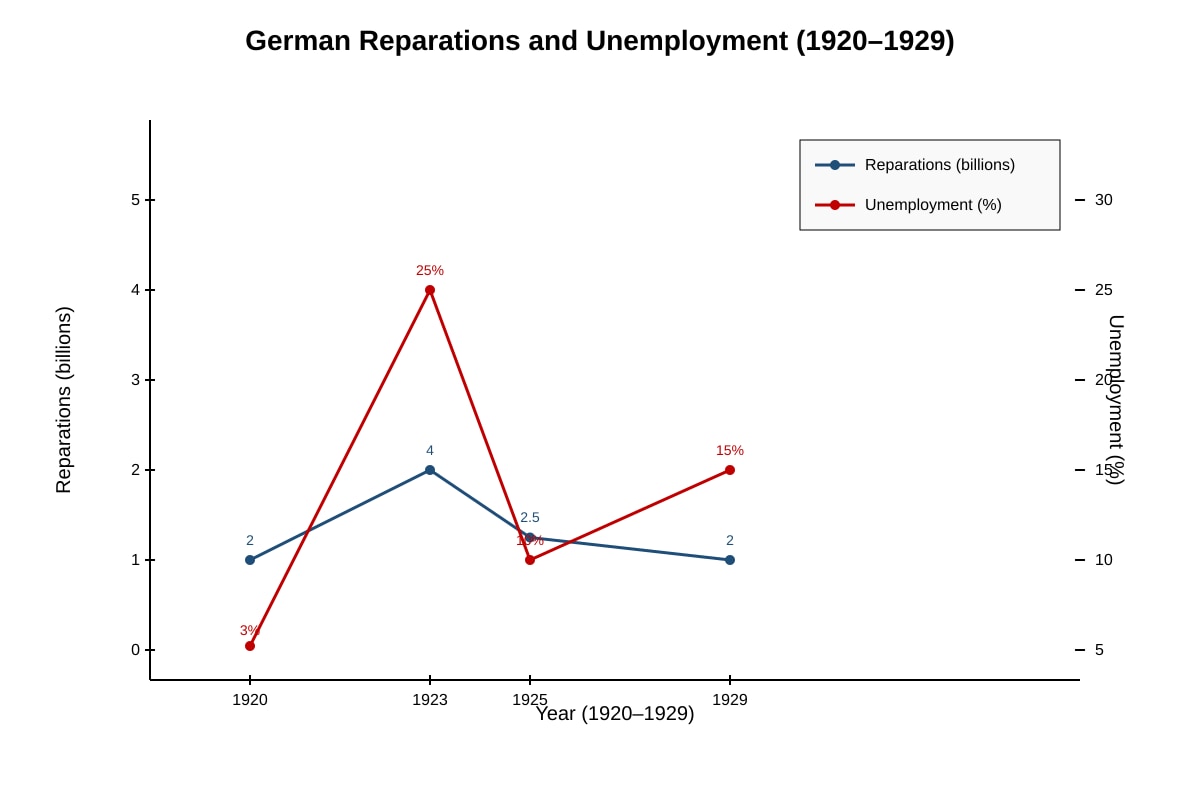
Unemployment rose sharply 1923 then eased; reparations peaked 1923 [3]
Marking: 1 trend unemp, 1 reparations, 1 link.
Teaching: Graph shows 25% unemp in 1923 with high reparations, showing crisis.
Section C Answers (17–20) [12 marks]
-
Understanding past actions in their context [2]
Teaching: Empathy = not judging by today's values. -
Locals faced marginalisation despite development [3]
Marking: 1 empathy, 2 from Source A (villages, migrants benefit).
Teaching: Source A shows Malays sidelined; empathy sees their viewpoint. -
Shows Nazi messaging but biased [4]
Marking: 2 value (contemporary, intent), 2 limitation (propaganda, no opposition).
Teaching: Useful for Nazi claims, not for balanced view. -
Source B (Hitler power) + C (Versailles anger) [3]
Marking: 1 each source, 1 link to authoritarianism.
Teaching: Treaty caused resentment; Nazis exploited it.