AI Generated Quiz
Secondary 3 Geography Resources Sustainability Quiz
Free Sec 3 Geography Resources Sustainability quiz, Kimi2.6 AI version, with questions, answers, and O Level-style practice for Singapore students.
These static practice materials are generated from the site's syllabus and paper-generation workflow, with source and model context shown so students and parents can evaluate the material before use.
Questions
Free quiz and exam paper access
Enter your details to view this paper
Your access is remembered on this device.
Answers
Secondary 3 Geography Quiz - Resources Sustainability — ANSWER KEY
Total Marks: 40
Section A: Multiple Choice (Questions 1–8) [8 marks]
1. B — "Meeting present needs without compromising the ability of future generations to meet their needs"
Explanation: This is the Brundtland Commission's widely adopted definition of sustainable development. Option A describes unsustainable exploitation; option C describes preservationism that ignores human needs; option D is unrelated to the core concept. [1]
2. B — "Ensure diversified and sustainable water supply"
Explanation: The Four National Taps (local catchment water, imported water, NEWater, desalinated water) deliberately create redundancy and reduce dependence on any single source. This diversification is a risk-management strategy for water security. [1]
3. A — "Reverse osmosis and ultraviolet disinfection"
Explanation: NEWater is produced using advanced membrane technologies (microfiltration, reverse osmosis) followed by ultraviolet disinfection. The reverse osmosis process removes contaminants at the molecular level, producing water cleaner than typical drinking water standards. [1]
4. B — "Limited land area for water catchment and storage"
Explanation: Singapore receives about 2,400mm of rainfall annually (well above global average), but its small land area (734 km²) restricts reservoir capacity. Urbanisation also reduces natural infiltration and increases rapid runoff, complicating capture. [1]
5. B — "Energy diversification, efficiency, and demand reduction"
Explanation: Singapore's energy strategy (the "4 Switches") includes natural gas, solar, regional power grids, and emerging low-carbon alternatives, combined with energy efficiency improvements and demand management. Complete reliance on any single source is avoided due to constraints. [1]
6. C — "Reduce"
Explanation: The waste hierarchy prioritises prevention/reduction first, as this eliminates waste at source and avoids resource use entirely. Reuse extends product life; recycling reprocesses materials; recovery extracts energy from residual waste. Each step down the hierarchy is less preferred. [1]
7. C — "Solar energy"
Explanation: Singapore's equatorial location provides consistent sunshine, and solar technology can be deployed on rooftops, reservoirs, and vertical surfaces to overcome land constraints. Wind speeds are too low; there are no major rivers for hydroelectricity; no geothermal activity exists. [1]
8. B — "Produce 30% of Singapore's nutritional needs locally by 2030"
Explanation: The "30 by 30" goal targets local production to reduce import dependency (currently over 90% of food is imported). This enhances resilience against supply disruptions from climate change, geopolitical events, or logistics failures. [1]
Section B: Source-Based and Data Response (Questions 9–14) [16 marks]
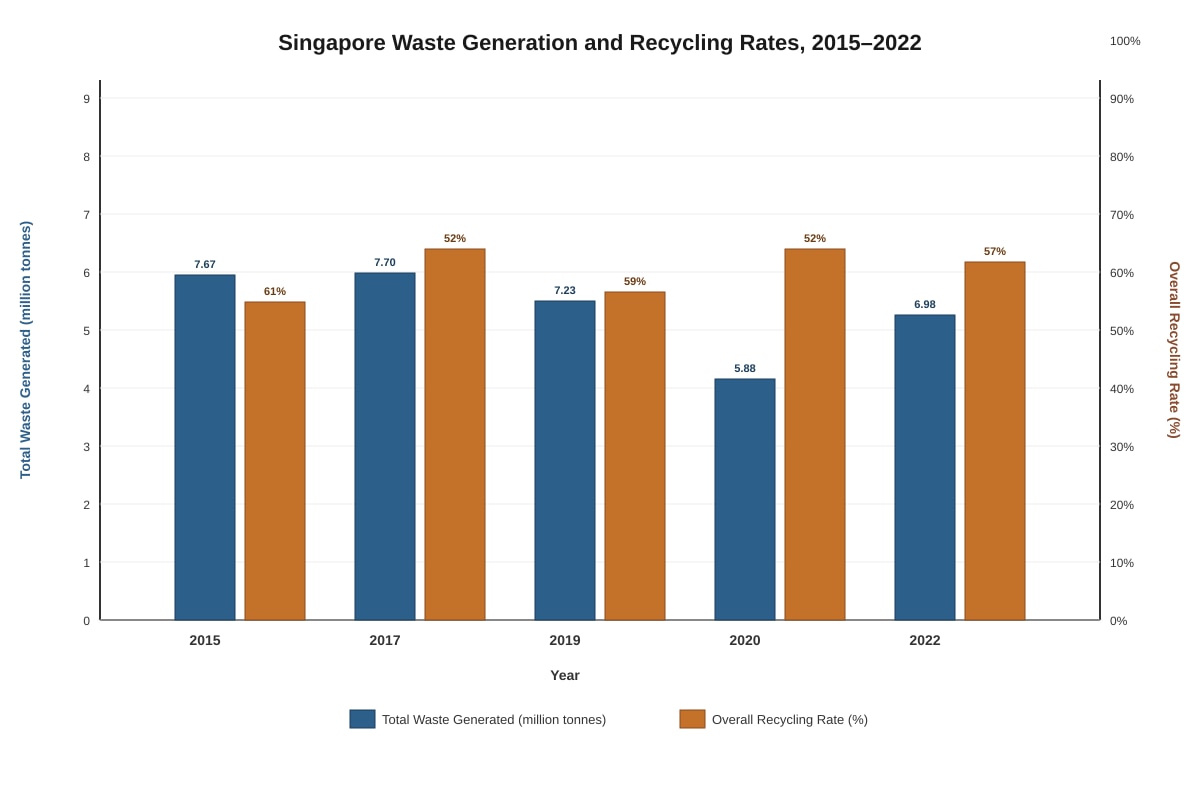
9(a). Describe the trend in total waste generated shown in the chart between 2015 and 2022. [2]
Marking scheme:
- 1 mark: Identifies overall relatively stable/fluctuating trend with slight decrease, OR notes specific changes (e.g., peak in 2017, drop in 2020, rise again by 2022)
- 1 mark: Quantifies with data (e.g., from 7.67 million tonnes in 2015 to 6.98 million tonnes in 2022, with lowest point at 5.88 million in 2020)
Model answer: Total waste generation remained relatively high but fluctuated, peaking at 7.70 million tonnes in 2017, dropping significantly to 5.88 million tonnes in 2020, then rising again to 6.98 million tonnes by 2022. Overall, this represents a net decrease from 2015 to 2022. [2]
9(b). Suggest one reason for the decrease in waste generated in 2020. [1]
Model answer: COVID-19 pandemic restrictions reduced economic activity, construction projects, and consumer spending, leading to lower commercial and industrial waste generation. [1]
Alternative: Reduced tourism and hospitality sector operations.
10(a). Calculate the approximate amount of waste recycled in Singapore in 2019. Show your working. [2]
Marking scheme:
- 1 mark: Correct method (total waste × recycling rate)
- 1 mark: Correct answer with units
Working:
- Total waste generated in 2019 = 7.23 million tonnes
- Recycling rate in 2019 = 59%
- Waste recycled = 7.23 million × 0.59 = 4.2657 million tonnes
Model answer: 4.27 million tonnes (accept 4.26–4.27 million tonnes) [2]
10(b). Explain why achieving high recycling rates does not necessarily mean less waste is sent to Semakau Landfill. [2]
Marking scheme:
- 1 mark: Explains that total waste generation may increase, offsetting recycling gains
- 1 mark: Or explains that not all waste types are recyclable/contamination reduces effective recycling
Model answer: Even with high recycling rates, if total waste generation increases substantially, the absolute amount of non-recycled waste can still rise. Additionally, some materials cannot be recycled (contaminated items, certain plastics), and recycling processes themselves may generate residual waste. The 2019 data shows 59% recycling but still ~2.96 million tonnes disposed. [2]
11. Propose two strategies Singapore could implement to further reduce waste generation, beyond improving recycling rates. [2]
Marking scheme: 1 mark per valid, distinct strategy
Model answers:
- Extended Producer Responsibility schemes: Require manufacturers to design products for durability, repairability, and reduced packaging, taking responsibility for end-of-life management.
- Mandatory food waste segregation and treatment: Implement on-site food waste digesters at commercial premises and drive behavioural change through regulation.
- Right-to-repair legislation: Extend product lifespans by ensuring spare parts and repair information are available.
- Single-use plastic bans or charges: Reduce disposable item consumption at source. [2]
12. Identify two physical/geographical constraints that limit Singapore's renewable energy options. [2]
Marking scheme: 1 mark per valid constraint
Model answers:
- Small land area limits space for solar farms, wind turbines, or geothermal plants
- Low average wind speeds (2–3 m/s) are insufficient for commercially viable wind power
- No major rivers or water bodies with significant elevation change for hydroelectricity
- Lack of geothermal activity (not located on tectonic plate boundaries with heat flux)
- High cloud cover and equatorial conditions reduce solar irradiance compared to desert regions [2]
13. Explain why natural gas, rather than coal or oil, is Singapore's primary fuel for electricity generation. [3]
Marking scheme:
- 1 mark: Lower carbon emissions per unit of electricity (about 50% less CO₂ than coal)
- 1 mark: Cleaner burning (minimal particulate matter, sulphur dioxide, heavy metals)
- 1 mark: Readily available through established LNG infrastructure and global markets; compatible with Singapore's urban environment without severe air quality impacts
Model answer: Natural gas emits significantly less carbon dioxide per unit of electricity generated compared to coal (approximately 0.4 kg CO₂/kWh vs 0.9 kg CO₂/kWh), supporting climate commitments. It burns cleaner, producing negligible sulphur dioxide, particulates, and toxic ash, which is essential for Singapore's dense urban environment where air quality directly impacts public health. Additionally, liquefied natural gas (LNG) can be imported via established maritime infrastructure, providing supply security without domestic mining or storage of solid fuels. [3]
14. Evaluate whether Singapore's target of net zero emissions by 2050 is realistic. [2]
Marking scheme:
- 1 mark: Supporting factor (e.g., strong government commitment, funding for R&D, international partnerships, technological progress)
- 1 mark: Challenging factor (e.g., reliance on unproven technologies, high costs, limited land for solar, need for regional cooperation beyond national control)
Model answer: The target is ambitious but faces both supporting and challenging factors. Supporting factors include strong government commitment (S$5 billion for research and development of low-carbon solutions), rapid solar deployment, and exploration of hydrogen and carbon capture technologies. However, challenges include heavy current reliance on natural gas (over 95%), limited renewable potential due to land constraints, and dependence on regional power imports and hydrogen supply chains that require international cooperation. Success depends on technological breakthroughs and reliable partnerships. [2]
Section C: Structured Response (Questions 15–20) [16 marks]
15. Define "water stress" and explain why Singapore experiences water stress despite receiving abundant rainfall. [3]
Marking scheme:
- 1 mark: Correct definition (insufficient available water per person, or demand exceeding reliable supply)
- 2 marks: Two valid explanatory factors with development
Model answer: Water stress occurs when annual water supplies fall below 1,700 m³ per person, or more practically when demand for freshwater exceeds available supply.
Despite ~2,400mm annual rainfall, Singapore experiences water stress because:
- Limited catchment and storage: Only about half the land area is suitable for water catchment, and reservoir capacity is restricted by urban development needs. Rapid urbanisation increases surface runoff and reduces groundwater recharge.
- No natural groundwater reserves: Unlike larger landmasses, Singapore lacks significant underground aquifers, so almost all freshwater must be actively captured and stored.
- High demand: Dense population (nearly 6 million) and water-intensive industries create demand that natural rainfall alone cannot satisfy. [3]
16. Describe how the Marina Barrage contributes to Singapore's water sustainability. [2]
Marking scheme: 1 mark per function, with brief explanation
Model answer:
- Freshwater reservoir creation: The barrage converts Marina Bay and Kallang Basin into a freshwater reservoir by preventing tidal saltwater intrusion, increasing Singapore's local catchment area to two-thirds of the island.
- Flood control: The barrage's tidal gates and pumping stations manage stormwater discharge during heavy rainfall, protecting low-lying urban areas while preserving reservoir capacity.
- Recreation and public education: The sustainable design (solar panels, green roof) promotes water consciousness, though this is secondary to direct supply functions. [2]
17. Explain why food security is a concern for Singapore, identifying two reasons. [2]
Marking scheme: 1 mark per distinct reason with brief explanation
Model answer:
- Extreme import dependency: Over 90% of food is imported from more than 170 countries, making supplies vulnerable to export bans, geopolitical conflicts, or global price shocks (evident during COVID-19 and Ukraine conflict).
- No significant agricultural land: Urbanisation has left minimal space for traditional farming; climate change threatens remaining regional agricultural productivity through altered rainfall patterns, sea level rise, and extreme weather events. [2]
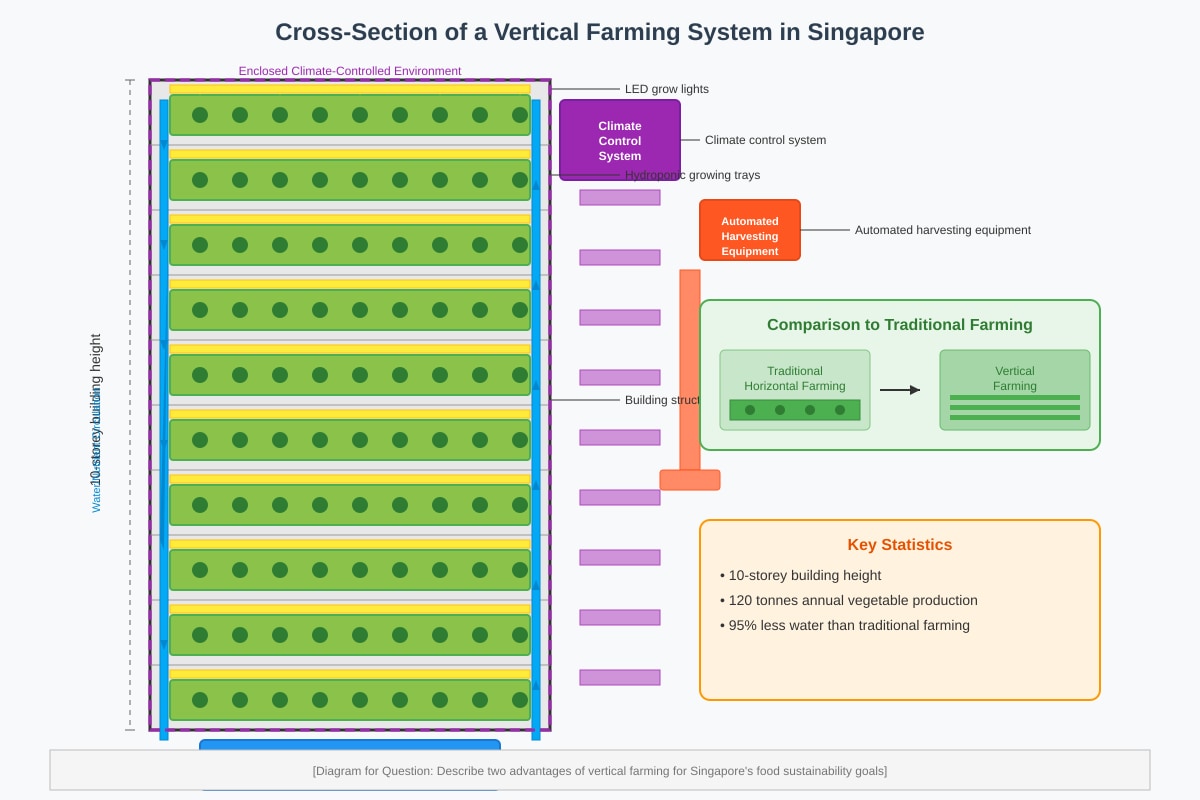
18. Describe two advantages of vertical farming for Singapore's food sustainability goals. [2]
Marking scheme: 1 mark per valid advantage with clear link to Singapore's context
Model answer (referencing <image_placeholder> Q18-fig1):
- Land use efficiency: Vertical farming stacks crops in layers within controlled buildings, producing significantly more food per unit ground area (the diagram shows 10-storey configuration) compared to traditional horizontal farming, directly addressing Singapore's severe land constraints.
- Resource efficiency and climate resilience: The enclosed environment with LED lighting and hydroponic systems uses 95% less water than field farming, eliminates pesticide needs, and protects crops from external weather variability and climate change impacts, ensuring more reliable year-round production. [2]
19. Explain the concept of a "circular economy" and how it differs from a traditional linear economy. [3]
Marking scheme:
- 1 mark: Definition of circular economy (design out waste, keep materials in use, regenerate natural systems)
- 1 mark: Clear contrast with linear economy (take-make-dispose)
- 1 mark: Specific example or mechanism showing the difference
Model answer: A circular economy is an economic system designed to eliminate waste through superior design of materials, products, and systems, ensuring resources maintain their highest value for as long as possible.
This contrasts with the linear economy (take-make-dispose), which extracts raw materials, manufactures products for single use, and discards them as waste, depleting natural capital and creating pollution.
Key differences in operation:
- Linear: A smartphone is mined for metals, manufactured, sold, used for 2–3 years, then landfilled—materials are lost.
- Circular: The same phone is designed for easy disassembly; components are refurbished, remanufactured, or recycled into new products; materials flow continuously through the economy. This requires rethinking product design, business models (leasing rather than selling), and reverse logistics for collection and processing. [3]
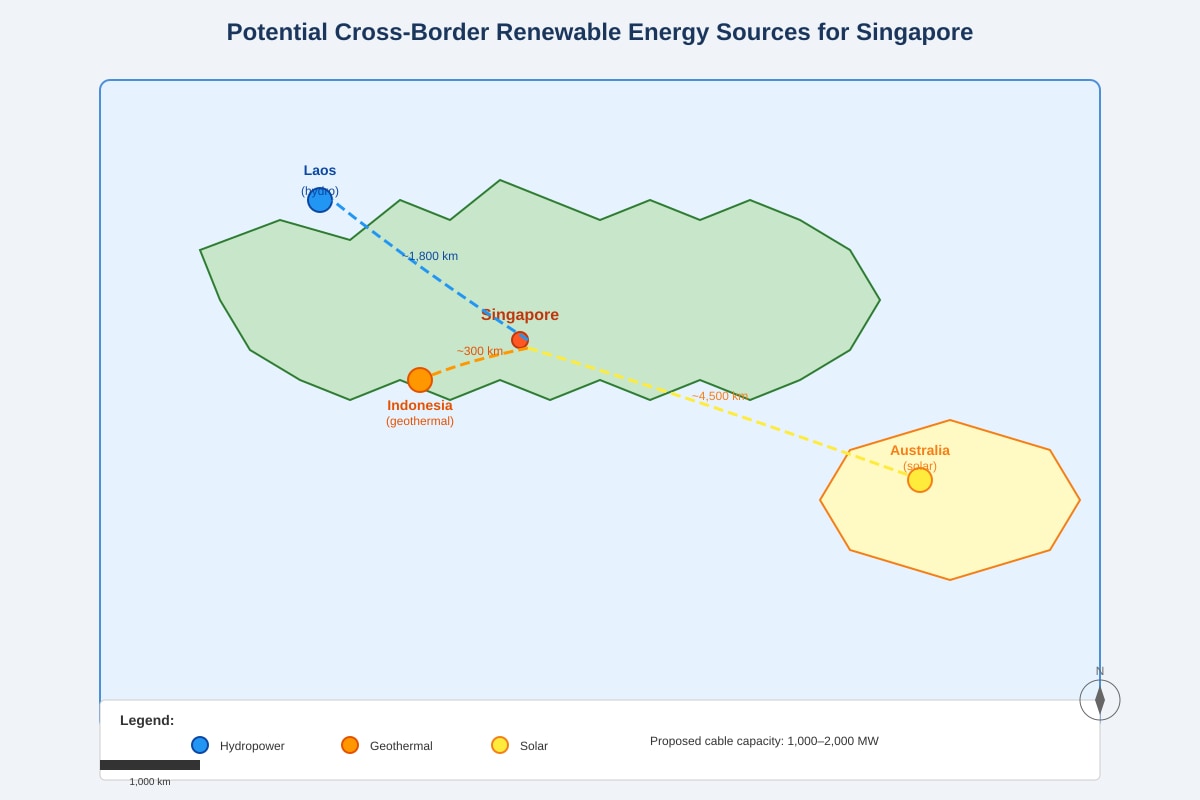
20. Assess whether regional energy cooperation is a viable strategy for Singapore's long-term energy sustainability. Consider at least two opportunities and two challenges. [4]
Marking scheme:
- 1 mark: Valid opportunity with development
- 1 mark: Second valid opportunity with development OR detailed explanation of first
- 1 mark: Valid challenge with development
- 1 mark: Second valid challenge with development OR balanced assessment/conclusion
Model answer (referencing <image_placeholder> Q20-fig1):
Opportunities:
- Access to abundant renewable resources: Regional neighbours possess resources Singapore lacks. Laos has significant hydropower potential from the Mekong River; Australia has vast solar resources; Indonesia has geothermal capacity. The map shows potential interconnector routes of 1,800–4,500 km, enabling Singapore to "import" renewable energy it cannot generate domestically, directly supporting net zero goals.
- Economies of scale and cost reduction: Joint development and shared transmission infrastructure reduce costs compared to Singapore developing equivalent capacity alone. Regional power pools can optimise generation across time zones and demand patterns.
Challenges:
- Technical and infrastructure costs: Submarine/underground cables over 1,800–4,500 km face significant capital costs, transmission losses (approximately 3–5% per 1,000 km for HVDC), and complex maritime route planning. The shortest route to Sumatra (300 km) still requires international seabed agreements.
- Geopolitical and supply security risks: Dependence on foreign governments for critical energy creates vulnerability to political disputes, policy changes, or supply interruptions. Unlike domestic generation, Singapore cannot fully control regional partner reliability. The 2021 Laos-Thailand-Malaysia-Singapore Power Integration Project pilot (100 MW) tests this cooperation but remains small-scale.
Assessment: Regional cooperation is potentially viable as a complement to—not replacement for—domestic efforts, but requires diversified partnerships, long-term contractual frameworks, and continued investment in unproven large-scale interconnection infrastructure. Singapore's strategy wisely pursues multiple switches rather than depending solely on imports. [4]
END OF ANSWER KEY