AI Generated Quiz
Secondary 3 Geography Human Geography Quiz
Free Sec 3 Geography Human Geography quiz, Kimi2.6 AI version, with questions, answers, and O Level-style practice for Singapore students.
These static practice materials are generated from the site's syllabus and paper-generation workflow, with source and model context shown so students and parents can evaluate the material before use.
Questions
Free quiz and exam paper access
Enter your details to view this paper
Your access is remembered on this device.
Answers
Secondary 3 Geography Quiz - Human Geography: Answer Key
Total: 40 marks
Section A: Knowledge and Understanding (1 mark each)
1. Define the term sustainable development.
Answer: Sustainable development is development that meets the needs of the present generation without compromising the ability of future generations to meet their own needs.
Teaching note: This is the Brundtland Commission definition (1987). The key idea is intergenerational equity—using resources now in a way that does not prevent future populations from having sufficient resources. Common error: students often mention "saving the environment" without the critical time dimension (present AND future needs).
2. Identify the main push factor that causes people to migrate from rural to urban areas in developing countries.
Answer: Lack of employment opportunities / limited job prospects / poverty / low wages in rural areas. (Accept: unemployment, poor living conditions, lack of services, land degradation, mechanisation of agriculture reducing labour needs.)
Teaching note: A "push factor" drives people away from a place. In the rural-urban migration context, the most fundamental push is economic—rural areas in LEDCs often have subsistence farming with little cash income. Students should distinguish push factors (negative conditions at origin) from pull factors (positive attractions at destination). Common mistake: naming "better jobs in cities" as a push factor—this is actually a pull factor.
3. State two reasons why tourism is considered an important economic sector for many countries.
Answer: Any two from:
- Creates employment opportunities (direct jobs in hotels, restaurants, transport; indirect jobs in supply chains)
- Generates foreign exchange earnings / increases GDP / contributes to national income
- Supports development of infrastructure (roads, airports, utilities) that benefits local communities
- Encourages growth of other sectors (retail, construction, agriculture supplying food to hotels)
- Diversifies economy, reducing dependence on single industries like agriculture or mining
Teaching note: The economic importance of tourism extends beyond direct tourist spending. The multiplier effect means that one dollar spent by a tourist circulates through the economy, creating additional value. For small island developing states (SIDS), tourism can represent 25-80% of GDP, making it critical for economic survival.
4. Name the term used to describe the maximum number of tourists a destination can accommodate without causing damage to the environment or local culture.
Answer: Carrying capacity.
Teaching note: Carrying capacity has three dimensions: physical (number of people infrastructure can handle), environmental (ecosystem resilience), and social (local residents' tolerance of tourists). Exceeding carrying capacity leads to environmental degradation, cultural commodification, and declining visitor satisfaction.
5. Identify one strategy Singapore uses to manage the impact of mass tourism.
Answer: Any one from:
- Introducing casino entry levies for Singapore citizens and PRs to discourage over-gambling
- Implementing the Singapore Tourism Board's sustainable tourism roadmap
- Managing visitor numbers to sensitive attractions (timed entry to Gardens by the Bay conservatories)
- Promoting lesser-known neighbourhoods and attractions to spread tourists beyond Orchard/Marina Bay
- Strict zoning and land-use planning for tourist attractions
- Quality over quantity approach—targeting higher-spending tourists rather than mass budget tourism
Teaching note: Singapore takes a managed approach to tourism rather than maximising visitor numbers. The 2011 casino entry levy (3,000/year) is a distinctive Singapore policy to reduce social problems from casino gambling while still capturing tourism revenue.
6. State two ways globalisation has affected the movement of labour between countries.
Answer: Any two from:
- Increased demand for skilled workers in global cities and technology hubs
- Growth of labour migration from developing to developed countries (both low-skilled and high-skilled)
- Rise of transnational corporations (TNCs) transferring managers and professionals between countries
- Development of international recruitment agencies facilitating labour matching
- Increased competition for jobs in host countries, sometimes leading to protectionist policies
- Growth of remittance flows from migrant workers to home countries
- Emergence of "brain drain" from developing countries losing skilled workers
Teaching note: Globalisation and labour migration are interconnected through multiple channels. The knowledge economy drives demand for specialised skills globally, while cost differentials drive outsourcing and offshoring of manufacturing and services. Students should recognise that labour movement is not uniform—there are distinct patterns for high-skilled (H-1B visas, intra-company transfers) versus low-skilled (guest worker programmes, irregular migration) workers.
7. Define the term foreign direct investment (FDI).
Answer: Foreign direct investment is investment made by a company or individual from one country into business interests located in another country, typically involving establishing operations or acquiring substantial ownership in a foreign enterprise.
Teaching note: FDI differs from portfolio investment (buying stocks/bonds passively) because it involves managerial control or significant influence. FDI brings capital, technology, and jobs to host countries but can also lead to profit repatriation, cultural dominance, and dependency. In Singapore, FDI has been fundamental to industrialisation since the 1960s, with government agencies like EDB actively recruiting multinational corporations.
8. Identify the main economic activity found in the Central Business District (CBD) of a city.
Answer: Tertiary / quaternary / service sector activities, especially financial and business services (banking, insurance, accounting, law, headquarters of corporations).
Teaching note: The CBD is defined by its Accessibility (best transport links), Land value (highest rents), and Functions (high-order services). The bid-rent theory explains why only activities that can afford very high rents—those with high turnover or needing prestige locations—can locate in the CBD. Manufacturing and most retail (except high-end flagship stores) are priced out.
9. State two problems associated with rapid urbanisation in less economically developed countries (LEDCs).
Answer: Any two from:
- Growth of informal settlements / squatter settlements / slums with inadequate housing
- Pressure on infrastructure (overcrowded transport, water shortages, power cuts)
- Unemployment and underemployment in informal sector
- Environmental pollution (air, water, noise)
- Spread of diseases due to poor sanitation and crowded conditions
- Traffic congestion
- Social problems (crime, inequality, social tension)
- Inadequate provision of social services (schools, healthcare)
Teaching note: These problems stem from planning failure—cities grow faster than governments can provide services. The infrastructure gap in LEDC cities is often 30-40% of what's needed. Informal settlements like favelas, koppies, and bustees house 1 billion people globally, representing both a problem (lack of services) and a solution (affordable housing created by residents themselves).
10. Name the process by which wealthier residents move back into previously deteriorated urban areas, often leading to rising property prices.
Answer: Gentrification.
Teaching note: Gentrification involves class succession—higher-income groups replace lower-income residents in a neighbourhood. Triggers include: cheap property in good central locations, cultural amenities attracting creative professionals, public investment (transport, safety), and changing perceptions of "edgy" neighbourhoods. Consequences are mixed: economic revitalisation and reduced crime, but displacement of original residents, loss of community networks, and cultural commodification.
Section B: Application and Analysis (2 marks each)
11. Explain how the development of theme parks in a destination can lead to both positive and negative impacts on the local community.
Answer:
Positive impacts (max 1 mark):
- Creates employment opportunities for local residents (direct jobs in park operations; indirect jobs in accommodation, food supply, transport)
- Generates income for local businesses through tourist spending
- May improve local infrastructure (roads, utilities) that benefits residents
- Presents/celebrates local culture and heritage, enhancing community pride
Negative impacts (max 1 mark):
- Displacement of local residents if land acquisition occurs for park development
- Cultural erosion if theme parks present stereotyped or commercialised versions of local culture
- Environmental damage from construction and increased visitor pressure
- Leakage of profits if park is foreign-owned, limiting local economic benefit
- Seasonal employment causing income instability; low wages for local workers
- Increased cost of living in surrounding area as prices rise for tourists
Marking: One positive AND one negative effect fully explained = 2 marks. If only listed without explanation, award 1 mark maximum.
Teaching note: The integrated resort model in Singapore (Resorts World Sentosa, Marina Bay Sands) illustrates this complexity. These developments created 50,000+ jobs and upgraded infrastructure, but also led to social concerns about gambling addiction, and much profit flows to foreign parent companies. The concept of ecological modernisation suggests that well-planned tourism can be economically beneficial while minimising environmental harm, but this requires strong regulation.
12. Study the table showing tourist arrivals in Singapore from 2018 to 2023.
(a) Identify the year with the lowest number of tourist arrivals.
Answer: 2021 (0.3 million). [1]
(b) Suggest one reason for the sharp decline in tourist arrivals between 2019 and 2021.
Answer: The COVID-19 pandemic / global travel restrictions and border closures implemented to control virus transmission. [1]
Teaching note: The data shows the massive impact of the COVID-19 pandemic on international tourism—globally, tourist arrivals fell 73% in 2020. Singapore's strict border controls (quarantine requirements, SHN, TraceTogether, Vaccinated Travel Lane phases) were among the most stringent worldwide. The recovery to 13.6 million in 2023 shows resilience but remains below 2019 peak, indicating structural scarring in tourism sectors and changed travel patterns (regional travel replacing long-haul).
13. Explain why medical tourism has become increasingly popular in countries such as Thailand, India, and Singapore.
Answer:
- Cost differential: Medical procedures cost 30-80% less than in developed countries (e.g., heart bypass in India costs ~100,000+ in USA) [1]
- Quality improvements: These countries have invested in internationally accredited hospitals with modern equipment and Western-trained doctors [0.5]
- Shorter waiting times: Compared to public healthcare systems with long queues in source countries [0.5]
- Combining treatment with recovery/tourism: Patients can recuperate in attractive destinations, reducing effective cost by combining medical and holiday expenses [0.5–1 depending on depth]
Marking: Well-developed explanation of cost and quality = 2 marks. Additional factors strengthen answer but maximum is 2.
Teaching note: Medical tourism exemplifies globalisation of healthcare—the commodification of medical services across borders. Singapore positions itself as high-end medical tourism (complex procedures, oncology, organ transplants) rather than competing purely on cost, unlike Thailand (cosmetic surgery, wellness) or India (cardiac surgery, orthopaedics). The Joint Commission International (JCI) accreditation is a key marker of quality that attracts patients. Risks include: medical complications requiring follow-up in home country, ethical concerns about organ trafficking, and brain drain from poor countries if doctors emigrate to medical tourism hubs.
14. Describe how the concept of carrying capacity can be applied to manage the environmental impacts of tourism on a small island destination.
Answer:
Carrying capacity is the maximum number of visitors a destination can sustain without causing unacceptable environmental or social degradation. [0.5 definition]
For a small island destination, application involves:
- Establishing visitor quotas or limits: Setting daily/seasonal maximum visitor numbers based on ecosystem research (e.g., coral reef resilience, freshwater availability, waste processing capacity) [0.5]
- Zoning and spatial management: Designating high-use zones (beaches, ports) and protected zones (marine reserves, nesting areas) to concentrate impact and preserve sensitive ecosystems [0.5]
- Temporal management: Spreading visitors across seasons or restricting access during breeding/nesting periods for wildlife [0.5]
- Infrastructure investment: Ensuring sewage treatment, waste management, and water supply can handle peak visitor loads without degrading local environment [0.5]
Marking: Definition (0.5) + two applied strategies clearly described (1.5) = 2 marks. Maximum 2 marks even if more strategies given.
Teaching note: Small islands are particularly vulnerable to tourism overshoot due to limited land area, freshwater scarcity, and fragile ecosystems. Examples: Boracay, Philippines was closed for 6 months in 2018 due to environmental degradation from 2 million annual visitors; Galápagos Islands limit cruise ship permits and visitor numbers to each island. The Alo+ha+ Challenge in the Pacific shows regional cooperation on sustainable tourism indicators.
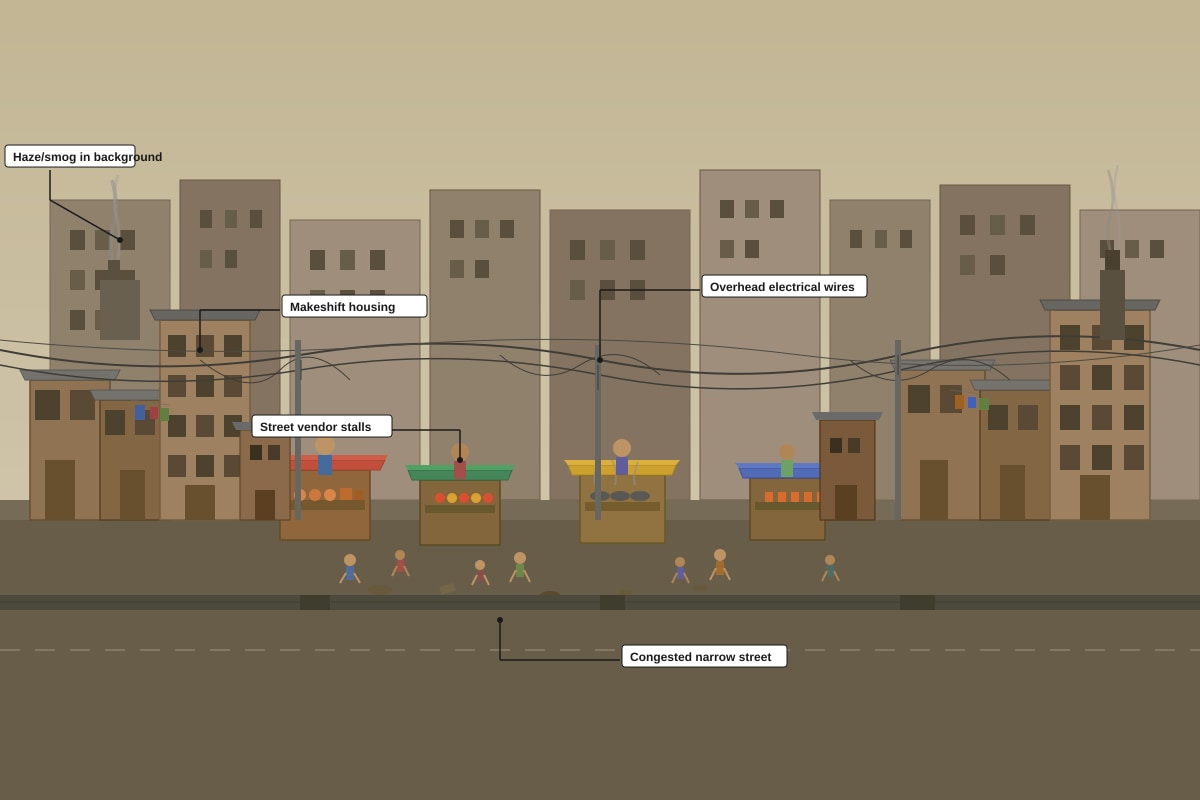
15. Study the photograph showing a street scene in an urban area.
Answer:
Two characteristics indicating an LEDC urban area:
- Informal/makeshift housing (squatter settlements, self-built structures with poor materials like corrugated metal, plywood, or plastic sheeting) showing inadequate housing supply and lack of government provision or regulation [1]
- Informal economic activity (street vendors, unlicensed small businesses operating in public spaces) indicating limited formal employment and survival-level livelihood strategies [1]
- Visible infrastructure deficits (overhead tangled electrical wires, absence of paved roads, open drainage, lack of street lighting) suggesting inadequate public investment [1]
- Environmental degradation visible (air pollution/haze, litter, contaminated water) showing weak environmental regulation and industrial co-location with residential areas [1]
- High density/crowding with narrow lanes and buildings constructed close together [1]
Marking: Any two well-developed observations linked to LEDC context = 2 marks. Must be specific to photograph evidence, not generic.
Teaching note: The informal sector in LEDC cities often employs 50-90% of workers, compared to 10-20% in developed countries. This is not "unemployment" but informal employment—work without legal protection, social security, or stable income. The dual economy model (Harris-Todaro) explains why rural-urban migration continues despite visible urban poverty: expected urban income (probability of formal job × wage) still exceeds rural income. Policies like microfinance, street vendor registration, and slum upgrading (e.g., India's JNNURM, Thailand's Baan Mankong) attempt to improve conditions without displacement.
Section C: Evaluation and Synthesis (4 marks each)
16. "Tourism always brings more benefits than problems to host countries." To what extent do you agree with this statement? Use examples to support your answer.
Answer mark scheme:
Level 3 (4 marks): Balanced argument with clear evaluation, specific examples, and reasoned conclusion.
Level 2 (2–3 marks): Some balance but limited examples, or one-sided argument with good development. May have conclusion without full reasoning.
Level 1 (1 mark): Simple assertion with minimal support; largely descriptive.
Key content points for developed answer:
Benefits that may outweigh problems:
- Economic multiplier effect creating widespread employment (Singapore: 4% of GDP, 150,000+ jobs)
- Foreign exchange earnings reduce trade deficits
- Infrastructure development has spillover benefits for residents
- Cultural preservation when heritage is commodified for tourism (e.g., Georgetown, Penang UNESCO World Heritage Site)
- Environmental protection when natural areas gain economic value from ecotourism (e.g., Costa Rica's national park system)
Problems that may outweigh benefits:
- Economic leakage: 40-80% of tourist spending leaves destination (foreign-owned hotels, imported food, expatriate salaries)
- Seasonal instability and low-paid, precarious employment
- Environmental degradation exceeding carrying capacity (Boracay closure, Maya Bay closure)
- Cultural commodification and staged authenticity
- Land alienation and displacement (fishing communities evicted for resort development)
- Increased cost of living for residents ("tourism inflation")
Evaluation framework:
- Depends on type of tourism: mass vs. alternative/sustainable
- Depends on stage of development: mature destinations may see diminishing returns
- Depends on management capacity: strong governance (Singapore, Bhutan) can capture benefits; weak governance results in exploitation
- Depends on scale: small-scale community tourism often more beneficial than large resort development
Exemplar conclusion: "While tourism generates essential foreign exchange and employment, the 'always' in the statement is problematic. The net benefit depends critically on destination management capacity, tourism type, and the distribution of economic returns. Singapore's managed, high-value tourism generates sustained benefits with controlled social costs, whereas unmanaged mass tourism in some Thai islands has caused environmental collapse requiring closure and restoration. Therefore, tourism is neither inherently beneficial nor harmful; outcomes are politically and institutionally determined."
Teaching note: This is a classic geography essay requiring explicit evaluative language ("to some extent," "it depends on," "while... nevertheless"). The best answers use comparative case studies—Singapore versus an LEDC destination, or mass tourism versus ecotourism—to demonstrate understanding of contingency.
17. City Profile: Dhaka, Bangladesh
(a) Explain two push factors that have contributed to rural-urban migration to Dhaka.
Answer:
Push factor 1: Agricultural mechanisation and land consolidation reducing labour demand in rural areas; or natural disasters (flooding, riverbank erosion) destroying agricultural livelihoods; or declining soil fertility and stagnant crop yields making subsistence farming unable to support families. [1] Must explain mechanism—"poverty" alone is insufficient; need to explain why poverty drives out-migration.
Push factor 2: Lack of rural non-farm employment opportunities; limited access to education and healthcare services; landlessness following inheritance division; climate change impacts increasing rural vulnerability. [1]
Teaching note: Bangladesh illustrates environmental displacement as a migration driver. The ** Ganges-Brahmaputra delta** is highly vulnerable to flooding (20% of country floods annually), sea level rise (predicted 1m rise would displace 20 million people), and riverbank erosion (displacing 100,000+ annually). These are direct push factors distinct from general economic pressures.
(b) Evaluate the effectiveness of relocating residents from bustees to planned housing estates as a strategy to solve Dhaka's housing problems.
Answer:
Arguments for effectiveness (max 1):
- Improves physical living conditions (proper sanitation, solid construction, electricity, water)
- Reduces health risks from waterborne diseases and structural collapse
- Enables better provision of public services (schools, clinics, community facilities)
- Clears hazardous locations (floodplains, drains) reducing disaster mortality
- Releases central land for commercial use, potentially increasing city revenue for further investment
Arguments against effectiveness / limitations (max 1):
- Relocation often to peripheral locations far from employment (e.g., Mirpur, Uttara), increasing commuting costs and time
- Breaks community networks and social capital that provided informal support
- Original residents may sell/rent allocated units and return to bustees, or sublet to poorer households (chain displacement)
- Often insufficient units built; waiting lists extend for years
- Cost recovery requirements make units unaffordable for poorest residents
- Forced eviction without consultation violates rights and creates resistance
Evaluation mark (1): Clear judgment with reasoning—e.g., "Partially effective for improving physical conditions but ineffective for social integration and economic accessibility; success depends on location of resettlement, resident participation in planning, and complementary livelihood programmes."
Marking: One strength + one limitation + evaluative conclusion = 2 marks. If one-sided, max 1 mark. If only describes without evaluating, max 1 mark.
Teaching note: Dhaka's Ashrayan Project and earlier Bhashantek Rehabilitation Project illustrate mixed results. The Right to the City framework emphasises that housing solutions must enable access to livelihoods and social integration, not merely provide shelter. Singapore's HDB resettlement (1960s-70s) succeeded partly because new towns were planned with industrial estates, transport links, and community facilities—integrated rather than isolated solutions.
18. Map of Singapore's economic activities
(a) Suggest one reason why chemical industries are located on Jurong Island rather than in the city centre.
Answer: Jurong Island provides large land area with lower land costs; proximity to deep-water port for import of raw materials and export of products; separation from residential areas reducing health risks from pollution/accidents; ability to share infrastructure and achieve economies of scale through industrial symbiosis (waste heat, by-products exchanged between firms); government planning designated this zone for hazardous industry. [1]
Teaching note: Jurong Island was created by land reclamation merging seven islands (1990s-2000s) specifically for petrochemical and energy industries. It hosts 100+ companies in an integrated complex producing 1% of Singapore's GDP. The circular economy principles applied there—one company's waste becomes another's input—reduce environmental impact and costs.
(b) Explain how the location of Changi Airport has influenced the development of tourism in Singapore.
Answer:
- Accessibility: Located in eastern Singapore with dedicated expressway and MRT connection, making airport-city transfer efficient (30 minutes to city centre), reducing visitor friction and improving first impressions [0.5]
- Scale and connectivity: Changi is a major aviation hub (7th busiest international airport pre-COVID, 68 million passengers in 2019) with flights to 160+ cities, enabling Singapore to capture stopover traffic and MICE delegates who might otherwise fly direct [0.5]
- Airport as attraction: Jewel Changi, butterfly garden, cinemas, and shopping create destination appeal beyond transport function, generating airport tourism where visiting the airport is itself an activity [0.5]
- Economic zone development: Changi Business Park and airport logistics cluster create employment supporting business travel; adjacent Changi City Point and hotels serve transit passengers [0.5]
Marking: Two well-developed points = 2 marks. Mention of connectivity + one other factor with explanation sufficient.
Teaching note: Changi Airport exemplifies aerotropolis development—economic activity clustering around major airports. Singapore's aviation policy actively promotes sixth freedom traffic (connecting passengers between other countries), making the airport's location strategically important for capturing flows between Europe-Australia, Asia-Europe, and intra-Asia routes. The airport's consistent ranking as "world's best" is a marketing asset for Singapore tourism itself.
(c) Using evidence from the map, explain how Singapore's government has attempted to reduce congestion in the Central Business District.
Answer: The map shows development of regional centres and decentralisation of activities: Jurong Island (chemicals), Tuas (port/industrial), One-North (R&D), Woodlands (residential with some commercial) [0.5]. This represents decentralisation policy—moving economic activities away from the CBD to reduce commuting flows and peak-period pressure on central transport infrastructure [0.5]. The relocation of the port from Tanjong Pagar to Tuas (ongoing through 2040s) is the most significant decentralisation project.
Teaching note: Singapore's Concept Plan 2019 emphasises "45-minute city" and "20-minute towns"—reducing need to travel to CBD for work and services. The Greater Southern Waterfront transformation (releasing land from current port) will create new CBD-grade commercial space while maintaining decentralisation. Electronic Road Pricing (ERP), Area Licensing Scheme (historically), and vehicle quota system complement spatial strategies.
19. Globalisation and labour migration in Singapore
(a) Explain why Singapore's economy requires both high-skilled and low-skilled foreign workers.
Answer:
High-skilled workers needed because: [1]
- Singapore's small population (5.9 million, citizens 3.5 million) cannot produce sufficient expertise in all advanced sectors (biotech, artificial intelligence, quantitative finance, specialist medicine)
- Global competition for talent requires importing expertise to maintain Singapore's position as regional headquarters and innovation hub
- Some skills require global experience and networks that local training cannot fully replicate
- Supports growth of new sectors where local education pipelines are still developing
Low-skilled workers needed because: [1]
- Singapore's demographic transition (low fertility, ageing population) creates labour shortages in physically demanding or low-wage sectors (construction, cleaning, domestic work, eldercare, food services) that Singaporeans increasingly reject
- Cost competitiveness in some sectors requires access to lower-wage labour; entirely automated or high-wage solutions would make Singapore uncompetitive internationally
- Rapid infrastructure development (HDB construction, MRT expansion, port relocation) requires large, flexible workforce that local supply cannot meet
Teaching note: Singapore's foreign workforce is 1.45 million (2023), comprising 38% of total workforce. The Dependency Ratio Ceiling and S Pass/Work Permit tiers deliberately stratify foreign workers by skill and salary. The Progressive Wage Model attempts to upgrade low-wage jobs, but structural dependence on foreign labour persists. The "Singaporeans First" policy tensions (2010s-2020s) reflect political challenges of this dual labour market.
(b) Suggest two strategies the Singapore government could use to improve social integration between local residents and foreign workers.
Answer: [2 marks total, 1 per strategy]
Strategy 1: Improve spatial integration rather than segregation. Currently most low-willed migrant workers live in dormitories (purpose-built or converted industrial) separated from residential neighbourhoods. Opening more integrated housing options or ensuring dormitory locations allow community interaction; requiring mixed-use development with commercial spaces; or creating community hubs where workers and residents interact. [1]
Strategy 2: Expand community integration programmes beyond employer-controlled environments. Current efforts (Integration and Naturalisation Champions, community dialogues) focus on permanent residents and professionals. Extending organised activities—sports leagues, volunteer programmes, cultural exchanges—specifically including transient workers; allowing workers freedom of movement and use of public spaces rather than confining to dormitories on rest days. [1]
Alternative strategies:
- Reform dormitory governance to reduce institutional segregation
- Ensure equal access to justice and dispute resolution (currently workers may fear reporting abuse)
- Media representation that humanises rather than problematises foreign workers
- Education in schools about migration and interdependence
Teaching note: The COVID-19 dormitory crisis (2020) revealed extreme vulnerability from segregation—320,000 workers in cramped conditions experienced explosive transmission. Post-crisis, government announced 10-year plan to improve dormitory standards but structural segregation persists. The Transient Workers Count Too (TWC2) and HOME advocate for rights-based approaches. Integration challenges reflect global care chains and global construction chains where migrant labour enables developed world lifestyles while being socially excluded.
20. Water consumption in Singapore's tourism sector
(a) Identify which tourism sector uses the most water per visitor.
Answer: Luxury hotels (800–1,200 litres per visitor per day). [1]
Teaching note: This is 20-30× Singapore's domestic water consumption target (140 litres per person per day). Luxury hotels feature swimming pools, extensive landscaping, multiple food outlets, spa facilities, and frequent linen changes—all water-intensive. The water-energy nexus means this consumption also implies significant energy use for treatment and distribution.
(b) Suggest two practical measures that luxury hotels could implement to reduce water consumption.
Answer: [1 mark for two sensible measures]
- Reuse systems: Greywater recycling (treating sink/shower water for toilet flushing or irrigation); rainwater harvesting for non-potable uses
- Efficiency technologies: Low-flow fixtures, smart irrigation with soil moisture sensors, water-efficient laundry systems
- Operational changes: Linen and towel reuse programmes (guest choice to decline daily change), pool covers reducing evaporation, native/drought-resistant landscaping replacing tropical water-intensive gardens
- Guest engagement: Information programmes, incentives for reduced consumption, transparent reporting of hotel water use
Teaching note: Singapore's PUB Water Efficiency Fund and Building Control Act amendments encourage such measures. The Green Mark certification by BCA includes water performance. However, Jevons paradox may apply—efficiency gains enable expansion (more rooms, more facilities) that partially offset savings. Absolute reduction requires sufficiency approaches, not only efficiency.
(c) Evaluate whether achieving a 15% reduction in tourism water use by 2030 is a realistic target for Singapore.
Answer: [2 marks — 1 for argued position, 1 for supporting reasoning with data/knowledge]
Arguments for realistic: [1 mark if well-developed]
- Luxury hotels (highest water user) have most scope for reduction; efficiency technologies can achieve 30-50% reduction in specific applications
- Singapore's strong governance and mandatory building standards can enforce compliance; PUB already regulates non-domestic water use
- Water pricing (progressive water tariff, water conservation tax) provides economic incentive
- Green Mark and GSTC-recognised certification programmes create reputational incentives
- Previous success: Singapore reduced per capita domestic water use from 165 litres (2003) to 141 litres (2023), showing institutional capacity for demand management
Arguments against realistic / limitations: [1 mark if well-developed]
- Tourism recovery may increase absolute visitor numbers, making 15% reduction harder even with efficiency (rebound effect)
- Luxury positioning of Singapore tourism may resist operational changes that reduce service quality
- Dependence on entrepôt trade and aviation means water embedded in tourist transport is not captured in these figures
- Climate change increasing cooling/evaporation loads may increase water needs
Evaluation: Synthesis showing awareness of tension between growth and sustainability; recognition that target is technically achievable but requires strong enforcement and may conflict with tourism growth objectives. [1 mark for evaluation element]
Exemplar: "Realistic but challenging. The data shows luxury hotels use vastly more water than other sectors, so targeted regulation here could achieve disproportionate savings. However, Singapore's goal to increase tourism to 24 million visitors by 2025 may conflict with absolute reduction unless efficiency improvements outpace growth. Success depends on whether 'sustainable tourism' is genuinely prioritised over 'more tourism'."
Teaching note: Singapore's Four National Taps (local catchment, imported water, NEWater, desalination) provide water security but at energy cost. Tourism water use is small fraction of total (perhaps 2-3%) but symbolically important as visible consumption in a water-scarce nation. The Singapore Green Plan 2030 targets net zero emissions and sustainability; tourism sector alignment is expected but not automatic.
END OF ANSWER KEY