AI Generated Quiz
Secondary 3 Geography Human Geography Quiz
Free Sec 3 Geography Human Geography quiz, HY3 AI version, with questions, answers, and O Level-style practice for Singapore students.
These static practice materials are generated from the site's syllabus and paper-generation workflow, with source and model context shown so students and parents can evaluate the material before use.
Questions
Secondary 3 Geography Quiz - Human Geography
Name: ___________________________
Class: ___________________________
Date: ___________________________
Score: ___________ / 40
Duration: 50 minutes
Total Marks: 40
Instructions:
- This quiz has 20 questions across three sections.
- Section A: 10 multiple-choice or short-answer questions (1 mark each).
- Section B: 6 structured questions (2 marks each).
- Section C: 4 extended questions (subparts, total 3 marks each).
- Answer all questions in the spaces provided.
- This is syllabus-first practice content generated from inferred templates; it is not derived from past-year papers.
Section A (Questions 1–10, 1 mark each)
-
Which of the following best describes the tourism system component that connects generating and destination regions?
A. Transit route
B. Tourist personality
C. Ecosystem service
D. Leakage
-
In the Tourism Area Life Cycle model, which stage comes after "involvement"?
A. Exploration
B. Development
C. Consolidation
D. Stagnation
-
"Dependables" tourist personality type prefers __________.
A. remote adventures
B. familiar and organised destinations
C. unknown cultures
D. extreme sports
-
An example of a provisioning ecosystem service in an urban neighbourhood is __________.
A. air purification
B. food from community gardens
C. spiritual relaxation
D. soil formation
-
Which is a negative economic impact of tourism?
A. Employment creation
B. Leakage of tourist spending to foreign companies
C. Cultural preservation
D. Conservation funding
-
Sustainable development meets present needs without compromising the ability of __________ to meet their needs.
A. tourists
B. future generations
C. developers
D. neighbouring countries
-
In Singapore's spatial hierarchy, the largest scale listed is __________.
A. precinct
B. neighbourhood
C. town
D. block
-
A common hazard in urban neighbourhoods is __________.
A. volcanic eruption
B. air pollution
C. coral bleaching
D. glacier melt
-
Which sampling method gives every member of a population an equal chance of selection?
A. Convenience sampling
B. Quota sampling
C. Random sampling
D. Snowball sampling
-
Tourism trend driven by online platforms and smartphones is called __________.
A. globalisation
B. diversification
C. new media influence
D. climate change
Section B (Questions 11–16, 2 marks each)
-
Explain one positive social impact and one negative social impact of tourism on a host community.
-
State two factors that have led to the growth of tourism globally.
-
Describe two strategies for building a sustainable urban neighbourhood.
-
Identify two types of ecosystem services and give one example of each.
-
Using the Tourism Area Life Cycle, describe what happens at the "stagnation" stage.
-
Explain why leakages reduce the economic benefit of tourism to a destination country.
Section C (Questions 17–20, 3 marks each)
- Study the table below showing tourist arrivals (in thousands) to Country X.
| Year | Arrivals |
|---|---|
| 2019 | 200 |
| 2020 | 80 |
| 2021 | 120 |
| 2022 | 260 |
(a) Calculate the percentage increase from 2021 to 2022. (1 mark)
(b) Suggest one reason for the drop in 2020. (1 mark)
(c) State one stage of the Tourism Area Life Cycle that Country X may be in by 2022. (1 mark)
- A mental map study in a Singapore neighbourhood collected 40 responses. 25 residents named "hawker centre" as important.
(a) What is a mental map? (1 mark)
(b) Calculate the percentage of residents who named the hawker centre. (1 mark)
(c) Explain how this shows sense of place. (1 mark)
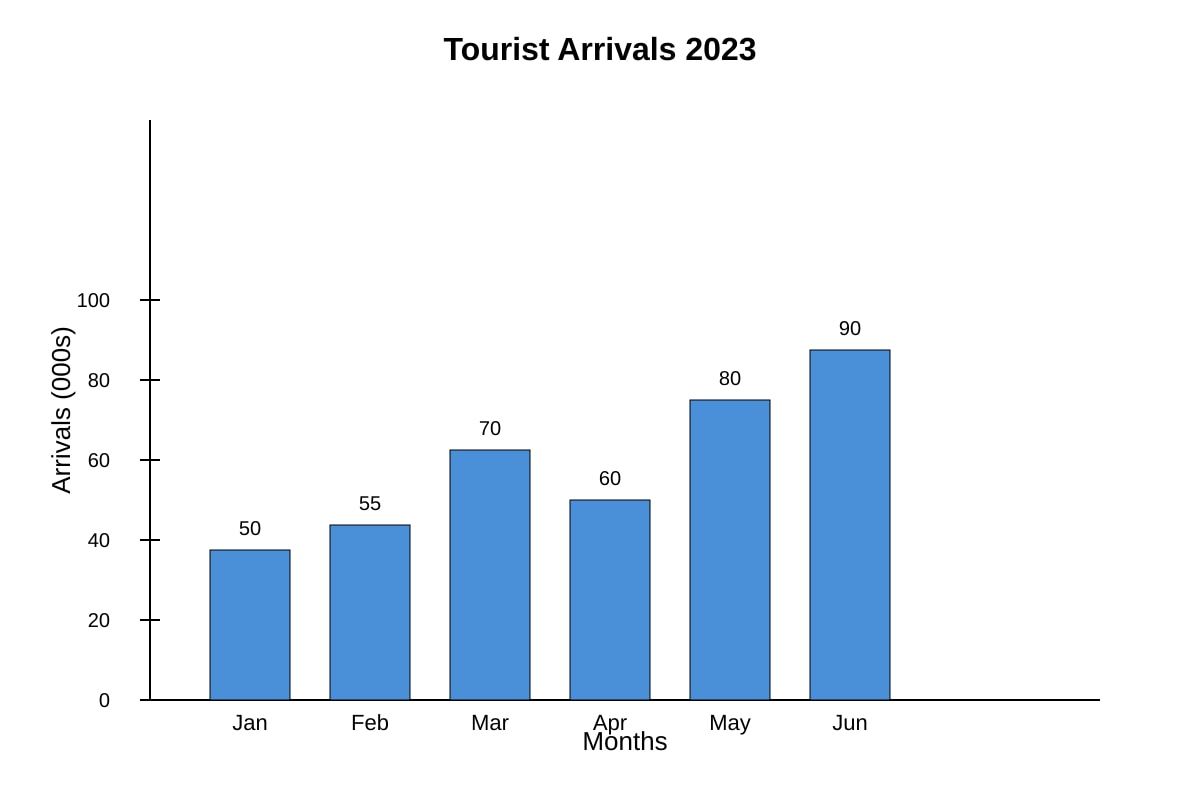
Image pending generation: graph for Q19.
(a) Which month had the highest arrivals? (1 mark)
(b) Calculate the total arrivals for the first quarter (Jan–Mar). (1 mark)
(c) Suggest one reason for the June peak. (1 mark)
- Explain how sustainable development can balance economic and environmental needs in a tourism town. Use a named example if possible. (3 marks)
Answers
Secondary 3 Geography Quiz - Human Geography (Answer Key)
Total Marks: 40
Note: Syllabus-first content from inferred templates; not past-year derived.
Section A Answers (1 mark each)
-
A. Transit route
Teaching: The tourism system has generating regions (where tourists come from), destination regions (where they go), and transit routes linking them. -
B. Development
Teaching: Sequence is exploration → involvement → development → consolidation → stagnation → decline/rejuvenation. -
B. familiar and organised destinations
Teaching: Dependables prefer comfort and known experiences; Venturers seek novelty. -
B. food from community gardens
Teaching: Provisioning = products obtained from ecosystems (food, water, raw materials). -
B. Leakage of tourist spending to foreign companies
Teaching: Leakage occurs when money leaves the local economy (e.g., foreign-owned hotels). -
B. future generations
Teaching: Definition from Brundtland Report: meet present without compromising future. -
C. town
Teaching: Singapore hierarchy: precinct → neighbourhood → town. -
B. air pollution
Teaching: Urban hazards include traffic, fire, air pollution; others are not urban-typical. -
C. Random sampling
Teaching: Random = equal chance; convenience/quota are non-random. -
C. new media influence
Teaching: New media (social media, apps) is a key trend changing how tourists choose.
Section B Answers (2 marks each)
-
Positive: cultural preservation through festivals (1). Negative: cultural commodification where traditions altered for tourists (1).
Teaching: Social impacts are on people/community, not just money or nature. -
Any two: rising incomes (1), more leisure time (1), cheaper air travel, better technology.
Teaching: Growth factors = motivation, ability, mobility. -
Any two: green spaces (1), public transport to reduce emissions (1), recycling, community gardens.
Teaching: Strategies address environmental + social sustainability. -
e.g., Regulating – flood control (1); Cultural – recreation (1).
Teaching: Four types: provisioning, regulating, cultural, supporting. -
Stagnation: visitor numbers peak and stop growing (1); facilities may be outdated, environment strained (1).
Teaching: After stagnation, place declines or rejuvenates. -
Leakage means tourist money goes to foreign firms (1) so less stays to create local jobs/income (1).
Teaching: Economic benefit depends on retention of spending.
Section C Answers (3 marks each)
(a) % increase = (260−120)/120 × 100 = 116.7% (1).
(b) COVID-19 pandemic reducing travel (1).
(c) Development or consolidation stage (1).
Teaching: Calculate % change using old value as denominator.
(a) Map drawn from a person's perception of an area (1).
(b) 25/40 × 100 = 62.5% (1).
(c) Frequent naming shows emotional attachment and shared meaning (1).
Teaching: Sense of place = personal/social connection to space.
(a) June (1).
(b) 50+55+70 = 175 thousand (1).
(c) School holidays / festivals (1).
Visual check: Graph must show June bar highest at 90; Q1 total 175.
Mark descriptors:
- Names balance (1): e.g., limit visitors to protect reefs while earning from tours.
- Economic example (1): entrance fees fund conservation.
- Environmental protection (1): carrying capacity set.
Example: Bali manages temples with fees.
Teaching: Sustainability = balance three pillars.
Free quiz and exam paper access
Enter your details to view this paper
Your access is remembered on this device.