AI Generated Quiz
Secondary 3 English Summary Quiz
Free Sec 3 English Summary quiz, AI version, with questions, answers, and O Level-style practice for Singapore students.
These static practice materials are generated from the site's syllabus and paper-generation workflow, with source and model context shown so students and parents can evaluate the material before use.
Questions
Free quiz and exam paper access
Enter your details to view this paper
Your access is remembered on this device.
Answers
Secondary 3 English Quiz - Summary: Answer Key
Total Marks: 40
Section A: Identifying Main Ideas and Key Points (Questions 1–5)
Passage 1: Urban Farming
1. According to the passage, what are two main benefits of urban farming? (2 marks)
Answer:
- It reduces carbon emissions by cutting down on the distance food travels (food miles).
- It improves food security in areas with limited access to fresh produce (food deserts).
- It transforms unused spaces into green areas, improving neighbourhood aesthetics and the environment.
(Award 1 mark for each of two distinct benefits mentioned in the passage. Accept any two of the three listed above.)
Marking Notes:
- Students must identify benefits from the passage, not general knowledge.
- "Reduces carbon emissions" is acceptable; "reduces distance food travels" is also acceptable as it implies the same.
- "Improves food security" or "provides access to fresh produce" are both acceptable.
2. The passage mentions a term 'food desert'. Explain in your own words what this term means in the context of the passage. (2 marks)
Answer: A 'food desert' is an area, typically in a densely populated city, where residents have limited or no access to fresh, healthy, and affordable food, such as fruits and vegetables.
Marking Notes:
- Award 1 mark for identifying it as an area/place.
- Award 1 mark for explaining the lack of access to fresh/healthy food.
- Do not award marks for simply copying the phrase "limited access to fresh produce" without explanation.
- Students must use their own words; direct copying should be penalised.
Teaching Note: The term 'food desert' is a metaphor. A desert is a barren, empty place. A 'food desert' is a place that is barren of healthy food options. The passage links this to "densely populated areas," so students should understand it is an urban problem.
3. Identify two obstacles that urban farmers face, as stated in the passage. (2 marks)
Answer:
- High land costs.
- Soil contamination in old industrial zones.
- The need for technical expertise for cultivation in confined spaces.
(Award 1 mark for each obstacle, up to a maximum of 2.)
Marking Notes:
- Accept paraphrases such as "expensive land," "polluted soil," or "lack of knowledge/skills."
- Do not accept general obstacles not mentioned in the passage.
4. What is the main reason the urban farming movement continues to grow, despite its challenges? (1 mark)
Answer: It is driven by a combination of environmental awareness and a desire for local, healthy food.
Marking Notes:
- Award 1 mark for a response that captures both "environmental awareness" and "desire for local/healthy food."
- Accept "people want to be more environmentally friendly and eat healthier food."
5. In a single sentence, summarise the main argument of the passage. (2 marks)
Answer: The passage argues that while urban farming faces significant obstacles, it is a growing movement driven by environmental and health benefits that offer solutions to urban challenges.
Marking Notes:
- Award 1 mark for identifying the main topic (urban farming).
- Award 1 mark for capturing the balanced argument (benefits vs. challenges, but ultimately positive/growing).
- The answer must be a single sentence.
Section B: Synthesising Information from Multiple Sources (Questions 6–10)
Passage A & B: Remote Work
6. Based on Passage A, what was the immediate effect of the pandemic on companies' attitudes towards remote work? (1 mark)
Answer: Companies that were previously hesitant were forced to adopt remote work almost overnight.
Marking Notes:
- Award 1 mark for the idea that companies had to adapt/change their attitude quickly.
- Accept "companies were forced to let employees work from home."
7. According to Passage B, what is a major psychological drawback of remote work? (1 mark)
Answer: Feelings of isolation and loneliness.
Marking Notes:
- Award 1 mark for "isolation" or "loneliness."
- "Burnout" is also a psychological drawback mentioned, but it is linked to the blurring of work-life boundaries, not directly social. Accept either.
8. Using information from both passages, identify one benefit and one drawback of remote work that are directly related to social interaction. (2 marks)
Answer:
- Benefit: Improved work-life balance (from Passage A), which can allow for more time with family and friends.
- Drawback: Feelings of isolation and loneliness due to missing social interaction at the office (from Passage B).
(Award 1 mark for a correct benefit related to social interaction, 1 mark for a correct drawback.)
Marking Notes:
- The benefit must be linked to social interaction. "Reduced commuting" is not directly social. "More time with family" is acceptable.
- The drawback must be from Passage B and relate to social interaction.
9. Both passages mention a change in the way people work. What is the key difference in the perspective of each passage on this change? (2 marks)
Answer: Passage A presents the change (remote work) in a positive light, focusing on the benefits and increased productivity. Passage B presents a more negative perspective, highlighting the challenges and drawbacks.
Marking Notes:
- Award 1 mark for identifying Passage A's perspective as positive/optimistic.
- Award 1 mark for identifying Passage B's perspective as negative/critical/balanced with drawbacks.
- Accept "Passage A focuses on the advantages, while Passage B focuses on the disadvantages."
10. In your own words, summarise the overall message conveyed by both passages about remote work. Write no more than 30 words. (3 marks)
Answer: Remote work offers significant benefits like flexibility and productivity, but it also presents serious challenges such as isolation and burnout that must be addressed.
Marking Notes:
- Award 1 mark for mentioning the benefits.
- Award 1 mark for mentioning the drawbacks.
- Award 1 mark for using own words and keeping within the word limit.
- Deduct 1 mark if the summary exceeds 30 words.
Teaching Note: This is a synthesis task. Students must combine the main ideas from both texts into a single, balanced statement. The key is to show they understand that the overall message is not purely positive or negative, but a combination of both.
Section C: Summarising a Longer Text (Questions 11–15)
Passage: The Plight of the Honeybee
11. According to paragraph 1, what is the primary role of honeybees in the ecosystem? (1 mark)
Answer: They are pollinators, responsible for the reproduction of many plants.
Marking Notes:
- Award 1 mark for "pollinators" or "pollination."
12. List three factors mentioned in paragraph 2 that contribute to the decline in honeybee populations. (3 marks)
Answer:
- The use of pesticides (specifically neonicotinoids).
- Habitat loss due to intensive agriculture and urban development.
- The spread of parasites and diseases (e.g., Varroa destructor mite).
(Award 1 mark for each correct factor.)
Marking Notes:
- Accept paraphrases like "chemicals that harm bees," "loss of places to live," or "mites and sickness."
- Do not accept "Colony Collapse Disorder" as it is the name of the phenomenon, not a cause.
13. Explain in your own words what is meant by the term 'keystone species' as it is used in paragraph 3. (2 marks)
Answer: A keystone species is a species whose health and well-being is a crucial indicator of the overall health of the entire ecosystem. Its decline can cause widespread negative effects on many other species.
Marking Notes:
- Award 1 mark for the idea that it is an indicator of ecosystem health.
- Award 1 mark for the idea that its decline has a cascading/harmful effect on other species.
- Do not accept a simple dictionary definition without connecting it to the context of the passage.
14. According to paragraph 4, what are two strategies for addressing the decline of honeybees? (2 marks)
Answer:
- Reducing or eliminating the use of harmful pesticides.
- Creating and preserving pollinator-friendly habitats.
- Supporting research into bee diseases and developing resistant bee strains.
(Award 1 mark for each strategy, up to a maximum of 2.)
15. Write a summary of the passage in no more than 80 words. Your summary should cover the importance of honeybees, the reasons for their decline, and the proposed solutions. Use your own words as far as possible. (8 marks)
Model Answer: Honeybees are vital pollinators for much of our food supply, but their populations are declining due to pesticides, habitat loss, and disease. This threatens both agriculture and biodiversity. Solutions include reducing pesticide use, creating bee-friendly habitats, and researching bee diseases to ensure their survival.
(Word count: 48 words)
Marking Scheme (8 marks):
| Criterion | Marks | Descriptor |
|---|---|---|
| Content: Importance | 2 | Clearly states the role of honeybees as pollinators and their importance to food supply/ecosystem. |
| Content: Reasons for Decline | 2 | Mentions at least two of the three main causes (pesticides, habitat loss, disease/parasites). |
| Content: Solutions | 2 | Mentions at least two of the proposed solutions (reduce pesticides, create habitats, research). |
| Style & Organisation | 2 | Uses own words effectively; ideas are logically organised and within the word limit. |
Marking Notes:
- Own Words (Style): Award 1 mark for frequent and appropriate use of own words. Award 2 marks for sustained and successful use of own words. Penalise heavy lifting of phrases from the passage.
- Word Limit: Deduct 1 mark if the summary exceeds 80 words.
- Concision: The summary should be concise and focused on the three required areas. Irrelevant details should not be rewarded.
Teaching Note: This is a classic O-Level summary task. Students should be taught to:
- Read the question carefully to identify the focus areas (importance, reasons, solutions).
- Scan the passage and underline/highlight relevant points for each area.
- Paraphrase the points using synonyms and different sentence structures.
- Organise the points logically (e.g., importance first, then problems, then solutions).
- Count the words and ensure they are within the limit.
Section D: Summarising with Visual Data (Questions 16–20)
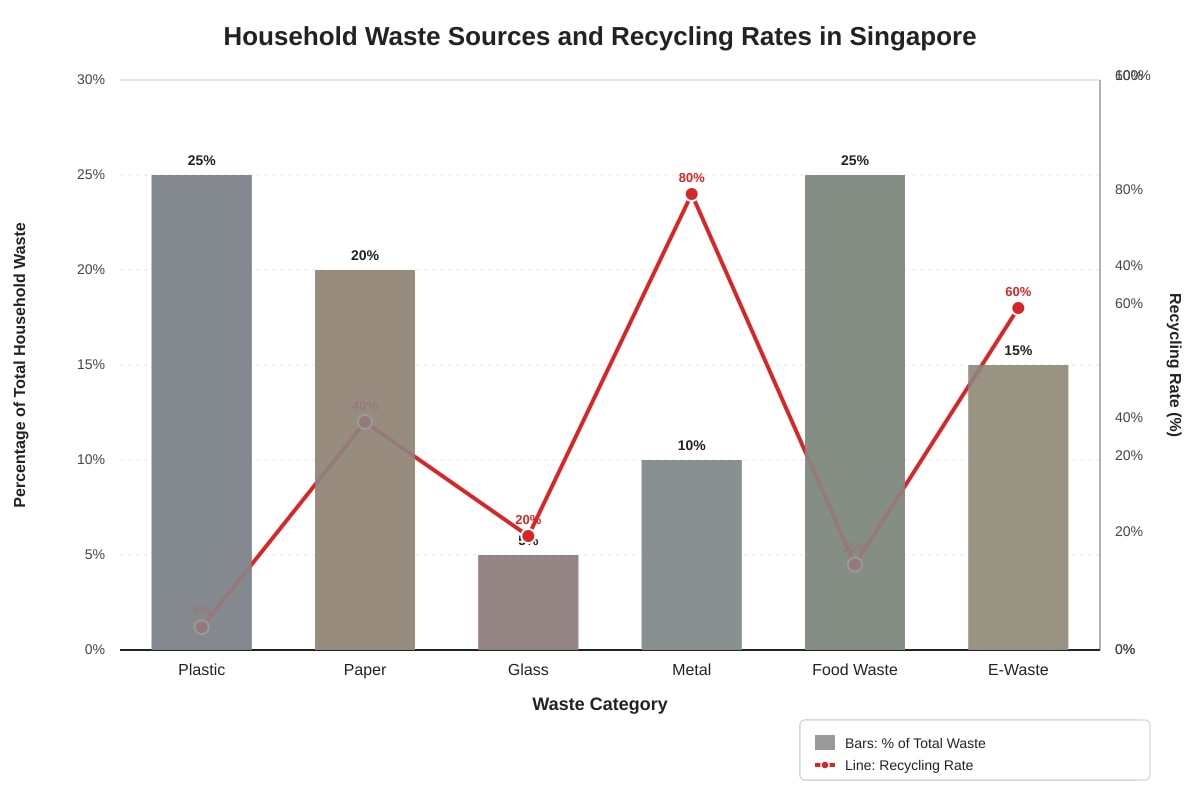
Infographic: Household Waste in Singapore
16. Based on the infographic, which category of waste makes up the largest proportion of household waste? (1 mark)
Answer: Plastic and Food Waste (both at 25%).
Marking Notes:
- Award 1 mark for identifying either "Plastic" or "Food Waste" or both. Accept "Plastic and Food Waste are tied at 25%."
17. Which category of waste has the highest recycling rate? (1 mark)
Answer: Metal (80%).
Marking Notes:
- Award 1 mark for "Metal" or "Metal at 80%."
18. Identify one category where the recycling rate is significantly lower than its proportion of total waste. Explain why this is a concern. (2 marks)
Answer:
- Category: Plastic (25% of waste, only 4% recycled) OR Food Waste (25% of waste, only 15% recycled).
- Explanation: This is a concern because a large amount of waste is being sent to landfills or incinerators instead of being recycled, which is unsustainable and harmful to the environment.
(Award 1 mark for identifying the correct category with data. Award 1 mark for a reasonable explanation of why it is a concern.)
Marking Notes:
- Accept "E-Waste" (15% of waste, 60% recycled) is not a good example because the recycling rate is relatively high. The key is the disparity between the two values.
- The explanation must be linked to the environmental impact of low recycling rates.
19. Using data from the infographic, write a sentence comparing the recycling rates of Plastic and Metal. (2 marks)
Answer: While Plastic makes up 25% of household waste, only 4% of it is recycled. In contrast, Metal accounts for only 10% of waste but has a much higher recycling rate of 80%.
Marking Notes:
- Award 1 mark for correctly stating the recycling rate of Plastic (4%).
- Award 1 mark for correctly stating the recycling rate of Metal (80%) and making a comparative statement (e.g., "much higher," "in contrast").
- The sentence must be grammatically correct and use comparative language.
20. In no more than 50 words, summarise the key message of the infographic about waste management in Singapore. (3 marks)
Answer: The infographic shows that while some materials like Metal are recycled effectively, others like Plastic and Food Waste, which form a large portion of waste, have very low recycling rates, indicating a need for improvement.
Marking Scheme (3 marks):
| Criterion | Marks | Descriptor |
|---|---|---|
| Content: Main Message | 2 | Clearly identifies the core message: a disparity between waste generation and recycling rates for key materials. |
| Style & Conciseness | 1 | Uses own words effectively and is within the 50-word limit. |
Marking Notes:
- Award 2 marks for a clear, accurate summary of the main message.
- Award 1 mark for a partially accurate or vague summary.
- Deduct 1 mark if the summary exceeds 50 words.
Teaching Note: When summarising visual data, students should:
- Look at the title and labels to understand what the infographic is about.
- Identify the main trend or relationship (e.g., "high waste, low recycling").
- Support the main message with specific data points from the chart.
- Avoid describing every single data point; focus on the big picture.
End of Answer Key