AI Generated Quiz
Secondary 3 English Comprehension Quiz
Free Sec 3 English Comprehension quiz, HY3 AI version, with questions, answers, and O Level-style practice for Singapore students.
These static practice materials are generated from the site's syllabus and paper-generation workflow, with source and model context shown so students and parents can evaluate the material before use.
Questions
Secondary 3 English Quiz - Comprehension
Name: ___________________________
Class: ___________________________
Date: ___________________________
Score: _______ / 30
Duration: 60 minutes
Total Marks: 30
Topic: Comprehension (based on LLM-inferred Stage 4 templates; syllabus-first, not claimed as past-year exam derived)
Instructions:
- Read the passages carefully before answering.
- Answer all 20 questions.
- Write your answers in the spaces provided.
- Use your own words where instructed.
- Section A: Literal & Inferential (Questions 1–8, 1 mark each)
- Section B: Language Use & Analysis (Questions 9–14, 2–3 marks each)
- Section C: Extended Comprehension (Questions 15–20, mixed marks)
Passage 1 (for Questions 1–8)
The old lighthouse on Cape Merrow had stood for over a century. When Elias first arrived as a young keeper in 1998, he was full of resolution but he had little hope of staying long. The island was bleak, battered by winds that seemed never to rest. According to the station log, the wild horses that roamed the cliffs were sold off at the auction each autumn; after they were sold, they were shipped to the mainland and never returned. Elias took a great interest in the remaining birds, noting their migrations with quiet devotion. He often said the phrase "the sea remembers everything" when storms erased his footprints on the shore.
Section A: Literal & Inferential (1 mark each)
1. According to Paragraph 1, what happened to the wild horses after they were sold off at the auction?
2. What does the phrase "full of resolution but he had little hope" (line 2) tell us about Elias's state of mind?
3. Whom did Elias have a great interest in, based on the passage?
4. What does the word "bleak" suggest about the island?
5. According to the passage, in which year did Elias first arrive at the lighthouse?
6. What does the phrase "the sea remembers everything" reveal about Elias's attitude to the shore?
7. What do you think the italicised word "they" (line 4) refers to?
8. According to the station log, when were the wild horses sold off?
Passage 2 (for Questions 9–14)
The marketplace was a riot of colour. Vendors shouted with a roughness that echoed off the stone walls, yet their eyes sparkled with mischief. Children darted between stalls like startled fish. The smell of roasted spices clung to the air, heavy and sweet. One vendor, Old Pari, moved with a slow grace that contrasted the chaos; her hands, wrinkled as tree bark, sorted herbs with precision.
Section B: Language Use & Analysis
9. Explain in your own words why the writer describes the children as "darted between stalls like startled fish" (line 3). [2 marks]
10. What does the sentence "her hands, wrinkled as tree bark, sorted herbs with precision" tell us about Old Pari's attitude towards her work? [1 mark]
11. How does the language used in Paragraph 2 (Passage 2) convey the busy, lively atmosphere of the marketplace? Support your answer with three details. [3 marks]
(a) ______________________________________________________
(b) ______________________________________________________
(c) ______________________________________________________
12. What does the word "riot" (line 1) suggest about the marketplace? [1 mark]
13. Identify the referent of the italicised word "their" in "their eyes sparkled with mischief" (line 2). [1 mark]
14. What does the description of Old Pari as moving with "slow grace" suggest about her character compared to the others? [2 marks]
Passage 3 and Visual (for Questions 15–20)
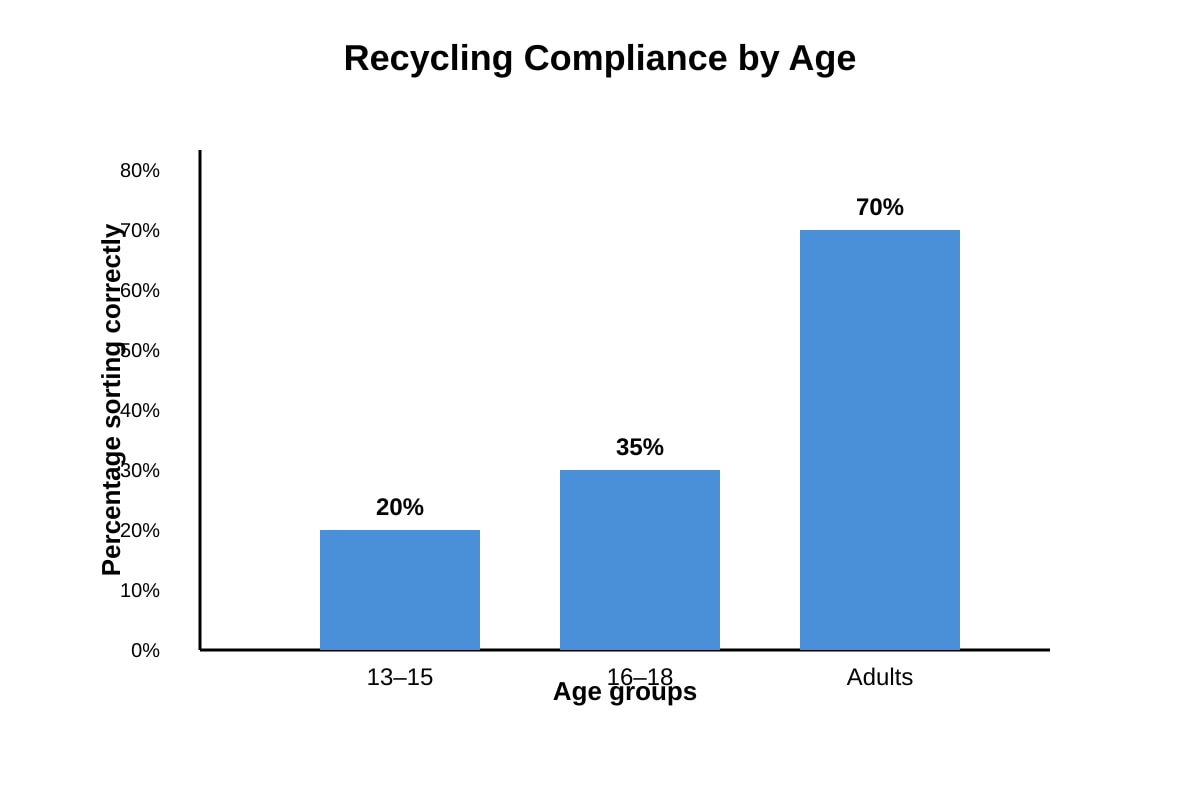
The town council published an infographic on recycling habits. The writer argued that teenagers were careless with waste. The accompanying text claimed that only 20% of students sorted trash correctly.
Image pending generation: chart for Q15.
15. Study the chart above and the text. Explain how the visual elements support the writer's argument about teenager carelessness. Give two specific examples. [3 marks]
(a) ______________________________________________________
(b) ______________________________________________________
16. According to the text and chart, what percentage of 16–18 year olds sorted trash correctly? [1 mark]
17. What does the writer's claim that "teenagers were careless" reveal about his tone? [1 mark]
18. Explain in your own words why the writer says "only 20% of students sorted trash correctly" (line 3). [2 marks]
19. How does the comparison between age groups in the chart emphasise the writer's concern? Support with one detail. [2 marks]
20. What does the phrase "published an infographic" (line 1) tell us about the source of the information? [1 mark]
Answers
Secondary 3 English Quiz - Comprehension (Answer Key)
Total Marks: 30
Topic: Comprehension (LLM-inferred Stage 4 templates; syllabus-first)
Section A: Literal & Inferential
1. [1 mark] They were shipped to the mainland and never returned.
Teaching note: Scan Paragraph 1: "after they were sold, they were shipped to the mainland and never returned." Answer must come from text, not general knowledge.
2. [1 mark] He was determined but unsure he would stay / he lacked optimism.
Teaching note: "Resolution" = determination; "little hope" = doubt. Together they show mixed feelings. Avoid dictionary-only definitions.
3. [1 mark] The remaining birds.
Teaching note: "He took a great interest in the remaining birds" (line 5). Direct factual recall.
4. [1 mark] It was empty, bare, and unwelcoming / depressing.
Teaching note: "Bleak" in context of wind-battered island suggests harshness and lack of warmth.
5. [1 mark] 1998.
Teaching note: "When Elias first arrived as a young keeper in 1998". Simple locate-and-copy.
6. [1 mark] He felt the sea kept a record of events / nature was permanent.
Teaching note: Shows his reflective, patient attitude to nature.
7. [1 mark] The wild horses.
Teaching note: "they" follows "the wild horses that roamed… were sold off"; pronoun replaces horses.
8. [1 mark] Each autumn.
Teaching note: "sold off at the auction each autumn" from station log.
Section B: Language Use & Analysis
9. [2 marks] The writer uses a simile to show the children moved quickly and nervously through the crowd, like fish suddenly frightened.
Marking: 1 mark for "quick/nervous movement", 1 mark for explaining simile in own words.
Teaching note: Do not copy phrase; explain "darted" = quick movement, "startled fish" = scared.
10. [1 mark] She was careful, practised, and respectful of her task.
Teaching note: "Precision" and "wrinkled hands" show experience and care.
11. [3 marks]
(a) "Vendors shouted with roughness" – loud, chaotic sound.
(b) "Children darted between stalls" – fast movement shows energy.
(c) "Smell of roasted spices clung heavy" – sensory detail of busy market.
Marking: 1 mark per detail with effect explained. Must link to "busy/lively".
Teaching note: Identify feature + quote + effect.
12. [1 mark] It was noisy, uncontrolled, full of activity.
Teaching note: "Riot of colour" = excessive, wild visual.
13. [1 mark] The vendors.
Teaching note: "Vendors shouted… their eyes" – "their" = vendors.
14. [2 marks] She was calm and composed unlike the chaotic others; her "slow grace" shows self-control and experience.
Marking: 1 mark calm/contrast, 1 mark character inference.
Section C: Extended Comprehension
15. [3 marks]
(a) Bar for 13–15 at 20% is low, supporting claim teens careless.
(b) Adults at 70% contrast shows teens below norm.
Marking: 1 mark each example + 1 for linking to argument.
Visual needed: Chart shows bars 20%, 35%, 70%.
16. [1 mark] 35%.
Teaching note: From chart values 16–18 group.
17. [1 mark] Critical / disapproving.
Teaching note: "Careless" is negative judgement.
18. [2 marks] The writer stresses that a small fraction (20%) of students followed rules, implying most did not care.
Marking: 1 mark for "low fraction", 1 for implication of carelessness.
19. [2 marks] The gap (20% vs 70%) highlights teen failure; adults show what is possible.
Marking: 1 mark detail, 1 mark concern emphasis.
20. [1 mark] It was an official council source / public information.
Teaching note: "Town council published" = authoritative.
Free quiz and exam paper access
Enter your details to view this paper
Your access is remembered on this device.