AI Generated Quiz
Secondary 3 English Composition Situational Writing Quiz
Free Sec 3 English Situational Writing quiz, HY3 AI version, with questions, answers, and O Level-style practice for Singapore students.
These static practice materials are generated from the site's syllabus and paper-generation workflow, with source and model context shown so students and parents can evaluate the material before use.
Questions
Free quiz and exam paper access
Enter your details to view this paper
Your access is remembered on this device.
Answers
Secondary 3 English Quiz - Composition Situational Writing (Answer Key)
Total Marks: 40
Topic: Composition – Situational Writing (syllabus-first, LLM-inferred)
Section A: Understanding Purpose, Audience and Context
Q1. (1 mark)
Answer: The canteen vendor (or food provider).
Teaching note: Audience is the person/group who receives the text. Here the request is directed to the vendor, so they are the audience.
Common mistake: Saying "students" or "school" — they are not the receiver.
Q2. (1 mark)
Answer: To suggest / propose a change to the recess timetable (or to persuade principal to change it).
Teaching note: Purpose = why you are writing. The task says "suggesting a change", so purpose is persuasive proposal.
Q3. (2 marks)
Answer: Context: class social media page / online student platform (1 mark). Language choice: should be semi-formal or friendly because peers are reading, not adults (1 mark).
Teaching note: Context includes where and how the text is shared. Social media → relaxed but clear language.
Marking: 1 for context, 1 for explanation of language effect.
Q4. (1 mark)
Answer: B) Speech
Teaching note: A spoken address at assembly = speech. Report/letter/email are written forms.
Q5. (2 marks)
Answer: Slang is too informal / unclear to officials; formal register shows respect and clarity (1 mark). It may cause the officer to ignore or misunderstand the request (1 mark).
Teaching note: Register must match audience. Government officer = formal.
Section B: Text-Type Features and Tone
Q6. (2 marks)
Answer: Any two of: formal greeting (e.g., "Dear Mr Tan"), subject line, clear closing ("Yours sincerely"), signature, date. (1 mark each)
Teaching note: Emails have structure like letters but with subject.
Q7. (2 marks)
Answer: heading / title and conclusion (or introduction and recommendation). (1 mark each)
Teaching note: Reports need clear sections so reader finds info fast.
Q8. (2 marks)
Answer: Tone: informal / casual (1 mark). Word: "Wassup" or "lol" or "Hey" (1 mark).
Teaching note: Informal markers show relaxed relationship.
Q9. (1 mark)
Answer: B
Teaching note: Only B uses standard formal request language.
Q10. (2 marks)
Answer: It softens the request (1 mark) and shows politeness / respect, increasing chance of positive reply (1 mark).
Teaching note: Modal "would" + grateful = polite hedging.
Section C: Using Given Information and Visual Texts
Q11. (2 marks)
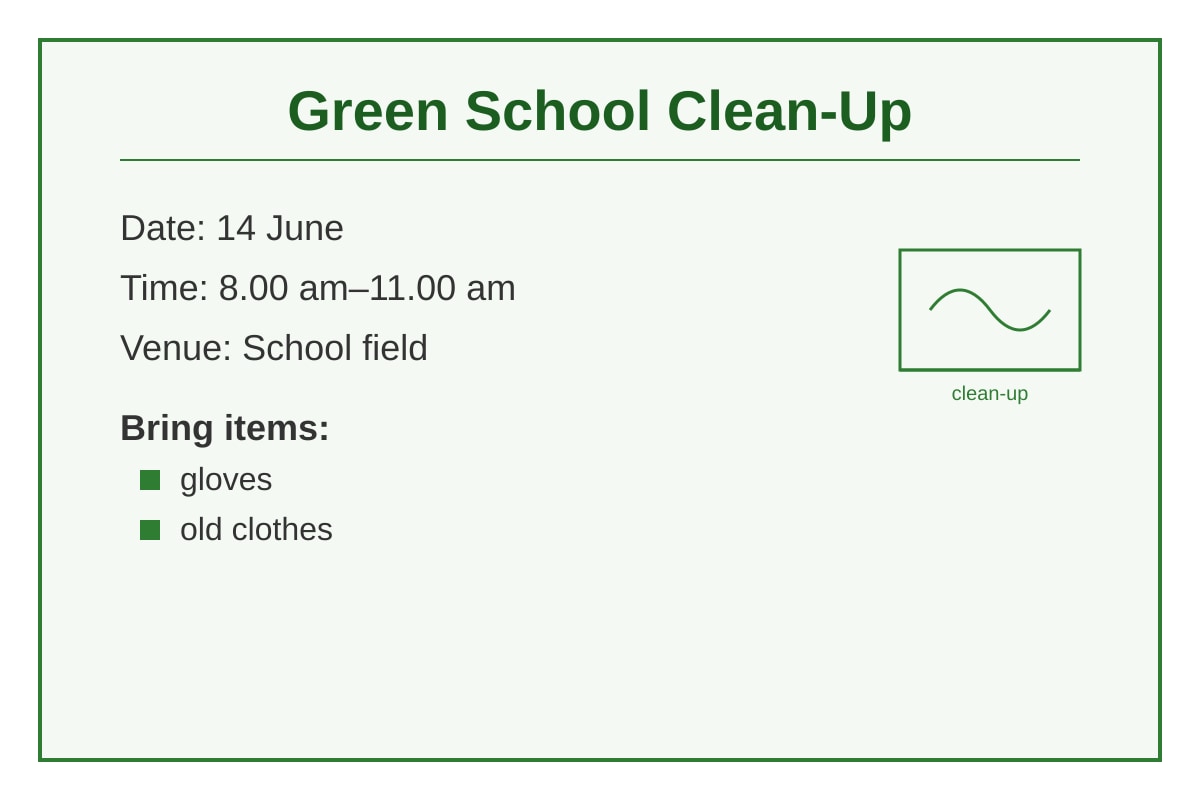
Answer: Two of: date 14 June, time 8–11 am, venue school field, bring gloves/old clothes. (1 mark each)
Visual needed: Poster with title "Green School Clean-Up", date, time, venue, items.
Teaching note: Always transfer key facts from visual to writing.
Q12. (2 marks)
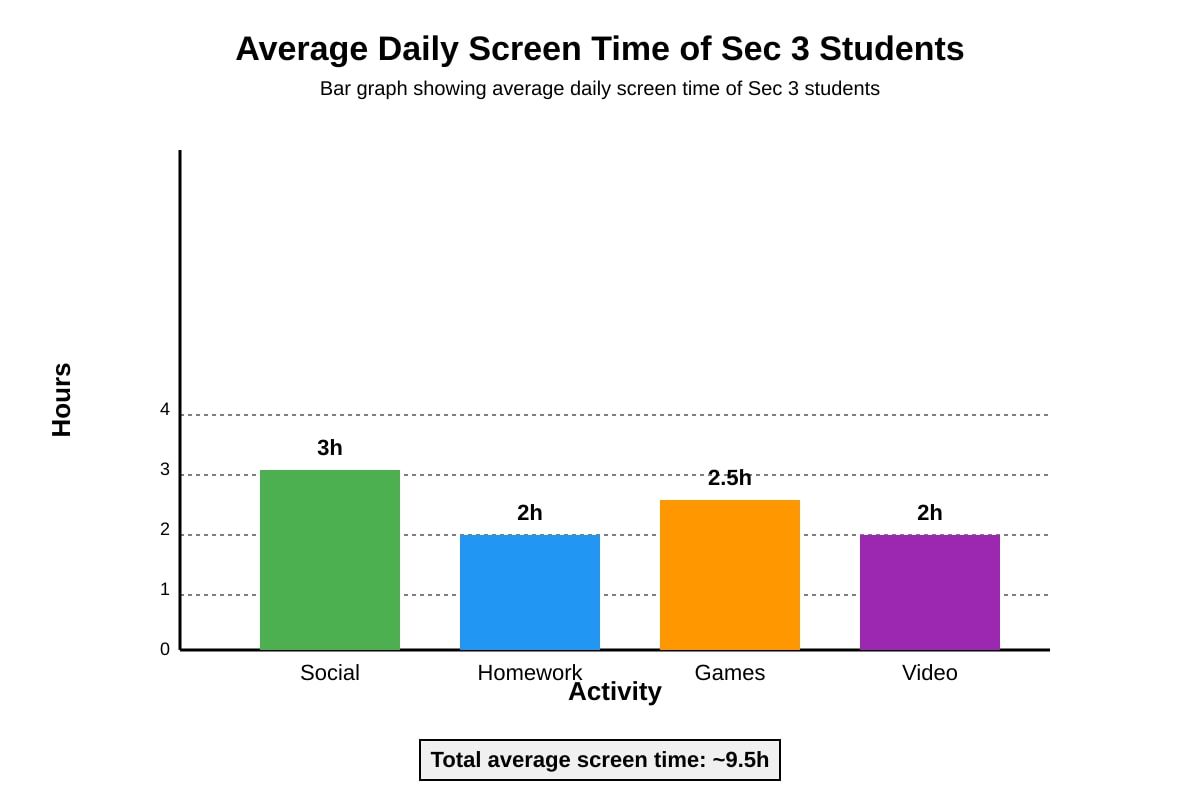
Answer: e.g., "Students spend 3h daily on social media" or "total ~9.5h screen time". (2 marks for clear fact)
Visual needed: Bar graph with 4 bars and values.
Teaching note: Use given data to support your proposal.
Q13. (1 mark)
Answer: B
Teaching note: Relevant survey data strengthens proposal to council.
Q14. (2 marks)
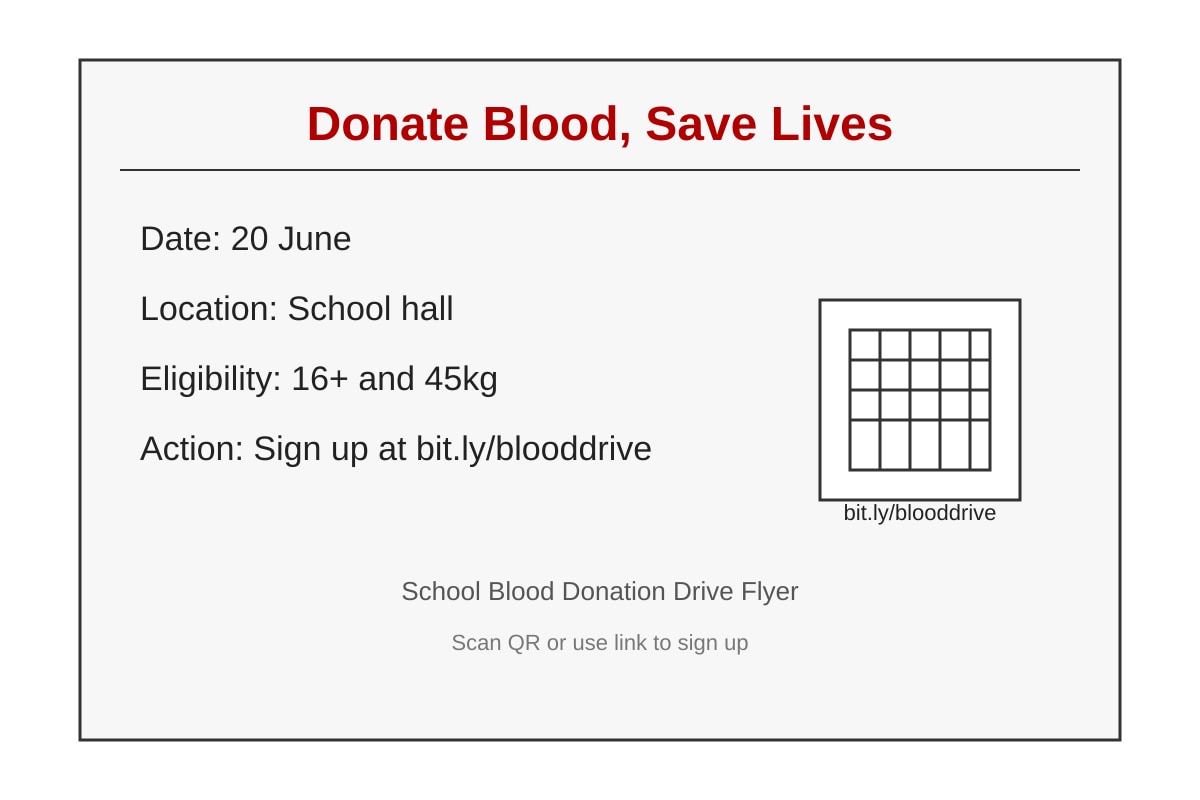
Answer: "Sign up at bit.ly/blooddrive" (or equivalent call-to-action from flyer). (2 marks)
Visual needed: Flyer with action link.
Teaching note: Call-to-action must come from source.
Q15. (2 marks)
Answer: Inventing prizes is dishonest (1 mark) and breaks task fulfilment — you must use given info only (1 mark).
Teaching note: Situational writing assesses use of provided details.
Section D: Planning and Evaluating Responses
Q16. (3 marks)
Answer: Three of: reason for delay, steps taken, request for extension, apology, new deadline. (1 mark each)
Teaching note: Plan covers content points before writing.
Q17. (3 marks)
Answer: Tone: rude / demanding (1 mark). Better phrase: "I would appreciate an extension if possible" (1 mark) + reason why (1 mark).
Teaching note: Evaluate register; replace with polite modal.
Q18. (2 marks)
Answer: Hook: question or statistic about cyberbullying (1 mark). Call-to-action: "Stand up, report bullying" (1 mark).
Teaching note: Speech needs engagement + clear end.
Q19. (2 marks)
Answer: Key information / content details (1 mark) + example filled (1 mark).
Teaching note: Plan must include what to say, not just to whom.
Q20. (2 marks)
Answer: Keeps response focused (1 mark); avoids penalty for being too short/long (1 mark).
Teaching note: Word limit is part of task fulfilment in 1184 SW.