AI Generated Quiz
Secondary 3 English Composition Situational Writing Quiz
Free Sec 3 English Situational Writing quiz, AI version, with questions, answers, and O Level-style practice for Singapore students.
These static practice materials are generated from the site's syllabus and paper-generation workflow, with source and model context shown so students and parents can evaluate the material before use.
Questions
Free quiz and exam paper access
Enter your details to view this paper
Your access is remembered on this device.
Answers
Answer Key: Secondary 3 English Quiz - Composition Situational Writing
Total Marks: 40
Section A: Understanding Purpose, Audience, and Context (Questions 1-5)
(2 marks each: 1 mark for correctly identifying all three elements, 1 mark for clear and accurate description)
1.
- Purpose: To persuade the Principal to approve funding for a new student lounge.
- Audience: The Principal (a figure of authority).
- Context: A formal proposal from the Student Council to the school's leadership.
- Marking Notes: Accept any reasonable phrasing that captures the persuasive intent, the authority figure as the audience, and the formal context.
2.
- Purpose: To persuade/inform students to participate in the recycling drive.
- Audience: Fellow students (peers).
- Context: An article for the school newsletter (informal but informative).
- Marking Notes: The key is that the audience is peers, so the tone should be encouraging and relatable, not overly formal.
3.
- Purpose: To complain about the lack of wheelchair access and request action.
- Audience: The Town Council (a formal body).
- Context: A formal letter of complaint.
- Marking Notes: The tone must be formal and respectful, even though it is a complaint. The purpose is not just to vent but to seek a solution.
4.
- Purpose: To persuade/recruit students to join the volunteer group for the beach clean-up.
- Audience: The entire school (students and teachers) at an assembly.
- Context: A speech delivered to a large audience.
- Marking Notes: A speech to a large audience needs an engaging opening and a clear, persuasive call to action.
5.
- Purpose: To express concerns and suggest a compromise.
- Audience: The Form Teacher (a figure of authority but with a closer relationship).
- Context: An email (semi-formal).
- Marking Notes: The tone should be respectful but can be slightly less formal than a letter to the Principal. The key is to show a willingness to find a solution, not just complain.
Section B: Analysing Visual Texts (Questions 6-10)
(2 marks each)
6.
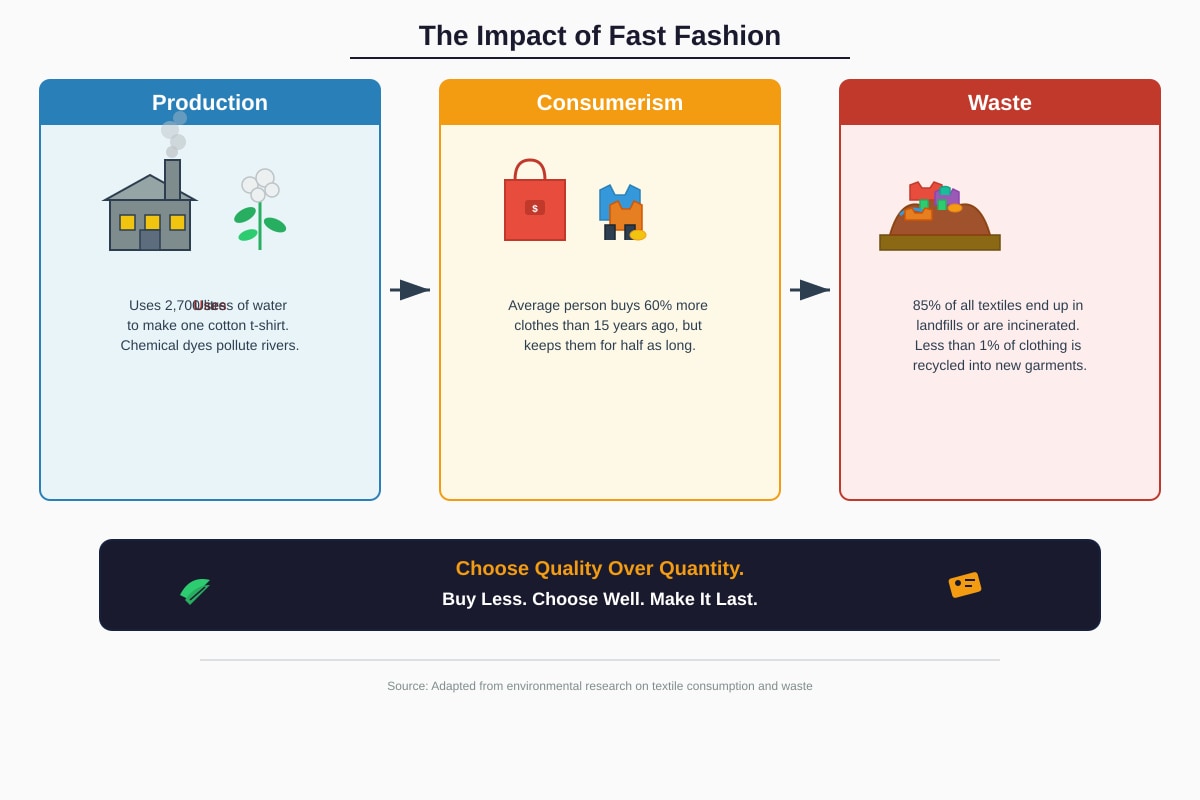
- Answer: The main message is that the fast fashion industry has a severely negative environmental impact, from production to waste, and that consumers should buy less and choose higher quality items.
- Marking Notes: (1 mark for identifying the negative impact, 1 mark for referencing the call to action). A simple answer like "fast fashion is bad" is insufficient.
7.
- Answer: Example: The statistic "85% of all textiles end up in landfills" is effective because it uses a very high percentage to shock the reader into realising how much clothing is wasted, making the problem seem huge and urgent.
- Marking Notes: (1 mark for correctly quoting a statistic, 1 mark for explaining why it is effective—e.g., it creates shock, highlights scale, makes the problem concrete). The explanation must link the statistic to its persuasive effect.
8.
- Answer: The target audience is general consumers, especially young people and adults who buy clothes frequently. The reason is that the infographic focuses on consumer behaviour ("buys 60% more clothes") and ends with advice for shoppers ("Choose Quality Over Quantity").
- Marking Notes: (1 mark for identifying the audience, 1 mark for a valid reason from the text). Accept "teenagers" or "young adults" as a specific group.
9.
- Answer: A suitable tone would be informative yet persuasive or concerned but hopeful. The infographic presents alarming facts (informative/concerned) but ends with a positive, actionable solution (persuasive/hopeful).
- Marking Notes: (1 mark for identifying the tone, 1 mark for explaining why it fits the content). The tone must match the dual nature of the infographic (problem + solution).
10.
- Answer: A student could follow this advice by buying second-hand or vintage clothes instead of new ones, or by repairing a torn shirt instead of throwing it away.
- Marking Notes: (1 mark for a specific action, 1 mark for showing how it relates to the advice). The action must be something a student can realistically do.
Section C: Planning and Outlining (Questions 11-15)
(2 marks each: 1 mark for identifying the correct text type and structure, 1 mark for relevant and well-organised points)
11.
- Answer: Text Type: Proposal.
- Outline:
- Introduction: State the purpose (to propose installing solar panels).
- Argument 1: Environmental benefit (reduce carbon footprint, align with school's green values).
- Argument 2: Financial benefit (long-term savings on electricity bills).
- Supporting Detail: Mention potential government grants or subsidies.
- Conclusion: Request a meeting to discuss feasibility and costs.
- Marking Notes: The outline must show a logical argument with supporting details, not just a list of ideas.
12.
- Answer: Text Type: Speech.
- Outline:
- Greeting: "Good morning, Principal, teachers, and fellow students."
- Hook: Start with a question or a fun fact about culture.
- Purpose: Announce Cultural Heritage Week and its goals.
- Key Events: Briefly mention 2-3 exciting activities (e.g., food fair, traditional games, costume contest).
- Call to Action: Encourage everyone to sign up and participate.
- Closing: "Thank you and let's celebrate our heritage!"
- Marking Notes: A speech outline must include an engaging opening and a clear call to action.
13.
- Answer: Text Type: Informal Email.
- Outline:
- Subject: "Great tutoring site I found!"
- Opening: Casual greeting ("Hey [Friend's Name]").
- Recommendation: State the name of the service and why you're recommending it.
- Details: Mention specific benefits (e.g., helpful tutors, affordable price, flexible timing).
- Personal Experience: Share a quick success story (e.g., "It really helped me with my Math").
- Closing: "Let me know if you want the link!"
- Marking Notes: The tone must be informal and personal, as it is to a friend.
14.
- Answer: Text Type: Formal Letter.
- Outline:
- Salutation: "Dear Mr/Ms [MP's Name],"
- Introduction: State your name and that you are a resident.
- Suggestion 1: Install more fitness stations (e.g., pull-up bars) for adults and teenagers.
- Reason: Promotes a healthy lifestyle.
- Suggestion 2: Add more shaded seating areas for elderly residents.
- Reason: Provides a comfortable place to rest and socialise.
- Conclusion: Thank the MP for considering your suggestions.
- Sign-off: "Yours sincerely, [Your Name]"
- Marking Notes: The letter must be formal and respectful. Each suggestion must be paired with a clear reason.
15.
- Answer: Text Type: Report.
- Outline:
- Title: "Report on the Basketball Team's Performance at the Inter-School Competition"
- Introduction: State the date, location, and teams involved.
- Match Summary: Briefly describe each game (won/lost, key moments).
- Team Performance: Highlight strengths (e.g., teamwork, defence) and weaknesses (e.g., shooting accuracy).
- Individual Performances: Mention 1-2 standout players.
- Recommendations: Suggest areas for improvement (e.g., more practice sessions, focus on fitness).
- Conclusion: Thank the Principal for support.
- Marking Notes: A report should be factual, structured, and objective. It should include an analysis, not just a description.
Section D: Writing Full Responses (Questions 16-20)
(4 marks each: 2 marks for Task Fulfilment, 2 marks for Language)
Marking Descriptors for Task Fulfilment (2 marks):
- 2 marks: All points in the scenario are addressed and developed. Purpose, audience, and context are fully addressed. The text type is correct.
- 1 mark: Most points are addressed, but some are not fully developed. Purpose, audience, and context are mostly addressed.
- 0 marks: Only one point is addressed, or the response is off-topic.
Marking Descriptors for Language (2 marks):
- 2 marks: The response is coherent and cohesive. Vocabulary and grammar are accurate and appropriate for the task. Tone is consistent and correct.
- 1 mark: The response is mostly coherent. Vocabulary and grammar are generally accurate, but there are some errors. Tone is mostly appropriate.
- 0 marks: The response is difficult to follow. Frequent errors in grammar and vocabulary. Tone is inappropriate.
16. Email to Principal (Mental Health Awareness Day)
- Model Answer:
Subject: Proposal for a Mental Health Awareness Day
Dear Principal [Name],
I am writing on behalf of the Student Council to formally request permission to organise a "Mental Health Awareness Day" for the school.
The purpose of this event is to reduce the stigma surrounding mental health and to equip students with coping strategies. We propose two main activities: a talk by a counsellor on managing stress, and a "Wellness Booth" where students can learn about mindfulness and relaxation techniques.
We believe this event would greatly benefit students by providing them with practical tools to manage academic pressure and improve their overall well-being. It would also foster a more supportive school culture.
We would be grateful for the opportunity to discuss this proposal with you in more detail. Please let us know a convenient time for a meeting.
Thank you for your consideration.
Yours sincerely, [Your Name] Chairperson, Student Council
- Marking Notes: Check that the email is formal, addresses all four bullet points, and is addressed to the correct audience (the Principal).
17. Report to Science Teacher (Biodiversity)
- Model Answer:
Report on: The Importance of Biodiversity
To: Mr/Ms [Teacher's Name] From: [Your Name], Group Leader Date: [Date]
Introduction: This report summarises what our group learned during our project on biodiversity.
Topic: Our group researched the role of bees in maintaining biodiversity.
Key Findings: First, we learned that bees are essential pollinators for over 70% of the world's crops. Second, we discovered that bee populations are declining rapidly due to pesticide use and habitat loss.
Importance: Biodiversity is important because it creates a balanced ecosystem. Without bees, many plants would not reproduce, which would affect the entire food chain, including humans.
Recommendation: To help protect biodiversity, students can plant bee-friendly flowers in their gardens or on the school balcony to provide food for local bees.
Conclusion: Our project showed that even small actions can have a big impact on protecting our environment.
- Marking Notes: The report should be factual and structured with clear headings. Check that all five bullet points are addressed.
18. Speech for Career Day
- Model Answer:
Good morning, Principal, teachers, and fellow students.
Today, I am excited to talk to you about our upcoming Career Day. This is not just another school event—it is a golden opportunity for each of us to explore our future.
Career Day is important because it allows us to hear directly from professionals about their jobs. It can help us make informed decisions about our subject choices and future pathways.
To make the most of it, I have two tips for preparing good questions. First, do some research on the speakers beforehand. This will help you ask specific, thoughtful questions instead of generic ones. Second, think about what you are curious about. Ask about the challenges of the job, not just the benefits.
So, I encourage you all to come with an open mind and a notebook full of questions. Your future self will thank you!
Thank you.
- Marking Notes: The speech must have an engaging opening, a clear structure, and a persuasive tone. Check that all four bullet points are included.
19. Letter to the Editor (Social Media)
- Model Answer:
Dear Editor,
I am writing to argue that social media does more harm than good among teenagers.
Firstly, social media platforms are designed to be addictive. The constant notifications and "likes" trigger dopamine releases in the brain, leading to excessive screen time and poor sleep. Secondly, social media fosters unhealthy social comparison. Teenagers often feel inadequate when they see curated, unrealistic versions of their peers' lives, which can lead to anxiety and depression.
Of course, some argue that social media helps teenagers stay connected. While this is true, the quality of these connections is often shallow. A hundred online "friends" cannot replace a few genuine, face-to-face relationships.
In conclusion, while social media has its benefits, the negative impact on teenage mental health is too significant to ignore. We must learn to use it mindfully.
Yours faithfully, [Your Name]
- Marking Notes: The letter must take a clear stance, provide two supporting arguments, acknowledge a counter-argument, and end with a strong conclusion. The tone should be persuasive but respectful.
20. Proposal to Town Council (Eco-Park)
- Model Answer:
Proposal for Improvements to the Eco-Park
To: The Town Council From: [Your Name], Resident Date: [Date]
Introduction: I recently visited the new Eco-Park and was impressed by its design. However, I believe a few improvements could make it even more beneficial for the community.
Suggestion 1: I propose adding a community recycling station with separate bins for plastic, paper, and glass. This would encourage residents to recycle more and reduce waste going to landfills.
Suggestion 2: I also suggest creating a small community garden where residents can grow their own vegetables. This would promote healthy eating, provide a relaxing activity, and foster a sense of community.
Benefits: The recycling station would have an immediate environmental impact, while the community garden would provide long-term social and health benefits.
Offer to Help: I would be happy to volunteer my time to help set up and maintain the community garden.
Conclusion: I hope you will consider these suggestions to make the Eco-Park a true asset for everyone.
Yours faithfully, [Your Name]
- Marking Notes: The proposal must be formal and persuasive. Check that all five bullet points are addressed, including the offer to help. Each suggestion must be paired with a clear benefit.