AI Generated Quiz
Secondary 3 English Composition Situational Writing Quiz
Free Sec 3 English Situational Writing quiz, AI version, with questions, answers, and O Level-style practice for Singapore students.
These static practice materials are generated from the site's syllabus and paper-generation workflow, with source and model context shown so students and parents can evaluate the material before use.
Questions
Free quiz and exam paper access
Enter your details to view this paper
Your access is remembered on this device.
Answers
Secondary 3 English Quiz - Composition Situational Writing: Answer Key
Total Marks: 50
Section A: Understanding Purpose, Audience, and Context (Questions 1–5)
2 marks each: 1 mark for correctly identifying all three PAC elements, 1 mark for clear and appropriate phrasing.
1.
- Purpose: To request permission to hold a charity carnival on the school field.
- Audience: The Principal of the school.
- Context: You are the Chairperson of the Student Council writing a formal request.
- Marking Notes: Accept any reasonable phrasing that captures the request. The audience must be specific (the Principal, not just "the school").
2.
- Purpose: To encourage students to bring their own reusable water bottles.
- Audience: The entire student body (and possibly teachers) during morning assembly.
- Context: You are a member of the Green Club delivering a speech.
- Marking Notes: The purpose is persuasive (to encourage action). The audience is broad and requires an engaging, relatable tone.
3.
- Purpose: To summarise what was learned at the workshop and suggest how it could benefit the class.
- Audience: Your form teacher.
- Context: You are a student writing a report after attending a workshop.
- Marking Notes: The purpose is both informative (summarising) and persuasive (suggesting benefits). The tone should be respectful and professional.
4.
- Purpose: To express your views (praise or criticism) on the library's facilities and services.
- Audience: Readers of the local newspaper, including the editor and the public.
- Context: You are a member of the public writing a letter to the editor.
- Marking Notes: The purpose is to share an opinion. The audience is the general public, so the language should be clear and accessible.
5.
- Purpose: To thank volunteers for their participation and provide details for the next meeting.
- Audience: The volunteers of the community service project.
- Context: You are the project leader writing an email.
- Marking Notes: The purpose is dual: gratitude and information. The tone should be warm and appreciative but also clear and organised.
Section B: Analysing Visual Texts (Questions 6–10)
3 marks each: 1 mark for a clear and accurate response, 1 mark for supporting detail or explanation, 1 mark for appropriate language and depth.
6.
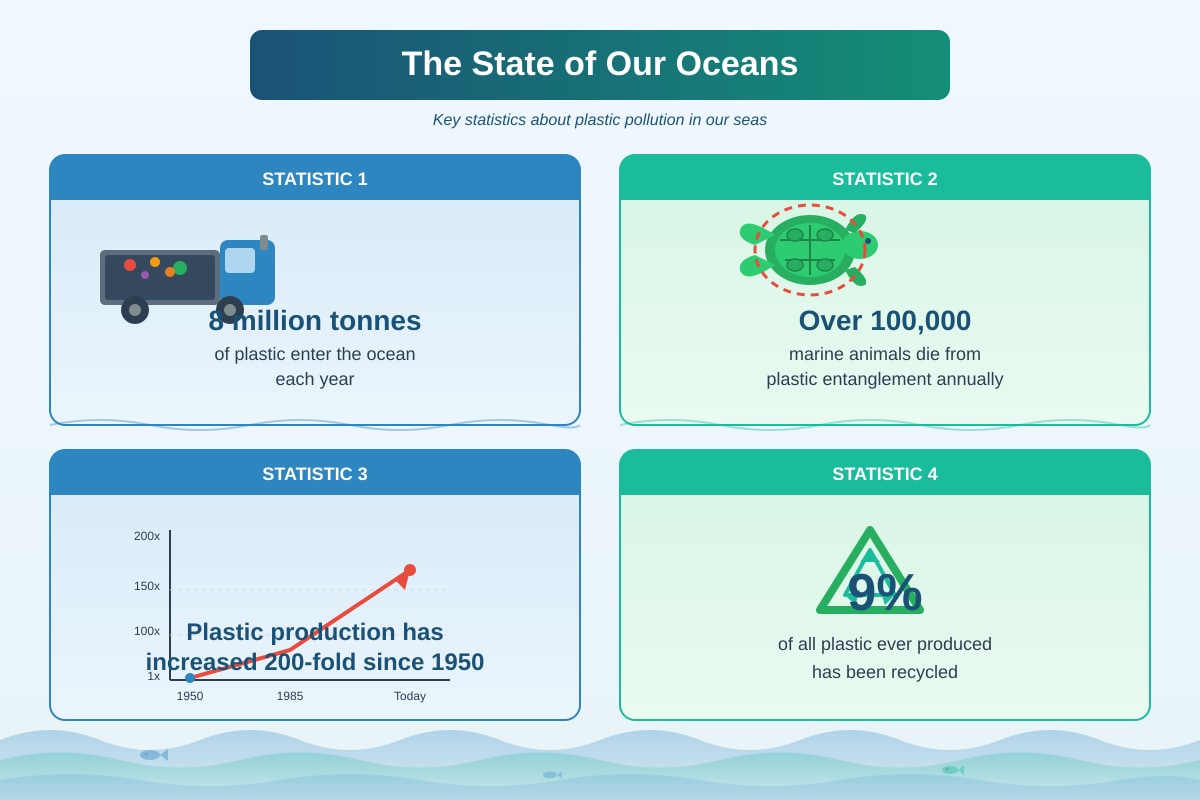
- Answer: The main message is that plastic pollution is a severe and growing crisis for the world's oceans, with devastating effects on marine life and a very low rate of recycling.
- Marking Notes: Accept answers that capture the urgency and scale of the problem. A simple statement like "plastic is bad" is insufficient for full marks.
7.
- Answer: The garbage truck icon dumping plastic into the ocean is a powerful visual metaphor. It makes the abstract statistic of "8 million tonnes" concrete and shocking, helping the viewer immediately grasp the scale of the problem. The image of the sea turtle entangled in plastic also creates an emotional appeal, making the viewer care about the issue.
- Marking Notes: Award 1 mark for identifying the element, 1 mark for explaining how it supports the message, and 1 mark for the quality of the explanation. Accept any of the four visual elements.
8.
- Answer: The purpose would be to urge the MP to take action on plastic pollution, such as supporting legislation to reduce single-use plastics, improve recycling infrastructure, or fund ocean clean-up initiatives.
- Marking Notes: The purpose must be action-oriented (to persuade or request action), not just to inform. Accept any reasonable policy suggestion.
9.
- Answer: Adding the economic cost of plastic pollution (e.g., "Plastic pollution costs the global economy $13 billion annually in damage to marine ecosystems") would make the infographic more persuasive by appealing to financial concerns.
- Marking Notes: Accept any relevant statistic that adds a new dimension (e.g., health impacts, time to decompose, comparison to other pollutants). The key is that it strengthens the persuasive appeal.
10.
- Answer: A speech would likely use a more emotional and urgent tone, with rhetorical questions, direct appeals ("We must act now!"), and personal stories to engage the audience. A formal report would use a more objective, factual, and measured tone, with data, evidence, and recommendations presented in a structured, impersonal way.
- Marking Notes: Award 1 mark for identifying the difference in tone, 1 mark for describing the speech tone, and 1 mark for describing the report tone. The contrast must be clear.
Section C: Planning a Situational Writing Response (Questions 11–15)
3 marks each: 1 mark for identifying 2-3 relevant key points, 1 mark for identifying the correct tone, 1 mark for the quality and appropriateness of the plan.
11.
- Key Points to Include:
- Express sincere gratitude for the PTA's funding, which made the club's success possible.
- Briefly mention the competition and the achievement (e.g., "We won first place in the National Robotics Championship").
- Extend a formal invitation to the PTA to attend a demonstration of the winning robot.
- Provide details of the demonstration (date, time, venue).
- Appropriate Tone: Formal, grateful, and respectful.
12.
- Key Points to Include:
- An engaging introduction summarising the purpose and success of Health and Wellness Week.
- A description of key activities (e.g., yoga sessions, healthy cooking demonstrations, mental health talks).
- Feedback or quotes from participants to show impact.
- A concluding statement about the importance of health and wellness.
- Appropriate Tone: Informative, positive, and engaging; suitable for a school newsletter.
13.
- Key Points to Include:
- A warm welcome to prospective students and parents.
- An overview of the school's strengths (e.g., academic excellence, co-curricular activities, supportive environment).
- A personal anecdote or testimonial about your positive experience at the school.
- An invitation to explore the school and ask questions.
- Appropriate Tone: Warm, welcoming, enthusiastic, and persuasive.
14.
- Key Points to Include:
- A clear request to use the auditorium for the debate competition.
- The date and time of the competition.
- The purpose and importance of the event (e.g., "This is a prestigious inter-school competition that will showcase our students' talents").
- A commitment to follow all school rules and leave the venue clean.
- Appropriate Tone: Polite, formal, and respectful.
15.
- Key Points to Include:
- A polite introduction and explanation of who you are (class and school).
- A clear description of the fundraising project and its purpose (e.g., "We are raising funds for a new library for underprivileged children").
- A specific request for sponsorship (e.g., "We would be grateful for a cash donation of $500 or sponsorship of prizes").
- An explanation of how the business will be recognised (e.g., logo on posters, mention in school newsletter).
- Appropriate Tone: Polite, professional, and persuasive.
Section D: Writing a Complete Situational Text (Questions 16–20)
4 marks each: Marked holistically based on the following criteria:
- Task Fulfilment (2 marks): All key points from the scenario are addressed. The purpose, audience, and context are fully considered.
- Language and Organisation (2 marks): The response is well-organised, uses appropriate tone and register, and demonstrates accurate grammar, spelling, and punctuation.
Marking Descriptors:
| Score | Task Fulfilment | Language and Organisation |
|---|---|---|
| 4 | All points addressed and developed in detail; PAC fully addressed. | Coherent and cohesive; ambitious vocabulary and grammar; accurate. |
| 3 | Most points addressed with some development; PAC addressed. | Most ideas coherent; vocabulary and grammar sufficiently varied; few errors. |
| 2 | Some points addressed; PAC partially addressed. | Some organisation; simple vocabulary and grammar; several errors. |
| 1 | One point addressed; PAC occasionally addressed. | Ideas presented in isolation; limited vocabulary; frequent errors. |
| 0 | No relevant content. | No response or completely off-task. |
16. Sample Answer (Formal Report): To: The Principal From: Chairperson, Environment Club Date: [Date] Subject: Report on "Zero Waste Week" Campaign
Introduction The Environment Club successfully organised a "Zero Waste Week" campaign from [Date] to [Date]. The aim was to reduce waste generation within the school and promote sustainable habits among students and staff.
Activities Conducted The campaign included a "Bring Your Own Container" day at the canteen, a recycling drive for old textbooks and stationery, and a workshop on composting food waste. A total of 15 student volunteers helped to man the information booth during recess.
Outcomes Achieved The campaign was a resounding success. We collected over 200 kilograms of recyclable materials. The canteen vendor reported a 30% reduction in disposable container usage. A survey indicated that 85% of students were more aware of their waste footprint after the campaign.
Recommendations To build on this momentum, I recommend making "Zero Waste Wednesday" a weekly event and installing more clearly labelled recycling bins around the school. I also suggest incorporating waste management topics into the Science curriculum.
Conclusion The "Zero Waste Week" campaign has demonstrated that our school community is ready to embrace more sustainable practices. I look forward to your support in implementing the recommendations above.
17. Sample Answer (Thank-you Email): To: [email protected] Subject: Thank You for the Work Attachment Opportunity
Dear Mr. Tan,
I am writing to express my heartfelt gratitude for the opportunity to complete my two-week work attachment at your publishing company. It was an invaluable experience that has greatly enriched my understanding of the publishing industry.
I was particularly grateful for the chance to observe the editorial process, from manuscript submission to final proofreading. Your guidance during the team meetings helped me appreciate the importance of attention to detail and collaboration. I also enjoyed learning about the marketing strategies used to promote new books.
The attachment has confirmed my interest in pursuing a career in publishing. I now have a clearer idea of the skills I need to develop, such as strong writing and time management.
Thank you once again for your patience and mentorship. I hope to apply what I have learned in my future studies and career.
Yours sincerely,
[Your Name]
18. Sample Answer (Speech): Good morning, school!
Imagine the joy on a child's face when they discover a new world through a book. Now, imagine being the person who helps them turn that page. That is exactly what our community service group, "Read to Inspire," does every Saturday at the Clementi Community Library.
We spend just one hour a week reading with children aged four to eight. It is simple, fun, and incredibly rewarding. You do not need any special skills—just a love for stories and a willingness to share your time.
By joining us, you will not only help these children develop a love for reading, but you will also gain valuable experience in communication and leadership. Plus, it looks great on your co-curricular activity record!
If you are interested, please sign up at the Student Affairs Office by Friday. Let us work together to make a difference, one story at a time.
Thank you.
19. Sample Answer (Article): Mind Over Matter: Why Mental Health Matters for Teens
We often hear about the importance of physical health—eat your vegetables, exercise regularly, get enough sleep. But what about our mental health? For teenagers, this is just as crucial.
The pressure to excel in exams, maintain friendships, and plan for the future can be overwhelming. According to a recent survey, one in five teenagers experiences symptoms of anxiety or depression. Yet, many suffer in silence, afraid of being judged.
So, what can we do? First, talk about it. Share your feelings with a trusted friend, family member, or school counsellor. Second, practice self-care. This means taking breaks, pursuing hobbies, and setting realistic goals. Finally, be kind to yourself and others. You never know what someone else is going through.
Remember, seeking help is a sign of strength, not weakness. Let us break the stigma together.
20. Sample Answer (Proposal Letter): To: The Principal From: President, Student Council Date: [Date] Subject: Proposal for a "Buddy System for New Students"
Introduction The Student Council proposes the implementation of a "Buddy System" to help new students transition smoothly into our school community.
The Problem Each year, new students often feel lost and isolated during their first few weeks. They struggle to navigate the school, make friends, and understand our culture. This can negatively affect their academic performance and overall well-being.
Proposed Solution We propose pairing each new student with a trained senior student "buddy" for the first term. The buddy would help with orientation, answer questions, and provide social support. Buddies would receive basic training in communication and empathy.
Benefits This system will foster a welcoming school culture, reduce bullying, and help new students settle in faster. It will also develop leadership and responsibility among senior students.
Conclusion We believe this initiative will greatly benefit our school community. We request your approval to pilot the programme starting next semester.
Thank you for your consideration.
Yours sincerely,
[Your Name] President, Student Council
— End of Answer Key —