AI Generated Quiz
Secondary 3 English Composition Situational Writing Quiz
Free Sec 3 English Situational Writing quiz, AI version, with questions, answers, and O Level-style practice for Singapore students.
These static practice materials are generated from the site's syllabus and paper-generation workflow, with source and model context shown so students and parents can evaluate the material before use.
Questions
Free quiz and exam paper access
Enter your details to view this paper
Your access is remembered on this device.
Answers
Secondary 3 English Quiz - Composition Situational Writing: Answer Key
Total Marks: 50
Section A: Understanding Text Types and Conventions
Question 1
Marks: 2 (1 mark for each correct feature)
Answer: Any two of the following:
- A formal letter uses a formal salutation (e.g., "Dear Sir/Madam") and a formal closing (e.g., "Yours faithfully").
- A formal letter uses formal language and avoids contractions (e.g., "I am writing" instead of "I'm writing").
- A formal letter includes the sender's and recipient's addresses and the date.
- A formal letter has a clear subject line.
- A formal letter maintains a polite and respectful tone throughout.
Teaching Note: The key difference lies in register (formal vs. informal) and format. A formal letter follows a strict structure and uses standard English without slang or colloquialisms. An informal email to a friend is conversational, may use contractions, and does not require a formal header.
Common Mistake: Students often list features that are common to both (e.g., "it has a greeting") without highlighting the difference.
Question 2
Marks: 2 (1 mark for purpose, 1 mark for audience)
Answer:
- Purpose: To inform students about the activities planned for "Green Week" (and possibly to encourage participation).
- Audience: All students in the school.
Teaching Note: The purpose is the reason for writing (to inform, persuade, request, etc.). The audience is the intended reader or listener. Identifying these two elements is the first step in any situational writing task, as they determine the tone, content, and format of the response.
Question 3
Marks: 2 (1 mark for each correct piece of information)
Answer: Any two of the following:
- The purpose of the report (e.g., "The purpose of this report is to highlight the poor condition of the computer laboratory").
- The date and location of the inspection/observation.
- A brief overview of the general state of the laboratory.
- The name of the person who conducted the inspection.
Teaching Note: A report's opening paragraph should establish the context and purpose. It tells the reader what the report is about and why it was written. This is a standard convention for formal reports.
Question 4
Marks: 2 (1 mark for each correct feature)
Answer: Any two of the following:
- A speech is written to be spoken aloud, so it uses more rhetorical devices (e.g., repetition, rhetorical questions) to engage the audience.
- A speech directly addresses the audience using "you" and "we".
- A speech has a conversational yet persuasive tone.
- A speech often includes an opening that grabs attention and a closing that leaves a lasting impression.
- A speech may include pauses, emphasis, and other cues for the speaker.
Teaching Note: The primary difference is the mode of delivery. A speech is for the ear, not the eye. Therefore, it uses shorter sentences, more direct address, and rhetorical devices to maintain the audience's attention. A report is for the eye, so it is more structured and uses headings and formal language.
Question 5
Marks: 2 (1 mark for each correct technique)
Answer: Any two of the following:
- Using an emotional appeal (e.g., "Imagine the smiles you'll bring to the elderly").
- Using a personal invitation (e.g., "I'd really love for you to come with me").
- Highlighting the benefits (e.g., "It'll be a fun and rewarding experience").
- Creating a sense of urgency (e.g., "There are only a few slots left!").
- Using a rhetorical question (e.g., "Don't you want to make a difference?").
Teaching Note: Persuasive techniques are used to convince the reader to take a specific action. In an informal email to a friend, the tone should be friendly and personal, but the persuasive techniques remain important.
Section B: Adapting Language, Tone, and Content
Question 6
Marks: 2
Answer: The tone of Sentence A is formal, objective, and impersonal, using formal vocabulary ("significant increase") and a passive structure ("has been noted"). The tone of Sentence B is informal, casual, and personal, using colloquial language ("Hey," "loads of people," "hitting the library") and a direct, conversational structure.
Teaching Note: Tone is the writer's attitude towards the subject and audience. Formal tone uses standard English, avoids contractions and slang, and often uses passive voice. Informal tone is conversational, uses contractions and colloquialisms, and is more personal.
Marking Notes:
- 1 mark for identifying the tone of Sentence A.
- 1 mark for identifying the tone of Sentence B.
Question 7
Marks: 2
Answer: A formal rewrite could be: "It is concerning that a significant amount of food is being wasted by residents on a regular basis." OR "The indiscriminate disposal of food by residents is a serious issue that needs to be addressed."
Teaching Note: To change from informal to formal register:
- Remove contractions ("It's" → "It is").
- Replace informal vocabulary ("really bad" → "concerning"; "throw away" → "dispose of"; "so much" → "a significant amount").
- Use a more objective and impersonal structure.
Marking Notes:
- 1 mark for removing informal language/contractions.
- 1 mark for using appropriate formal vocabulary and structure.
Question 8
Marks: 2 (1 mark for each correct detail)
Answer: Any two of the following:
- The purpose of the Read-a-thon (e.g., to raise funds for the school library).
- The date, time, and venue of the event.
- The specific number of books needed and the type of books suitable as prizes.
- How the donation will be acknowledged (e.g., "We will feature your bookstore's name in our publicity materials").
- A polite expression of gratitude.
Teaching Note: When making a request, you need to provide enough context for the recipient to understand the request and be persuaded to help. Including specific details (what, when, where, why) makes the request clear and credible.
Question 9
Marks: 2 (1 mark for each correct phrase)
Answer:
- Formal phrase: "Participating in a co-curricular activity offers numerous benefits, including..." OR "It is widely acknowledged that CCAs contribute significantly to a student's holistic development."
- Informal phrase: "Joining a CCA is a great way to make new friends and have fun!" OR "If you're looking for a break from textbooks, a CCA is the perfect choice."
Teaching Note: Formal language is objective, precise, and avoids slang. Informal language is conversational, engaging, and may use colloquialisms. The choice of register depends on the audience and purpose.
Question 10
Marks: 2
Answer: A reason could be: "The community garden provides an opportunity for students to contribute to the neighbourhood and learn about sustainability." OR "Students have shown interest in the garden, as indicated by their enthusiasm to visit and volunteer."
Teaching Note: This question tests your ability to select and use relevant information from a given stimulus. The conversation provides two key points: (1) the garden is new and opening soon, and (2) it needs volunteers. Your proposal should use this information to support your suggestion.
Marking Notes:
- 1 mark for identifying a relevant reason from the conversation.
- 1 mark for phrasing it appropriately for a formal proposal.
Section C: Planning and Writing a Situational Response
Question 11
Marks: 2 (1 mark for each correct benefit)
Answer: Any two of the following:
- Reducing the school's carbon footprint and promoting environmental sustainability.
- Reducing long-term electricity costs for the school.
- Serving as an educational tool for students to learn about renewable energy.
- Demonstrating the school's commitment to environmental stewardship.
Teaching Note: A proposal needs to present clear, logical, and persuasive reasons to convince the reader. Benefits should be relevant to the audience (the Principal) and the school's goals.
Question 12
Marks: 2 (1 mark for challenge, 1 mark for solution)
Answer:
- Challenge: The high initial cost of purchasing and installing solar panels.
- Solution: The school could apply for government grants or funding schemes that support renewable energy adoption in schools. OR The school could partner with a solar energy company for a sponsored installation.
Teaching Note: Addressing potential challenges shows that you have thought through the proposal thoroughly. A good solution should be practical and feasible.
Question 13
Marks: 2 (1 mark for each correct reason)
Answer: Any two of the following:
- It encourages a love for reading among students by providing a comfortable and inviting space.
- It provides a quiet and conducive environment for students to study or relax during breaks.
- It enhances the aesthetic appeal of the school campus.
- It can be used for lessons and other educational activities.
Teaching Note: When persuading an audience like the PTA, you should focus on the benefits to the students and the school. This makes your argument more compelling.
Question 14
Marks: 2
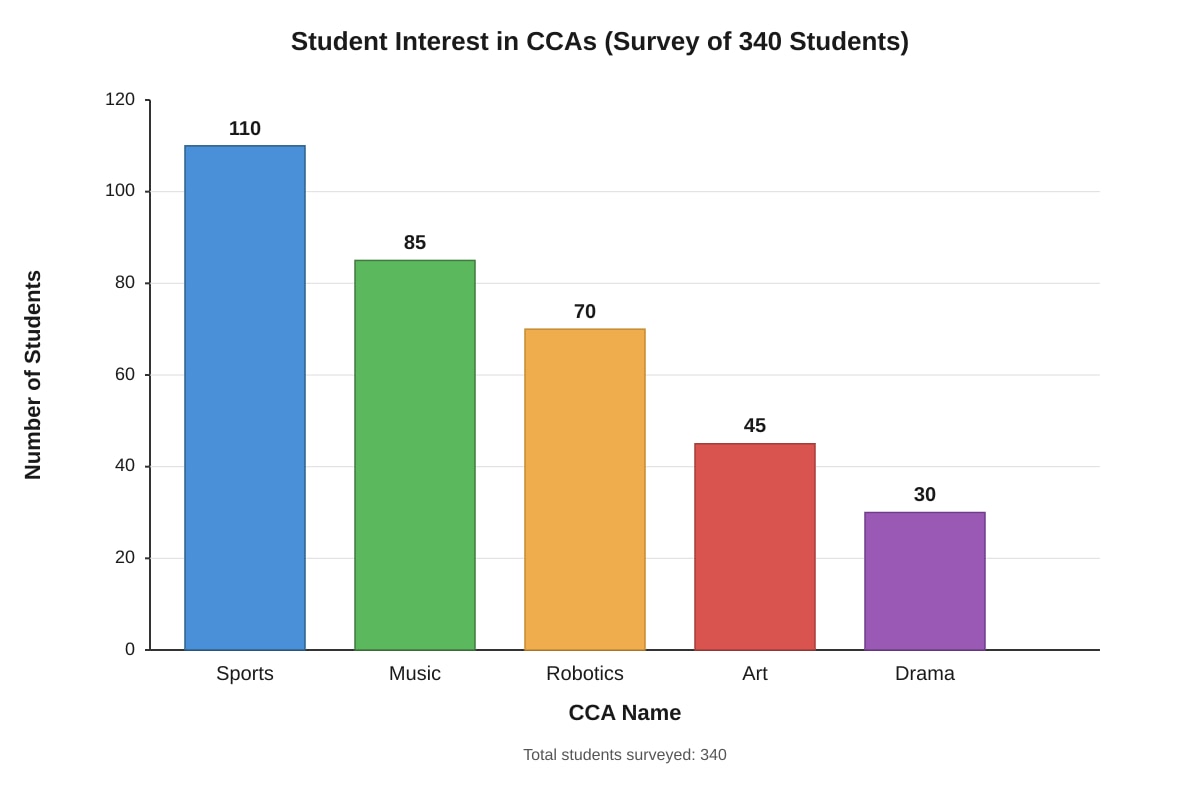
Answer: A key finding is that Sports is the most popular CCA, with 110 out of 340 students expressing interest, while Drama is the least popular, with only 30 students interested.
Teaching Note: When interpreting data, you should identify the most significant trends or patterns. This often includes the highest and lowest values, or a notable comparison.
Marking Notes:
- 1 mark for identifying a specific trend or pattern.
- 1 mark for supporting it with data from the chart.
Question 15
Marks: 2
Answer: Any one of the following:
- The school could conduct a survey to find out why students are not interested in Drama.
- The school could promote the Drama CCA more actively through assemblies or social media.
- The school could invite a professional theatre company to conduct a workshop to generate interest.
- The school could offer a trial session for students to experience Drama before committing.
Teaching Note: This question requires you to use the data to propose a practical and logical action. The action should directly address the problem identified (low interest in Drama).
Question 16
Marks: 2 (1 mark for each correct piece of information)
Answer: Any two of the following:
- The date, time, and venue of the talk.
- The theme of the Health Awareness Week.
- The expected duration of the talk and the preferred format (e.g., presentation, Q&A session).
- The profile of the audience (e.g., Secondary 1 to 3 students).
- The specific topics or areas of focus the school would like her to cover.
Teaching Note: When inviting a guest speaker, you need to provide all the logistical details and the context of the event to help them prepare effectively.
Question 17
Marks: 2 (1 mark for each correct argument)
Answer: Any two of the following:
- Green spaces improve air quality and help mitigate the urban heat island effect.
- They provide recreational spaces for residents, promoting physical and mental well-being.
- They support biodiversity by providing habitats for flora and fauna.
- They enhance the aesthetic appeal of the city and contribute to a higher quality of life.
Teaching Note: A letter to the editor is a formal piece of writing that presents a clear opinion supported by logical arguments and evidence. Your arguments should be relevant to the Singapore context.
Question 18
Marks: 2 (1 mark for each correct feature)
Answer: Any two of the following:
- A clear and catchy headline or slogan (e.g., "Say No to Single-Use Plastics!").
- An eye-catching image or graphic that illustrates the problem.
- A clear call to action (e.g., "Bring your own reusable bag!").
- Concise and impactful text that is easy to read.
- Use of contrasting colours to draw attention.
Teaching Note: A poster is a visual text. Its effectiveness depends on its ability to communicate a message quickly and memorably. The features should work together to attract attention, convey the message, and prompt action.
Question 19
Marks: 2 (1 mark for each correct type of information)
Answer: Any two of the following:
- An introduction outlining the club's objectives and activities for the year.
- A summary of key events, competitions, or workshops organised by the club.
- A report on the club's achievements and milestones.
- A section on the club's members and their contributions.
- A conclusion with plans or goals for the upcoming year.
Teaching Note: A report is a structured, factual document. For a club report in a school magazine, it should provide a comprehensive overview of the club's activities and achievements over the year.
Question 20
Marks: 4
Answer: A model response:
"Good morning, everyone. A new school year is like a blank page in a book, waiting to be filled with stories of our own making. Each of us has the power to decide what this year will hold. Today, I want to talk about the importance of setting personal goals—not just for our grades, but for who we want to become. Let's make this year one we can look back on with pride."
Teaching Note: A good speech opening should:
- Greet the audience ("Good morning, everyone").
- Hook the audience with an interesting idea or image ("a blank page in a book").
- State the purpose clearly ("talk about the importance of setting personal goals").
- Use an appropriate tone (encouraging, inspiring, and inclusive).
Marking Notes (4 marks):
- Content (2 marks): The opening has a clear purpose and a relevant hook.
- Language (2 marks): The language is appropriate for a speech, with a persuasive and engaging tone. Grammar, spelling, and punctuation are accurate.
Common Mistake: Students often write a generic opening without a clear hook or purpose, or they use a tone that is too informal for a school assembly.