From Real Exams Quiz
Secondary 3 English Composition Situational Writing Quiz
Free Sec 3 English Situational Writing quiz, Exam version, with questions, answers, and O Level-style practice for Singapore students.
These static practice materials are generated from the site's syllabus and paper-generation workflow, with source and model context shown so students and parents can evaluate the material before use.
Questions
Free quiz and exam paper access
Enter your details to view this paper
Your access is remembered on this device.
Answers
Secondary 3 English Quiz - Composition Situational Writing: Answer Key
Total Marks: 50
Section A: Understanding Purpose, Audience and Context (Questions 1–5)
Question 1 (2 marks)
Answer:
- Feature of language: Formal and polite language (e.g., "I would like to request...", "I hope you will consider...")
- Feature of format: A formal letter format with the sender's address, date, recipient's address, salutation ("Dear Principal"), and a formal closing ("Yours faithfully")
Marking Notes:
- 1 mark for a valid language feature
- 1 mark for a valid format feature
Teaching Notes: A formal letter to a Principal requires a respectful and polite tone. The language should avoid slang or contractions. The format must follow standard formal letter conventions, including the proper salutation and closing. The purpose (requesting permission) and audience (the Principal) determine these choices.
Common Mistakes:
- Using informal language features (e.g., "Hey", "Can I...")
- Confusing format features with content features
Question 2 (2 marks)
Answer:
- Purpose: To inform teenagers about the free weekend coding workshop and encourage them to join.
- Audience: Teenagers (secondary school students) in the community.
Marking Notes:
- 1 mark for identifying the purpose (informing/persuading teenagers to join)
- 1 mark for identifying the audience (teenagers)
Teaching Notes: The purpose of a notice is usually to inform and persuade. The audience is the group the notice is directed at, which in this case is teenagers. Identifying purpose and audience helps the writer choose appropriate language and content.
Question 3 (2 marks)
Answer:
- Short, direct sentences help the audience (students at an assembly) understand the message easily and keep their attention.
- A conversational tone makes the speech sound natural and relatable, helping the speaker connect with the audience and make the topic more engaging.
Marking Notes:
- 1 mark for explaining the effect of short, direct sentences (clarity, attention)
- 1 mark for explaining the effect of a conversational tone (connection, engagement)
Teaching Notes: A speech is meant to be heard, not read. Short sentences are easier to follow when listening. A conversational tone creates a sense of connection between the speaker and the audience, making the message more persuasive and relatable.
Question 4 (2 marks)
Answer: Any two of the following:
- An apology for the inconvenience caused
- An explanation of the steps being taken to resolve the issue (e.g., replacement, refund)
- A request for more details (e.g., order number, receipt) to investigate the matter
- A commitment to follow up or a timeline for resolution
Marking Notes:
- 1 mark for each valid point, up to 2 marks
Teaching Notes: A reply to a complaint should acknowledge the customer's concern, show that the company is taking the matter seriously, and outline the next steps. This builds trust and shows professionalism.
Question 5 (2 marks)
Answer:
- Audience: Students, teachers, and parents of the school (the school community).
- Explanation: The tone should be positive, enthusiastic, and celebratory to reflect the success of the event and to engage the school community. It should be informative but also lively to capture the spirit of the day.
Marking Notes:
- 1 mark for identifying the audience
- 1 mark for a valid explanation of how the audience affects the tone
Teaching Notes: The audience of a school newsletter report is the school community. The tone should match the purpose of celebrating a successful event. A positive and enthusiastic tone makes the report enjoyable to read and reinforces school spirit.
Section B: Analysing Visual Texts (Questions 6–10)
Question 6 (2 marks)
Answer: Any one of the following:
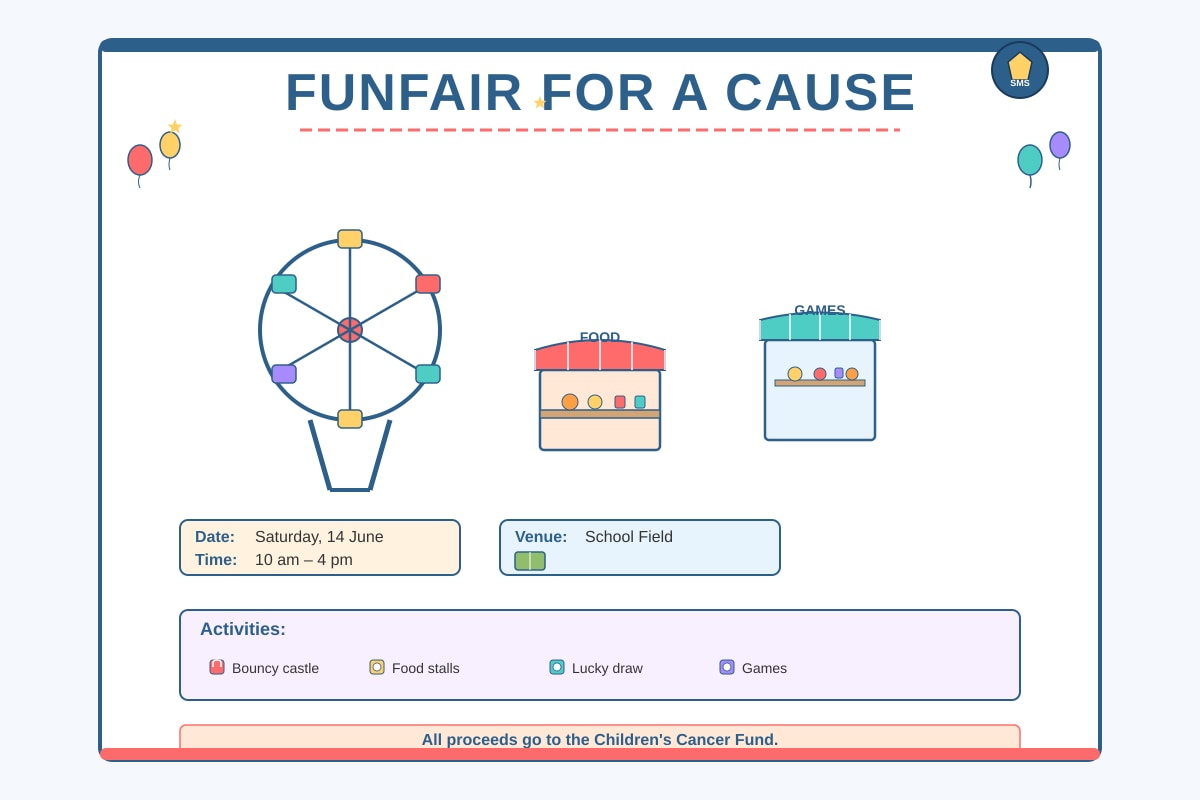
- Bouncy castle
- Food stalls
- Lucky draw
- Games
Marking Notes:
- 2 marks for a correct answer
- 0 marks for an answer not found on the poster
Teaching Notes: This is a direct retrieval question. The student needs to scan the poster for the list of activities and state one of them.
Question 7 (2 marks)
Answer: The school field.
Marking Notes:
- 2 marks for the correct answer
Teaching Notes: This is a factual recall question. The venue is clearly stated on the poster as "School Field".
Question 8 (2 marks)
Answer: To raise funds for the Children's Cancer Fund.
Marking Notes:
- 2 marks for the correct answer
Teaching Notes: The poster states "All proceeds go to the Children's Cancer Fund." This indicates the main purpose of the event is fundraising for this charity.
Question 9 (2 marks)
Answer: Any two of the following:
- The date (Saturday, 14 June)
- The time (10 am – 4 pm)
- The venue (School Field)
- The purpose (raising funds for the Children's Cancer Fund)
Marking Notes:
- 1 mark for each valid piece of information, up to 2 marks
Teaching Notes: An announcement must include essential details that allow the audience to attend. The date, time, and venue are critical. The purpose is also important to encourage attendance.
Question 10 (2 marks)
Answer: The phrase "FUNFAIR FOR A CAUSE" is effective because it links the funfair to a charitable purpose. The word "cause" suggests that attending the event is not just for entertainment but also for helping others, which appeals to people's sense of compassion and makes them more likely to attend.
Marking Notes:
- 1 mark for identifying the link between the funfair and charity
- 1 mark for explaining the persuasive effect (appeals to compassion, sense of purpose)
Teaching Notes: This question tests the student's ability to analyse language for effect. The phrase creates a positive association between having fun and doing good, which is a powerful persuasive technique.
Section C: Applying Situational Writing Skills (Questions 11–15)
Question 11 (3 marks)
Answer: Any three of the following:
- The library would provide a quiet space for students to study.
- It would encourage reading and improve literacy in the community.
- It would offer free access to books and resources for people who cannot afford them.
- It would serve as a venue for community events and activities.
- It would increase property values and attract more visitors to the area.
Marking Notes:
- 1 mark for each valid point, up to 3 marks
Teaching Notes: A persuasive letter to the editor should present clear, logical reasons that appeal to the readers' interests. Each point should be developed with evidence or examples in a full response.
Question 12 (3 marks)
Answer:
- Greeting: "Hey [Name]!" or "Hi [Name],"
- Closing: "Cheers," "Talk soon," or "See you there!"
Marking Notes:
- 1 mark for an appropriate informal greeting
- 1 mark for an appropriate informal closing
- 1 mark for overall suitability (both are informal and match the purpose)
Teaching Notes: An informal email to a friend uses casual greetings and closings. The language is relaxed and personal, unlike formal letters.
Question 13 (3 marks)
Answer:
- Formal language: A report to the Principal is an official document. Formal language shows respect and professionalism, making the report more credible and likely to be taken seriously.
- Specific examples: Including specific examples (e.g., "the tables near the drinks stall are sticky", "the ceiling has water stains") provides concrete evidence that supports the report's claims, making it more convincing and helping the Principal understand the severity of the issue.
Marking Notes:
- 1 mark for explaining why formal language is appropriate
- 1 mark for explaining why specific examples are needed
- 1 mark for a clear, well-developed explanation
Teaching Notes: The audience (the Principal) and the purpose (to report a problem) determine the need for formality and evidence. Specific examples turn vague complaints into a credible case for action.
Question 14 (3 marks)
Answer: Any three of the following:
- Using rhetorical questions (e.g., "Do you want to see our beaches covered in trash?")
- Appealing to emotions (e.g., describing the harm to marine life)
- Using statistics or facts (e.g., "Over 8 million tonnes of plastic enter the ocean each year")
- Using inclusive language (e.g., "We can make a difference together")
- Creating a vivid image of the problem or the solution
Marking Notes:
- 1 mark for each valid technique, up to 3 marks
Teaching Notes: Persuasive techniques are tools used to convince an audience. Rhetorical questions engage the listener, emotional appeals create empathy, and statistics provide logical support. Inclusive language makes the audience feel part of the solution.
Question 15 (3 marks)
Answer: Any two of the following:
- A friendly, conversational tone (e.g., using contractions, casual expressions)
- Personal anecdotes or descriptions that make the letter engaging
- Questions to the pen pal to encourage a reply (e.g., "Have you ever been to a sports day?")
- A warm and enthusiastic style that shows excitement about the event
Marking Notes:
- 1 mark for each valid feature, up to 2 marks
- 1 mark for a clear explanation of how the feature makes the letter suitable
Teaching Notes: A friendly letter is personal and engaging. Features like a conversational tone and personal stories create a connection with the reader, making the letter enjoyable to read and encouraging a response.
Section D: Extended Situational Writing Task (Questions 16–20)
Question 16 (3 marks)
Answer: The purpose of the proposal is to seek the Principal's approval and funding for the "Green Week" event.
Marking Notes:
- 3 marks for a complete and accurate statement of purpose
- 2 marks for a partially accurate statement (e.g., only mentions approval, not funding)
- 1 mark for a vague or incomplete statement (e.g., "to talk about Green Week")
Teaching Notes: A proposal is a formal document written to persuade a decision-maker to approve a plan. The purpose must be stated clearly at the beginning so the reader knows what is being requested.
Question 17 (3 marks)
Answer:
- Audience: The Principal of Greenview Secondary School.
- Explanation: The tone should be formal, respectful, and persuasive. Since the Principal is the decision-maker and holds a position of authority, the language must be polite and professional. The proposal should present logical arguments and evidence to convince the Principal to approve the event and provide funding.
Marking Notes:
- 1 mark for identifying the audience
- 2 marks for a clear explanation of how the audience affects the tone (formal, respectful, persuasive)
Teaching Notes: The audience determines the register of the writing. A proposal to a Principal requires formal language, a respectful tone, and well-organised arguments. The writer must show that the event is worthwhile and the budget is reasonable.
Question 18 (3 marks)
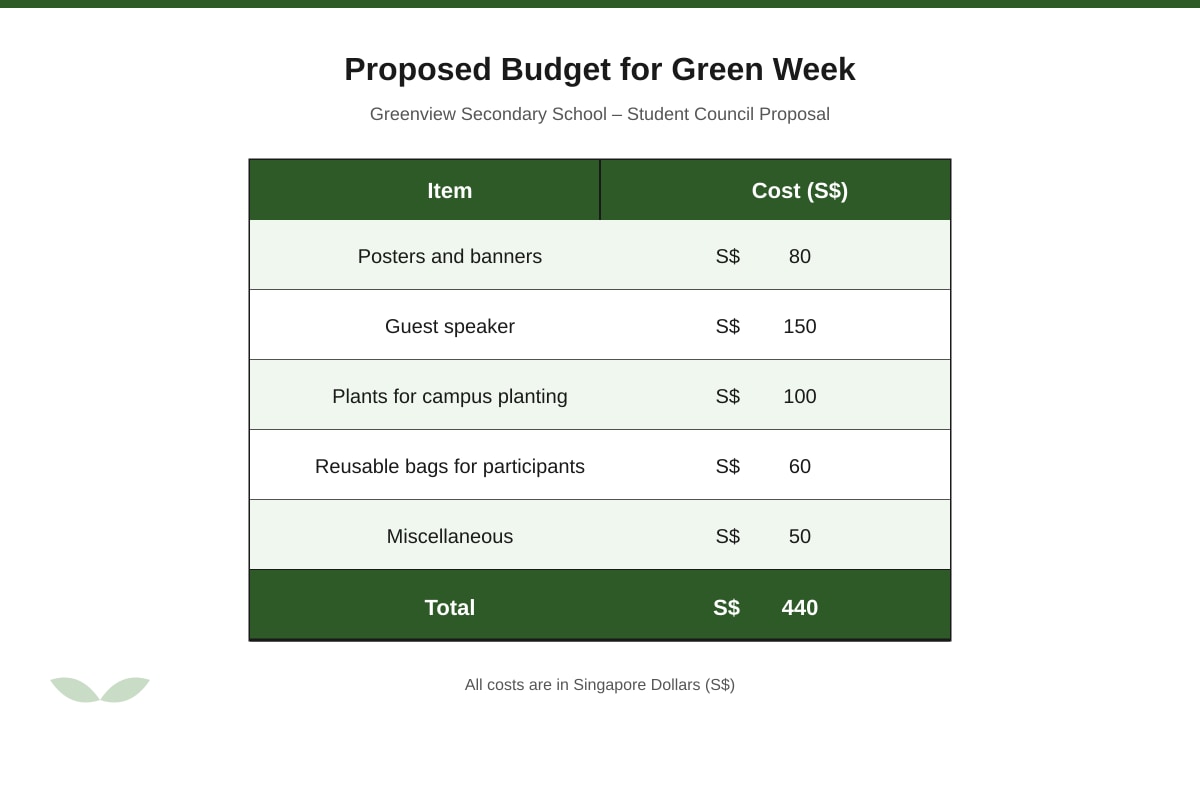
Answer: S$440
Marking Notes:
- 3 marks for the correct answer
- 0 marks for an incorrect total
Teaching Notes: The total is calculated by adding all the items in the budget table: S150 + S60 + S440
Question 19 (3 marks)
Answer: Any two of the following:
- It raises environmental awareness among students.
- It encourages students to adopt more sustainable habits.
- It fosters a sense of community and teamwork through shared activities.
- It provides a platform for students to learn about environmental issues from experts (e.g., guest speaker).
- It improves the school environment (e.g., through campus planting).
Marking Notes:
- 1 mark for each valid benefit, up to 2 marks
- 1 mark for a clear link to the purpose of persuading the Principal
Teaching Notes: Benefits should be framed in terms of how they help the school and its students. This makes the proposal more persuasive because it shows the event has value beyond just being an activity.
Question 20 (3 marks)
Answer: A sample response:
"I am writing to propose the organisation of 'Green Week', a five-day event aimed at promoting environmental awareness among students at Greenview Secondary School. The event will feature a talk by a guest speaker, a campus planting session, and a series of interactive workshops. The total cost of the event is S$440, as detailed in the attached budget. I believe this event will not only educate our students but also inspire them to adopt more sustainable practices in their daily lives."
Marking Notes:
- 1 mark for stating the purpose of the event
- 1 mark for briefly describing what the event involves
- 1 mark for mentioning the total cost (S$440)
- Deduct marks for language errors that impede understanding
Teaching Notes: A good opening paragraph of a proposal should:
- State the purpose clearly.
- Give a brief overview of the event.
- Mention the cost to prepare the reader for the budget section.
- Use formal, persuasive language.
Common Mistakes:
- Forgetting to mention the cost
- Using informal language
- Providing too much detail (the opening should be a summary, not a full plan)
END OF ANSWER KEY