From Real Exams Quiz
Secondary 3 English Argument Evaluation Quiz
Free Sec 3 English Argument Evaluation quiz, HY3 Exam version, with questions, answers, and O Level-style practice for Singapore students.
These static practice materials are generated from the site's syllabus and paper-generation workflow, with source and model context shown so students and parents can evaluate the material before use.
Questions

Free quiz and exam paper access
Enter your details to view this paper
Your access is remembered on this device.
Answers
Secondary 3 English Quiz - Argument Evaluation (Answer Key)
Total Marks: 40
Topic: Argument Evaluation
Section A: Identifying Arguments and Claims
1. [1] Claim: Schools should ban mobile phones.
Teaching note: A claim is the position the writer wants you to accept. The reason ("because…") supports it. Common mistake: writing the reason as the claim.
2. [1] "therefore"
Teaching note: Conclusion signals include therefore, thus, so, hence. "Exercise improves mood" is a premise.
3. [1] Fact
Teaching note: A fact can be verified (closing time). An opinion is a belief. Mistake: calling it opinion due to personal dislike.
4. [1] Homework should not be reduced.
Teaching note: Jia Wei gives a reason (helps revise) then states conclusion. Identify the "should" statement.
5. [1] "Thus, the school should start later."
Teaching note: "Thus" introduces conclusion. Underline only the conclusion clause.
Section B: Supporting Evidence and Reasoning
6. [1] Survey showing 60% of students disliked the grease. (or friend vomited)
Teaching note: Evidence = data/example used to support.
7. [2] The survey covers many students (60%) so it shows a general pattern; the friend's case is one person and may be unusual.
Marking: 1 mark for "broader sample", 1 mark for "single case not representative".
8. [2] Weak because it is one student (anecdote), not proof tuition works for all; may have other causes.
Marking: 1 mark identifying anecdote, 1 mark for alternative cause.
9. [1] Assumption: Sleeping early causes top scores (reverse of stated link).
Teaching note: Assumption is unstated belief. Here, correlation mistaken for cause.
10. [1] Logical (uses ranking data) — though could be seen as shame-based; accepted answer: logical.
Teaching note: Not emotional appeal alone; uses a rank.
Section C: Evaluating Argument Strength
11. [2] Partly convincing because rest can improve focus; but no data on tiredness.
Marking: 1 mark for extent, 1 mark for reason.
12. [2] (From image) Promotes health; builds teamwork. (or current court crowded)
Marking: 1 mark each. Image must show 3 bullets; any two accepted.
13. [2] Could say: no proof current court cannot be expanded; or health claim not backed by data.
Marking: 1 mark for valid weak point, 1 mark for explanation.
14. [2] Flaw: generalising from some countries to all; happiness not equal to learning.
Marking: 1 mark flaw, 1 mark explanation.
15. [2] Mistake: hasty generalisation from Lee's case; ignores other reasons for sleep.
Marking: 1 mark flaw, 1 mark explanation.
Section D: Constructing and Responding to Arguments
16. [2] Counter: CCTV may invade privacy and trust; discipline can be taught without surveillance.
Marking: 1 mark for valid opposing point, 1 mark for reason.
17. [1] Mr Lim.
Teaching note: His view mentions "before exams".
18. [2] Add: study showing novel readers scored higher on vocab tests; or examples of rare words in novels.
Marking: 1 mark evidence type, 1 mark specific example.
19. [4] Agree (or disagree) with two points: e.g., (1) shorter assembly saves time for lessons; (2) standing long causes fatigue.
Marking: 1 mark stance, 1 mark each point (max 2), 1 mark explanation quality. Descriptors: Band 5 = 2 clear points + link.
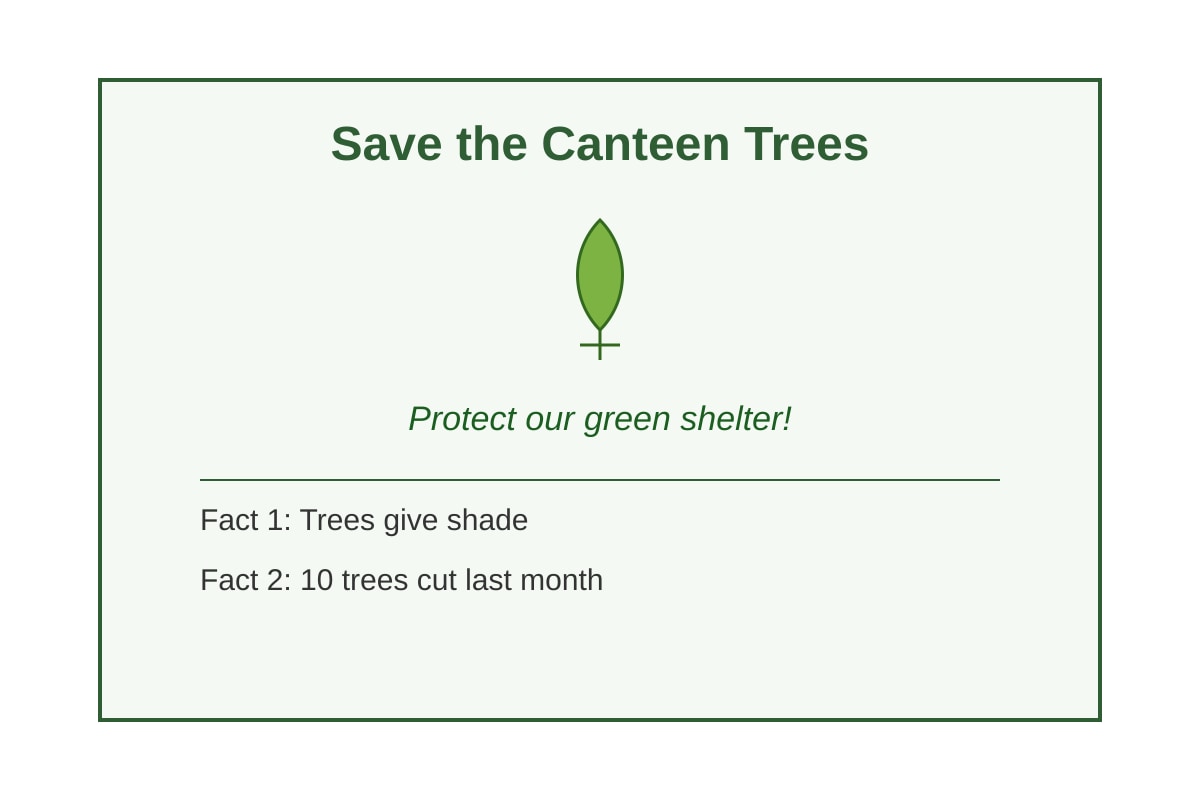
20. [3] Argument: Cutting trees should stop (they give shade; 10 cut). Strength: uses factual count, but emotional icon may bias.
Marking: 1 mark argument from image, 1 mark evaluation, 1 mark use of visual detail.