AI Generated Exam Paper
Secondary 3 English Practice Paper 2
Free Sec 3 English Practice Paper 2, HY3 AI version, with questions, answers, and O Level-style practice for Singapore students.
These static practice materials are generated from the site's syllabus and paper-generation workflow, with source and model context shown so students and parents can evaluate the material before use.
Questions
Free quiz and exam paper access
Enter your details to view this paper
Your access is remembered on this device.
Answers
TuitionGoWhere Practice Paper - English Secondary 3 (Answer Key)
Version 2 of 5 — Total Marks: 50
Section A: Literal & Inferential Comprehension (12 marks)
Q1. [1 mark]
Answer: They were sold to private buyers and moved to mainland farms.
Teaching note: Scan Paragraph 3 for "wild horses". The text states they were "sold to private buyers and moved to mainland farms". Common mistake: saying only "sold" without the movement detail.
Q2. [1 mark]
Answer: He was solitary / private / unsociable.
Teaching note: "Kept to himself" means he did not interact much with others. Do not give dictionary definition; infer from context.
Q3. [1 mark]
Answer: The sea (or the sea around Caven Point / island).
Teaching note: "Its" refers back to the nearest logical noun — "the sea". Pronoun referent must be specific noun.
Q4. [2 marks]
Answer: The horses and land are gone, so the island's mysteries are hidden from people; Mr. Halim feels the natural secrets are lost with the changes. (1 mark for paraphrase of loss; 1 mark for connection to change)
Teaching note: Explain in own words the cause (auction, horses removed) and effect (secrets kept by sea). Do not copy phrase.
Q5. [1 mark]
Answer: He is resigned / sad / accepting of the loss.
Teaching note: Tone from "suppose" and "murmured" shows quiet acceptance, not anger.
Q6. [1 mark]
Answer: 1998.
Teaching note: Direct factual recall from line 2.
Q7. [1 mark]
Answer: He spoke quietly / softly / to himself.
Teaching note: "Murmured" = low, soft speech.
Q8. [1 mark]
Answer: The lighthouse (or villagers feared the lighthouse would collapse).
Teaching note: Text says "villagers feared the lighthouse would collapse".
Section A subtotal: 12 marks
Section B: Language Use & Analysis (18 marks)
Q9. [3 marks]
Mark breakdown: 1 mark per detail + effect.
Answer: (1) "grinding gears" — harsh sound imagery suggests noise/pain; (2) "concrete dust" — visual of pollution/suffocation; (3) "clawed at" — personification shows aggression. Any two with effect = 2 marks; third optional.
Teaching note: Identify feature, quote, explain effect.
Q10. [5 marks]
Marking descriptors: City vs village contrast with 3 examples (1 mark each for example, 2 for analysis).
Answer: City uses "grey steel", "ashen sky" (cold colours) vs village "golden wheat", "emerald sky" (warm). City short sentences vs village long flowing. City "roared" vs village "whispered".
Teaching note: Comparative analysis requires specific language features from both.
Q11. [2 marks]
Answer: The towers seem aggressive / threatening / unnatural.
Teaching note: Personification "clawed" gives human violence to buildings.
Q12. [2 marks]
Answer: e.g., "gentle breeze whispered" — auditory imagery creates calm. (1 example, 1 effect)
Teaching note: Sensory = sight/sound/touch. Link to effect.
Q13. [2 marks]
Answer: Alliteration or compound noun; effect of harsh mechanical sound.
Teaching note: "Grinding gears" uses consonant sound; shows city noise.
Q14. [2 marks]
Answer: City short/staccato, village long/flowing; shows pace difference.
Teaching note: Sentence length is structural choice conveying rhythm.
Section B subtotal: 18 marks
Section C: Visual Text & Integrated (20 marks)
Q15. [4 marks]
Mark: 1 mark per example.
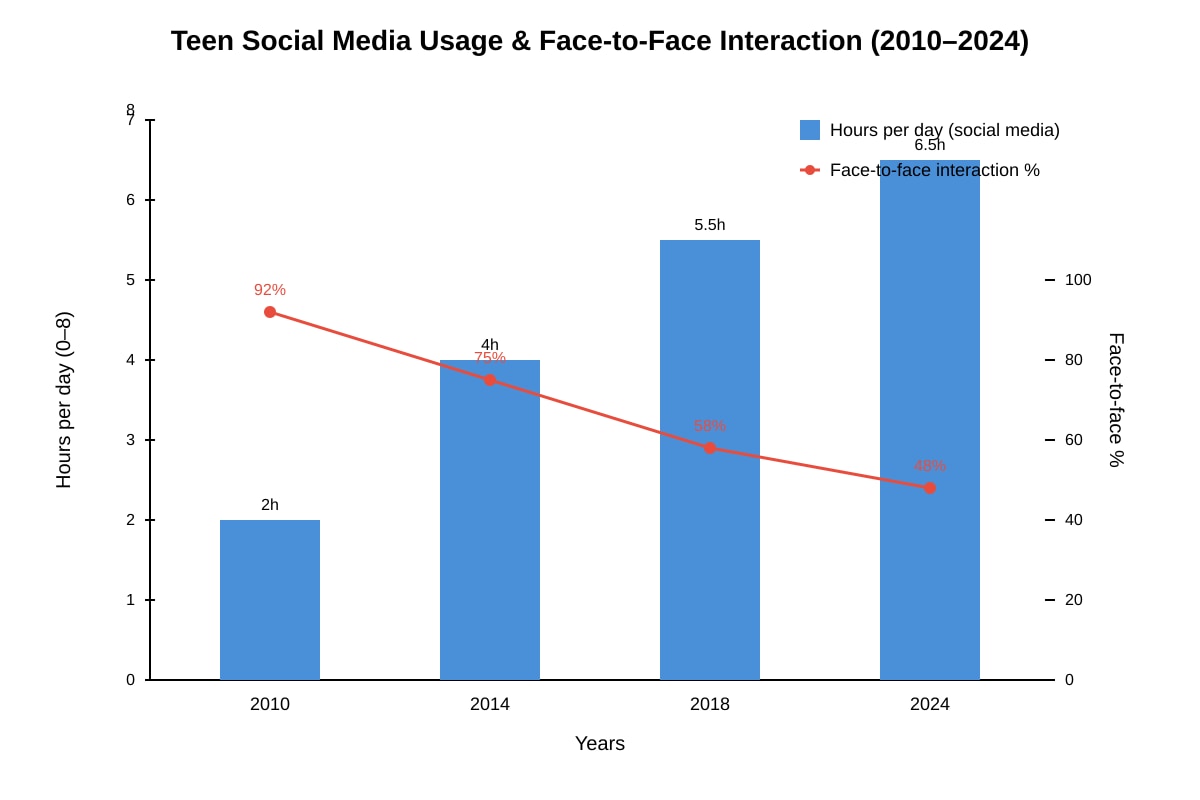
Answer: (1) Hours rose 2h→6.5h shows more device use; (2) Face-to-face fell 92%→48% shows isolation; (3) Inverse trend visually supports argument.
Teaching note: Use visual labels from placeholder.
Q16. [1 mark]
Answer: 58%.
Q17. [2 marks]
Answer: Sense of growing disconnect / irony of connected devices but fewer real talks.
Teaching note: Combine both data lines.
Q18. [2 marks]
Answer: Student overgeneralises; chart shows correlation not proof of evil. Reveals weak evaluation.
Teaching note: Evaluative level — distinguish data from opinion.
Q19. [3 marks]
Answer: Writer concerned because usage up, interaction down (1) → isolation risk (1) → less social skill (1).
Teaching note: Synthesise text + visual.
Q20. [4 marks]
Mark: 2 details × 2 marks.
Answer: Bars show climb; line shows drop — together reinforce habit change.
Teaching note: Visual reinforces message via contrast.
Section C subtotal: 20 marks
Total: 50 marks