From Real Exams Exam Paper
Secondary 3 English Semestral Assessment 2 (End of Year) Paper 5
Free Sec 3 English SA2 Paper 5, HY3 Exam version, with questions, answers, and O Level-style practice for Singapore students.
These static practice materials are generated from the site's syllabus and paper-generation workflow, with source and model context shown so students and parents can evaluate the material before use.
Questions
Free quiz and exam paper access
Enter your details to view this paper
Your access is remembered on this device.
Answers
TuitionGoWhere Exam Practice (AI) — SA2 Practice Paper Answer Key
Subject: English | Level: Secondary 3 | Paper: SA2 Comprehension (Version 5 of 5) | Total Marks: 50
Section A: Literal Understanding (Q1–8) — 8 marks
Q1 [1 mark]
Answer: The village elders said no ships come there anymore.
Teaching note: Scan Paragraph 1. The text states: "No ships come here anymore," they said. Accept paraphrase. Common mistake: answering from general knowledge instead of the text.
Q2 [1 mark]
Answer: The otters had made a nest inside the mechanism and their playful biting had severed the main cable.
Teaching note: Paragraph 2 explicitly states this. Student must name both the nest and the severed cable for full credit if asked for two parts, but here only "what they had done" — severing cable via biting is core.
Q3 [1 mark]
Answer: It tells us Joon was determined / firm in his purpose despite the situation.
Teaching note: "Resolution" in context means he was mentally decided to take on the role. Not dictionary "resolution = solution".
Q4 [1 mark]
Answer: A borrowed lantern (hung where the great lamp once shone).
Teaching note: Paragraph 3: "climbed the tower with a borrowed lantern".
Q5 [1 mark]
Answer: "This" refers to the storm (the storm that came in his second month / the test he feared).
Teaching note: Pronoun referent — read backward; the preceding sentence introduces the storm.
Q6 [1 mark]
Answer: A "stubborn star" refusing to vanish.
Teaching note: Direct quote from Paragraph 4 captain's words.
Q7 [1 mark]
Answer: He said nothing / he did not respond to the praise.
Teaching note: Paragraph 4: "Joon heard the praise but said nothing."
Q8 [1 mark]
Answer: He cleared the otters' nest and repaired the wire (main cable).
Teaching note: Two tasks stated in Paragraph 2. Mark awarded for both actions.
Section B: Inferential & Language Use (Q9–15) — 15 marks
Q9 [2 marks]
Answer: Joon was determined to take up the caretaker job and try his best (resolution), but he did not believe he could actually make the lighthouse work or change the village's situation (little hope).
Mark breakdown: 1 mark for resolution explained, 1 mark for little hope explained.
Teaching note: Paraphrase both halves. Do not copy phrase. Link to context: elders said no ships, light dead 11 years.
Q10 [1 mark]
Answer: The storm is personified as hostile / aggressive towards the land.
Teaching note: "Threw itself" gives human violence to sea. Attitude = attacking.
Q11 [3 marks]
Answer (three details):
- "threw itself" — personification suggests the sea attacked deliberately; conveys threat.
- "violence" — noun shows force and danger.
- "made the ground tremble" — physical effect emphasises power and fear.
Mark: 1 mark per detail + link.
Teaching note: Must quote and explain effect. Common trap: naming technique without effect.
Q12 [2 marks]
Answer: The captain saw the light as persistent and reliable ("stubborn" = refusing to give up; "star" = guiding). It shows he valued Joon's effort as life-saving.
Teaching note: Infer from metaphor. 1 mark for stubborn, 1 for star guidance.
Q13 [2 marks]
Answer: Joon felt his action was ordinary / part of duty, not worthy of praise; he was modest.
Mark: 1 for modesty, 1 for duty view.
Teaching note: Link to final sentence of Para 4.
Q14 [2 marks]
Answer: Joon sees his role as functional and humble; he does not seek credit. "Simply" shows he thinks it is normal.
Teaching note: Attitude = humble, duty-bound.
Q15 [2 marks]
Answer: He was practical and good-humoured; he laughed instead of being angry at the animals.
Mark: 1 for practical fix, 1 for amused reaction.
Section C: Evaluative & Synthesis (Q16–20) — 27 marks
Q16 [4 marks]
Answer:
- Detail 1: "fishing boat caught in squall saw the small light and steered away" — shows villagers/sea users now benefit.
- Detail 2: captain's praise "stubborn star" — language shows admiration, meaning restored.
Mark: 2 per detail with explanation.
Teaching note: Meaningful = valued by others.
Q17 [8 marks]
Mark descriptors:
- 7–8: Clear stance, uses ≥3 evidence (otters fix, lantern, boat saved), argues skill > luck.
- 5–6: Stance with 2 evidence, some analysis.
- 3–4: Partial agreement, weak evidence.
- 1–2: Lists only.
Sample answer: Disagree. Joon used skill: he diagnosed otter damage (Para 2), repaired cable, used lantern creatively (Para 3), thus boat saved (Para 4). Luck was minor (storm timing).
Teaching note: Text-supported reasoning required.
Q18 [3 marks]
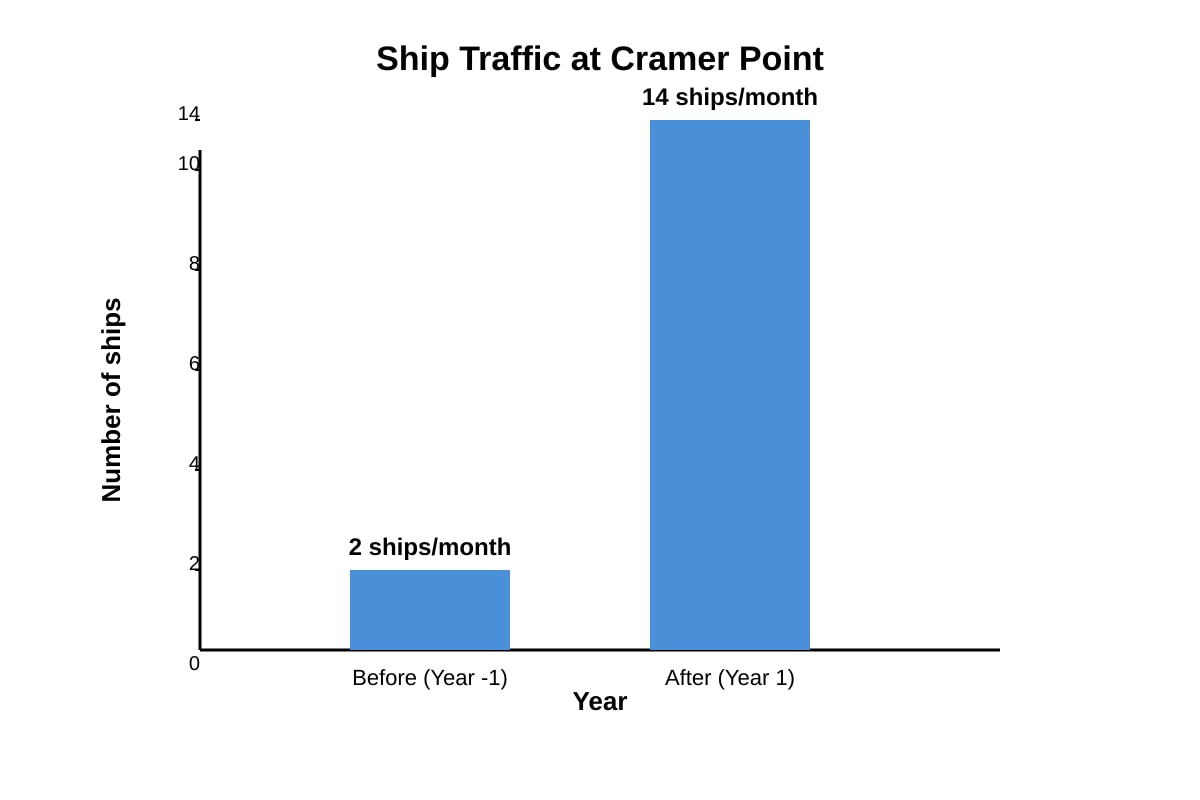
Answer: Ship traffic rose from 2 to 14 ships/month after relight. This supports passage ending by showing lighthouse again serves its purpose, village benefits.
Mark: 1 for values, 2 for link.
Visual features needed: bars labelled Before=2, After=14, title present.
Q19 [2 marks]
Answer: Captain's statement calling light "stubborn star" / village heard praise — shows changed respect.
Mark: 1 example, 1 explanation.
Q20 [8 marks]
Mark descriptors same as Q17.
Sample: Yes, heroic. Evidence: faced isolation (Para 1), fixed mechanism (Para 2), climbed in storm (Para 3), saved boat (Para 4), modest (Para 4).
Teaching note: Use passage evidence, not external definition only.