From Real Exams Exam Paper
Secondary 3 English Semestral Assessment 2 (End of Year) Paper 1
Free Sec 3 English SA2 Paper 1, HY3 Exam version, with questions, answers, and O Level-style practice for Singapore students.
These static practice materials are generated from the site's syllabus and paper-generation workflow, with source and model context shown so students and parents can evaluate the material before use.
Questions
Free quiz and exam paper access
Enter your details to view this paper
Your access is remembered on this device.
Answers
TuitionGoWhere Exam Practice (AI) — SA2 Practice Paper Answers
English Secondary 3 — Comprehension (Version 1 of 5)
Total Marks: 40
Section A: Literal Understanding (Q1–5) — Mark Scheme
Q1 [1 mark]
Answer: The wild horses were sold off to private owners.
Teaching note: Scan Paragraph 2: "After the auction of the land, the wild horses that once grazed nearby were sold off to private owners." This is a direct retrieval task. Common mistake: saying they were "set free" — not in text.
Q2 [1 mark]
Answer: Paint peeling and iron stairs rusted.
Teaching note: Paragraph 1 states "paint peeling and the iron stairs rusted". Both conditions needed for full mark. Common trap: naming only one.
Q3 [1 mark]
Answer: 1924.
Teaching note: Paragraph 2: "built in 1924 by a group of fishermen". Literal recall.
Q4 [1 mark]
Answer: Mr. Lim (a retired engineer).
Teaching note: Paragraph 4: "Maya met Mr. Lim, a retired engineer… He offered to help repair the stairs."
Q5 [1 mark]
Answer: To count the steps.
Teaching note: Paragraph 4: "the children returned to count the steps." Direct fact.
Section B: Inference & Language Use (Q6–15) — Mark Scheme
Q6 [1 mark]
Answer: She was determined but doubtful / she wanted to try but expected failure.
Teaching note: "Resolution" = determination; "little hope" = doubt. Contextual, not dictionary.
Q7 [2 marks]
Answer: The lighthouse was in very poor condition (peeling paint, rusted stairs, broken railings) so she doubted it could be fixed.
Mark breakdown: 1 mark for condition described, 1 mark for link to lack of hope.
Teaching note: Paraphrase required. Do not copy "little hope". Common error: only states "it was old".
Q8 [1 mark]
Answer: The sea "gives and takes without asking" (grandfather's saying).
Teaching note: "this" refers back to the quote in previous sentence. Not "the broken railings".
Q9 [1 mark]
Answer: He saw the sea as powerful and indifferent / uncontrollable.
Teaching note: "without asking" shows it takes what it wants; attitude = respectful but aware of its force.
Q10 [3 marks]
Answer (3 details):
- "broken railings" — suggests decay and abandonment.
- "wind was sharp" — personifies harsh, unwelcoming environment.
- "whisper through the cracks" — auditory imagery of emptiness.
Marking: 1 mark per detail + effect. Must link to lonely/worn-out.
Teaching note: Identify feature, quote, explain effect.
Q11 [1 mark]
Answer: It has dignity / it has stood through time with strength.
Teaching note: "proud" used metaphorically for the building's endurance.
Q12 [2 marks]
Answer: Though old and damaged, the lighthouse still stands and has historical value, so Mr. Lim respects it.
Marking: 1 for age/damage context, 1 for respect/value.
Teaching note: Own words; do not say "it feels pride".
Q13 [2 marks]
Answer: It shows the lighthouse is a symbol of the village's bond with the sea / a shared responsibility kept over time.
Marking: 1 for symbol, 1 for community bond.
Teaching note: Inferential — not literal promise.
Q14 [2 marks]
Answer:
- "beam was lit again" — change from dark to active.
- "promise kept" — from doubt to fulfilment.
Marking: 1 per detail.
Teaching note: Show contrast with earlier paragraphs.
Q15 [1 mark]
Answer: Villagers brought tools / children returned to count steps. (either)
Teaching note: Paragraph 4 evidence.
Section C: Combined Source & Visual (Q16–20) — Mark Scheme
Q16 [1 mark]
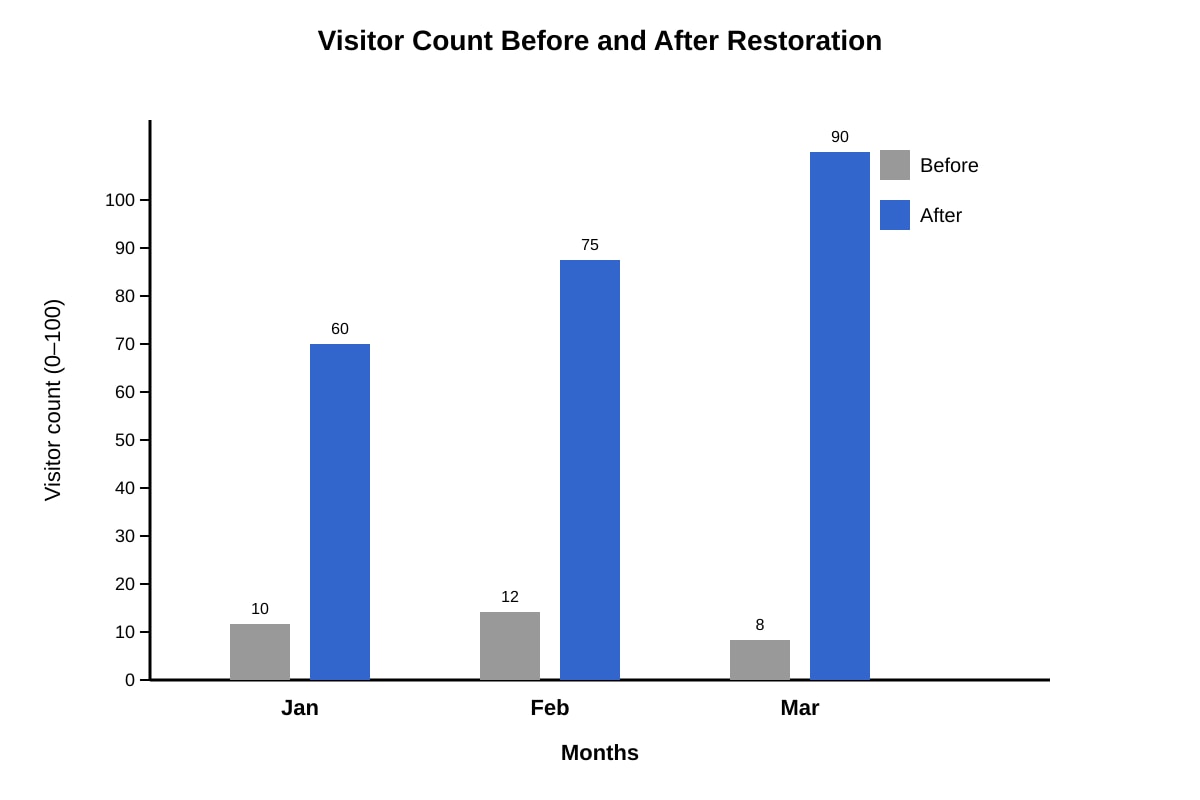
Answer: 90.
Teaching note: Table, March after = 90.
Q17 [2 marks]
Answer: After restoration, the lighthouse was functional and attractive again, so more people visited.
Marking: 1 for restoration link, 1 for increased interest.
Teaching note: Inference from Passage A + table.
Q18 [2 marks]
Answer: Visitor numbers after restoration are consistently higher than before for all three months (e.g., Mar 8→90).
Marking: 1 trend, 1 data reference.
Visual spec: Graph must show paired bars; answer uses those values.
Q19 [3 marks]
Answer:
- Table shows rise from ~10 to 60–90 monthly — renewed use.
- Graph shows growing gap — community re-engagement.
Marking: 1 per detail + 1 for conclusion of importance.
Teaching note: Synthesise both sources.
Q20 [4 marks]
Response framework:
- Agree/disagree stated (1)
- Evidence from Passage A: village teamwork, lighthouse as promise (1)
- Evidence from table: visitor increase shows benefit (1)
- Conclusion on community identity (1)
Teaching note: 4-mark extended; need text-supported reasoning, not opinion only.
End of Answer Key