AI Generated Quiz
Secondary 3 Elementary Mathematics Statistics Probability Quiz
Free Sec 3 E Maths Statistics quiz, Nemo3 AI version, with questions, answers, and O Level-style practice for Singapore students.
These static practice materials are generated from the site's syllabus and paper-generation workflow, with source and model context shown so students and parents can evaluate the material before use.
Questions

Free quiz and exam paper access
Enter your details to view this paper
Your access is remembered on this device.
Answers
Secondary 3 Elementary Mathematics Quiz - Statistics Probability (Answer Key)
Total Marks: 40
Section A: Data Handling and Representation
Question 1 [3 marks]
(a) Mode = 2
Reasoning: The mode is the value with the highest frequency. Frequency of 2 books is 9, which is the highest.
(b) Mean = 2.1
Working:
Mean = Σ(fx) / Σf
= (0×3 + 1×7 + 2×9 + 3×6 + 4×4 + 5×1) / 30
= (0 + 7 + 18 + 18 + 16 + 5) / 30
= 64 / 30
= 2.133... ≈ 2.1 (3 s.f.)
(c) Median = 2
Reasoning: For 30 students, median is the average of the 15th and 16th values.
Cumulative frequencies: 3, 10, 19, 25, 29, 30.
Both 15th and 16th values fall in the "2 books" category.
Median = 2.
Marking notes:
- 1 mark for correct mode
- 1 mark for correct mean calculation (method + answer)
- 1 mark for correct median with reasoning
- Accept 2.13 for mean if 3 s.f. used
Question 2 [3 marks]
(a) Stem-and-leaf diagram:
15 | 2 8
16 | 0 2 5 5 7 8 9
17 | 0 1 2 3 4 5 6 8
18 | 0 2 5
Key: 15 | 2 = 152 cm
(b) IQR = 13.5 cm
Working:
n = 20
Q1 position = (20+1)/4 = 5.25 → between 5th and 6th values
5th value = 165, 6th value = 165 → Q1 = 165
Q3 position = 3(20+1)/4 = 15.75 → between 15th and 16th values
15th value = 175, 16th value = 176 → Q3 = 175.75
IQR = Q3 - Q1 = 175.75 - 165 = 10.75 cm
Alternative method (using n/4 and 3n/4):
Q1 at 5th value = 165, Q3 at 15th value = 175 → IQR = 10 cm
Both methods accepted if clearly shown.
Marking notes:
- 1 mark for correct ordered stem-and-leaf with key
- 1 mark for correct Q1 and Q3 identification
- 1 mark for correct IQR calculation
- Common mistake: forgetting to order leaves or missing key
Question 3 [3 marks]
(a) Modal class = 60 < t ≤ 90
Reasoning: Highest frequency is 15.
(b) Estimated mean = 68.25 minutes
Working:
Use midpoints: 15, 45, 75, 105, 135
Σ(fx) = 5(15) + 12(45) + 15(75) + 6(105) + 2(135)
= 75 + 540 + 1125 + 630 + 270 = 2640
Mean = 2640 / 40 = 66 minutes
Correction: 2640/40 = 66 exactly.
Wait, recalculating: 75+540=615, +1125=1740, +630=2370, +270=2640. 2640/40 = 66.
Estimated mean = 66 minutes
(c) Median lies in class 60 < t ≤ 90
Reasoning: n = 40, median position = 20.5th value.
Cumulative frequencies: 5, 17, 32, 38, 40.
20.5th value falls in the 3rd class (60 < t ≤ 90).
Marking notes:
- 1 mark for modal class
- 1 mark for estimated mean (midpoints + calculation)
- 1 mark for correct median class with reasoning
- Common mistake: using class boundaries instead of midpoints
Question 4 [3 marks]
From cumulative frequency curve:
(a) Median ≈ 55 marks
Method: Median at 40th value (80/2). Read horizontally from 40 on CF axis to curve, then down to marks axis.
(b) IQR ≈ 35 marks
Method: Q1 at 20th value → ≈ 38 marks. Q3 at 60th value → ≈ 73 marks. IQR = 73 - 38 = 35 marks.
(c) Students scoring > 75 marks ≈ 12
Method: At 75 marks, CF ≈ 68. Students above = 80 - 68 = 12.
Marking notes:
- 1 mark each for reasonable estimates from graph
- Allow ±2 marks tolerance for reading off graph
- Must show evidence of reading from graph (horizontal/vertical lines)
Question 5 [3 marks]
(a) Comparisons:
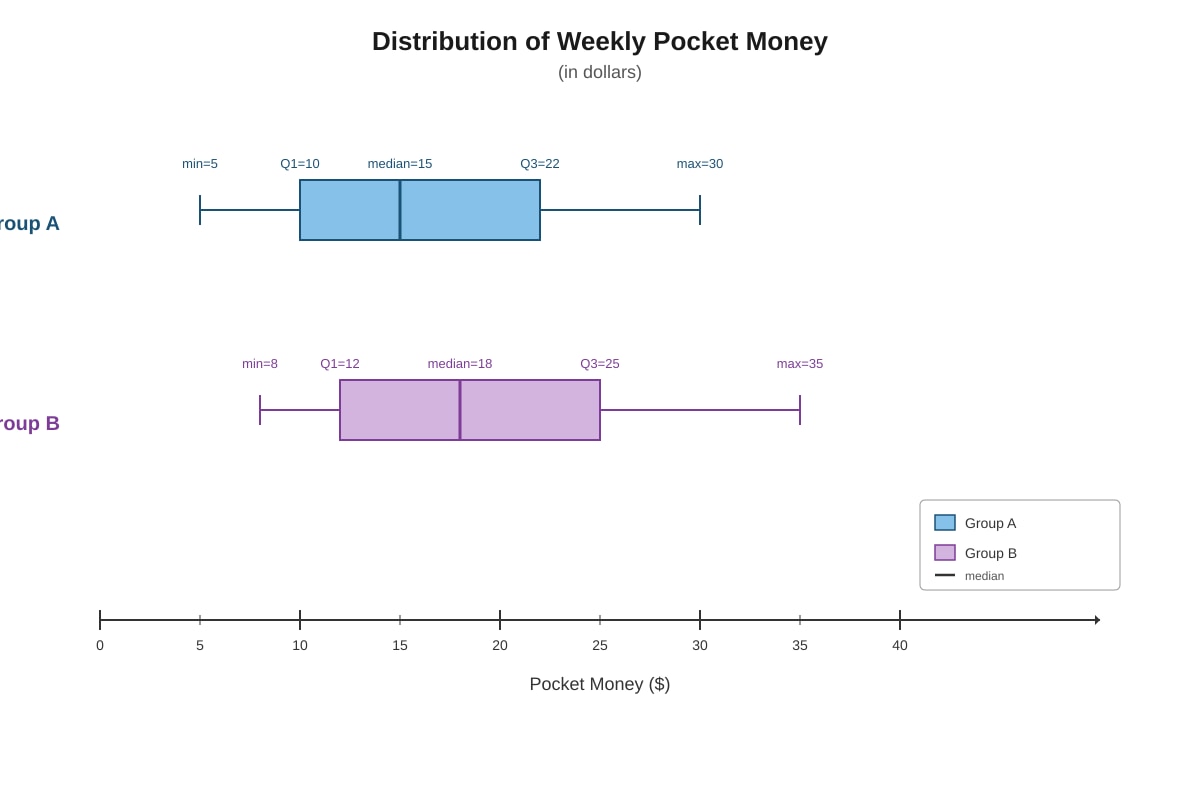
- Central tendency: Group B has higher median (18 vs 15), indicating students in Group B generally receive more pocket money.
- Spread: Group B has larger IQR (13 vs 12) and larger range (27 vs 25), indicating more variability in pocket money amounts.
(b) Claim is INCORRECT.
Reasoning: Median of Group B = 18. For Group A, Q3 = 22. Since Q3 (22) > 18, more than 25% of Group A students receive ≥ 22, which is > 18. In fact, 50% of Group A receive ≥ 15, and 25% receive ≥ 22. The claim says "at least 75% receive less than 18" — but 25% receive ≥ 22 (>18), and some between 15-22 also receive ≥ 18. So less than 75% receive < 18.
Marking notes:
- 1 mark for each valid comparison (max 2)
- 1 mark for correct evaluation of claim with reasoning
- Must reference specific values from box plot
Section B: Probability
Question 6 [2 marks]
(a) P(Red) = 5/10 = 1/2 = 0.5
(b) P(Not Blue) = 1 - P(Blue) = 1 - 3/10 = 7/10 = 0.7
Or: P(Red or Green) = 5/10 + 2/10 = 7/10
Marking notes: 1 mark each. Accept fractions, decimals, or percentages.
Question 7 [2 marks]
(a) A = {2, 4, 6}, B = {2, 3, 5} → A ∩ B = {2}
(b) A ∪ B = {2, 3, 4, 5, 6} → P(A ∪ B) = 5/6
Or: P(A) + P(B) - P(A∩B) = 3/6 + 3/6 - 1/6 = 5/6
Marking notes: 1 mark each. Must list set for (a).
Question 8 [3 marks]
Let R = rainy, C = cloudy. P(R) = 0.4, P(C) = 0.7, P(R∩C) = 0.3
(a) P(R ∪ C) = P(R) + P(C) - P(R∩C) = 0.4 + 0.7 - 0.3 = 0.8
(b) P(C but not R) = P(C) - P(R∩C) = 0.7 - 0.3 = 0.4
(c) Check independence: P(R) × P(C) = 0.4 × 0.7 = 0.28 ≠ 0.3 = P(R∩C)
→ Not independent (since P(R∩C) ≠ P(R)P(C))
Marking notes:
- 1 mark each part
- For (c), must show calculation and conclusion
Question 9 [4 marks]
(a) Tree diagram:
First draw:          Second draw:
W (4/10) ────────── W (3/9) → WW
        └────────── B (6/9) → WB
B (6/10) ────────── W (4/9) → BW
        └────────── B (5/9) → BB
Probabilities on branches: 4/10, 6/10, then conditional probabilities.
(b) P(same colour) = P(WW) + P(BB) = (4/10)(3/9) + (6/10)(5/9) = 12/90 + 30/90 = 42/90 = 7/15 ≈ 0.467
(c) P(2nd is White) = P(WW) + P(BW) = (4/10)(3/9) + (6/10)(4/9) = 12/90 + 24/90 = 36/90 = 2/5 = 0.4
Note: Same as P(1st is White) due to symmetry.
Marking notes:
- 1 mark for correct tree diagram with probabilities
- 1 mark for P(same colour) with working
- 1 mark for P(2nd White) with working
- 1 mark for correct final answers
- Common mistake: using replacement probabilities
Question 10 [4 marks]
(a) Venn diagram:
Two overlapping circles B (Biology) and C (Chemistry).
Intersection = 8.
B only = 18 - 8 = 10.
C only = 15 - 8 = 7.
Neither = 30 - (10+8+7) = 5.
(b) P(Biology but not Chemistry) = 10/30 = 1/3
(c) P(Biology | Chemistry) = P(B∩C) / P(C) = 8/15
Marking notes:
- 1 mark for correct Venn diagram with all values
- 1 mark for (b)
- 1 mark for (c) with conditional probability formula
- 1 mark for correct answers
Question 11 [3 marks]
(a) Multiples of 3: 3, 6 → 2 outcomes. P(win) = 2/8 = 1/4 = 0.25
(b) P(exactly 1 win in 2 spins) = 2 × (1/4) × (3/4) = 6/16 = 3/8 = 0.375
Binomial: n=2, p=1/4, P(X=1) = 2C1 × (1/4)¹ × (3/4)¹
(c) Expected winners = 120 × 1/4 = 30
Marking notes:
- 1 mark each part
- For (b), must consider both orders (WL and LW)
Question 12 [3 marks]
Let M = pass Math, E = pass English. P(M)=0.75, P(E)=0.8, P(M∩E)=0.65
(a) P(at least one) = P(M∪E) = 0.75 + 0.8 - 0.65 = 0.9
(b) P(exactly one) = P(M∪E) - P(M∩E) = 0.9 - 0.65 = 0.25
Or: P(M only) + P(E only) = (0.75-0.65) + (0.8-0.65) = 0.1 + 0.15 = 0.25
(c) P(E | M) = P(M∩E) / P(M) = 0.65 / 0.75 = 13/15 ≈ 0.867
Marking notes:
- 1 mark each part
- For (b), accept either method
Question 13 [4 marks]
Total = 10 marbles (6R, 4B). Draw 3 without replacement.
(a) P(3 Red) = (6/10)(5/9)(4/8) = 120/720 = 1/6 ≈ 0.167
(b) P(exactly 2 Red) = P(RRB) + P(RBR) + P(BRR)
= 3 × (6/10)(5/9)(4/8) = 3 × 120/720 = 360/720 = 1/2 = 0.5
Wait: For exactly 2 red, the blue can be in any of 3 positions. Each sequence: (6/10)(5/9)(4/8) = 120/720. But careful: after 2 reds drawn, 4 blue remain out of 8. Yes, 4/8. So 3 × 120/720 = 360/720 = 1/2.
(c) P(at least 1 Blue) = 1 - P(no Blue) = 1 - P(3 Red) = 1 - 1/6 = 5/6 ≈ 0.833
Marking notes:
- 1 mark for (a)
- 1 mark for (b) with correct combination count (3 ways)
- 1 mark for (c) using complement
- 1 mark for correct final answers
Question 14 [3 marks]
P(X)=0.5, P(Y)=0.4, P(X∪Y)=0.7
(a) P(X∩Y) = P(X) + P(Y) - P(X∪Y) = 0.5 + 0.4 - 0.7 = 0.2
(b) P(X|Y) = P(X∩Y)/P(Y) = 0.2/0.4 = 0.5
(c) Mutually exclusive means P(X∩Y) = 0. Here P(X∩Y) = 0.2 ≠ 0 → NOT mutually exclusive.
Marking notes:
- 1 mark each part
- For (c), must state definition and compare
Question 15 [3 marks]
P(defective) = 0.02, P(not defective) = 0.98. n = 5 independent trials.
(a) P(none defective) = (0.98)⁵ ≈ 0.9039
(b) P(at least 1 defective) = 1 - P(none) = 1 - 0.9039 = 0.0961
(c) Expected defective in 1000 = 1000 × 0.02 = 20
Marking notes:
- 1 mark each part
- For (a), accept (0.98)^5 or calculated value
- For (c), must be whole number
Section C: Combined Problems
Question 16 [3 marks]
(a) Mean = Σ(fx)/Σf = (1×4 + 2×8 + 3×15 + 4×12 + 5×11) / 50
= (4 + 16 + 45 + 48 + 55) / 50 = 168 / 50 = 3.36
(b) P(both scored 5) = (11/50) × (10/49) = 110/2450 = 11/245 ≈ 0.0449
Marking notes:
- 1 mark for mean
- 1 mark for correct probability setup (without replacement)
- 1 mark for correct answer
Question 17 [3 marks]
(a) Mean = (0×15 + 1×45 + 2×25 + 3×10 + 4×5) / 100
= (0 + 45 + 50 + 30 + 20) / 100 = 145/100 = 1.45 cars
(b) P(exactly 2 of 3 own 2 cars):
Households with 2 cars = 25. Without replacement.
P = 3C2 × (25/100) × (24/99) × (75/98)
= 3 × (25/100) × (24/99) × (75/98)
= 3 × (1/4) × (24/99) × (75/98)
= 3 × (1/4) × (8/33) × (75/98)
= 3 × 600 / (4×33×98) = 1800 / 12936 = 75/539 ≈ 0.139
Marking notes:
- 1 mark for mean
- 1 mark for correct binomial-like setup with without-replacement probabilities
- 1 mark for correct answer
Question 18 [4 marks]
P(on time) = 0.85, P(late) = 0.15. n = 5 independent days. Binomial distribution.
(a) P(5 on time) = (0.85)⁵ ≈ 0.4437
(b) P(exactly 4 on time) = 5C1 × (0.85)⁴ × (0.15)¹ = 5 × 0.5220 × 0.15 ≈ 0.3915
(c) P(late ≥ 2) = 1 - P(late 0) - P(late 1)
P(late 0) = (0.85)⁵ ≈ 0.4437
P(late 1) = 5 × (0.85)⁴ × (0.15) ≈ 0.3915
P(late ≥ 2) = 1 - 0.4437 - 0.3915 = 0.1648
Marking notes:
- 1 mark each part
- For (c), accept complement method or direct sum of P(2)+P(3)+P(4)+P(5)
- Answers to 4 d.p. or 3 s.f.
Question 19 [4 marks]
3 Gold (G), 7 Silver (S). Total 10. Draw 2 without replacement.
(a) P(G) = 3/10 = 0.3
(b) P(S | G) = 7/9 (after 1 gold removed, 9 left with 7 silver)
(c) P(G ∩ S) = P(G) × P(S|G) = (3/10) × (7/9) = 21/90 = 7/30 ≈ 0.233
(d) Check independence: P(G) × P(S) = (3/10) × (7/10) = 21/100 = 0.21
But P(G∩S) = 7/30 ≈ 0.233 ≠ 0.21 → NOT independent
Reason: Drawing without replacement makes events dependent.
Marking notes:
- 1 mark each part
- For (d), must show calculation and conclusion
Question 20 [4 marks]
P(Dog) = 0.6, P(Cat) = 0.4, P(Dog∩Cat) = 0.15
(a) Venn diagram:
Two overlapping circles. Intersection = 0.15.
Dog only = 0.6 - 0.15 = 0.45.
Cat only = 0.4 - 0.15 = 0.25.
Neither = 1 - (0.45+0.15+0.25) = 0.15.
(b) P(neither) = 0.15
(c) P(Cat | Dog) = P(Dog∩Cat) / P(Dog) = 0.15 / 0.6 = 0.25
(d) Check independence: P(Dog) × P(Cat) = 0.6 × 0.4 = 0.24
P(Dog∩Cat) = 0.15 ≠ 0.24 → NOT independent
The claim is false. Having a dog and having a cat are negatively associated (households with dogs are less likely to have cats than if independent).
Marking notes:
- 1 mark for Venn diagram with correct probabilities
- 1 mark for (b)
- 1 mark for (c) with conditional probability
- 1 mark for (d) with calculation and conclusion
End of Answer Key