Secondary 3 Elementary Mathematics Quiz - Calculus
Name: ___________________________
Class: ______________
Date: ______________
Score: _______ / 40
Duration: 50 minutes
Total Marks: 40
Instructions:
- This quiz covers introductory calculus concepts aligned with the Secondary 3 Elementary Mathematics syllabus (rate of change, gradient of a curve, average rate of change, and basic differentiation of simple power functions).
- Answer all 20 questions.
- Show your working clearly where space is provided.
- Use π = 3.142 where needed.
Section A: Rate of Change and Gradient of a Curve (Questions 1–7)
1. [2 marks] A car travels 240 m in 8 seconds. Find the average speed of the car in m/s.
2. [2 marks] The temperature of a liquid decreases from 80°C to 68°C in 4 minutes. Find the average rate of decrease in °C per minute.
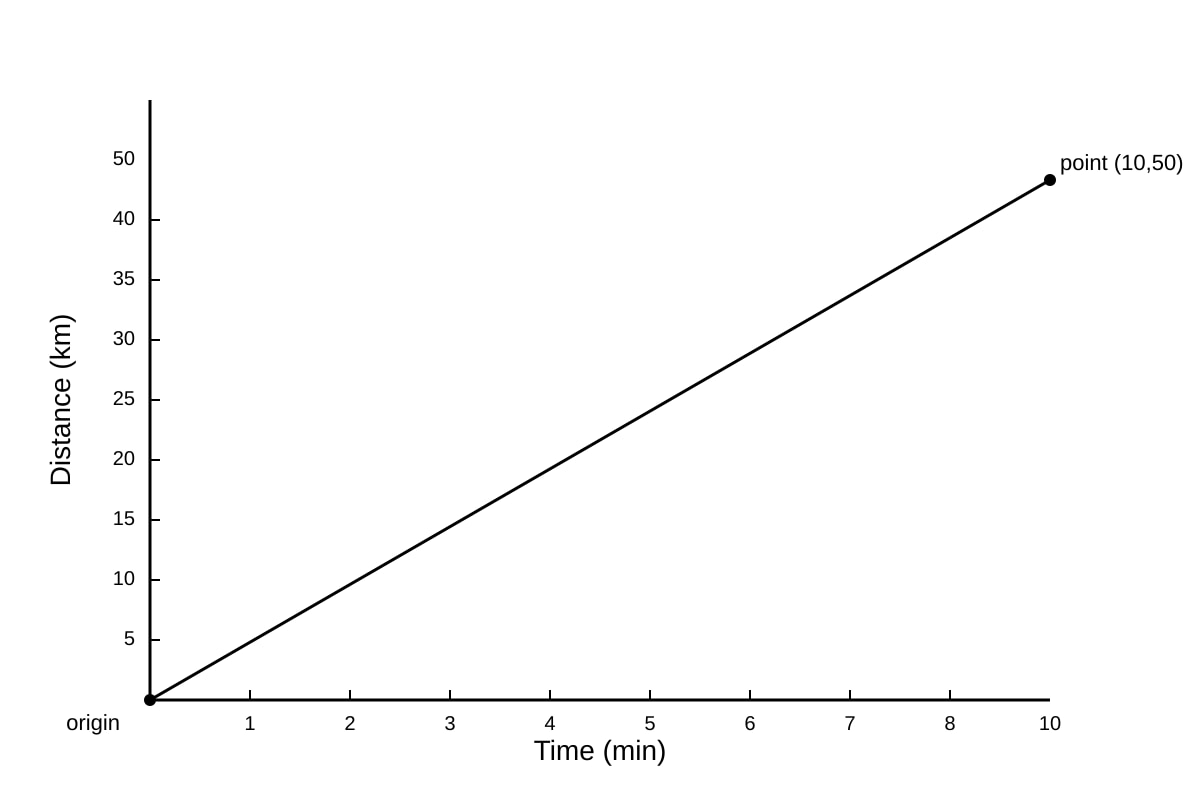
3. [2 marks] The graph below shows the distance travelled by a cyclist over time.
Generated graph for Q3.
Estimate the average speed of the cyclist between 0 and 10 minutes.
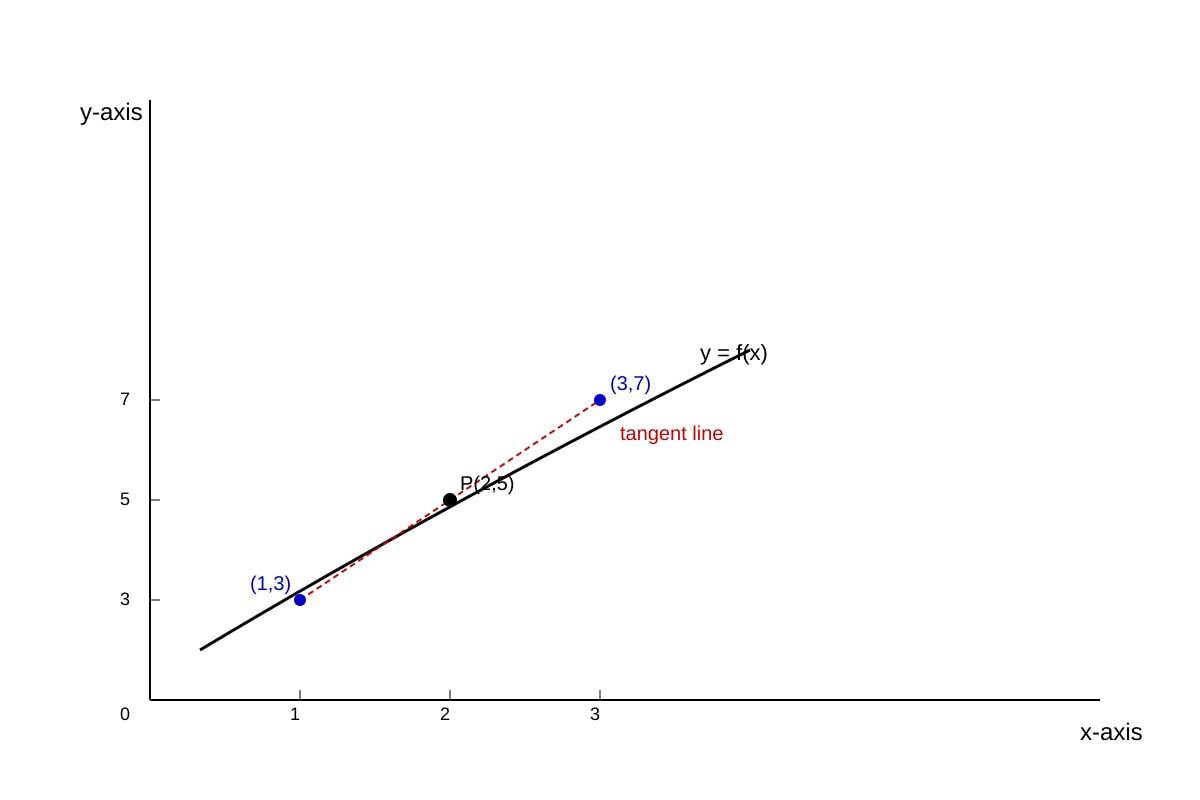
4. [2 marks] The diagram shows a curve y = f(x). At point P(2, 5), a tangent is drawn.
Generated diagram for Q4.
Using the points (1, 3) and (3, 7) on the tangent, find the gradient of the tangent at P.
5. [2 marks] A ball is dropped and its height h (in m) after t seconds is h = 20 − 5t². Find the average rate of change of height between t = 1 and t = 2.
6. [2 marks] The gradient of a curve at a point is given by the value of (\frac{dy}{dx}) at that point. Explain in one sentence what (\frac{dy}{dx}) represents.
7. [2 marks] A curve has gradient 0 at x = 4. State what this tells you about the tangent to the curve at x = 4.
Section B: Basic Differentiation of Power Functions (Questions 8–14)
8. [1 mark] Given (y = x^3), write down (\frac{dy}{dx}).
9. [2 marks] Differentiate (y = 4x^2) with respect to x.
10. [2 marks] Find (\frac{dy}{dx}) for (y = 3x^2 - 5x + 2).
11. [2 marks] A curve has equation (y = x^3 - 2x). Find the gradient of the curve at x = 2.
12. [2 marks] Given (y = \frac{1}{x^2}), express y as a power of x and find (\frac{dy}{dx}).
13. [3 marks] The height of water in a tank is given by (h = 2t^2 + 3t) where h is in cm and t in minutes.
(a) Find (\frac{dh}{dt}). [1]
(b) Hence find the rate of change of height when t = 3. [2]
14. [3 marks] A company’s profit P (in $1000) after x months is (P = 5x^2 - 20x + 30).
(a) Find (\frac{dP}{dx}). [1]
(b) Find the rate of change of profit when x = 4. [2]
Section C: Application and Interpretation (Questions 15–20)
15. [2 marks] The position s (m) of a robot is (s = 2t^2 + t). Find the velocity (rate of change of s) at t = 3 s.
16. [2 marks] A curve is given by (y = 6x - x^2). Find the x-coordinate where the gradient is zero.
17. [2 marks] The volume of a cube increases at a constant rate of 12 cm³/s. Explain why the side length does not increase at a constant rate.
18. [3 marks] The cost C of making x items is (C = x^2 - 4x + 10).
(a) Find (\frac{dC}{dx}). [1]
(b) Find the rate at which cost is changing when x = 5. [2]
19. [3 marks] A ball is thrown up. Its height is (h = 10t - 5t^2).
(a) Find (\frac{dh}{dt}). [1]
(b) Find the time when the ball stops rising. [2]
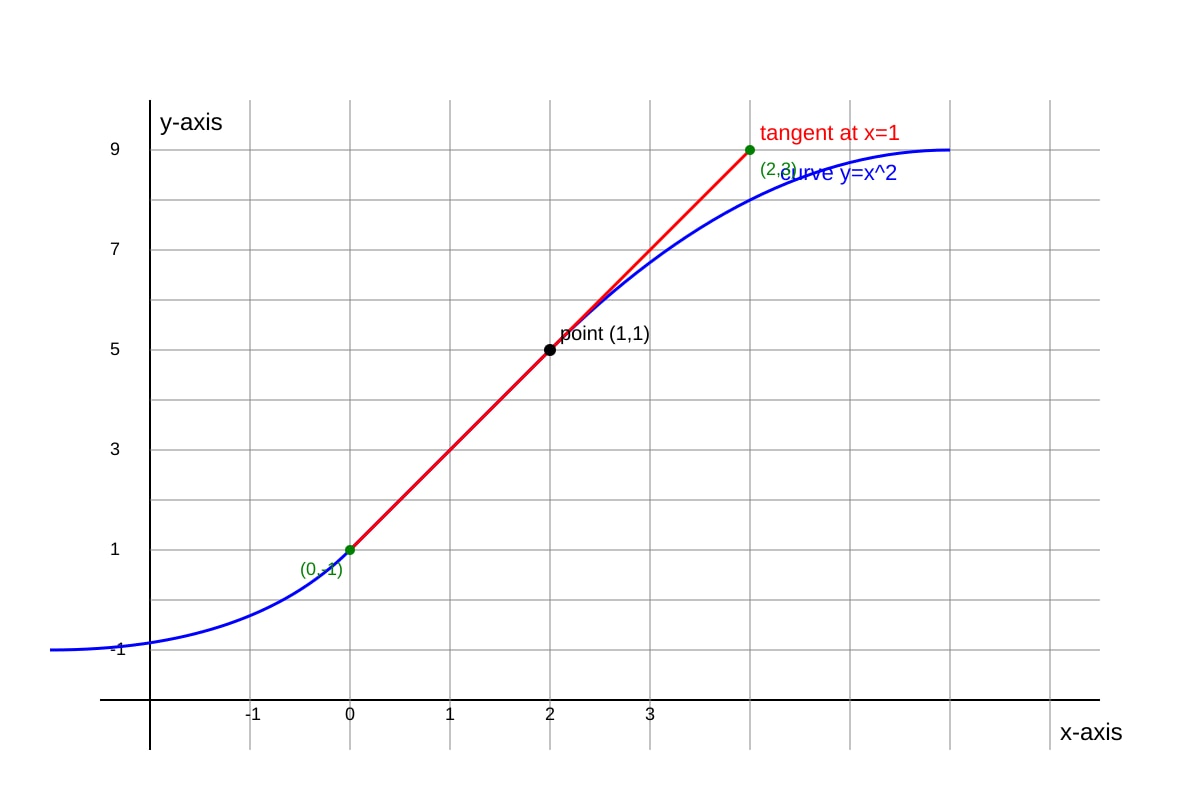
20. [3 marks] The graph shows y = x².
Generated graph for Q20.
(a) Find the gradient of the tangent drawn at x = 1 using the points given. [1]
(b) Use differentiation to verify this gradient. [2]
</stage5_quiz_answers_md>
<stage5_quiz_answers_md>
Secondary 3 Elementary Mathematics Quiz - Calculus (Answer Key)
Total Marks: 40
Topic: Calculus (introductory: rate of change, gradient of curve, basic differentiation)
Section A: Rate of Change and Gradient of a Curve
Q1. [2 marks]
Average speed = distance ÷ time = 240 ÷ 8 = 30 m/s.
Teaching note: Speed is a rate of change of distance with time. Divide total distance by total time.
Common mistake: Using 8 ÷ 240 instead of 240 ÷ 8.
Q2. [2 marks]
Decrease = 80 − 68 = 12°C over 4 min. Rate = 12 ÷ 4 = 3°C/min.
Teaching note: Average rate of decrease = total change ÷ time taken. Negative gradient if plotted.
Q3. [2 marks]
From graph, distance at 0 min = 0 km, at 10 min = 50 km.
Average speed = (50 − 0) ÷ (10 − 0) = 5 km/min.
Teaching note: Gradient of distance-time graph = speed. Use two points on line.
Q4. [2 marks]
Gradient = (7 − 3) ÷ (3 − 1) = 4 ÷ 2 = 2.
Teaching note: Gradient of tangent = (y₂−y₁)/(x₂−x₁). This estimates curve gradient at P.
Q5. [2 marks]
h(1) = 20 − 5(1)² = 15 m; h(2) = 20 − 5(2)² = 0 m.
Avg rate = (0 − 15) ÷ (2 − 1) = −15 m/s.
Teaching note: Negative means height decreasing. Average rate = Δh/Δt.
Q6. [2 marks]
(\frac{dy}{dx}) represents the gradient of the curve y = f(x) at a given point (or instantaneous rate of change of y with respect to x).
Teaching note: It is the limit of the gradient of the chord as the interval shrinks to zero.
Q7. [2 marks]
The tangent is horizontal (parallel to x-axis) at x = 4.
Teaching note: Zero gradient means no steepness; curve is flat there (possible maximum/minimum).
Section B: Basic Differentiation of Power Functions
Q8. [1 mark]
(\frac{dy}{dx} = 3x^2).
Teaching note: Power rule: bring down power, reduce power by 1.
Q9. [2 marks]
y = 4x² → (\frac{dy}{dx} = 4 × 2x^{1} = 8x).
Marking: 1 for rule, 1 for answer.
Q10. [2 marks]
(\frac{dy}{dx} = 3×2x^{1} - 5×1x^{0} + 0 = 6x - 5).
Teaching note: Constant becomes 0.
Q11. [2 marks]
(\frac{dy}{dx} = 3x^2 - 2). At x = 2: 3(4) − 2 = 10.
Marking: 1 for derivative, 1 for substitution.
Q12. [2 marks]
y = x⁻². (\frac{dy}{dx} = -2x^{-3} = -\frac{2}{x^3}).
Teaching note: 1/x² = x⁻²; apply power rule.
Q13. [3 marks]
(a) [1] (\frac{dh}{dt} = 4t + 3).
(b) [2] At t=3: 4(3)+3 = 15 cm/min.
Teaching note: Rate of change from derivative; substitute t.
Q14. [3 marks]
(a) [1] (\frac{dP}{dx} = 10x - 20).
(b) [2] At x=4: 10(4)−20 = 20 ($1000/month).
Teaching note: Positive means profit increasing.
Section C: Application and Interpretation
Q15. [2 marks]
v = (\frac{ds}{dt} = 4t + 1). At t=3: 4(3)+1 = 13 m/s.
Q16. [2 marks]
(\frac{dy}{dx} = 6 - 2x = 0) → x = 3.
Teaching note: Set gradient = 0 for stationary point.
Q17. [2 marks]
Volume V = s³, dV/dt constant = 12, but ds/dt = (1/3)s⁻² dV/dt depends on s, so not constant.
Teaching note: Side length rate varies as s changes.
Q18. [3 marks]
(a) [1] (\frac{dC}{dx} = 2x - 4).
(b) [2] At x=5: 2(5)−4 = 6 ($1000/item).
Q19. [3 marks]
(a) [1] (\frac{dh}{dt} = 10 - 10t).
(b) [2] Stops rising when 10−10t=0 → t=1 s.
Q20. [3 marks]
(a) [1] Gradient = (3−(−1))/(2−0) = 4 ÷ 2 = 2.
(b) [2] y=x² → dy/dx=2x; at x=1, gradient = 2×1 = 2. Verified.
</stage5_quiz_answers_md>
<stage5_quiz_md>
Secondary 3 Elementary Mathematics Quiz - Calculus
Name: ___________________________
Class: ______________
Date: ______________
Score: _______ / 40
Duration: 50 minutes
Total Marks: 40
Instructions:
- This quiz covers introductory calculus concepts aligned with the Secondary 3 Elementary Mathematics syllabus (rate of change, gradient of a curve, average rate of change, and basic differentiation of simple power functions).
- Answer all 20 questions.
- Show your working clearly where space is provided.
- Use π = 3.142 where needed.
Section A: Rate of Change and Gradient of a Curve (Questions 1–7)
1. [2 marks] A car travels 240 m in 8 seconds. Find the average speed of the car in m/s.
2. [2 marks] The temperature of a liquid decreases from 80°C to 68°C in 4 minutes. Find the average rate of decrease in °C per minute.
3. [2 marks] The graph below shows the distance travelled by a cyclist over time.

Generated graph for Q3.
Estimate the average speed of the cyclist between 0 and 10 minutes.
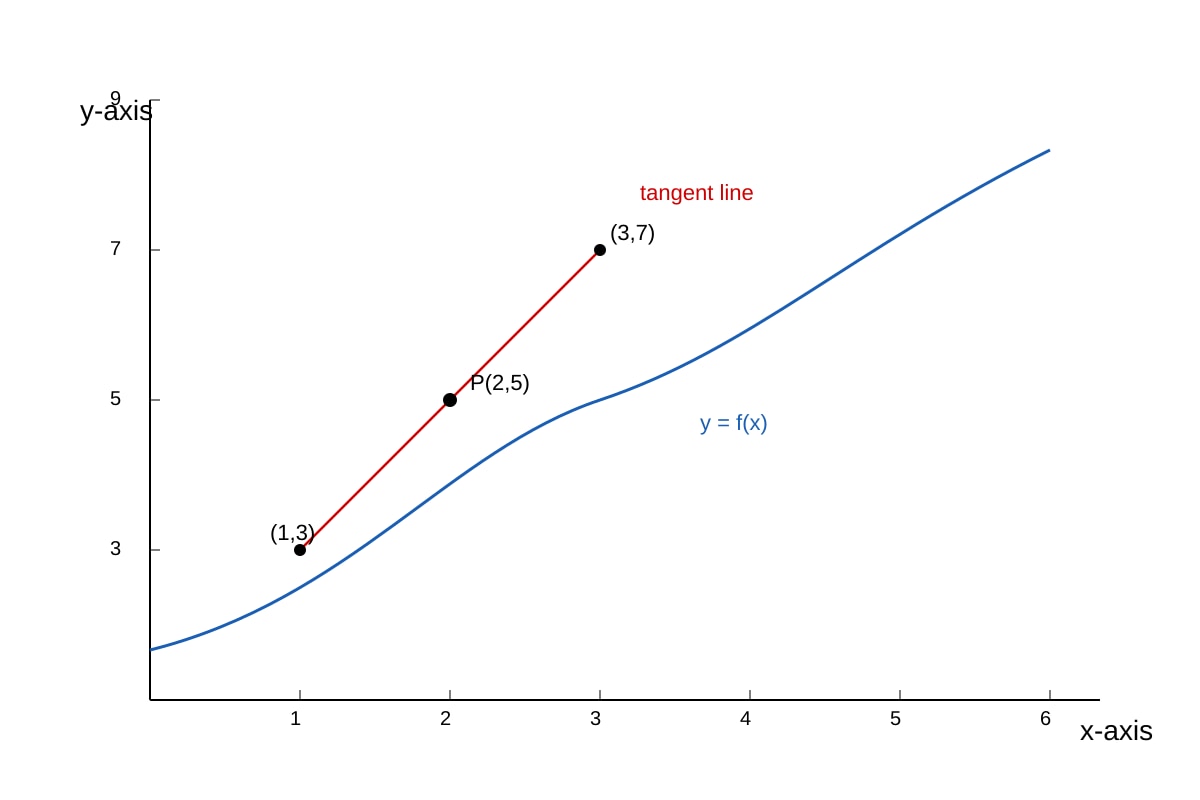
4. [2 marks] The diagram shows a curve y = f(x). At point P(2, 5), a tangent is drawn.
Generated diagram for Q4.
Using the points (1, 3) and (3, 7) on the tangent, find the gradient of the tangent at P.
5. [2 marks] A ball is dropped and its height h (in m) after t seconds is h = 20 − 5t². Find the average rate of change of height between t = 1 and t = 2.
6. [2 marks] The gradient of a curve at a point is given by the value of (\frac{dy}{dx}) at that point. Explain in one sentence what (\frac{dy}{dx}) represents.
7. [2 marks] A curve has gradient 0 at x = 4. State what this tells you about the tangent to the curve at x = 4.
Section B: Basic Differentiation of Power Functions (Questions 8–14)
8. [1 mark] Given (y = x^3), write down (\frac{dy}{dx}).
9. [2 marks] Differentiate (y = 4x^2) with respect to x.
10. [2 marks] Find (\frac{dy}{dx}) for (y = 3x^2 - 5x + 2).
11. [2 marks] A curve has equation (y = x^3 - 2x). Find the gradient of the curve at x = 2.
12. [2 marks] Given (y = \frac{1}{x^2}), express y as a power of x and find (\frac{dy}{dx}).
13. [3 marks] The height of water in a tank is given by (h = 2t^2 + 3t) where h is in cm and t in minutes.
(a) Find (\frac{dh}{dt}). [1]
(b) Hence find the rate of change of height when t = 3. [2]
14. [3 marks] A company’s profit P (in $1000) after x months is (P = 5x^2 - 20x + 30).
(a) Find (\frac{dP}{dx}). [1]
(b) Find the rate of change of profit when x = 4. [2]
Section C: Application and Interpretation (Questions 15–20)
15. [2 marks] The position s (m) of a robot is (s = 2t^2 + t). Find the velocity (rate of change of s) at t = 3 s.
16. [2 marks] A curve is given by (y = 6x - x^2). Find the x-coordinate where the gradient is zero.
17. [2 marks] The volume of a cube increases at a constant rate of 12 cm³/s. Explain why the side length does not increase at a constant rate.
18. [3 marks] The cost C of making x items is (C = x^2 - 4x + 10).
(a) Find (\frac{dC}{dx}). [1]
(b) Find the rate at which cost is changing when x = 5. [2]
19. [3 marks] A ball is thrown up. Its height is (h = 10t - 5t^2).
(a) Find (\frac{dh}{dt}). [1]
(b) Find the time when the ball stops rising. [2]
20. [3 marks] The graph shows y = x².
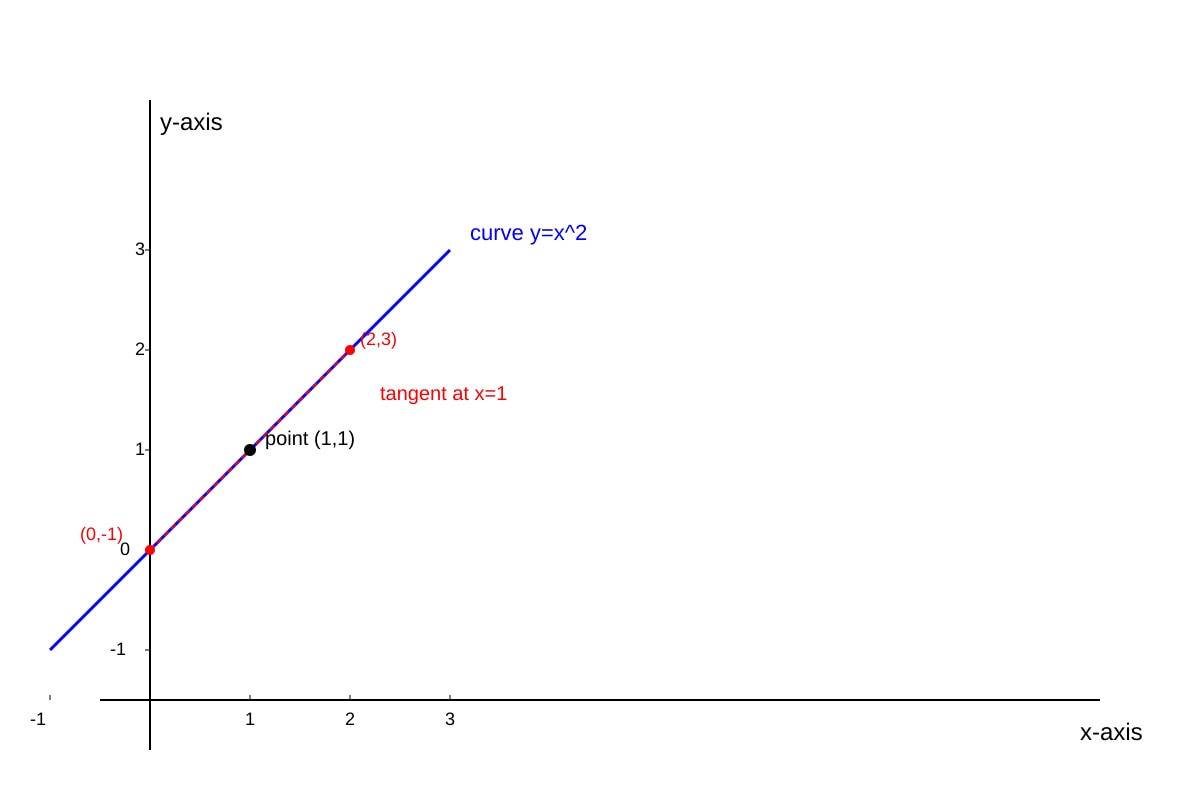
Generated graph for Q20.
(a) Find the gradient of the tangent drawn at x = 1 using the points given. [1]
(b) Use differentiation to verify this gradient. [2]