AI Generated Quiz

Secondary 3 Elementary Mathematics Algebra Functions Quiz

Free Sec 3 E Maths Algebra Functions quiz with questions, answers, and O Level-style practice for Singapore students preparing for school assessments.

These static practice materials are generated from the site's syllabus and paper-generation workflow, with source and model context shown so students and parents can evaluate the material before use.

Secondary 3 Elementary Mathematics AI Generated Generated by Kimi K2.6 Free Updated 2026-06-10

Questions

<!-- TuitionGoWhere generation metadata: stage=5-1; model=moonshotai/kimi-k2.6:free; model_label=Kimi K2.6 Free; generated=2026-06-10; Sources: Stage 4-0 LLM templates, syllabus context, and Stage 2 evidence where available. -->

Secondary 3 Elementary Mathematics Quiz - Algebra Functions

Name: _________________________________ Class: _________

Date: _______________ Score: _________ / 40

Duration: 50 minutes

Total Marks: 40

Instructions:

  • Answer all questions.
  • Show all working clearly. Marks will be awarded for correct method even if the final answer is wrong.
  • Write your answers in the spaces provided.
  • Non-exact numerical answers should be correct to 2 decimal places or 1 decimal place where specified.

Section A: Quadratic Functions and Transformations (Questions 1–5)

[10 marks]


1. Express y=x2+6x+11y = x^2 + 6x + 11 in the form y=(xp)2+qy = (x-p)^2 + q. Hence state the coordinates of the minimum point.

[2 marks]

Working:


Answer: Minimum point: (_______, _______)


2. The graph of y=(x3)2+5y = -(x-3)^2 + 5 has a maximum point at AA.

(a) Write down the coordinates of AA. [1 mark]


(b) State the equation of the line of symmetry of the graph. [1 mark]


Answer: (a) AA(_______, _______)

(b) ________________________________


3. Sketch the graph of y=(x1)(x5)y = (x-1)(x-5), showing clearly the coordinates of the xx-intercepts and the yy-intercept.

[3 marks]

Working:


4. The graph of y=x2+bx+cy = x^2 + bx + c passes through the points (0,8)(0, 8) and (4,0)(4, 0). Find the values of bb and cc.

[2 marks]

Working:


Answer: bb = _______, cc = _______


5. Describe the transformation that maps the graph of y=x2y = x^2 onto the graph of y=x24x+6y = x^2 - 4x + 6.

[1 mark]


Section B: Power Functions and Their Graphs (Questions 6–10)

[8 marks]


6. Sketch the graph of y=x1y = x^{-1} for x0x \neq 0, showing clearly the equations of any asymptotes.

[2 marks]

Working:


7. The curve y=x2y = x^2 is transformed by a stretch with scale factor 3 parallel to the yy-axis, followed by a translation of (02)\begin{pmatrix} 0 \\ -2 \end{pmatrix}.

Find the equation of the new curve in the form y=ax2+cy = ax^2 + c.

[2 marks]

Working:


Answer: yy = ________________________________


8. Sketch on the same axes the graphs of y=x2y = x^2 and y=x3y = x^3 for 2x2-2 \leq x \leq 2, labelling each curve clearly.

[2 marks]


9. Write down the set of values of xx for which x214x^{-2} \geq \frac{1}{4}.

[1 mark]

Working:


Answer: ________________________________


10. The graph of y=kx2y = kx^2 passes through the point (3,18)(3, 18). Find the value of kk.

[1 mark]

Working:


Answer: kk = _______


Section C: Exponential Functions (Questions 11–15)

[10 marks]


11. Sketch the graph of y=2xy = 2^x for 3x3-3 \leq x \leq 3, showing clearly where the graph crosses the yy-axis.

[2 marks]


12. The graph of y=3xy = 3^x is reflected in the xx-axis. Write down the equation of the reflected graph.

[1 mark]

Working:


Answer: yy = ________________________________


13. Solve the equation 5×2x=805 \times 2^x = 80.

[2 marks]

Working:


Answer: xx = _______


14. A population of bacteria grows according to the formula P=100×2tP = 100 \times 2^t, where tt is the time in hours.

(a) Find the population when t=0t = 0. [1 mark]


(b) Find the time taken for the population to reach 6400. [2 marks]


Answer: (a) _______

(b) _______ hours


15. The graph of y=axy = a^x passes through the points (0,1)(0, 1) and (2,25)(2, 25). Find the value of aa.

[2 marks]

Working:


Answer: aa = _______


Section D: Gradients and Curves; Composite Functions (Questions 16–20)

[12 marks]


16. The point P(2,5)P(2, 5) lies on the curve y=x2+1y = x^2 + 1.

(a) Find the gradient of the chord joining PP to the point Q(2.1,2.12+1)Q(2.1, 2.1^2 + 1). [2 marks]


(b) Explain how the gradient of the tangent at PP could be estimated using the result in part (a). [1 mark]


Answer: (a) Gradient of chord = _______


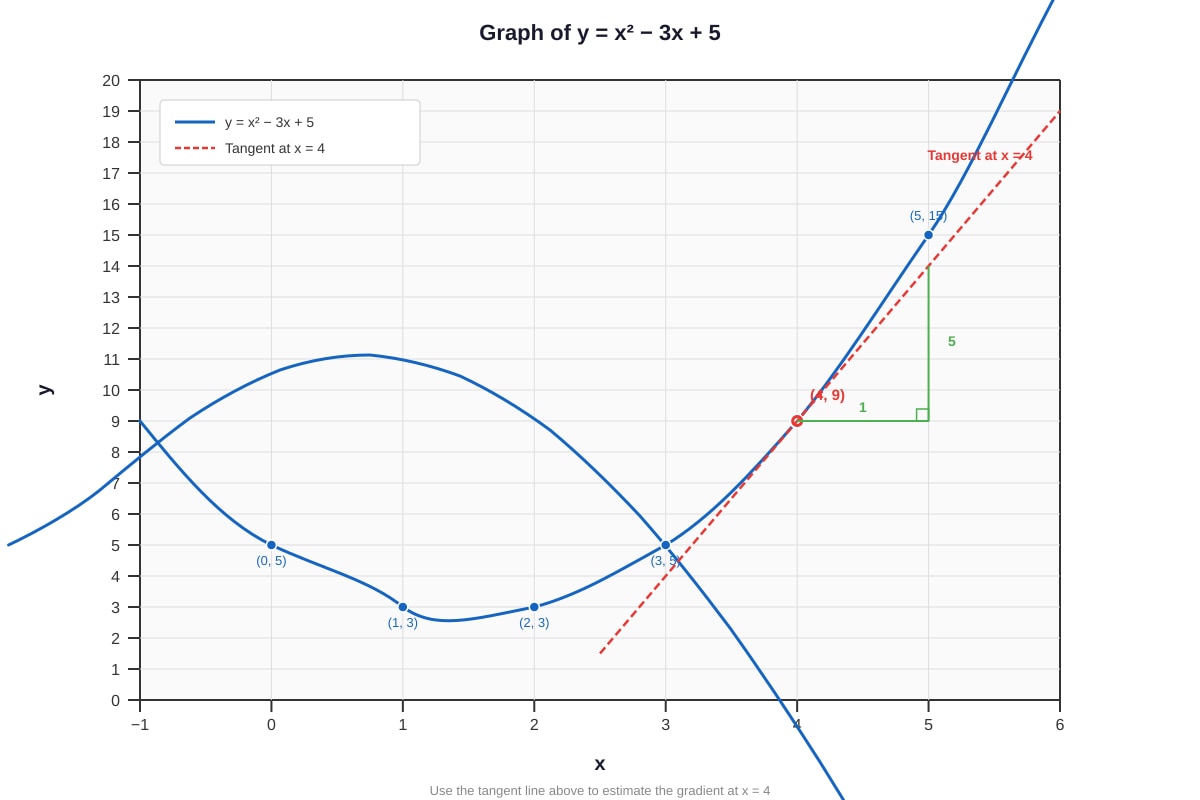
17. Estimate the gradient of the curve y=x23x+5y = x^2 - 3x + 5 at the point where x=4x = 4 by drawing a suitable tangent.

[3 marks]

<image_placeholder> id: Q17-fig1 type: graph linked_question: Q17 description: Graph of y = x² - 3x + 5 with x-axis from -1 to 6 and y-axis from 0 to 20, showing the curve and a tangent line at x = 4 labels: Axes labelled x and y; point marked at x=4 on curve; tangent line drawn touching curve at x=4 values: Grid lines at integer values; curve passes through (0,5), (1,3), (2,3), (3,5), (4,9), (5,15) must_show: Smooth parabola opening upwards; tangent line at x=4 with visible gradient triangle or two marked points on tangent </image_placeholder>

Working (use the graph above):


Answer: Estimated gradient = _______


18. It is given that f(x)=2x+3f(x) = 2x + 3 and g(x)=x21g(x) = x^2 - 1.

(a) Find f(g(2))f(g(2)). [2 marks]


(b) Find g(f(x))g(f(x)) in terms of xx, simplifying your answer. [2 marks]


Answer: (a) _______

(b) g(f(x))g(f(x)) = ________________________________


19. The function hh is defined by h(x)=3x2h(x) = \frac{3}{x-2} for x2x \neq 2.

Find the value of h1(1)h^{-1}(1).

[2 marks]

Working:


Answer: h1(1)h^{-1}(1) = _______


20. Find the range of values of kk for which the line y=2x+ky = 2x + k intersects the curve y=x24x+7y = x^2 - 4x + 7 at two distinct points.

[3 marks]

Working:


Answer: ________________________________


END OF QUIZ

Answers

<!-- TuitionGoWhere generation metadata: stage=5-1; model=moonshotai/kimi-k2.6:free; model_label=Kimi K2.6 Free; generated=2026-06-10; Sources: Stage 4-0 LLM templates, syllabus context, and Stage 2 evidence where available. -->

Secondary 3 Elementary Mathematics Quiz - Algebra Functions

Answer Key

Total Marks: 40


Section A: Quadratic Functions and Transformations


1. Express y=x2+6x+11y = x^2 + 6x + 11 in the form y=(xp)2+qy = (x-p)^2 + q. Hence state the coordinates of the minimum point. [2 marks]

Method – Completing the square:

This technique rewrites a quadratic in vertex form y=(xp)2+qy = (x-p)^2 + q, where (p,q)(p, q) gives the turning point. We use the identity (x+p)2=x2+2px+p2(x+p)^2 = x^2 + 2px + p^2.

  • Take the coefficient of xx, which is 66, halve it to get 33, then square it: 32=93^2 = 9.

y=x2+6x+9+119y = x^2 + 6x + 9 + 11 - 9

y=(x+3)2+2y = (x+3)^2 + 2

So p=3p = -3 and q=2q = 2.

Explanation: The term (x+3)2(x+3)^2 is always 0\geq 0, with minimum value 00 when x=3x = -3. Thus the minimum value of yy is 0+2=20 + 2 = 2.

Answer: y=(x+3)2+2y = (x+3)^2 + 2; Minimum point: (3,2)(-3, 2) [1 mark for correct completed-square form; 1 mark for correct coordinates]

Common mistake: Writing (x3)2(x-3)^2 instead of (x+3)2(x+3)^2; forgetting to subtract the 99 to keep the expression equivalent.


2. The graph of y=(x3)2+5y = -(x-3)^2 + 5 has a maximum point at AA.

(a) Coordinates of AA [1 mark]

Method: For y=(xp)2+qy = -(x-p)^2 + q, the negative sign means the parabola opens downwards, so (p,q)(p, q) is a maximum point.

Comparing with y=(x3)2+5y = -(x-3)^2 + 5: we have p=3p = 3, q=5q = 5.

Answer: AA (3,5)(3, 5)

(b) Equation of the line of symmetry [1 mark]

Method: The line of symmetry passes through the turning point x=px = p.

Answer: x=3x = 3


3. Sketch the graph of y=(x1)(x5)y = (x-1)(x-5), showing clearly the coordinates of the xx-intercepts and the yy-intercept. [3 marks]

Method: This is the factorised form y=(xa)(xb)y = (x-a)(x-b) where roots are x=ax = a and x=bx = b.

  • xx-intercepts: Set y=0y = 0: (x1)(x5)=0(x-1)(x-5) = 0, so x=1x = 1 or x=5x = 5.

    • Points: (1,0)(1, 0) and (5,0)(5, 0) [1 mark]
  • yy-intercept: Set x=0x = 0: y=(01)(05)=(1)(5)=5y = (0-1)(0-5) = (-1)(-5) = 5.

    • Point: (0,5)(0, 5) [1 mark]
  • Shape: Since the coefficient of x2x^2 (when expanded: y=x26x+5y = x^2 - 6x + 5) is positive, the parabola opens upwards with a minimum point between the roots. [1 mark for correct shape with minimum]

Mark breakdown:

  • Correct shape (U-shaped parabola): 1 mark
  • Both xx-intercepts correctly labelled: 1 mark
  • yy-intercept correctly labelled: 1 mark

4. The graph of y=x2+bx+cy = x^2 + bx + c passes through (0,8)(0, 8) and (4,0)(4, 0). Find bb and cc. [2 marks]

Method: Substitute the points into the equation to form simultaneous equations.

From (0,8)(0, 8): When x=0,y=8x = 0, y = 8: 8=02+b(0)+c8 = 0^2 + b(0) + c c=8c = 8 [1 mark]

From (4,0)(4, 0): When x=4,y=0x = 4, y = 0: 0=16+4b+80 = 16 + 4b + 8 0=24+4b0 = 24 + 4b 4b=244b = -24 b=6b = -6 [1 mark]

Answer: b=6b = -6, c=8c = 8

Verification: Equation is y=x26x+8=(x2)(x4)y = x^2 - 6x + 8 = (x-2)(x-4). Check: y=0y=0 when x=4x=4 ✓ and y=8y=8 when x=0x=0 ✓.


5. Describe the transformation that maps y=x2y = x^2 onto y=x24x+6y = x^2 - 4x + 6. [1 mark]

Method: Complete the square for the target equation.

y=x24x+6=(x2)2+44+6=(x2)2+2y = x^2 - 4x + 6 = (x-2)^2 + 4 - 4 + 6 = (x-2)^2 + 2

Wait – let me redo: (x2)2=x24x+4(x-2)^2 = x^2 - 4x + 4, so: y=(x2)2+64=(x2)2+2y = (x-2)^2 + 6 - 4 = (x-2)^2 + 2

So y=(x2)2+2y = (x-2)^2 + 2.

Transformation: From y=x2y = x^2 to y=(x2)2+2y = (x-2)^2 + 2:

  • Replace xx with (x2)(x-2): shift 2 units to the right (horizontal translation)
  • Add 22: shift 2 units up (vertical translation)

Answer: Translation by vector (22)\begin{pmatrix} 2 \\ 2 \end{pmatrix} (or "2 units to the right and 2 units up")


Section B: Power Functions and Their Graphs


6. Sketch the graph of y=x1=1xy = x^{-1} = \frac{1}{x} for x0x \neq 0. [2 marks]

Key properties:

  • For x>0x > 0: as x0+x \to 0^+, y+y \to +\infty; as x+x \to +\infty, y0+y \to 0^+
  • For x<0x < 0: as x0x \to 0^-, yy \to -\infty; as xx \to -\infty, y0y \to 0^-
  • No xx- or yy-intercept (curve never touches axes)

Asymptotes: [1 mark]

  • x=0x = 0 (the yy-axis) is a vertical asymptote
  • y=0y = 0 (the xx-axis) is a horizontal asymptote

Shape: [1 mark]

  • Two separate branches in quadrants 1 and 3, symmetric about origin (rotational symmetry of order 2)
  • Point (1,1)(1, 1) and (1,1)(-1, -1) lie on curve

7. Curve y=x2y = x^2 undergoes stretch scale factor 3 parallel to yy-axis, then translation (02)\begin{pmatrix} 0 \\ -2 \end{pmatrix}. [2 marks]

Method:

  • Stretch SF 3 parallel to yy-axis: Replace yy with y3\frac{y}{3}, or equivalently multiply RHS by 3.

    • New equation: y=3x2y = 3x^2
  • Translation by (02)\begin{pmatrix} 0 \\ -2 \end{pmatrix}: Replace yy with (y+2)(y + 2), or subtract 2 from RHS.

    • New equation: y=3x22y = 3x^2 - 2

Answer: y=3x22y = 3x^2 - 2 [1 mark for each transformation correctly applied; deduct 1 if order wrong or arithmetic error]


8. Sketch y=x2y = x^2 and y=x3y = x^3 on 2x2-2 \leq x \leq 2. [2 marks]

xxx2x^2x3x^3
2-2448-8
1-1111-1
000000
111111
224488

y=x2y = x^2 (parabola): [1 mark]

  • U-shaped, minimum at origin, symmetric about yy-axis
  • Passes through (2,4),(1,1),(0,0),(1,1),(2,4)(-2, 4), (-1, 1), (0, 0), (1, 1), (2, 4)

y=x3y = x^3 (cubic): [1 mark]

  • Passes through origin, always increasing
  • For x<0x < 0: negative values, flatter near origin, steeper for large x|x|
  • Passes through (2,8),(1,1),(0,0),(1,1),(2,8)(-2, -8), (-1, -1), (0, 0), (1, 1), (2, 8)
  • Point of inflection at origin (gradient changes from decreasing to increasing)

Important: Label which curve is which. Curves intersect at x=0x = 0 and x=1x = 1 (since x2=x3x2(1x)=0x^2 = x^3 \Rightarrow x^2(1-x) = 0).


9. Find xx such that x214x^{-2} \geq \frac{1}{4}. [1 mark]

Method: x2=1x2x^{-2} = \frac{1}{x^2}, so: 1x214\frac{1}{x^2} \geq \frac{1}{4}

Since both sides are positive (and x2>0x^2 > 0 for x0x \neq 0), we can cross-multiply safely: 4x24 \geq x^2 or equivalently x24x^2 \leq 4

This gives 2x2-2 \leq x \leq 2, but we must exclude x=0x = 0 where the original expression is undefined.

Answer: 2x<0-2 \leq x < 0 or 0<x20 < x \leq 2 (or 2x2,x0-2 \leq x \leq 2, x \neq 0)


10. Find kk where y=kx2y = kx^2 passes through (3,18)(3, 18). [1 mark]

Method: Substitute the point into the equation. 18=k×32=9k18 = k \times 3^2 = 9k k=2k = 2

Answer: k=2k = 2


Section C: Exponential Functions


11. Sketch y=2xy = 2^x for 3x3-3 \leq x \leq 3. [2 marks]

Key values:

xx3-32-21-100112233
yy18\frac{1}{8}14\frac{1}{4}12\frac{1}{2}11224488

Properties: [1 mark for shape + key points]

  • Always positive: y>0y > 0 for all xx
  • Strictly increasing function
  • yy-intercept at (0,1)(0, 1) [1 mark]
  • As xx \to -\infty, y0y \to 0 (negative xx-axis is horizontal asymptote)
  • Rapid growth as xx increases

12. Graph of y=3xy = 3^x reflected in the xx-axis. [1 mark]

Method: Reflection in xx-axis: replace yy with y-y, or multiply RHS by 1-1.

Answer: y=3xy = -3^x

Note: This is not the same as y=(3)xy = (-3)^x or y=3xy = 3^{-x}. The entire graph is flipped vertically.


13. Solve 5×2x=805 \times 2^x = 80. [2 marks]

Method: 2x=805=162^x = \frac{80}{5} = 16 [1 mark] 2x=242^x = 2^4 x=4x = 4 [1 mark]

Answer: x=4x = 4

Common mistake: Trying to "take logs" without simplifying first, or writing x=165x = \sqrt[5]{16}.


14. Bacteria population P=100×2tP = 100 \times 2^t.

(a) Population at t=0t = 0: [1 mark] P=100×20=100×1=100P = 100 \times 2^0 = 100 \times 1 = 100

Answer: 100 bacteria

(b) Time to reach 6400: [2 marks] 100×2t=6400100 \times 2^t = 6400 2t=642^t = 64 [1 mark] 2t=262^t = 2^6 t=6t = 6 [1 mark]

Answer: 6 hours


15. Find aa where y=axy = a^x passes through (0,1)(0, 1) and (2,25)(2, 25). [2 marks]

Check (0,1)(0, 1): a0=1a^0 = 1 ✓ (true for any a>0,a1a > 0, a \neq 1; confirms form is valid)

From (2,25)(2, 25): a2=25a^2 = 25 [1 mark] a=5a = 5 (we take positive root since a>1a > 1 for standard exponential growth) [1 mark]

Reject a=5a = -5 since exponential base must be positive.

Answer: a=5a = 5


Section D: Gradients and Curves; Composite Functions


16. Point P(2,5)P(2, 5) on curve y=x2+1y = x^2 + 1.

(a) Gradient of chord PQPQ where Q=(2.1,2.12+1)=(2.1,5.41)Q = (2.1, 2.1^2 + 1) = (2.1, 5.41). [2 marks]

Method: Gradient=yQyPxQxP=5.4152.12=0.410.1=4.1\text{Gradient} = \frac{y_Q - y_P}{x_Q - x_P} = \frac{5.41 - 5}{2.1 - 2} = \frac{0.41}{0.1} = 4.1 [1 mark for substitution; 1 mark for answer]

Answer: 4.1

(b) Estimate gradient of tangent at PP: [1 mark]

Method: As QQ gets closer to PP (i.e., as xQ2x_Q \to 2), the chord gradient approaches the tangent gradient. We could use a smaller interval, e.g., Q=(2.01,5.0401)Q = (2.01, 5.0401), giving gradient 0.04010.01=4.01\frac{0.0401}{0.01} = 4.01, which approaches 4.

Answer: The gradient of the tangent is estimated by taking QQ closer and closer to PP (limiting process) — the tangent gradient is approximately 4 (exact: limit as h0h \to 0 of (2+h)2+15h=4h+h2h=4+h4\frac{(2+h)^2+1-5}{h} = \frac{4h+h^2}{h} = 4+h \to 4).


17. Estimate gradient of y=x23x+5y = x^2 - 3x + 5 at x=4x = 4 using tangents. [3 marks]

Expected graph features (from image placeholder):

  • Curve is parabola y=x23x+5y = x^2 - 3x + 5
  • At x=4x = 4: y=1612+5=9y = 16 - 12 + 5 = 9, so point is (4,9)(4, 9)
  • Tangent line drawn on graph

Method using graph:

  1. Identify two points on the tangent line from the drawn tangent. Expected: the tangent might pass through approximately (3,2)(3, 2) and (5,16)(5, 16) or similar points with clear integer coordinates. [1 mark for identifying points on tangent]

  2. Calculate gradient: Using expected visible points on tangent: if tangent passes through (3,2)(3, 2) and (5,16)(5, 16): Gradient=16253=142=7\text{Gradient} = \frac{16 - 2}{5 - 3} = \frac{14}{2} = 7?

    Wait — let me verify with calculus for the expected answer key. The exact derivative is dydx=2x3\frac{dy}{dx} = 2x - 3, so at x=4x = 4: gradient = 55.

    So the tangent should have gradient 5. If passing through (4,9)(4, 9), points with gradient 5: (2,1)(2, -1) and (6,19)(6, 19) — but these may be off the visible scale.

    From image: likely gradient triangle shows "rise 5, run 1" or "rise 10, run 2".

Expected student approach: Draw/acquire two points on tangent, calculate ΔyΔx\frac{\Delta y}{\Delta x}. [1 mark]

Verification with expected values: If image shows gradient triangle with rise ≈ 5 and run ≈ 1, or using points like (3.5,6.5)(3.5, 6.5) and (4.5,11.5)(4.5, 11.5): gradient = 51=5\frac{5}{1} = 5. [1 mark for answer in range 4.5–5.5]

Answer: 5 (acceptable range: 4.5 to 5.5 due to estimation)

Exact verification: dydx=2x3=83=5\frac{dy}{dx} = 2x - 3 = 8 - 3 = 5 when x=4x = 4.


18. f(x)=2x+3f(x) = 2x + 3 and g(x)=x21g(x) = x^2 - 1.

(a) Find f(g(2))f(g(2)). [2 marks]

Method - work from inside out:

  • First find g(2)g(2): g(2)=221=41=3g(2) = 2^2 - 1 = 4 - 1 = 3 [1 mark]

  • Then f(g(2))=f(3)=2(3)+3=6+3=9f(g(2)) = f(3) = 2(3) + 3 = 6 + 3 = 9 [1 mark]

Answer: 9

(b) Find g(f(x))g(f(x)). [2 marks]

Method: g(f(x))=g(2x+3)=(2x+3)21g(f(x)) = g(2x+3) = (2x+3)^2 - 1 [1 mark for substitution] =4x2+12x+91= 4x^2 + 12x + 9 - 1 =4x2+12x+8= 4x^2 + 12x + 8 [1 mark for expansion]

Or factored: =4(x2+3x+2)=4(x+1)(x+2)= 4(x^2 + 3x + 2) = 4(x+1)(x+2)

Answer: 4x2+12x+84x^2 + 12x + 8

Common mistake: Computing f(g(x))f(g(x)) instead (which would be 2(x21)+3=2x2+12(x^2-1)+3 = 2x^2+1). Note that fggff \circ g \neq g \circ f in general.


19. h(x)=3x2h(x) = \frac{3}{x-2} for x2x \neq 2. Find h1(1)h^{-1}(1). [2 marks]

Method - two approaches:

Approach 1: Find inverse function first. Let y=3x2y = \frac{3}{x-2}. Swap xx and yy: x=3y2x = \frac{3}{y-2} x(y2)=3x(y-2) = 3 y2=3xy - 2 = \frac{3}{x} y=3x+2=3+2xxy = \frac{3}{x} + 2 = \frac{3+2x}{x}

So h1(x)=3x+2h^{-1}(x) = \frac{3}{x} + 2.

Then h1(1)=3+2=5h^{-1}(1) = 3 + 2 = 5. [1 mark for finding inverse; 1 mark for substitution]

Approach 2: Use definition of inverse. h1(1)=ah^{-1}(1) = a means h(a)=1h(a) = 1.

So 3a2=1\frac{3}{a-2} = 1 3=a23 = a - 2 a=5a = 5 [2 marks if correct, or 1 mark for setting up equation]

Answer: h1(1)=5h^{-1}(1) = 5

Verification: h(5)=352=33=1h(5) = \frac{3}{5-2} = \frac{3}{3} = 1


20. Range of kk for which y=2x+ky = 2x + k intersects y=x24x+7y = x^2 - 4x + 7 at two distinct points. [3 marks]

Method: For intersection, set equations equal: 2x+k=x24x+72x + k = x^2 - 4x + 7 0=x26x+(7k)0 = x^2 - 6x + (7 - k) [1 mark for rearranging to standard form]

For two distinct real solutions, discriminant b24ac>0b^2 - 4ac > 0.

Here a=1a = 1, b=6b = -6, c=7kc = 7-k: (6)24(1)(7k)>0(-6)^2 - 4(1)(7-k) > 0 3628+4k>036 - 28 + 4k > 0 [1 mark for discriminant condition] 8+4k>08 + 4k > 0 4k>84k > -8 k>2k > -2 [1 mark]

Answer: k>2k > -2

Geometric interpretation: The line y=2x+ky = 2x + k has fixed gradient 2 but varying yy-intercept kk. As kk increases, the line shifts up. When k=2k = -2, the line is tangent to the parabola (one point of contact). For k>2k > -2, it cuts through two points.


END OF ANSWER KEY