From Real Exams Quiz
Secondary 3 Elementary Mathematics Statistics Probability Quiz
Free Sec 3 E Maths Statistics quiz, Nemo3 Exam version, with questions, answers, and O Level-style practice for Singapore students.
These static practice materials are generated from the site's syllabus and paper-generation workflow, with source and model context shown so students and parents can evaluate the material before use.
Questions
Free quiz and exam paper access
Enter your details to view this paper
Your access is remembered on this device.
Answers
Secondary 3 Elementary Mathematics Quiz - Statistics Probability (Answer Key)
Total Marks: 40
Section A: Short Answer Questions (Questions 1–10, 2 marks each)
1. A fair six-sided die is rolled once. Find the probability that the number obtained is a prime number.
Answer: or 0.5
Marks: [2]
Working:
- Sample space: {1, 2, 3, 4, 5, 6} → 6 equally likely outcomes
- Prime numbers on a die: 2, 3, 5 → 3 favourable outcomes
- P(prime) =
Teaching note: Remember that 1 is not a prime number. Prime numbers have exactly two factors: 1 and itself.
2. A bag contains 5 red balls, 3 blue balls, and 2 green balls. A ball is drawn at random. Find the probability that the ball is not blue.
Answer: or 0.7
Marks: [2]
Working:
- Total balls = 5 + 3 + 2 = 10
- Non-blue balls = 5 red + 2 green = 7
- P(not blue) =
Alternative method: P(not blue) = 1 − P(blue) = 1 − =
3. The probability that it rains on a given day in Singapore is 0.3. Find the probability that it does not rain on that day.
Answer: 0.7
Marks: [2]
Working:
- P(rain) = 0.3
- P(not rain) = 1 − P(rain) = 1 − 0.3 = 0.7
Teaching note: Complementary events always sum to 1. P(A) + P(A') = 1.
4. Two fair coins are tossed simultaneously. List all possible outcomes and find the probability of getting exactly one head.
Answer: or 0.5
Marks: [2]
Working:
- Sample space: {HH, HT, TH, TT} → 4 equally likely outcomes
- Exactly one head: {HT, TH} → 2 favourable outcomes
- P(exactly one head) =
Teaching note: HT and TH are different outcomes because the coins are distinct (first coin, second coin).
5. A spinner is divided into 8 equal sectors numbered 1 to 8. The spinner is spun once. Find the probability that the number obtained is a multiple of 3.
Answer: or 0.25
Marks: [2]
Working:
- Multiples of 3 from 1 to 8: 3, 6 → 2 favourable outcomes
- Total outcomes = 8
- P(multiple of 3) =
6. In a class of 40 students, 25 students play badminton, 18 students play basketball, and 10 students play both sports. A student is chosen at random. Find the probability that the student plays neither badminton nor basketball.
Answer: or 0.175
Marks: [2]
Working:
- Use inclusion-exclusion: n(Badminton ∪ Basketball) = 25 + 18 − 10 = 33
- Students playing neither = 40 − 33 = 7
- P(neither) =
Teaching note: Venn diagram helps visualise: only badminton = 15, only basketball = 8, both = 10, neither = 7.
7. A box contains 4 white marbles and 6 black marbles. Two marbles are drawn at random without replacement. Find the probability that both marbles are white.
Answer: or 0.133 (3 s.f.)
Marks: [2]
Working:
- P(first white) =
- P(second white | first white) =
- P(both white) =
Teaching note: Without replacement means the total and favourable counts decrease after the first draw.
8. The probability that student A passes a test is 0.7. The probability that student B passes the same test is 0.6. Assuming independence, find the probability that both students pass the test.
Answer: 0.42
Marks: [2]
Working:
- For independent events: P(A and B) = P(A) × P(B)
- P(both pass) = 0.7 × 0.6 = 0.42
Teaching note: Independence means the outcome of one does not affect the other. Always check if "assuming independence" is stated.
9. A card is drawn at random from a standard deck of 52 playing cards. Find the probability that the card is a heart or a king.
Answer: or 0.308 (3 s.f.)
Marks: [2]
Working:
- Hearts: 13 cards
- Kings: 4 cards
- King of hearts counted twice → subtract 1
- Favourable = 13 + 4 − 1 = 16
- P(heart or king) =
Teaching note: Use P(A ∪ B) = P(A) + P(B) − P(A ∩ B). The king of hearts is the intersection.
10. A factory produces light bulbs. The probability that a bulb is defective is 0.02. If 500 bulbs are produced, find the expected number of defective bulbs.
Answer: 10
Marks: [2]
Working:
- Expected number = n × p = 500 × 0.02 = 10
Teaching note: Expected value for binomial distribution: E(X) = np. This is the long-run average.
Section B: Structured Questions (Questions 11–16, 3 marks each)
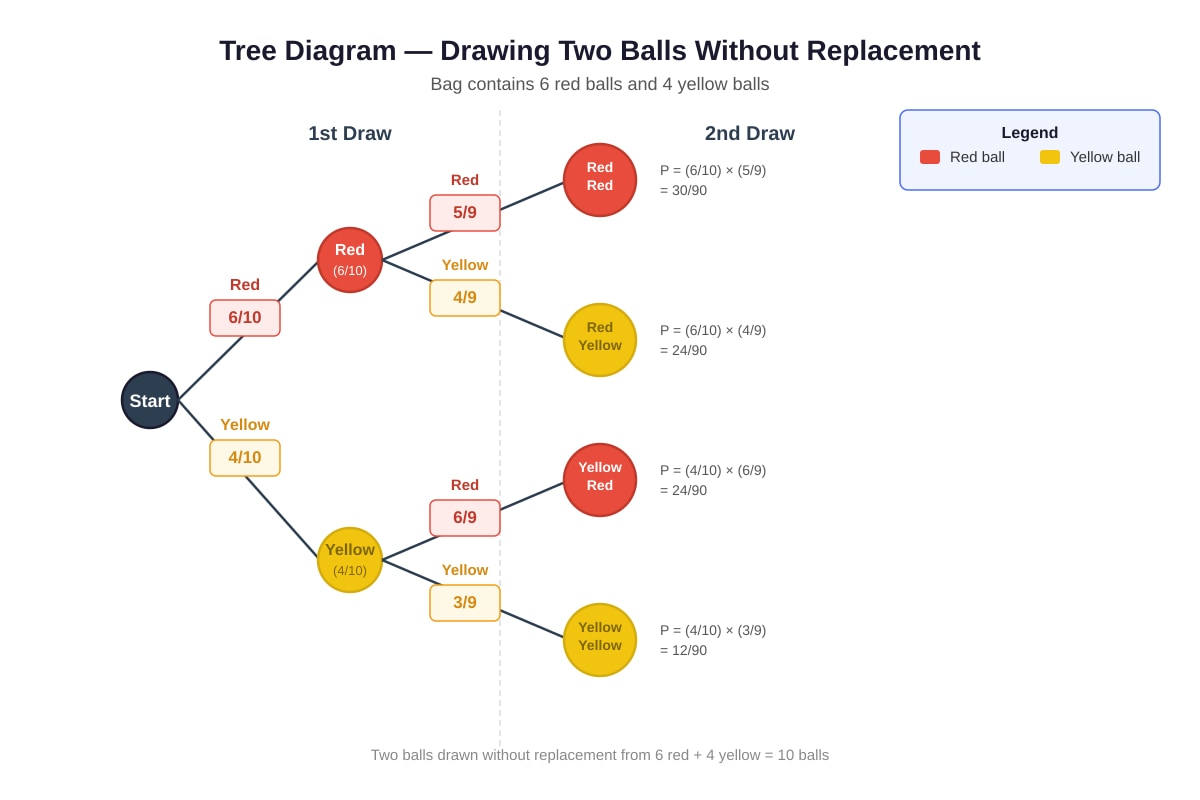
11. (a) Tree diagram completion
Answer: See diagram below
Marks: [1] for correct probabilities on all branches
Completed tree diagram:
- First draw: Red (), Yellow ()
- After Red: Red (), Yellow ()
- After Yellow: Red (), Yellow ()
11. (b) Find the probability that the two balls are of different colours.
Answer: or 0.533 (3 s.f.)
Marks: [2]
Working:
- P(R then Y) =
- P(Y then R) =
- P(different colours) =
Marking: M1 for correct products, A1 for correct sum and simplification.
12. (a) Find the probability that a randomly chosen student spent more than 6 hours on homework.
Answer: or 0.3
Marks: [1]
Working:
- Students with > 6 hours: 10 + 5 = 15
- Total students = 50
- P(> 6 hours) =
12. (b) Two students are chosen at random without replacement. Find the probability that both students spent at most 4 hours on homework.
Answer: or 0.235 (3 s.f.)
Marks: [2]
Working:
- Students with ≤ 4 hours: 8 + 15 = 23
- P(first ≤ 4) =
- P(second ≤ 4 | first ≤ 4) =
- P(both ≤ 4) =
Marking: M1 for correct fractions, A1 for correct product and simplification.
13. (a) Find P(A ∩ B).
Answer: 0.2
Marks: [1]
Working:
- P(A ∪ B) = P(A) + P(B) − P(A ∩ B)
- 0.7 = 0.5 + 0.4 − P(A ∩ B)
- P(A ∩ B) = 0.9 − 0.7 = 0.2
13. (b) Determine whether A and B are independent events. Justify your answer.
Answer: A and B are independent.
Marks: [2]
Working:
- For independence: P(A ∩ B) = P(A) × P(B)
- P(A) × P(B) = 0.5 × 0.4 = 0.2
- P(A ∩ B) = 0.2 (from part a)
- Since P(A ∩ B) = P(A) × P(B), A and B are independent.
Marking: M1 for stating condition/checking product, A1 for correct conclusion with justification.
14. (a) Find the probability of winning a prize in one spin.
Answer: or 0.7
Marks: [1]
Working:
- Multiples of 2: 2, 4, 6, 8, 10 → 5 numbers
- Multiples of 3: 3, 6, 9 → 3 numbers
- Multiple of both (6): counted twice → subtract 1
- Favourable = 5 + 3 − 1 = 7
- P(win) =
14. (b) If a player spins the wheel twice, find the probability that the player wins exactly once.
Answer: or 0.42
Marks: [2]
Working:
- P(win) = , P(lose) =
- P(exactly one win in 2 spins) = P(WL) + P(LW)
- =
- =
Marking: M1 for identifying two cases, A1 for correct calculation.
15. (a) Find the probability that a randomly chosen person likes tea or coffee (or both).
Answer: 0.8
Marks: [1]
Working:
- P(T ∪ C) = P(T) + P(C) − P(T ∩ C)
- = 0.6 + 0.5 − 0.3 = 0.8
15. (b) Given that a person likes tea, find the probability that the person also likes coffee.
Answer: 0.5
Marks: [2]
Working:
- Conditional probability: P(C | T) =
- =
Teaching note: "Given that" signals conditional probability. Formula: P(A|B) = P(A∩B)/P(B).
16. (a) Find the probability that all three items are non-defective.
Answer: or 0.292 (3 s.f.)
Marks: [1]
Working:
- P(1st non-defective) =
- P(2nd non-defective | 1st non-defective) =
- P(3rd non-defective | first two non-defective) =
- P(all three non-defective) =
16. (b) Find the probability that exactly one item is defective.
Answer: or 0.525
Marks: [2]
Working:
- Three cases: DNN, NDN, NND (D = defective, N = non-defective)
- P(DNN) =
- P(NDN) =
- P(NND) =
- Total =
Alternative: Use combinations:
Marking: M1 for correct approach (3 cases or combinations), A1 for correct answer.
Section C: Application Questions (Questions 17–20)
17. (a) Find the probability that the student gets exactly 2 questions correct.
Answer: or 0.264 (3 s.f.)
Marks: [2]
Working:
- Binomial distribution: n = 5, p = , q =
- P(X = 2) =
- =
Teaching note: Binomial formula: P(X = r) = .
17. (b) Find the probability that the student gets at least 1 question correct.
Answer: or 0.763 (3 s.f.)
Marks: [2]
Working:
- P(at least 1) = 1 − P(none correct)
- P(none) =
- P(at least 1) = 1 − =
Teaching note: "At least one" is easier via complement: 1 − P(none).
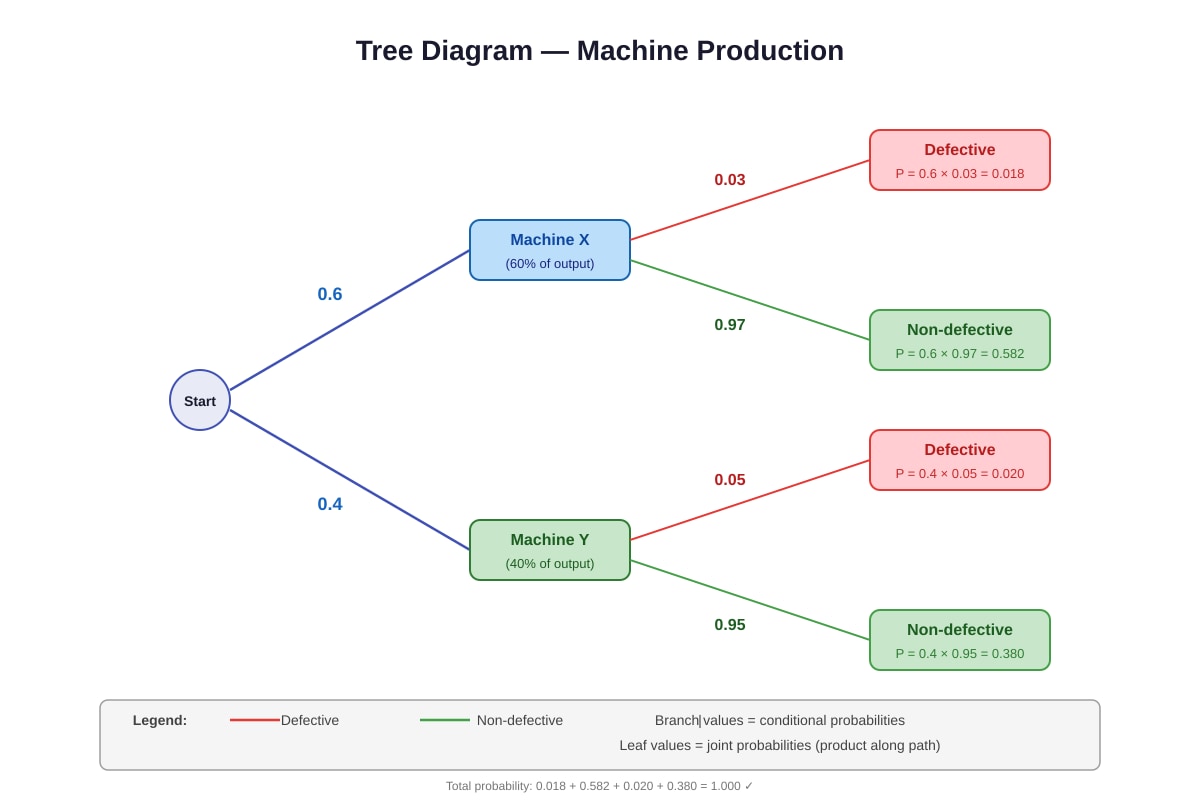
18. (a) Tree diagram
Answer: See diagram below
Marks: [1] for correct structure and probabilities
Tree diagram:
- Machine X (0.6) → Defective (0.03), Non-defective (0.97)
- Machine Y (0.4) → Defective (0.05), Non-defective (0.95)
18. (b) Find the probability that a randomly selected component is defective.
Answer: 0.038
Marks: [2]
Working:
- Law of total probability:
- P(Defective) = P(X) × P(D|X) + P(Y) × P(D|Y)
- = 0.6 × 0.03 + 0.4 × 0.05
- = 0.018 + 0.02 = 0.038
Marking: M1 for correct formula/products, A1 for correct answer.
18. (c) Given that a component is defective, find the probability that it was produced by Machine Y.
Answer: or 0.526 (3 s.f.)
Marks: [2]
Working:
- Bayes' theorem / conditional probability:
- P(Y | D) =
- =
Teaching note: This is a classic Bayes' theorem problem. P(cause | effect) = P(effect | cause) × P(cause) / P(effect).
19. (a) Find the probability that it rains on exactly 2 out of 3 consecutive days in April.
Answer: 0.288
Marks: [2]
Working:
- Binomial: n = 3, p = 0.4, q = 0.6
- P(X = 2) =
- = 3 × 0.16 × 0.6 = 0.288
19. (b) Find the probability that it rains on at least 1 day out of 3 consecutive days in April.
Answer: 0.784
Marks: [2]
Working:
- P(at least 1) = 1 − P(none)
- P(none) = (0.6)^3 = 0.216
- P(at least 1) = 1 − 0.216 = 0.784
20. (a) Find the probability that the three balls are all of different colours.
Answer: or 0.273 (3 s.f.)
Marks: [3]
Working:
- Total ways to choose 3 balls from 12:
- Ways to choose 1 red, 1 blue, 1 green:
- P(all different) =
Alternative (sequential without replacement):
- P(R then B then G) =
- 3! = 6 orders →
Marking: M1 for correct total outcomes, M1 for correct favourable outcomes, A1 for correct probability.
20. (b) Find the probability that at least two balls are of the same colour.
Answer: or 0.727 (3 s.f.)
Marks: [1]
Working:
- Complement of "all different colours"
- P(at least two same) = 1 − P(all different)
- = 1 − =
Teaching note: "At least two same" is the complement of "all different". Always check for complement shortcuts.
End of Answer Key