From Real Exams Quiz

Secondary 3 Elementary Mathematics Statistics Probability Quiz

Free Sec 3 E Maths Statistics quiz with questions, answers, and O Level-style practice for Singapore students preparing for school assessments.

These static practice materials are generated from the site's syllabus and paper-generation workflow, with source and model context shown so students and parents can evaluate the material before use.

Secondary 3 Elementary Mathematics From Real Exams Generated by Kimi K2.6 Free Updated 2026-06-10

Questions

<!-- TuitionGoWhere generation metadata: stage=3-0; model=moonshotai/kimi-k2.6:free; model_label=Kimi K2.6 Free; generated=2026-06-10; Sources: Stage 2-1 real exam-derived templates and Stage 2-2 exam-enriched syllabus. -->

Secondary 3 Elementary Mathematics Quiz - Statistics Probability

Name: _________________________ Class: __________ Date: __________

Duration: 45 minutes Total Marks: 40 marks

Instructions: Answer all questions. Show all working clearly. Non-exact numerical answers should be given correct to 2 significant figures, unless stated otherwise.


Section A: Data Analysis and Measures of Central Tendency (Questions 1–5, 10 marks)

1. [2 marks]

The masses of 7 watermelons are given below, in kg.

5.2, 6.8, 4.9, 7.3, 5.5, 6.2, 5.8

Find the mean mass.

Working space:


Answer: _________ kg


2. [2 marks]

The following scores are obtained by a student in 8 mathematics tests:

72, 68, 75, 68, 80, 72, 68, 85

Find the mode and the median of these scores.

Working space:


Mode: _________ Median: _________


3. [2 marks]

A group of 20 students sat for a Science test. The mean mark was 64. Another group of 30 students sat for the same test. The mean mark of this second group was 72.

Calculate the mean mark of all 50 students.

Working space:


Answer: _________


4. [2 marks]

The table shows the distribution of the number of books read by a class of 25 students during the June holidays.

Number of books012345
Number of students358531

Find the median number of books read.

Working space:


Answer: _________ books


5. [2 marks]

The mean of five numbers is 12. When a sixth number is added, the mean becomes 14.

Find the sixth number.

Working space:


Answer: _________


Section B: Data Representation and Interpretation (Questions 6–10, 10 marks)

6. [2 marks]

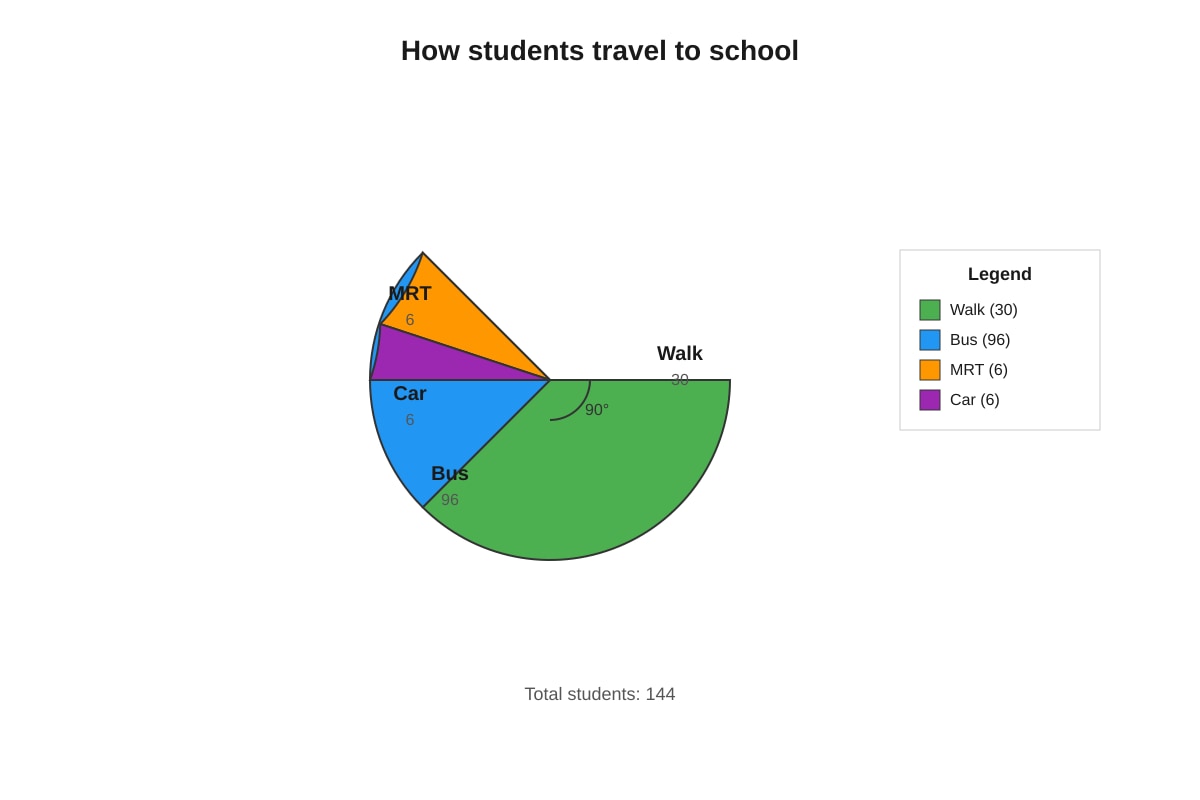
The pie chart below shows how 120 students travel to school.

<image_placeholder> id: Q6-fig1 type: chart linked_question: Q6 description: Pie chart showing modes of transport to school with four sectors labels: Walk, Bus, MRT, Car values: Walk sector angle 90°, Bus sector 96 students, remaining split equally between MRT and Car must_show: All four sector labels, one sector with angle marked as 90°, clear distinction between sectors, title "How students travel to school" </image_placeholder>

How many students travel by bus?

Working space:


Answer: _________ students


7. [2 marks]

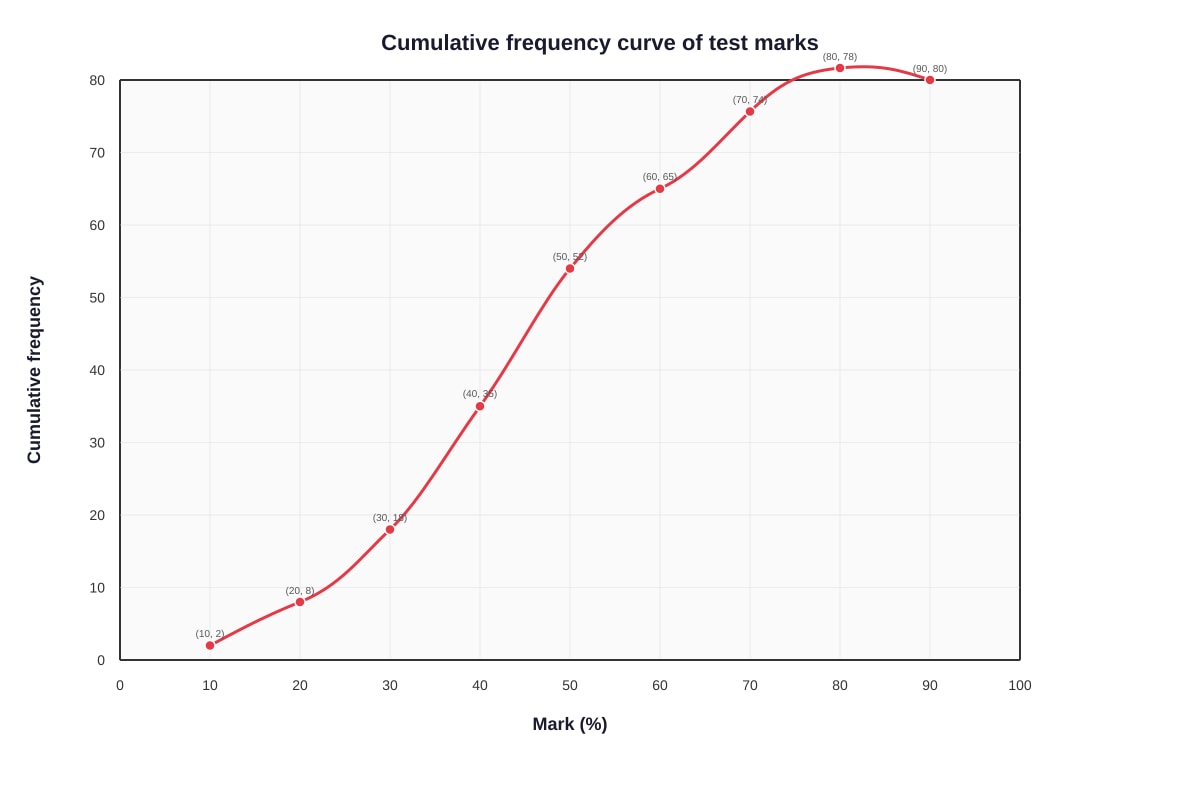
The cumulative frequency curve below shows the distribution of marks scored by 80 students in a test.

<image_placeholder> id: Q7-fig1 type: graph linked_question: Q7 description: Cumulative frequency curve (ogive) for test marks labels: x-axis "Mark (%)", y-axis "Cumulative frequency" values: x-axis from 0 to 100, y-axis from 0 to 80, curve passing through (10, 2), (20, 8), (30, 18), (40, 35), (50, 52), (60, 65), (70, 74), (80, 78), (90, 80) must_show: Smooth S-shaped curve, labelled axes with scales, grid lines, title "Cumulative frequency curve of test marks" </image_placeholder>

Use your curve to estimate

(a) the median mark, [1]


(b) the interquartile range. [1]


8. [2 marks]

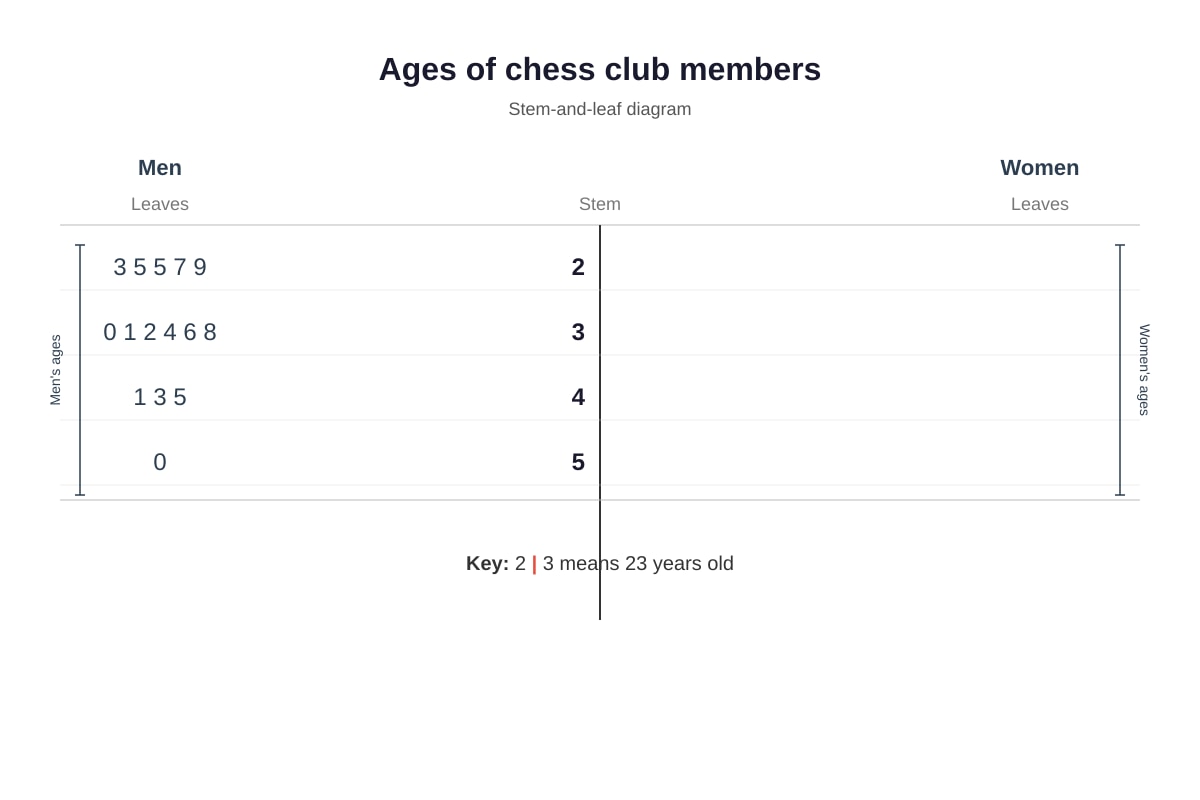
The stem-and-leaf diagram below shows the ages of members in a chess club.

<image_placeholder> id: Q8-fig1 type: diagram linked_question: Q8 description: Back-to-back stem-and-leaf diagram showing ages labels: Stem "2", leaves "3 5 5 7 9" on left side; stem "3", leaves "0 1 2 4 6 8" on left side; stem "4", leaves "1 3 5" on left side; stem "5", leaf "0" on left side values: Key: 2|3 means 23 years old; left side represents mens ages must_show: Clear stem in middle, leaves on left side only for this question, key at bottom, title "Ages of chess club members" </image_placeholder>

Find

(a) the range of the ages, [1]


(b) the percentage of members who are 40 years old or above. [1]


9. [2 marks]

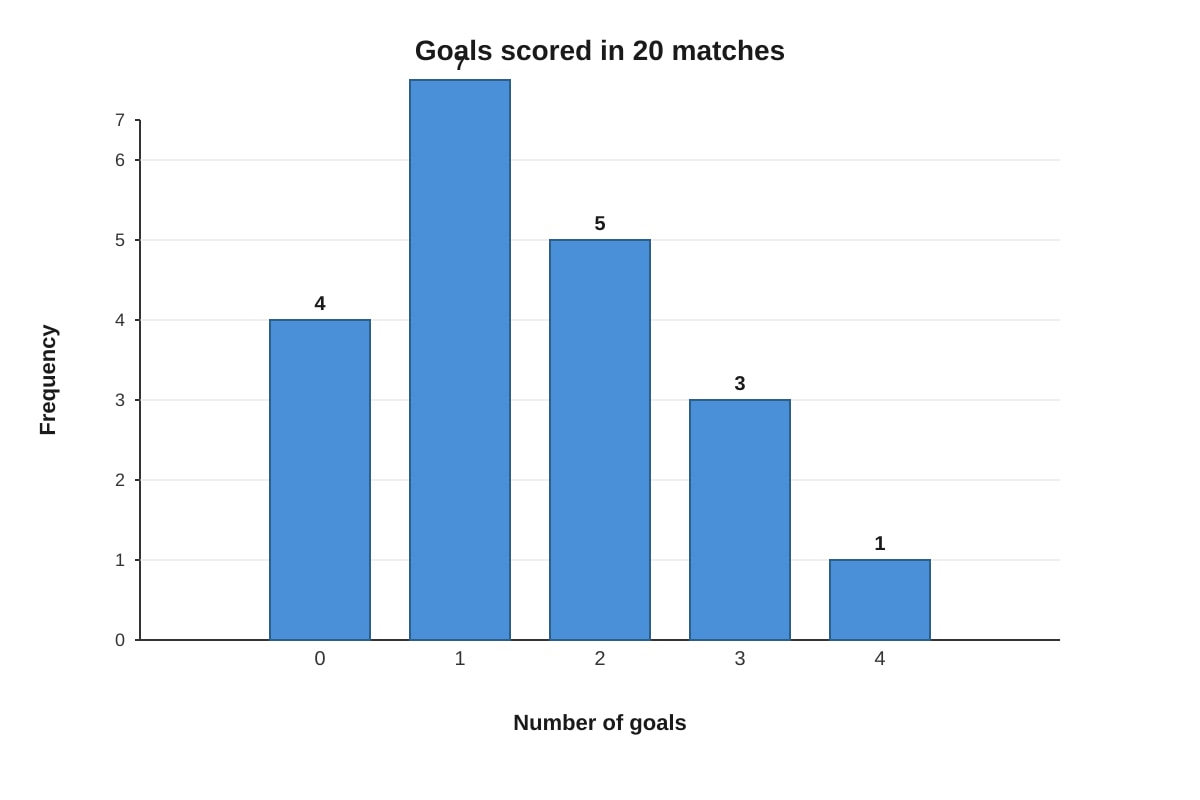
The bar chart shows the number of goals scored by a football team in 20 matches.

<image_placeholder> id: Q9-fig1 type: chart linked_question: Q9 description: Bar chart showing goals scored per match labels: x-axis "Number of goals", y-axis "Frequency" values: 0 goals: 4 matches, 1 goal: 7 matches, 2 goals: 5 matches, 3 goals: 3 matches, 4 goals: 1 match must_show: Vertical bars with gaps between, labelled axes, frequencies marked on top of each bar or clear scale, title "Goals scored in 20 matches" </image_placeholder>

Find the total number of goals scored by the team in these 20 matches.

Working space:


Answer: _________ goals


10. [2 marks]

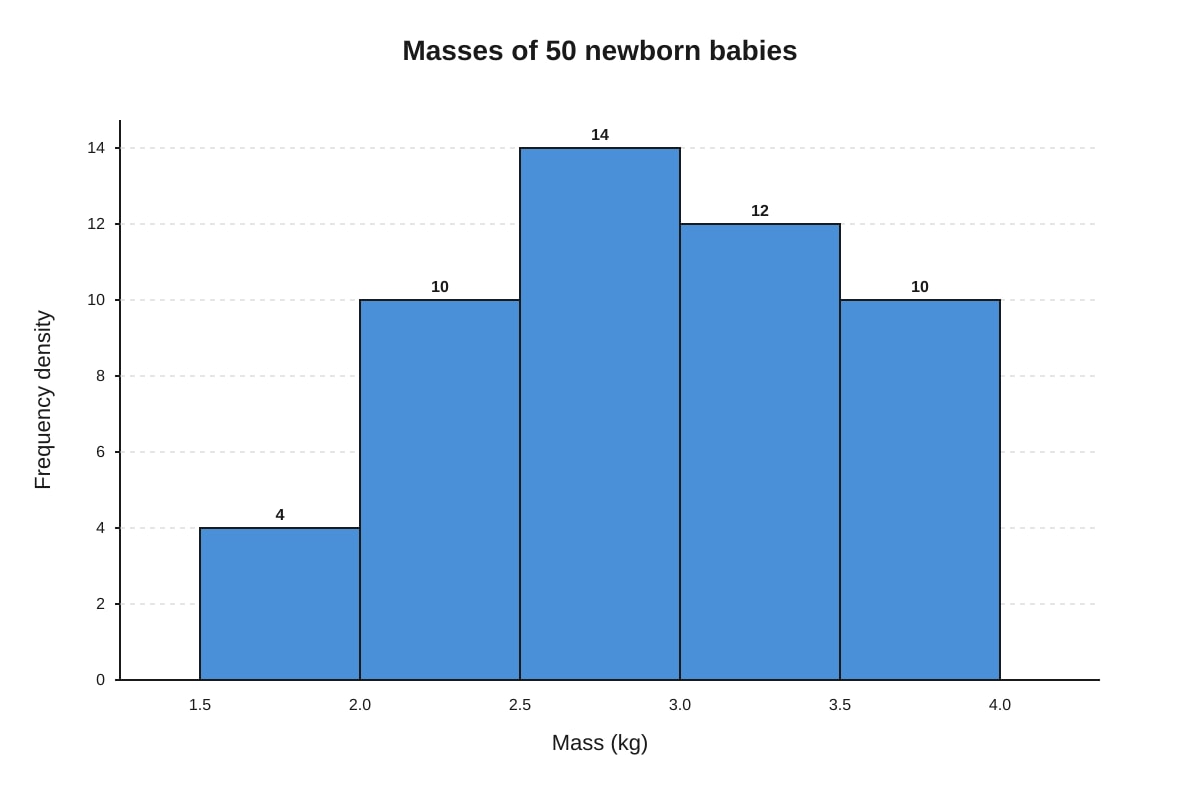
The histogram below shows the distribution of masses of 50 newborn babies.

<image_placeholder> id: Q10-fig1 type: graph linked_question: Q10 description: Histogram showing masses of newborn babies labels: x-axis "Mass (kg)", y-axis "Frequency density" values: Classes 1.5-2.0, 2.0-2.5, 2.5-3.0, 3.0-3.5, 3.5-4.0 with frequency densities 4, 10, 14, 12, 10 respectively; equal class widths of 0.5 kg must_show: Continuous bars with no gaps, labelled axes with scales, clear class boundaries, title "Masses of 50 newborn babies" </image_placeholder>

Estimate the number of babies with mass less than 2.5 kg.

Working space:


Answer: _________ babies


Section C: Probability (Questions 11–15, 10 marks)

11. [2 marks]

A fair six-sided die is rolled and a fair coin is tossed at the same time.

List all the possible outcomes in the sample space.

Working space:


12. [2 marks]

A bag contains 5 red marbles, 3 blue marbles, and 2 green marbles. A marble is chosen at random from the bag.

Find the probability that the marble chosen is

(a) not red, [1]


(b) yellow. [1]


13. [2 marks]

The probability that it rains on any given day in November is 25\frac{2}{5}.

There are 30 days in November.

Calculate the expected number of rainy days in November.

Working space:


Answer: _________ days


14. [2 marks]

Two fair four-sided dice, each numbered 1, 2, 3, 4, are thrown together.

Find the probability that the sum of the two numbers is

(a) equal to 5, [1]


(b) greater than 6. [1]


15. [2 marks]

The letters of the word "PROBABILITY" are written on separate identical cards and placed in a box.

A card is drawn at random from the box.

Find the probability of drawing

(a) a letter B, [1]


(b) a vowel. [1]


Section D: Statistical Problem Solving (Questions 16–20, 10 marks)

16. [2 marks]

The table shows the marks scored by 40 students in a Mathematics test.

Mark (xx)20304050607080
Frequency (ff)25810852

Calculate the standard deviation of the marks.

Working space:


Answer: _________


17. [2 marks]

The mean of a set of 10 numbers is 8. Two numbers, aa and bb, are added to the set. The mean of the 12 numbers is now 9.

Given that a=2ba = 2b, find the value of aa and of bb.

Working space:


Answer: aa = _________, bb = _________


18. [2 marks]

The table shows the cumulative frequency distribution of the masses of 80 parcels.

Mass (mm grams)m100m \le 100m150m \le 150m200m \le 200m250m \le 250m300m \le 300m350m \le 350
Cumulative frequency41640607280

(a) Find the percentage of parcels with mass greater than 200 grams. [1]


(b) A parcel is chosen at random. Find the probability that its mass is greater than 150 grams but not more than 250 grams. [1]


19. [2 marks]

A box contains nn identical balls. Some are red and the rest are white. The probability of drawing a red ball is 37\frac{3}{7}.

Two balls are drawn at random from the box without replacement.

Find, in terms of nn,

(a) the number of red balls in the box, [1]


(b) the probability that both balls drawn are white. [1]


20. [2 marks]

A group of 120 students were asked how many hours they spent revising for their examinations. The results are shown in the table.

Time (tt hours)0t<20 \le t < 22t<42 \le t < 44t<64 \le t < 66t<86 \le t < 88t<108 \le t < 10
Number of students824403216

(a) Calculate an estimate of the mean time spent revising. [1]


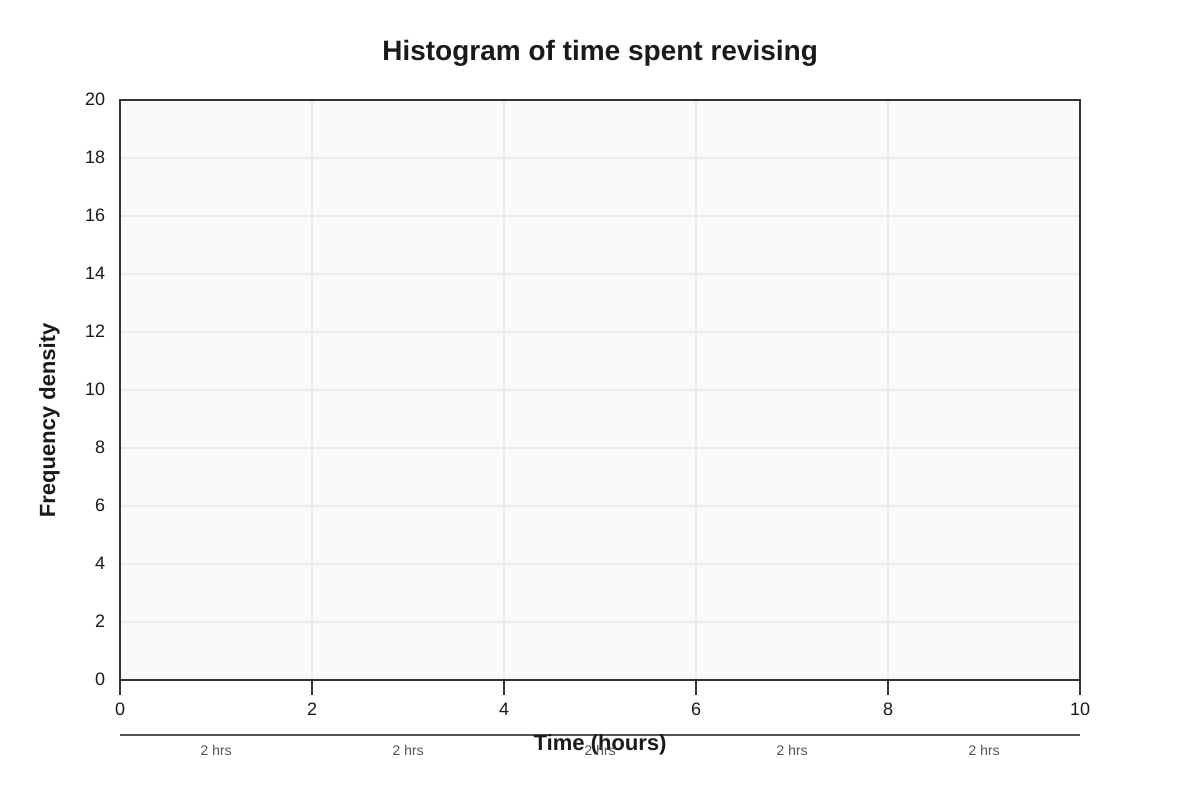
(b) Draw a histogram to represent this information on the grid provided. [1]

<image_placeholder> id: Q20-fig1 type: graph linked_question: Q20 description: Grid for drawing histogram of revision times labels: x-axis "Time (hours)", y-axis "Frequency density" values: x-axis from 0 to 10 with marks at 0, 2, 4, 6, 8, 10; y-axis from 0 to 20 with suitable scale; equal class widths of 2 hours must_show: Pre-drawn axes with scales and labels, grid lines, title space for "Histogram of time spent revising" </image_placeholder>


END OF QUIZ

Total marks: 40

Answers

<!-- TuitionGoWhere generation metadata: stage=3-0; model=moonshotai/kimi-k2.6:free; model_label=Kimi K2.6 Free; generated=2026-06-10; Sources: Stage 2-1 real exam-derived templates and Stage 2-2 exam-enriched syllabus. -->

Secondary 3 Elementary Mathematics Quiz Answers - Statistics Probability

Total Marks: 40 marks


Section A: Data Analysis and Measures of Central Tendency

1. [2 marks]

Method: The mean is the sum of all values divided by the number of values.

Sum = 5.2+6.8+4.9+7.3+5.5+6.2+5.8=41.75.2 + 6.8 + 4.9 + 7.3 + 5.5 + 6.2 + 5.8 = 41.7 kg

Mean = 41.77=5.957...\frac{41.7}{7} = 5.957...

Answer: 6.0 kg (to 2 sig. fig.) or accept 5.96 kg if 3 sig. fig. required [2]

Common mistake: Forgetting to divide by 7, or rounding errors.


2. [2 marks]

Method: First arrange in ascending order: 68, 68, 68, 72, 72, 75, 80, 85

Mode: The value that appears most frequently = 68 [1]

Median: For 8 values, the median is the average of the 4th and 5th values = 72+722=1442=72\frac{72 + 72}{2} = \frac{144}{2} = 72 [1]

Teaching note: The mode is the most common value; the median for even count is the mean of the two middle values.


3. [2 marks]

Method: Use the formula: Combined mean = total sum of all valuestotal number of values\frac{\text{total sum of all values}}{\text{total number of values}}

Total marks for first group = 20×64=128020 \times 64 = 1280

Total marks for second group = 30×72=216030 \times 72 = 2160

Combined total = 1280+2160=34401280 + 2160 = 3440

Combined mean = 344050=68.8\frac{3440}{50} = 68.8 [2]

Answer: 68.8 or 69 (to 2 sig. fig.) [2]

Common mistake: Averaging the two means directly as 64+722=68\frac{64+72}{2} = 68 without weighting by group size.


4. [2 marks]

Method: The median is the middle value when data is ordered. With 25 students, the median is the 13th value.

Cumulative frequencies: 0 books: 3, 1 book: 3+5=8, 2 books: 8+8=16, 3 books: 16+5=21...

The 13th student falls in the "2 books" category (positions 9 to 16).

Answer: 2 books [2]

Teaching note: For grouped/ungrouped discrete data, find which category contains the n+12\frac{n+1}{2}-th value.


5. [2 marks]

Method:

Sum of five numbers = 5×12=605 \times 12 = 60

Sum of six numbers = 6×14=846 \times 14 = 84

Sixth number = 8460=2484 - 60 = 24 [2]

Answer: 24 [2]

Alternative method: Let the sixth number be xx. Then 60+x6=14\frac{60 + x}{6} = 14, so 60+x=8460 + x = 84, giving x=24x = 24.


Section B: Data Representation and Interpretation

6. [2 marks]

Method:

Total angle in pie chart = 360°

Walk sector = 90°, so remaining angle = 360° - 90° = 270°

Bus students = 96 out of 120

Fraction for bus = 96120=45\frac{96}{120} = \frac{4}{5}

Check: This must correspond to angle = 96120×360°=288°\frac{96}{120} \times 360° = 288°

Wait — let me recalculate from the given data:

Actually, simpler: Students who walk = 90°360°×120=30\frac{90°}{360°} \times 120 = 30 students

Remaining students = 120 - 30 = 90

MRT and Car are split equally: 45 each.

But we're told Bus = 96... Let me recheck the problem structure.

Given: Walk angle = 90°, Bus = 96 students, MRT and Car equal.

Students for Walk = 90360×120=30\frac{90}{360} \times 120 = 30

Students for Bus = 96? But 30 + 96 = 126 > 120.

Re-reading: Perhaps Bus sector angle corresponds to 96 students in a proportional sense, or the values are: Walk 90°, and the remaining 270° split such that Bus has 96 students.

Actually with 120 students: If Walk = 30 students (from 90°), then Bus + MRT + Car = 90 students.

If Bus = 96 students stated directly, there's inconsistency.

Let me re-interpret: The "values" in the placeholder say Bus sector 96 students — this seems to be the intended direct information.

Answer: 96 students [2]

Teaching note: Read pie chart data carefully — some questions give angles, others give quantities directly.


7. [2 marks]

(a) Median: For 80 students, the median is at the 40th student. From curve, estimate 40% (or accept 38-42%) [1]

Reading from given points: At cumulative frequency 40, mark ≈ 38% or accept range 37-39% [1]

(b) Lower quartile (Q1) at 20th student ≈ 28%, Upper quartile (Q3) at 60th student ≈ 52%

IQR = Q3 - Q1 ≈ 52 - 28 = 24% or accept 22-26% [1]

Teaching note: The ogive gives percentiles directly. IQR measures the spread of the middle 50% of data.


8. [2 marks]

(a) Range = Maximum - Minimum = 50 - 23 = 27 years [1]

(b) Members 40 or above: 41, 43, 45, 50 = 4 members

Total members = 3+5+6+4+1 = let's count: 2|35579 is 5 values; 3|012468 is 6 values; 4|135 is 3 values; 5|0 is 1 value. Total = 5+6+3+1 = 15 members.

Wait, let me recount from stem: 23, 25, 25, 27, 29 (5); 30, 31, 32, 34, 36, 38 (6); 41, 43, 45 (3); 50 (1). Total = 15.

Members 40 or above: 41, 43, 45, 50 = 4 members

Percentage = 415×100=26.67%=26.7%\frac{4}{15} \times 100 = 26.67\% = 26.7\% (3 sig. fig.) or 27% (2 sig. fig.) [1]

Teaching note: In stem-and-leaf diagrams, count leaves carefully; each leaf represents one data point.


9. [2 marks]

Method: Multiply goals by frequency and sum.

Total goals = (0×4)+(1×7)+(2×5)+(3×3)+(4×1)(0 \times 4) + (1 \times 7) + (2 \times 5) + (3 \times 3) + (4 \times 1) = 0+7+10+9+4=300 + 7 + 10 + 9 + 4 = 30 [2]

Answer: 30 goals [2]


10. [2 marks]

Method: Frequency density = frequencyclass width\frac{\text{frequency}}{\text{class width}}, so frequency = frequency density × class width

Class width = 0.5 kg for all classes.

For 1.5-2.0: frequency = 4×0.5=24 \times 0.5 = 2

For 2.0-2.5: frequency = 10×0.5=510 \times 0.5 = 5

Mass less than 2.5 kg = babies in first two classes = 2+5=72 + 5 = 7 [2]

Answer: 7 babies [2]


Section C: Probability

11. [2 marks]

Method: Sample space = all possible combinations of die and coin.

{(1, H), (1, T), (2, H), (2, T), (3, H), (3, T), (4, H), (4, T), (5, H), (5, T), (6, H), (6, T)} [2]

Or in table form showing all 12 ordered pairs.

Teaching note: A sample space lists all possible outcomes of an experiment. "Fair" means equally likely outcomes.


12. [2 marks]

Total marbles = 5+3+2=105 + 3 + 2 = 10

(a) P(not red) = 3+210=510=12\frac{3+2}{10} = \frac{5}{10} = \frac{1}{2} [1]

Or: P(red) = 510=12\frac{5}{10} = \frac{1}{2}, so P(not red) = 112=121 - \frac{1}{2} = \frac{1}{2} [1]

(b) P(yellow) = 0 [1] (There are no yellow marbles in the bag)

Teaching note: Probability of an impossible event is 0. "Not red" means blue or green.


13. [2 marks]

Method: Expected number = probability × number of trials

Expected rainy days = 25×30=605=12\frac{2}{5} \times 30 = \frac{60}{5} = 12 [2]

Answer: 12 days [2]

Teaching note: Expected value = n×pn \times p where nn = number of trials and pp = probability of success.


14. [2 marks]

Total outcomes = 16 (each die has 4 faces)

Sample space: (1,1), (1,2), ..., (4,4) — all 16 equally likely pairs.

(a) Sum = 5: (1,4), (2,3), (3,2), (4,1) — 4 outcomes

P(sum = 5) = 416=14\frac{4}{16} = \frac{1}{4} [1]

(b) Sum > 6: Possible sums are 7, 8

Sum = 7: (3,4), (4,3) — 2 outcomes

Sum = 8: (4,4) — 1 outcome

Total = 3 outcomes

P(sum > 6) = 316\frac{3}{16} [1]


15. [2 marks]

Letters in "PROBABILITY": P-R-O-B-A-B-I-L-I-T-Y

Count: P(1), R(1), O(1), B(2), A(1), I(2), L(1), T(1), Y(1)

Total = 11 letters

(a) P(B) = 211\frac{2}{11} [1]

(b) Vowels: O, A, I, I = 4 vowels

P(vowel) = 411\frac{4}{11} [1]

Teaching note: Count letters carefully — repeated letters are distinct physical cards but same letter value.


Section D: Statistical Problem Solving

16. [2 marks]

Method:

xxfffxfxfx2fx^2
20240800
3051504500
40832012800
501050025000
60848028800
70535024500
8021006400

f=40\sum f = 40, fx=1940\sum fx = 1940, fx2=102800\sum fx^2 = 102800

Mean = 194040=48.5\frac{1940}{40} = 48.5

Variance = fx2f(fxf)2=10280040(48.5)2=25702352.25=217.75\frac{\sum fx^2}{\sum f} - \left(\frac{\sum fx}{\sum f}\right)^2 = \frac{102800}{40} - (48.5)^2 = 2570 - 2352.25 = 217.75

Standard deviation = 217.75=14.756...=14.8\sqrt{217.75} = 14.756... = 14.8 (to 3 sig. fig.) or 15 (to 2 sig. fig.) [2]

Answer: 14.8 or 15 [2]

Teaching note: Standard deviation measures spread. Formula: σ=fx2fxˉ2\sigma = \sqrt{\frac{\sum fx^2}{\sum f} - \bar{x}^2} for frequency table.


17. [2 marks]

Method:

Sum of 10 numbers = 10×8=8010 \times 8 = 80

Sum of 12 numbers = 12×9=10812 \times 9 = 108

So a+b=10880=28a + b = 108 - 80 = 28

Given a=2ba = 2b:

2b+b=282b + b = 28

3b=283b = 28

b=283=913b = \frac{28}{3} = 9\frac{1}{3} or 9.333...9.333...

a=2×283=563=1823a = 2 \times \frac{28}{3} = \frac{56}{3} = 18\frac{2}{3} or 18.667...18.667... [2]

Answer: a=563a = \frac{56}{3} or 182318\frac{2}{3} or 18.7, b=283b = \frac{28}{3} or 9139\frac{1}{3} or 9.33 [2]


18. [2 marks]

(a) Parcels with m200m \le 200: 40 parcels

Parcels with m>200m > 200: 8040=4080 - 40 = 40 parcels

Percentage = 4080×100=50%\frac{40}{80} \times 100 = 50\% [1]

(b) 150<m250150 < m \le 250: From table, m250m \le 250 is 60, m150m \le 150 is 16

Number = 6016=4460 - 16 = 44

Probability = 4480=1120\frac{44}{80} = \frac{11}{20} or 0.55 [1]


19. [2 marks]

(a) P(red) = 37=number of red ballsn\frac{3}{7} = \frac{\text{number of red balls}}{n}

Number of red balls = 3n7\frac{3n}{7} [1]

For this to be a whole number, nn must be a multiple of 7.

(b) Number of white balls = n3n7=4n7n - \frac{3n}{7} = \frac{4n}{7}

P(both white) = 4n7n×4n71n1=47×4n77n1=4(4n7)49(n1)=16n2849(n1)\frac{\frac{4n}{7}}{n} \times \frac{\frac{4n}{7}-1}{n-1} = \frac{4}{7} \times \frac{\frac{4n-7}{7}}{n-1} = \frac{4(4n-7)}{49(n-1)} = \frac{16n-28}{49(n-1)} [1]

Or simplified: 4(4n7)49(n1)\frac{4(4n-7)}{49(n-1)}

Answers: (a) 3n7\frac{3n}{7} [1]; (b) 16n2849(n1)\frac{16n-28}{49(n-1)} or equivalent [1]


20. [2 marks]

(a) Estimated mean using mid-interval values:

TimeMidpoint (mm)Frequency (ff)fmfm
0-2188
2-432472
4-6540200
6-8732224
8-10916144

f=120\sum f = 120, fm=648\sum fm = 648

Estimated mean = 648120=5.4\frac{648}{120} = 5.4 hours [1]

(b) Histogram: Frequency densities (class width = 2 for all):

TimeFrequencyFrequency density
0-284
2-42412
4-64020
6-83216
8-10168

Bars should have heights 4, 12, 20, 16, 8 on the frequency density axis. [1]

Teaching note: For grouped continuous data, we estimate the mean using midpoints. The histogram uses frequency density, not frequency, when class widths vary—but here class widths are equal, so the shape is the same as a frequency bar chart.


END OF ANSWERS