From Real Exams Quiz
Secondary 3 Elementary Mathematics Graphs Coordinate Geometry Quiz
Free Sec 3 E Maths Graphs Geometry quiz, HY3 Exam version, with questions, answers, and O Level-style practice for Singapore students.
These static practice materials are generated from the site's syllabus and paper-generation workflow, with source and model context shown so students and parents can evaluate the material before use.
Questions
Secondary 3 Elementary Mathematics Quiz - Graphs Coordinate Geometry
Name: ___________________________
Class: ____________
Date: ____________
Score: ____________
Duration: 60 minutes
Total Marks: 40
Instructions:
- Answer all 20 questions.
- Show your working clearly where required.
- Use a ruler and graph paper for sketching questions.
- Write your answers in the spaces provided.
Section A (Questions 1–5) — Short Answer [10 marks]
1. The point A has coordinates (3,−2). What is the x-coordinate of A? [1]
2. Write down the gradient of the line y=4x−7. [1]
3. State the equation of the y-axis. [1]
4. The line L passes through (0,0) and (2,6). Find the gradient of L. [1]
5. A quadratic graph has equation y=(x−1)2+3. Write down the coordinates of its vertex. [1]
Section B (Questions 6–13) — Structured Questions [16 marks]
6. The points P(1,2) and Q(5,8) lie on a straight line. (a) Find the gradient of PQ. [1] (b) Find the equation of the line PQ in the form y=mx+c. [2]
7. Find the equation of the line parallel to y=2x+5 that passes through (3,−1). [2]
8. The line y=−x+4 meets the x-axis at A and the y-axis at B. (a) Write down the coordinates of A. [1] (b) Write down the coordinates of B. [1]
9. A quadratic function is given by y=x2−6x+5. (a) Write it in the form y=(x−a)(x−b). [1] (b) State the x-intercepts. [1] (c) Find the equation of the axis of symmetry. [1]
10. Sketch the graph of y=−(x−2)2+4 on the grid below. Label the vertex and the x-intercepts. [3]

Generated graph for Q10.
11. The points R(−2,3) and S(4,−1) are given. (a) Find the midpoint of RS. [1] (b) Find the length of RS. [2]
12. The graph of y=ax2+bx+c passes through (0,2), (1,5), and (−1,3). Find the value of c. [2]
13. A line has gradient −3 and y-intercept 2. Write its equation in the form ax+by=c where a,b,c are integers. [2]
Section C (Questions 14–20) — Extended Application [14 marks]
14. Two points are M(2,5) and N(8,13). (a) Find the gradient of MN. [1] (b) Hence find the equation of the perpendicular bisector of MN. [3]
15. The quadratic y=2x2−8x+6 is given. (a) Express it in the form y=2(x−p)2+q. [2] (b) State the minimum value of y and the x-value at which it occurs. [1]
16. A straight line passes through A(1,3) and B(7,15). A point C lies on AB such that AC:CB=1:2. Find the coordinates of C. [3]
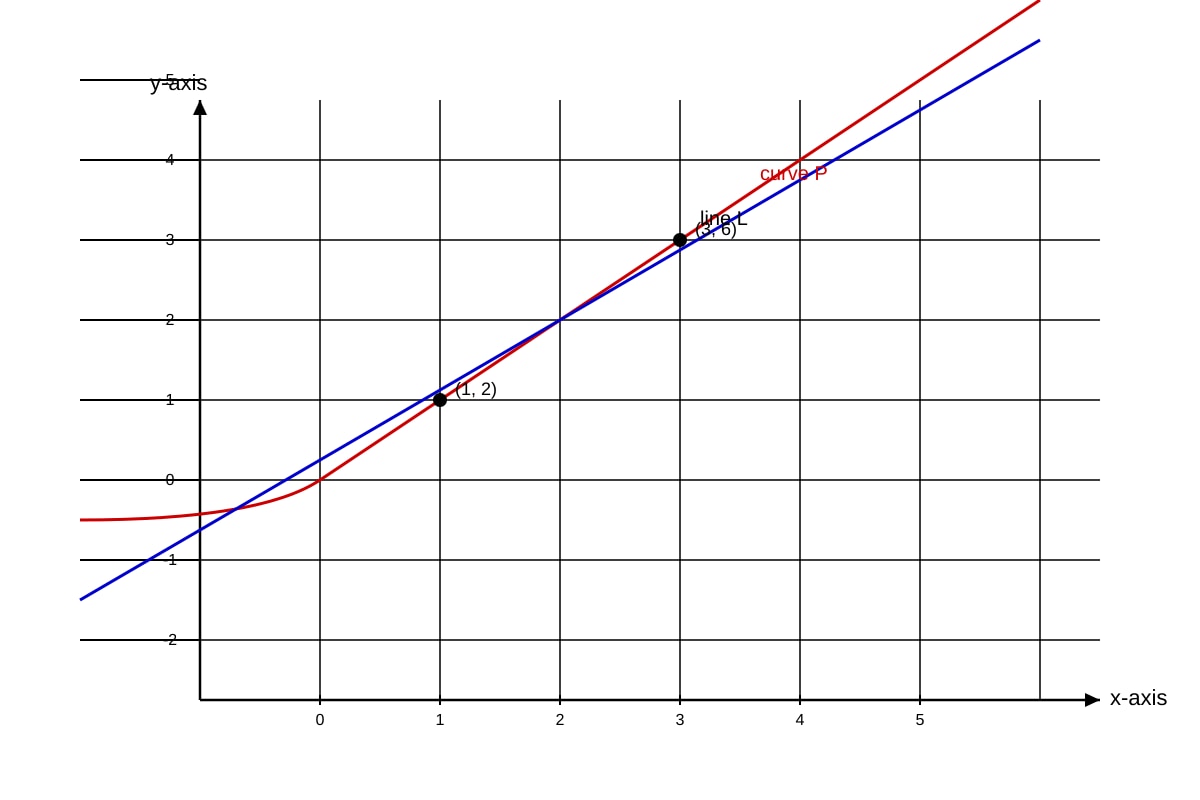
17. The diagram shows a line and a parabola.

Generated graph for Q17.
(a) Write down the coordinates of the two intersection points. [1] (b) Explain how the solutions of x2−3x+2=x+1 are found from the graph. [1]
18. The points D(0,0), E(6,0), F(6,8) form a right triangle. Show that DEF is right-angled at E using gradients. [2]
19. A quadratic graph has vertex (3,−4) and passes through (1,0). Find its equation in the form y=a(x−h)2+k. [3]
20. The table shows values for a straight line.
| x | 0 | 2 | 4 |
|---|---|---|---|
| y | 1 | 5 | 9 |
(a) Find the gradient of the line. [1] (b) Find the equation of the line. [1] (c) Find y when x=10. [1]
Answers
Answer Key — Secondary 3 Elementary Mathematics Quiz: Graphs Coordinate Geometry
Total Marks: 40
Topic: Graphs & Coordinate Geometry
Section A (Q1–5)
Q1. 3 [1]
Teaching note: The x-coordinate is the first number in the ordered pair (x,y). For A(3,−2), x=3.
Q2. 4 [1]
Teaching note: For a line y=mx+c, m is the gradient. Here m=4.
Q3. x=0 [1]
Teaching note: The y-axis is the vertical line where every point has x=0.
Q4. 3 [1]
Working: gradient =2−06−0=26=3.
Q5. (1,3) [1]
Teaching note: Vertex form y=(x−p)2+q has vertex (p,q). Here p=1,q=3.
Section B (Q6–13)
Q6. [3 total]
(a) Gradient =5−18−2=46=23 [1]
(b) Using y−y1=m(x−x1) with (1,2):
y−2=23(x−1)
y=23x−23+2=23x+21 [2]
Marking: 1 for correct substitution, 1 for correct equation.
Q7. [2]
Parallel line has same gradient m=2. Through (3,−1):
y+1=2(x−3)
y=2x−7
Working shown; final y=2x−7 [2].
Q8. [2]
(a) At x-axis, y=0: 0=−x+4⇒x=4, so A(4,0) [1]
(b) At y-axis, x=0: y=4, so B(0,4) [1]
Q9. [3]
(a) x2−6x+5=(x−1)(x−5) [1]
(b) x-intercepts: x=1,5 [1]
(c) Axis: x=21+5=3 [1]
Q10. [3]
Vertex (2,4), x-intercepts: 0=−(x−2)2+4⇒(x−2)2=4⇒x=0,4.
Marking: 1 vertex labelled, 1 each intercept labelled, shape correct (downward).
Expected visual: parabola through (0,0),(2,4),(4,0).
Q11. [3]
(a) Midpoint =(2−2+4,23+(−1))=(1,1) [1]
(b) Length =(4−(−2))2+(−1−3)2=62+(−4)2=52=213 [2]
Q12. [2]
At x=0,y=2⇒c=2. (Substitution into y=ax2+bx+c) [2]
Q13. [2]
y=−3x+2⇒3x+y=2. So a=3,b=1,c=2 [2].
Section C (Q14–20)
Q14. [4]
(a) Gradient MN=8−213−5=68=34 [1]
(b) Perpendicular gradient =−43. Midpoint =(5,9).
Equation: y−9=−43(x−5)
4y−36=−3x+15⇒3x+4y=51 [3: 1 perp grad, 1 midpoint, 1 equation]
Q15. [3]
(a) 2x2−8x+6=2(x2−4x)+6=2[(x−2)2−4]+6=2(x−2)2−2 [2]
(b) Min value =−2 at x=2 [1]
Q16. [3]
Section formula (1:2): C=(32(1)+1(7),32(3)+1(15))=(3,7) [3]
Q17. [2]
(a) From graph: (1,2) and (3,6) [1]
(b) Solutions are x-values where the line and parabola meet; solve x2−3x+2=x+1 [1]
Q18. [2]
Gradient DE=0, gradient EF undefined (vertical) ⇒ perpendicular, right angle at E [2].
Q19. [3]
y=a(x−3)2−4. Through (1,0): 0=a(1−3)2−4=4a−4⇒a=1.
So y=(x−3)2−4 [3]
Q20. [3]
(a) Gradient =2−05−1=2 [1]
(b) y=2x+1 (intercept 1) [1]
(c) x=10⇒y=21 [1]
Free quiz and exam paper access
Enter your details to view this paper
Your access is remembered on this device.