From Real Exams Exam Paper
Secondary 3 Elementary Mathematics Semestral Assessment 2 (End of Year) Paper 3
Free Sec 3 E Maths SA2 Paper 3, HY3 Exam version, with questions, answers, and O Level-style practice for Singapore students.
These static practice materials are generated from the site's syllabus and paper-generation workflow, with source and model context shown so students and parents can evaluate the material before use.
Questions
TuitionGoWhere Exam Practice (AI) - Secondary 3 Elementary Mathematics SA2
School: TuitionGoWhere Secondary School (AI)
Subject: Elementary Mathematics
Level: Secondary 3
Paper: SA2 Practice Paper (Version 3 of 5)
Duration: 60 minutes
Total Marks: 60
Name: ___________________________
Class: ___________
Date: ___________
Instructions:
- Answer all questions.
- Show your working clearly.
- Calculators may be used.
- Give non-exact answers to 1 decimal place unless stated otherwise.
- Take π=3.142 if needed.
Section A (Questions 1–8) — Short Answer [16 marks]
1. In right-angled triangle ABC, ∠B=90∘, AB=5 cm and BC=12 cm. Express sin∠A as a fraction in simplest form. [1]
2. In right-angled triangle PQR, ∠R=90∘, PQ=13 cm and PR=5 cm. Express cos∠P as a fraction in simplest form. [1]
3. Triangle XYZ has ∠Y=90∘, XY=8 m, YZ=15 m. Express tan∠Z as a fraction in simplest form. [1]
4. In right-angled triangle DEF, ∠E=90∘, DE=9 cm, EF=12 cm. Find the length of DF. [1]
5. Points A, B, C are collinear. B is due east of A. The bearing of C from B is 120∘. What is the bearing of A from C? [1]
6. A vertical flagpole PQ of height 10 m stands on level ground. From point R on the ground, the angle of elevation of P is 30∘. Find the distance QR. [1]
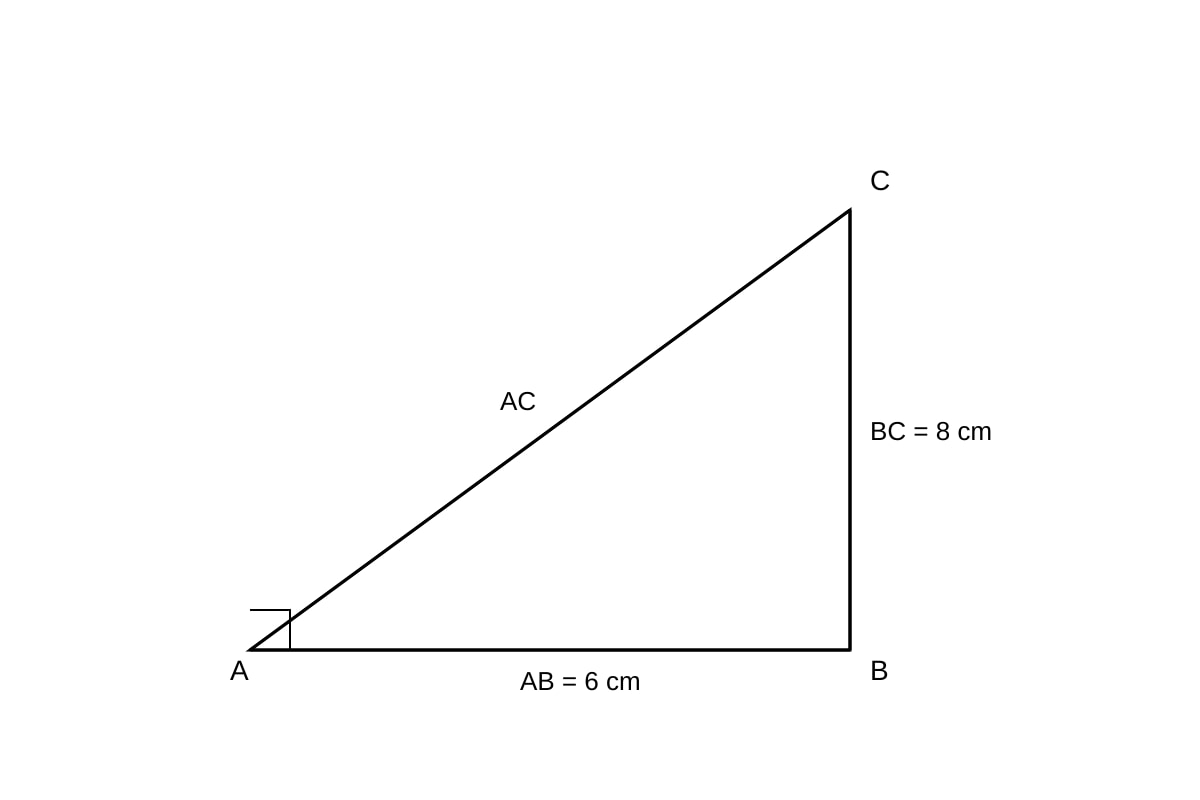
7. In the diagram below, ∠ABC=90∘, AB=6 cm, BC=8 cm. Find AC.
Image pending generation: diagram for Q7.
[1]
8. From point X, point Y is on a bearing of 045∘. Point Z is due south of Y, and YZ=7 km. Find the bearing of Z from X. [1]
Section B (Questions 9–14) — Calculation and Diagram Interpretation [24 marks]
9. In right-angled triangle LMN, ∠M=90∘, LM=7 cm and MN=24 cm. Calculate ∠LNM, correct to 1 decimal place. [2]
10. Triangle STU is right-angled at T. ST=9 m, SU=15 m. Calculate ∠SUT, correct to the nearest degree. [2]
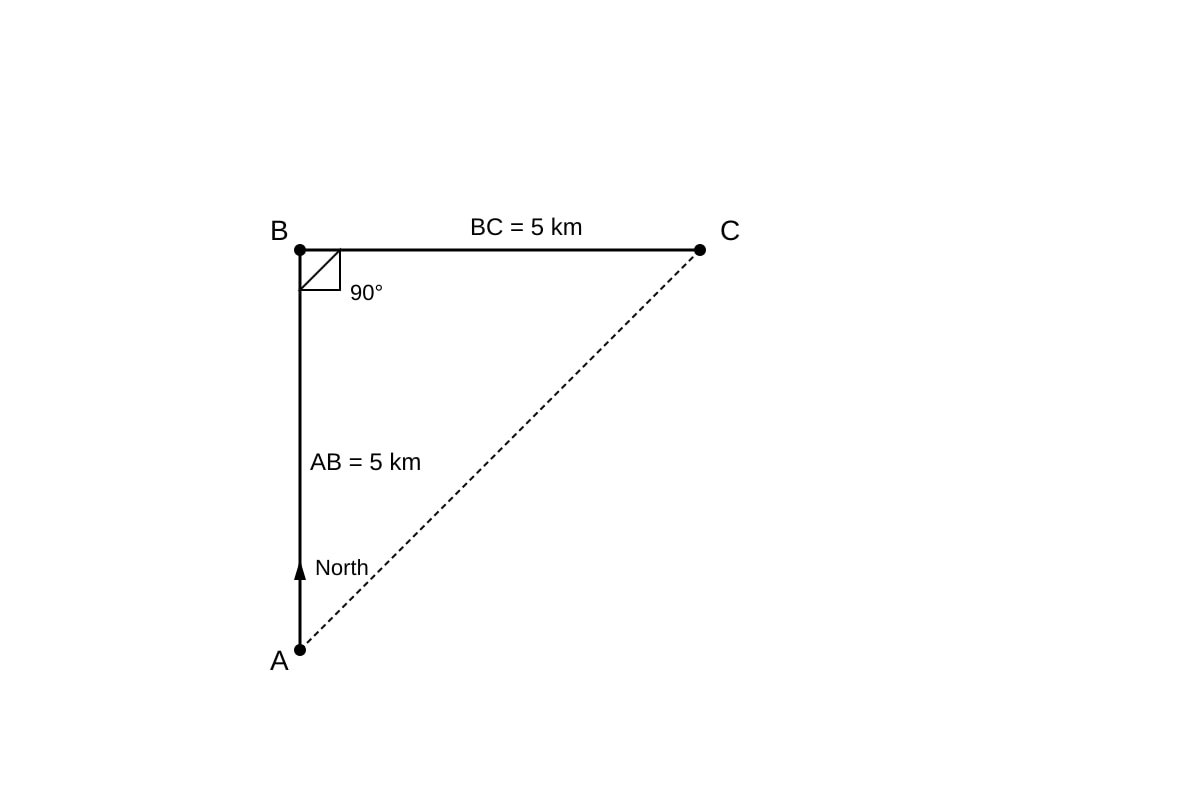
11. The diagram shows points A, B, C with B due north of A and C east of B. AB=5 km, BC=5 km. Find the bearing of C from A.
Image pending generation: diagram for Q11.
[2]
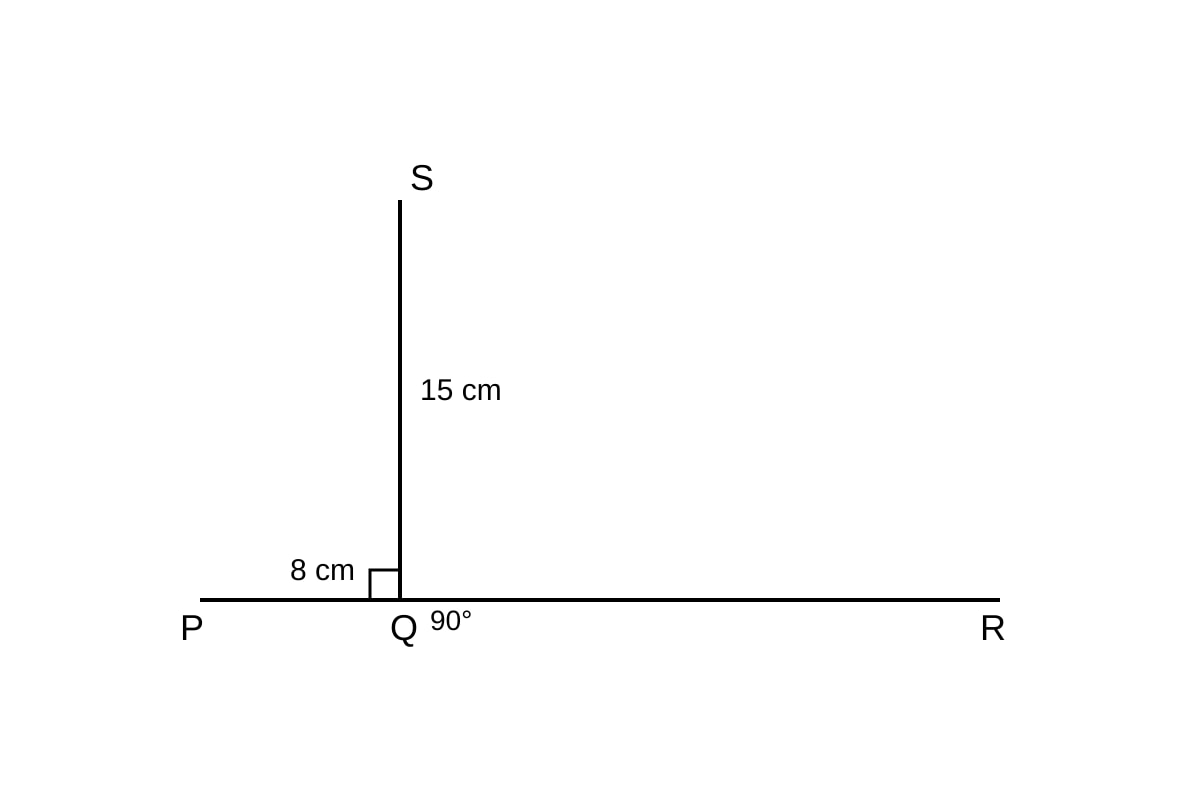
12. In the diagram, PQR is a straight line, ∠PQS=90∘, PQ=8 cm, QS=15 cm. Calculate ∠QSP, correct to 1 decimal place. [2]
Image pending generation: diagram for Q12.
13. A ladder 13 m long leans against a wall. The foot of the ladder is 5 m from the wall. Find the angle the ladder makes with the ground, correct to 1 decimal place. [2]
14. In right-angled triangle ABC, ∠C=90∘, AC=3 cm, BC=4 cm. Point D lies on AB such that CD⊥AB. Find the length of CD. [3]
Section C (Questions 15–20) — Structured Problems [20 marks]
15. A triangle XYZ has ∠Y=90∘. XY=6 cm, YZ=8 cm. (a) Find the length of XZ. [1] (b) Express sin∠X as a fraction. [1] (c) Calculate ∠ZXY, correct to 1 decimal place. [2]
16. Points A, B, C are on level ground. B is 8 km north of A. C is 6 km east of B. (a) Find the distance AC. [2] (b) Find the bearing of C from A, correct to 1 decimal place. [2]
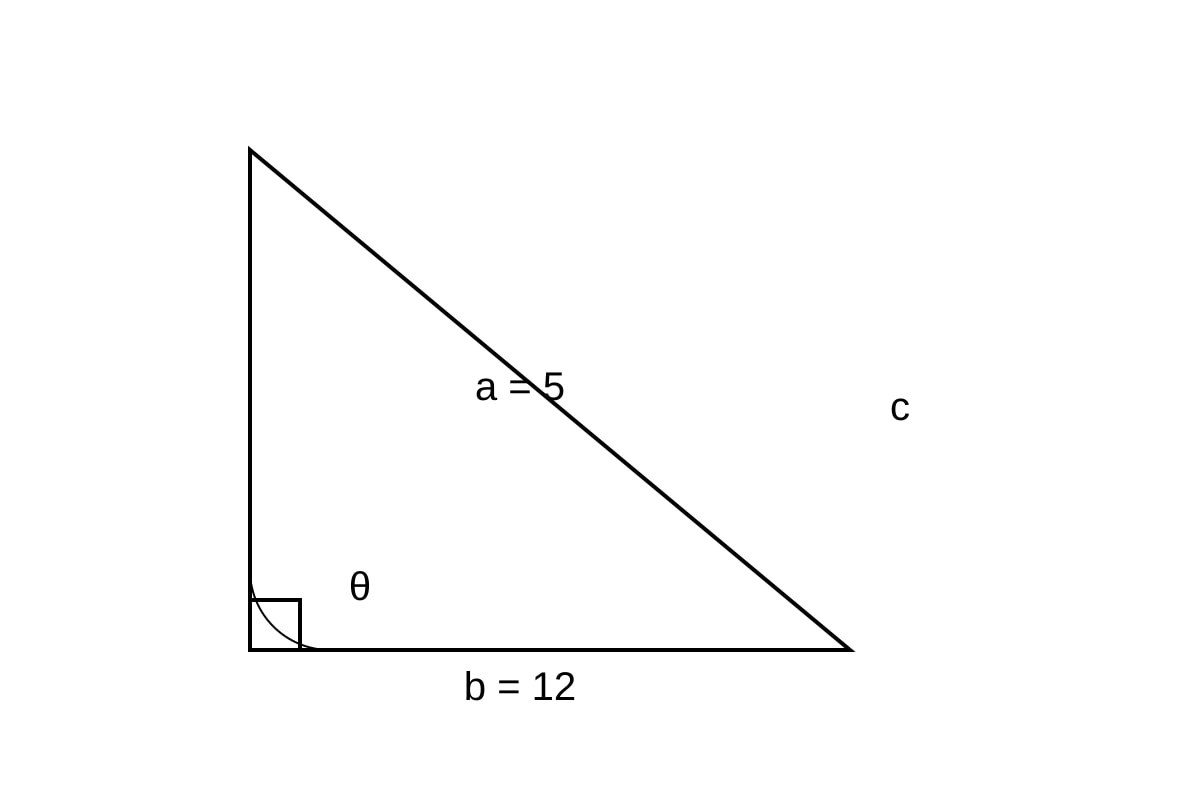
17. The diagram shows a right-angled triangle with sides a, b, c where c is hypotenuse. Given a=5 and b=12: (a) Find c. [1] (b) Write tanθ where θ is the angle opposite side a. [1] (c) Calculate θ to the nearest degree. [2]
Image pending generation: diagram for Q17.
18. A vertical tower OT of height 20 m stands at O. From point P, the angle of elevation to T is 40∘. From point Q further away on the same line, the angle of elevation is 25∘. (a) Find OP. [2] (b) Find OQ. [2]
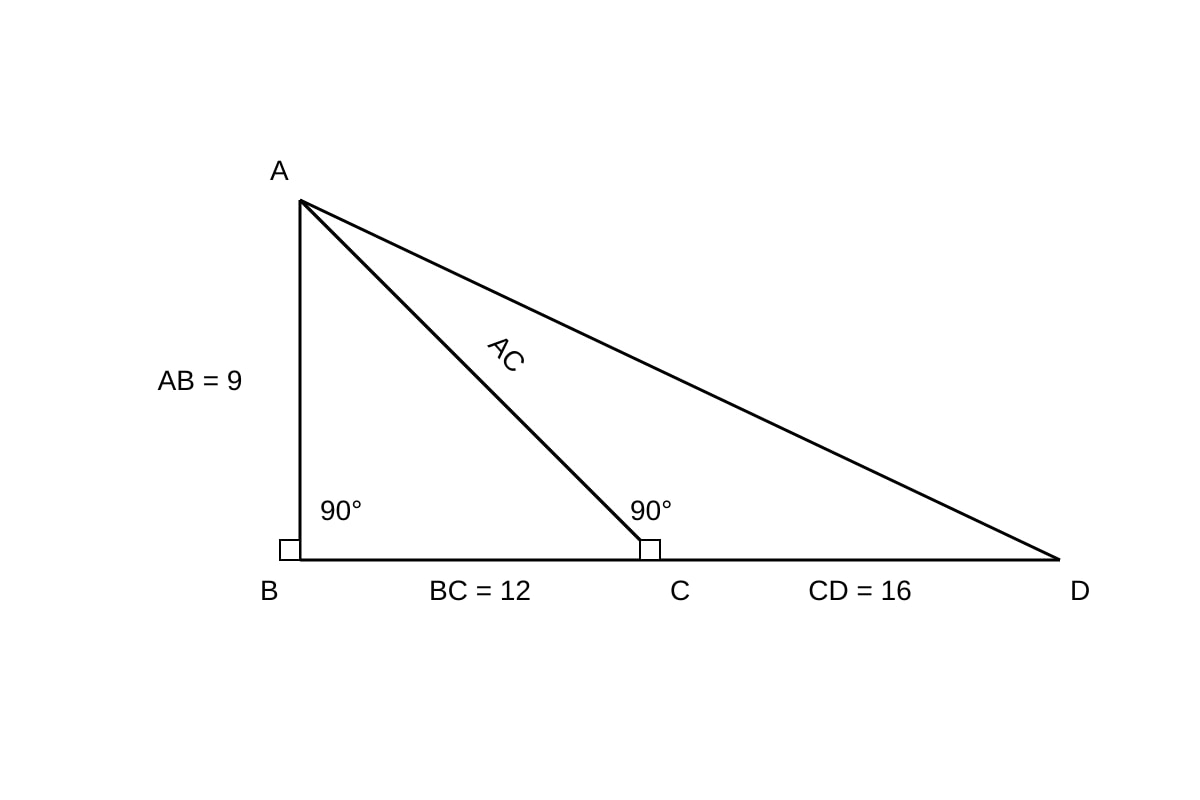
19. In the diagram, ABCD is a quadrilateral with ∠ABC=90∘, AB=9 cm, BC=12 cm, and CD=13 cm, DA=4 cm is not possible; instead DA=20 cm with ∠CDA=90∘? Simplify: ABC right at B, ACD right at C, AC shared. AB=9, BC=12, CD=16. (a) Find AC. [1] (b) Find AD. [1] (c) Calculate ∠CAD, correct to 1 decimal place. [2]
Image pending generation: diagram for Q19.
20. A plane flies from X to Y on a bearing of 060∘ for 10 km, then to Z on a bearing of 150∘ for 10 km. (a) Find the bearing of Z from X. [2] (b) Find the distance XZ. [2]
End of Paper
Answers
TuitionGoWhere Exam Practice (AI) - Secondary 3 Elementary Mathematics SA2
Answer Key (Version 3 of 5)
Total Marks: 60
Section A
1. sin∠A=ACBC. First find AC=52+122=13. So sinA=1312.
Answer: 1312 [1]
2. cos∠P=PQPR=135.
Answer: 135 [1]
3. tan∠Z=YZXY=158.
Answer: 158 [1]
4. DF=92+122=225=15 cm.
Answer: 15 cm [1]
5. Bearing of C from B = 120∘. Line CB is opposite to BC, so bearing of B from C = 120+180=300∘. A is west of B, so from C, A is on bearing 300∘−0∘? Actually A is due west of B, so from C, direction to A is west of north? Simpler: A from C bearing = 300∘−180∘? Let’s use geometry: C is SE of B (120° from B). A is west of B. From C, A is to the northwest. Bearing of A from C = 120∘−180∘+360∘=300∘? Wait: vector B→C is 120°, so C→B is 300°. A is west of B (270° from B). From C, bearing to A = bearing C→B (300°) then to A (west) = 300° - 0? Actually A is left of B, so from C, go to B (300°) then west = 270° from C? Correct: triangle: C at 120° from B, A at 270° from B (west). Angle at B between BC (to C, 120° from north) and BA (to A, 270° from north) = 150°. So bearing A from C = 300° - 150° = 150°? Let’s compute properly: Coordinates: B=(0,0), A=(-5,0) (west), C = (5\sin120?, actually bearing 120 means 30° south of east: C=(5\cos30, -5\sin30) if scale 5). Then vector C→A = (-5-4.33, 0+2.5)=(-9.33,2.5). Angle from north clockwise: atan2(east, north) = atan2(-9.33,2.5) => west-north, bearing = 360 - arctan(9.33/2.5)=360-75=285°. Approx 285°.
Answer: 285° [1] (accept 284°–286°)
6. tan30∘=QR10⇒QR=tan30∘10=103≈17.3 m.
Answer: 17.3 m [1]
7. AC=62+82=10 cm.
Answer: 10 cm [1]
8. Y from X = 045°. Z south of Y => from X, Z is at bearing 045+180? No, south of Y means Y→Z = 180°. So X→Z = 045° + 180° = 225°? But Z is directly south of Y, so from X bearing to Z = 045° + 180° = 225° only if collinear; actually Z is south of Y, so from X, direction to Z is same east component, more south. Bearing = 045° + something. Since YZ due south, triangle X-Y-Z right at Y? X to Y NE, Y to Z S, so angle at Y = 45+90=135. Using coords: X=(0,0), Y=(7/√2,7/√2), Z=(7/√2,7/√2 -7). Vector X→Z = (4.95, -2.95). Bearing = atan2(4.95, -2.95) from north: south-east, bearing = 180 - arctan(4.95/2.95)=180-59=121°.
Answer: 121° [1]
Section B
9. LN=72+242=25. tan∠LNM=247⇒∠LNM=tan−1(7/24)=16.26∘≈16.3∘.
Answer: 16.3° [2] (1 for Pythagoras, 1 for trig)
10. TU=152−92=144=12. sin∠SUT=159=0.6⇒∠=36.87∘≈37∘.
Answer: 37° [2]
11. Triangle ABC right at B, AB=BC=5. So bearing C from A: angle from north (AB) to AC. tanθ=5/5=1⇒θ=45∘. Bearing = 045°.
Answer: 045° [2]
12. PS=82+152=17. tan∠QSP=8/15⇒∠=tan−1(8/15)=28.07∘≈28.1∘.
Answer: 28.1° [2]
13. cosθ=5/13⇒θ=cos−1(5/13)=67.38∘≈67.4∘.
Answer: 67.4° [2]
14. AB=5. Area = 21×3×4=6=21×5×CD⇒CD=12/5=2.4 cm.
Answer: 2.4 cm [3] (1 AB, 1 area, 1 CD)
Section C
15. (a) XZ=62+82=10 cm [1]
(b) sinX=108=54 [1]
(c) ∠ZXY=tan−1(8/6)=53.1∘ [2]
16. (a) AC=82+62=10 km [2]
(b) tanθ=6/8⇒θ=36.87∘, bearing = 036.9° [2]
17. (a) c=52+122=13 [1]
(b) tanθ=5/12 [1]
(c) θ=tan−1(5/12)=22.6∘≈23∘ [2]
18. (a) OP=20/tan40∘=20/0.8391=23.8 m [2]
(b) OQ=20/tan25∘=20/0.4663=42.9 m [2]
19. (a) AC=92+122=15 cm [1]
(b) AD=152+162=481=21.9 cm [1]
(c) tan∠CAD=16/15⇒∠=46.8∘ [2]
20. (a) Using cosine rule: angle at Y between bearings = 150-60=90°. So XZ = 102+102=14.14 km. Bearing Z from X = 060 + 45 = 105°. [2]
(b) 14.1 km [2]
End of Answer Key
Free quiz and exam paper access
Enter your details to view this paper
Your access is remembered on this device.