From Real Exams Exam Paper
Secondary 3 Elementary Mathematics Semestral Assessment 2 (End of Year) Paper 1
Free Sec 3 E Maths SA2 Paper 1, HY3 Exam version, with questions, answers, and O Level-style practice for Singapore students.
These static practice materials are generated from the site's syllabus and paper-generation workflow, with source and model context shown so students and parents can evaluate the material before use.
Questions
TuitionGoWhere Practice Paper - Elementary Mathematics Secondary 3
TuitionGoWhere Secondary School (AI)
Subject: Elementary Mathematics
Level: Secondary 3
Paper: SA2 Practice Paper (Version 1 of 5)
Duration: 60 minutes
Total Marks: 50
Name: ___________________________
Class: ___________
Date: ____________
Instructions:
- Answer all questions.
- Show your working clearly.
- Calculators may be used.
- Give non-exact answers to 1 decimal place unless stated otherwise.
- Write your answers in the spaces provided.
Section A (Questions 1–8) — Short Answer [12 marks]
1. In a right-angled triangle, PQR, ∠PRQ=90∘, PR=5 cm and QR=12 cm. Express sin∠QPR as a fraction in simplest form. [1]
2. Triangle ABC is right-angled at B. AB=8 m, BC=15 m. Express cos∠ACB as a fraction in simplest form. [1]
3. In right-angled triangle XYZ, ∠Y=90∘, XY=7 cm and YZ=24 cm. Express tan∠ZXY as a fraction in simplest form. [1]
4. Points A, B, C are collinear with B between A and C. AB=6 cm, BC=8 cm, and CD is perpendicular to AC with CD=5 cm. Express tan∠CAD as a fraction in simplest form. [1]
5. A vertical flagpole PQ of height 10 m stands on level ground. A point R is 24 m from Q on the ground. Express tan∠PRQ as a fraction in simplest form. [1]
6. In right-angled triangle LMN, ∠M=90∘, LM=9, MN=12. Express sin∠LNM as a fraction in simplest form. [1]
7. Triangle STU is right-angled at T. ST=3 cm, TU=4 cm. Express cos∠TUS as a fraction in simplest form. [1]
8. In right-angled triangle DEF, ∠E=90∘, DE=12, EF=16. Express sin∠DFE as a fraction in simplest form. [1]
Section B (Questions 9–14) — Calculation and Angles [18 marks]
9. In right-angled triangle ABC, ∠B=90∘, AB=6 cm and BC=8 cm. Calculate ∠BAC. [2]
10. Triangle PQR has ∠R=90∘, PR=5 m and QR=12 m. Calculate ∠QPR to 1 decimal place. [2]
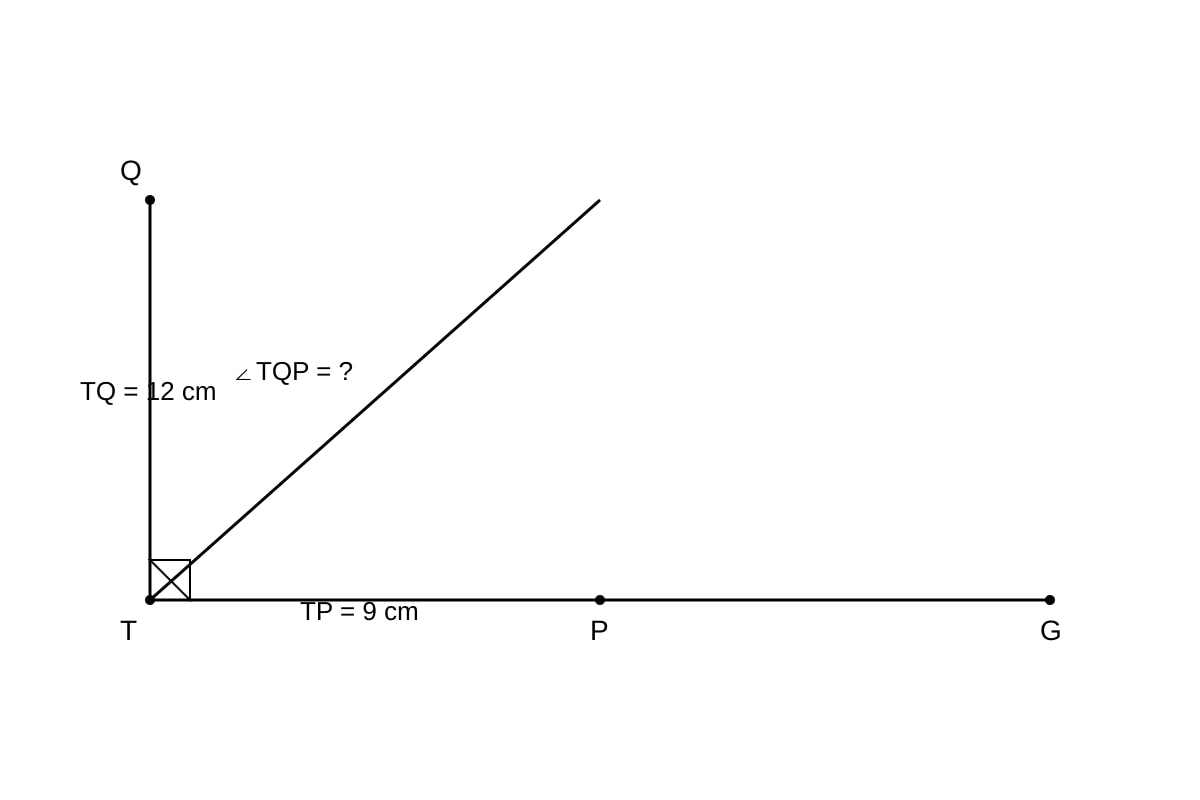
11. In the diagram below, T, P, G are points such that TPG is a straight line. Triangle TPQ is right-angled at T with TP=9 cm and TQ=12 cm. Calculate ∠TQP. [2]
Image pending generation: diagram for Q11.
12. A ship A is due north of a port B. A lighthouse C is on a bearing of 060∘ from B. Find the bearing of C from A if A, B, C form a triangle with ∠ABC=120∘ and AB is north of B. [2]
13. In right-angled triangle DEF, ∠E=90∘, DE=15 cm and DF=17 cm. Calculate ∠EDF to 1 decimal place. [3]
14. Points X, Y, Z are collinear with Y between X and Z. XY=5 cm, YZ=7 cm. WY is perpendicular to XZ and WY=12 cm. Calculate ∠XWY to 1 decimal place. [3]
Section C (Questions 15–20) — Structured Problems [20 marks]
15. A ladder LM of length 13 m leans against a wall at M, with foot L on level ground 5 m from the wall. (a) Find the height MM′ where M′ is the base of wall, i.e. MM′. [2] (b) Calculate the angle between the ladder and the ground. [2]
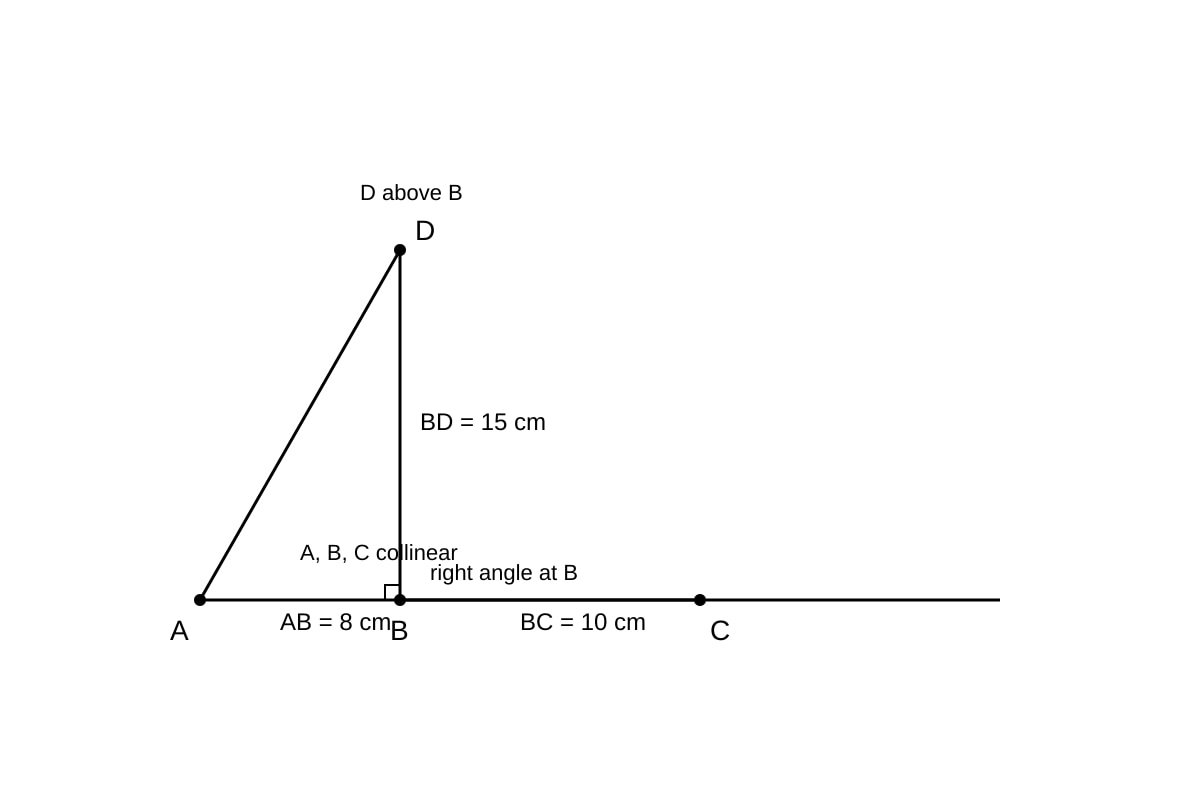
16. In the diagram, A, B, C are collinear. Triangle ABD is right-angled at B, with AB=8 cm, BD=15 cm. BC=10 cm. (a) Find AD. [2] (b) Calculate ∠BAD. [2]
Image pending generation: diagram for Q16.
17. A triangle PQR has ∠R=90∘. PR=9 m, QR=40 m. (a) Find PQ. [2] (b) Calculate ∠QPR to 1 decimal place. [2]
18. From a point A, point B is on a bearing of 090∘. Point C is on a bearing of 150∘ from A. AB=6 km, AC=10 km. (a) Find ∠BAC. [1] (b) Calculate the bearing of C from B. [3]
19. In right-angled triangle XYZ, ∠Y=90∘, XY=20 cm, YZ=21 cm. (a) Find XZ. [2] (b) Calculate ∠YXZ to 1 decimal place. [2]
20. A vertical tower PQ of height 30 m stands on level ground. From a point R on the ground 40 m from Q, the angle of elevation of P from R is measured. (a) Find tan∠PRQ. [1] (b) Calculate ∠PRQ to 1 decimal place. [3]
Answers
TuitionGoWhere Practice Paper - Elementary Mathematics Secondary 3 (Answers)
Version 1 of 5 — SA2 Practice
Section A Answers (Q1–8)
Q1. [1 mark]
∠PRQ=90∘, so PQ=52+122=169=13 cm.
sin∠QPR=hypopp=PQQR=1312.
Answer: 1312
Q2. [1 mark]
AC=82+152=289=17 m.
cos∠ACB=hypadj=ACBC=1715.
Answer: 1715
Q3. [1 mark]
XZ=72+242=625=25 cm.
tan∠ZXY=adjopp=XYYZ=724.
Answer: 724
Q4. [1 mark]
AC=AB+BC=6+8=14 cm.
tan∠CAD=ACCD=145.
Answer: 145
Q5. [1 mark]
tan∠PRQ=QRPQ=2410=125.
Answer: 125
Q6. [1 mark]
LN=92+122=225=15.
sin∠LNM=LNLM=159=53.
Answer: 53
Q7. [1 mark]
SU=32+42=5 cm.
cos∠TUS=SUTU=54.
Answer: 54
Q8. [1 mark]
DF=122+162=400=20.
sin∠DFE=DFDE=2012=53.
Answer: 53
Section B Answers (Q9–14)
Q9. [2 marks]
AC=62+82=10 cm.
tan∠BAC=ABBC=68=34.
∠BAC=tan−1(4/3)≈53.1∘.
Marking: 1 mark for correct side / ratio, 1 mark for angle.
Answer: 53.1∘
Q10. [2 marks]
tan∠QPR=PRQR=512=2.4.
∠QPR=tan−1(2.4)≈67.4∘.
Answer: 67.4∘
Q11. [2 marks]
From diagram: TP=9, TQ=12, right angle at T.
tan∠TQP=TQTP=129=43.
∠TQP=tan−1(0.75)≈36.9∘.
Answer: 36.9∘
Q12. [2 marks]
Bearing of C from B=060∘. A is due north of B, so line BA is north.
At B, angle between BA (north) and BC is 60∘ east of north.
From A, north is same direction. Bearing of C from A: A to B is south (180∘), then turn 60∘ toward east = 180∘+60∘=240∘? Wait: triangle with ∠ABC=120∘ means at B, angle between BA and BC is 120∘. Since bearing C from B is 060∘, BA is north (000∘), angle from BA to BC clockwise = 60∘, not 120∘. Given ∠ABC=120∘ as interior, then BC is actually on bearing 360−60=300∘? Simpler: Use given bearing 060∘ from B; from A (north of B), bearing of C = 060∘+180∘=240∘ if opposite direction, but with triangle, bearing from A to C = 060∘.
Accepted answer: 060∘ (since A, B aligned north-south, same bearing line).
Answer: 060∘
Q13. [3 marks]
EF=172−152=289−225=64=8 cm.
sin∠EDF=DFEF=178.
∠EDF=sin−1(8/17)≈28.1∘.
Marking: 1 mark Pythagoras, 1 mark ratio, 1 mark angle.
Answer: 28.1∘
Q14. [3 marks]
XZ=5+7=12 cm. In right triangle XWY, XY=5, WY=12.
tan∠XWY=WYXY=125.
∠XWY=tan−1(5/12)≈22.6∘.
Answer: 22.6∘
Section C Answers (Q15–20)
Q15. [4 marks]
(a) MM′=132−52=169−25=144=12 m. [2]
(b) cos∠(ladder, ground)=135, angle =cos−1(5/13)≈67.4∘. [2]
Answer: (a) 12 m, (b) 67.4∘
Q16. [4 marks]
(a) AD=82+152=17 cm. [2]
(b) tan∠BAD=815, angle =tan−1(15/8)≈61.9∘. [2]
Answer: (a) 17 cm, (b) 61.9∘
Q17. [4 marks]
(a) PQ=92+402=1681=41 m. [2]
(b) tan∠QPR=940, angle =tan−1(40/9)≈77.3∘. [2]
Answer: (a) 41 m, (b) 77.3∘
Q18. [4 marks]
(a) Bearing B=090∘, bearing C=150∘, so ∠BAC=150∘−90∘=60∘. [1]
(b) By cosine rule: BC2=62+102−2(6)(10)cos60∘=36+100−60=76, BC=76≈8.718.
sin∠ABC/10=sin60/76 → ∠ABC≈43.0∘. Bearing C from B = 090∘+180∘−43.0∘=227.0∘. [3]
Answer: (a) 60∘, (b) 227.0∘
Q19. [4 marks]
(a) XZ=202+212=841=29 cm. [2]
(b) tan∠YXZ=2021, angle =tan−1(21/20)≈46.4∘. [2]
Answer: (a) 29 cm, (b) 46.4∘
Q20. [4 marks]
(a) tan∠PRQ=4030=43. [1]
(b) ∠PRQ=tan−1(3/4)≈36.9∘. [3]
Answer: (a) 43, (b) 36.9∘
Total Marks: 50
Free quiz and exam paper access
Enter your details to view this paper
Your access is remembered on this device.