AI Generated Quiz
Secondary 3 Combined Science Physical Sciences Quiz
Free Sec 3 Combined Sci Physical Sciences quiz, Kimi2.6 AI version, with questions, answers, and O Level-style practice for Singapore students.
These static practice materials are generated from the site's syllabus and paper-generation workflow, with source and model context shown so students and parents can evaluate the material before use.
Questions
Free quiz and exam paper access
Enter your details to view this paper
Your access is remembered on this device.
Answers
Secondary 3 Combined Science Quiz Answers - Physical Sciences
Total Marks: 50
Section A: Multiple Choice
Question 1
Answer: B
Explanation: At the highest point of its motion, the ball momentarily comes to rest before falling back down.
- Kinetic energy depends on speed (). Since speed is zero at the highest point, kinetic energy is zero.
- Gravitational potential energy depends on height (). At maximum height, the ball has its maximum gravitational potential energy.
This illustrates energy transformation: as the ball rises, kinetic energy converts to gravitational potential energy. At the highest point, this conversion is complete (assuming no air resistance).
Common mistake: Choosing D, confusing speed with velocity. While velocity is momentarily zero as the ball changes direction, the key point is that height—and therefore GPE—is at maximum.
Marks: 2
Question 2
Answer: B
Explanation: Use Newton's Second Law:
First, find the net force acting on the block:
- Applied force (forward): N
- Frictional force (backward): N
Net force: N (forward)
Then calculate acceleration:
Common mistake: Using only the applied force (10 N) to get 5 m/s², forgetting to subtract friction; or adding the forces instead of subtracting them.
Marks: 2
Question 3
Answer: A
Explanation: Efficiency measures how much of the input energy is converted to useful output. The correct definition is:
This can also be expressed using work or power (since power = energy/time):
- Option B inverts the fraction (would give a value > 100% for real machines)
- Option C adds 100% incorrectly
- Option D subtracts 100% incorrectly
Marks: 2
Question 4
Answer: B
Explanation: For circular motion at constant speed, there is still centripetal acceleration directed towards the centre of the circle. By Newton's Second Law, this requires a resultant force (called centripetal force) also directed towards the centre.
- Speed is constant but velocity is not constant (velocity is a vector, and direction changes continuously).
- Therefore, there is acceleration and a resultant force.
- The force cannot be zero or away from the centre—that would result in straight-line motion or outward movement, not circular motion.
Teaching note: "Constant speed" does not mean "no acceleration" in circular motion. The confusion arises from confusing speed (scalar) with velocity (vector).
Marks: 2
Question 5
Answer: A
Explanation: Use the specific heat capacity formula:
Given:
- J
- kg
- °C
Rearranging:
Common mistake: Forgetting to calculate temperature change correctly (using 85°C instead of 60°C), giving 282 J/(kg·°C).
Marks: 2
Section B: Short Answer and Structured Questions
Question 6
Answer: Energy cannot be created or destroyed, only converted from one form to another (1 mark); the total energy in a closed system remains constant (1 mark).
Explanation: This is the fundamental conservation principle. The two parts are:
- Conversion only—energy changes form but doesn't appear from nowhere or disappear
- Total remains constant—summed over all forms in an isolated/closed system
Both parts are needed for full marks. "Total energy" is important—individual forms can change, but their sum is constant.
Marks: 2
Question 7
(a) Answer: (2 marks: formula 1, substitution and answer 1)
Explanation: Gravitational potential energy depends on mass, gravitational field strength ( m/s²), and height above the reference point. Take m/s² unless specified otherwise.
(b) Answer: Kinetic energy = 1.0 J (or "same as the GPE at the highest point") (1 mark)
By the Principle of Conservation of Energy, all gravitational potential energy at the highest point converts to kinetic energy at the lowest point, assuming no energy losses to air resistance or friction (1 mark).
Explanation: This is a direct application of energy conservation in a pendulum. In practice, some energy is lost to air resistance, causing the bob to gradually decrease its maximum height. The question explicitly removes this complication.
Marks: 4 total
Question 8
(a) Answer: (2 marks: formula 1, answer 1)
Explanation: The stone's kinetic energy depends only on its mass and speed at the point of interest. We don't need to know the height yet—that's for part (b).
(b) Answer: By conservation of energy, (since initial and final at ground level)
(3 marks: principle stated 1, correct equation set up 1, answer 1)
Explanation: This elegant solution avoids needing to calculate the stone's time of fall. The energy method is often simpler than kinematics for "falling object" problems. Note that the mass cancels out—any object falling from 45 m reaches 30 m/s (ignoring air resistance).
Alternative method: Using with , m/s², m/s gives m.
Marks: 5 total
Question 9
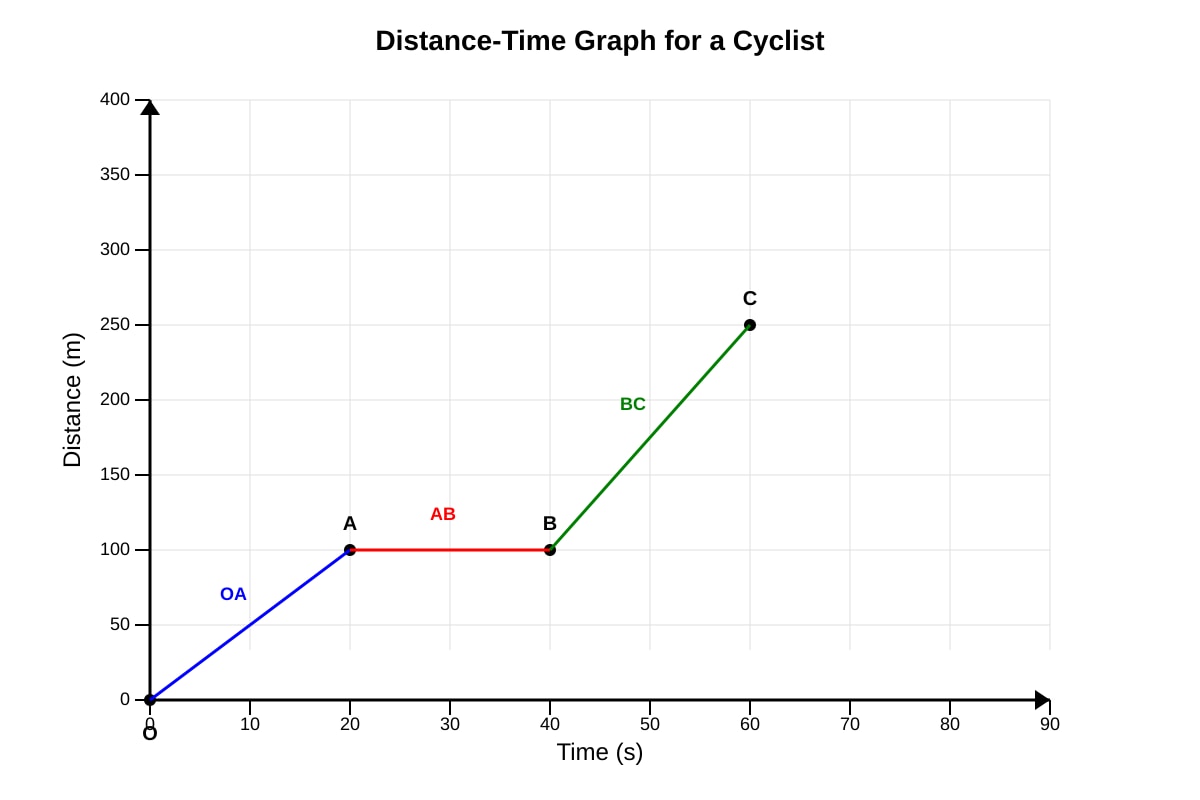
(a) Answer: The cyclist is at rest / stationary (accept: not moving). (1 mark)
Explanation: A horizontal line on a distance-time graph indicates zero gradient, which means zero speed—no change in distance over time.
(b) Answer: (2 marks: method 1, answer 1)
Explanation: Segment OA is a straight line through the origin, indicating constant speed. The gradient of a distance-time graph equals speed.
(c) Answer: (accept 4.2 m/s or m/s) (2 marks: method 1, answer 1)
Explanation: Average speed uses total distance and total time, not just the moving periods. The stationary period (AB) is included in the total time. This is why average speed (4.17 m/s) is less than the maximum speed during OA (5 m/s).
Marks: 5 total
Question 10
(a) Answer: (2 marks: formula 1, answer 1)
Explanation: Useful work equals the increase in gravitational potential energy of the load. This is the "minimum" energy needed; real systems require more due to inefficiencies.
(b) Answer: (2 marks: formula 1, answer 1)
Explanation: Power is energy per unit time: , so .
(c) Answer: (2 marks: method 1, answer 1)
Explanation: The motor is reasonably efficient; only 120 J is "wasted" (mainly as heat in the motor and friction in moving parts).
Marks: 6 total
Question 11
Answer: At very high speeds:
- More work is done against air resistance (drag force increases with speed, approximately proportional to at highway speeds) (1 mark)
- This increases the wasted energy output as thermal energy and sound transferred to the surroundings (1 mark)
- Since efficiency = (useful work done / energy input), the denominator (energy needed to maintain speed) increases more than the useful output (1 mark)
Alternative valid points:
- Engine operates outside its optimal RPM range, reducing combustion efficiency
- More energy lost to overcoming rolling resistance and internal friction
- Increased turbulence and aerodynamic losses
Marks: 3
Question 12
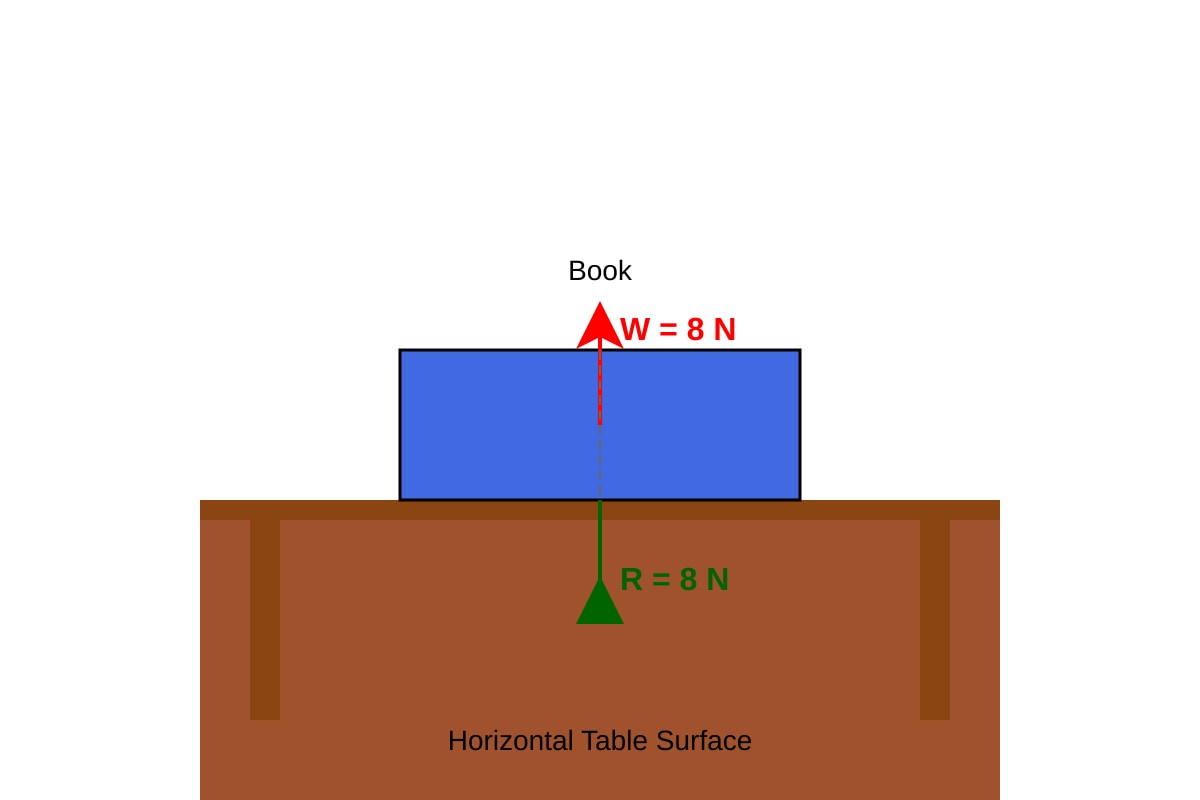
(a) Answer: Normal contact force (accept: normal reaction, reaction force, contact force) (1 mark)
Explanation: The table pushes up on the book with a force perpendicular to the surface. "Normal" means perpendicular.
(b) Answer: Magnitude of R = 8 N (1 mark)
The book remains at rest because the forces are balanced / net force is zero (Principle of equilibrium) (1 mark). The weight and normal contact force are equal in magnitude and opposite in direction, acting on the same object.
Explanation: This is Newton's First Law: an object at rest stays at rest if the net force on it is zero. The two forces form a Newton's Third Law pair with the Earth—in the interaction between Earth and book, both objects experience forces. However, the forces shown on the book itself (weight and normal contact force) are not a Third Law pair because they act on the same object.
Marks: 3 total
Question 13
(a) Answer: The block floats because the upthrust (buoyant force) acting upwards on the block equals the weight of the block acting downwards (1 mark). Since these two forces balance, there is no net force and the block remains in equilibrium at the surface (1 mark).
Explanation: By Archimedes' Principle, upthrust equals the weight of fluid displaced. For a floating object, this equals the object's weight. If upthrust were less than weight, the object would sink; if greater, it would rise.
(b) Answer: For a floating object:
(2 marks: method 1, answer 1)
Explanation: The fraction submerged equals the density ratio. This is why ice (ρ ≈ 920 kg/m³) floats with about 92% submerged in water. Wood less dense than water floats; if density exceeds water, it sinks.
Marks: 4 total
Question 14
(a) Answer: so (or 200 N/m) (2 marks: calculation 1, unit 1)
Explanation: Hooke's Law states that force is directly proportional to extension (within the elastic limit): . The spring constant is the force needed per unit extension. Units must match the data—N/cm if extension is in cm, N/m if in metres.
(b) Answer: (2 marks: method 1, answer 1)
Or using ratio: Since , doubling the force from 5 N to 10 N doubles extension to 5 cm; 12 N is 2.4× 5 N, so extension = 2.5 × 2.4 = 6 cm.
Explanation: Hooke's Law gives linear proportionality. This is valid only within the elastic limit; beyond this, the spring permanently deforms.
Marks: 4 total
Question 15
Answer:
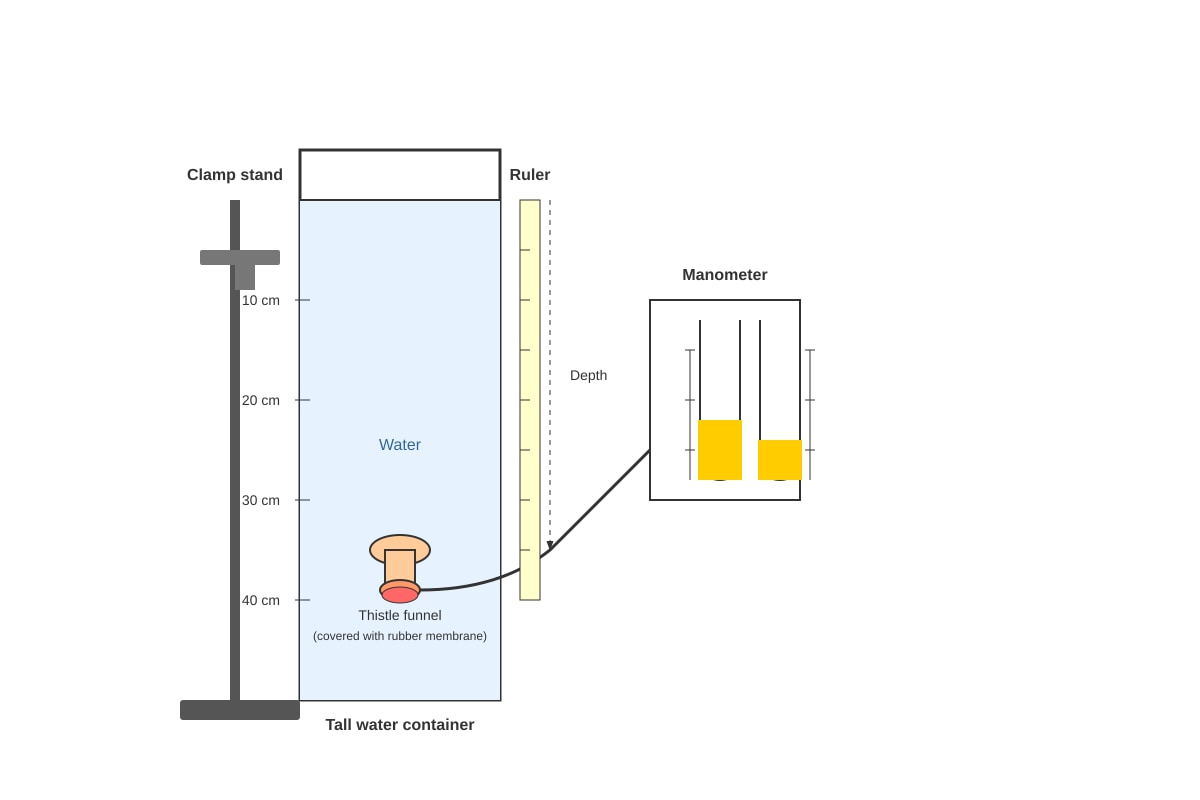
Diagram description for answer key (refer to Q15 image placeholder):
- Tall transparent container filled with water
- Thistle funnel covered with thin rubber membrane, connected by rubber tubing to manometer (U-tube with liquid)
- Ruler fixed alongside to measure depth
- Clamp stand holding thistle funnel
Procedure:
- Set up the apparatus with the thistle funnel connected to the manometer and placed at a known shallow depth (1 mark)
- Record the height difference (h) in the manometer arms as a measure of pressure (1 mark)
- Lower the thistle funnel to greater depths and record h at each depth (1 mark)
- Observation: Manometer reading h increases as depth increases, demonstrating that pressure ∝ depth (1 mark)
Key labels needed: water container, thistle funnel, rubber membrane, rubber tubing, manometer, ruler, clamp stand, various depths marked.
Explanation: Pressure in a liquid = , so pressure increases with depth. The manometer measures pressure difference via the height of liquid column it supports. The rubber membrane transmits pressure without letting water into the tubing.
Marks: 4
Section C: Data Analysis and Extended Response
Question 16
(a) Answer:
At s, speed = 10 m/s:
Kinetic energy: J (1 mark)
Height fallen: Using with , m/s², s: distance = m. So height = m?
Actually, using energy conservation: J? This suggests the object has reached ground level.
Wait—rechecking: initial total energy is 200 J. If J at s, then J.
But let's verify with motion: m/s, distance fallen = m. This equals the initial height. So the table data is constructed for a 5 m fall with m/s².
| Time (s) | Speed (m/s) | Kinetic energy (J) | GPE (J) | Total (J) |
|---|---|---|---|---|
| 1 | 10 | 200 | 0 | 200 |
Gravitational potential energy: 0 J (at ground level) (1 mark)
Total mechanical energy: 200 J (1 mark)
Explanation for method: The total should match the initial 200 J. We calculate KE directly, find GPE by energy conservation (or by height calculation), then verify the total is constant.
(b) Answer: The total mechanical energy remains constant / is conserved (equal to 200 J throughout) (1 mark). This demonstrates the Principle of Conservation of Energy for a system with no air resistance.
Explanation: In reality, air resistance would cause total mechanical energy to decrease gradually, with energy transferred to thermal energy of the air and object. The constant total here confirms this is an idealised, resistance-free scenario.
Marks: 5 total
Question 17
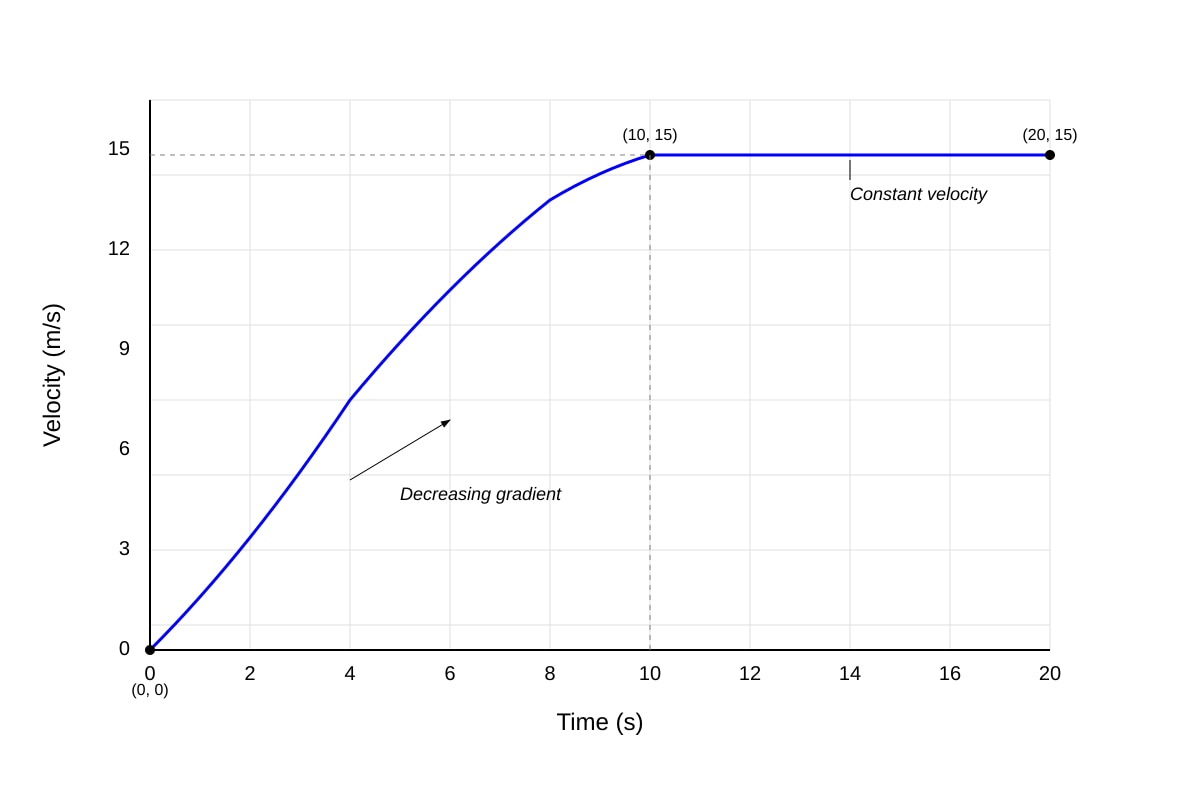
(a) Answer: The acceleration decreases as time increases during the first 10 seconds (1 mark). This is shown by the gradient of the velocity-time graph becoming less steep (decreasing gradient) (1 mark).
Explanation: Acceleration equals the gradient of a velocity-time graph. A decreasing positive gradient means decreasing positive acceleration. The car is still speeding up, but at a reducing rate—typical of an engine reaching its power limit or driver easing off the accelerator.
(b) Answer: For a curved velocity-time graph, distance = area under the graph. This requires estimation or geometric approximation.
The curve from (0,0) to (10,15) with decreasing gradient suggests the area is greater than the triangle (base 10, height 15: area = 75 m) but less than the rectangle (10 × 15 = 150 m).
Reasonable estimation—between triangle and the rectangle formed by final velocity, or using average area: approximately 95–110 m depending on exact curve shape. Using the pattern of constant acceleration from rest gives triangle: 75 m.
Given "decreasing gradient" meaning increasing at a decreasing rate, this is concave down curve. Area ≈ average of triangle and some upper estimate.
Accept reasoned estimate: approximately 100 m (or any value 90–110 m with appropriate method) (3 marks: method for area estimation 1, appropriate technique for curved graph 1, final answer 1)
Better method: If we approximate as a curve where acceleration halved, average speed ≈ m/s, giving distance ≈ 100 m.
(c) Answer: The car reaches its maximum speed / terminal velocity / cruising speed and maintains it at constant velocity (zero acceleration) (1 mark). This occurs when the driving force equals the total resistive forces, so net force is zero.
Explanation: At constant velocity, by Newton's First Law, net force must be zero. The engine's forward force exactly balances air resistance, rolling resistance, and other friction forces.
Marks: 6 total
Question 18
(a) Answer: so (2 marks: formula 1, answer 1)
Explanation: This is a moderately high current, which is why kettles need thicker wires and fused plugs (typically 13 A in Singapore/UK).
(b)(i) Answer: (2 marks: formula 1, answer 1)
Explanation: The temperature change is 75°C, not 100°C. Water's high specific heat capacity (4200 J/(kg·°C)) means it can absorb much energy with modest temperature rise—useful for cooling systems and hot water bottles.
(b)(ii) Answer: Electrical energy required = J (1 mark)
(2 marks: calculation 2)
Or combined:
Explanation: The kettle is not 100% efficient, so more electrical energy must be supplied than the useful thermal energy gained by the water. The "missing" energy goes to heating the kettle element itself, the container, and some heat loss to surroundings.
Marks: 7 total
Question 19
(a) Answer:
Energy transformation: GPE of water → KE of water → electrical energy
Useful power output = 50 MW = 50 × 10⁶ W
Electrical energy output per second = 50 × 10⁶ J
Since efficiency = 0.80: (1 mark)
This mechanical power comes from GPE loss per second =
So:
(2 marks: equation setup)
(1 mark)
Or approximately 52 tonnes per second (or 5.2 × 10⁴ kg/s) (1 mark for answer with unit)
Verification: GPE per second = 52,083 × 10 × 120 = 62.5 × 10⁶ J/s = 62.5 MW. At 80% efficiency: 50 MW output. ✓
Explanation: Hydroelectric power converts gravitational potential energy of elevated water to kinetic energy as it falls, then to rotational kinetic energy of turbines, and finally to electrical energy via generators. The large mass flow rate emphasizes the scale of hydroelectric installations.
(b) Answer:
Advantage: Renewable / no direct CO₂ emissions during operation / no fuel costs / long lifespan / can respond quickly to demand changes (1 mark)
Disadvantage: Requires specific geography (rivers, valleys) / large land area for reservoir / environmental impact on river ecosystems / initial construction cost and time / dependent on rainfall/water availability (1 mark)
Marks: 7 total
Question 20
Marking descriptors and guidance:
| Level | Marks | Description |
|---|---|---|
| Excellent | 5–6 | Clear explanation covering all three aspects with specific Singapore context and well-developed reasoning |
| Good | 3–4 | Covers most aspects with some Singapore-specific detail; logical structure |
| Basic | 1–2 | Partial coverage, limited context, mainly generic points |
| None | 0 | No relevant content |
Expected content points:
Environmental considerations (2 marks):
- Singapore's commitment to reduce carbon emissions and combat climate change
- Fossil fuel burning releases CO₂, contributing to global warming and sea-level rise (critical for low-lying Singapore)
- Air quality improvement by reducing fossil fuel use for power generation
- Paris Agreement obligations and Singapore's sustainability goals
Energy security (2 marks):
- Singapore has no natural energy resources (no oil, gas, coal, or significant hydro potential)
- Heavy dependence on imported natural gas (currently ~95% of electricity generation)
- Diversification through renewables reduces geopolitical and supply-chain risks
- Price volatility of fossil fuels affecting electricity costs
Practical limitations specific to Singapore (2 marks):
- Limited land area: Solar farms require substantial space; Singapore is land-scarce with competing needs (housing, industry, military, water catchment)
- Low wind speeds: Not viable for large-scale wind power
- No major rivers: Hydroelectric power impossible
- Cloud cover and equatorial climate: Solar efficiency affected by frequent thunderstorms and humidity, though solar is the most viable option
- High population density: Rooftop solar and floating solar (on reservoirs) are being developed as solutions
- Energy storage challenges: Intermittency of solar requires battery technology or backup systems
Explanation: This forces students to apply global energy knowledge to Singapore's unique constraints. The "city-state, island-nation, no natural resources" triumvirate is the key framework. Good answers should note Singapore's pivot to solar (rooftop, floating, imported from Australia via cable) and research into hydrogen and carbon capture.
Marks: 6
END OF ANSWER KEY