AI Generated Quiz
Secondary 3 Combined Science Chemistry Materials Quiz
Free Sec 3 Combined Sci Chemistry Materials quiz, HY3 AI version, with questions, answers, and O Level-style practice for Singapore students.
These static practice materials are generated from the site's syllabus and paper-generation workflow, with source and model context shown so students and parents can evaluate the material before use.
Questions
Secondary 3 Combined Science Quiz - Chemistry Materials
Name: ___________________________
Class: ___________________________
Date: ___________________________
Score: _______ / 40
Duration: 50 minutes
Total Marks: 40
Topic: Chemistry Materials (Chemistry & Materials focus)
Instructions:
- Answer all 20 questions.
- Section A: Short structured questions (1–8). Section B: Data and diagram interpretation (9–14). Section C: Extended structured response (15–20).
- Show all working where calculation is involved.
- Use the spaces provided.
Section A: Short Structured Questions (1–8)
1. [2 marks] State what is meant by the term "alloy".
2. [1 mark] Name one property of diamond that makes it useful as a cutting tool.
3. [2 marks] Explain, in terms of structure, why graphite can conduct electricity.
4. [1 mark] State the type of bonding present in a metal such as copper.
5. [2 marks] Give one difference between thermosoftening and thermosetting plastics.
6. [1 mark] Name the process used to separate coloured substances in a mixture such as ink.
7. [2 marks] State one advantage and one disadvantage of using plastics in everyday products.
Advantage: ________________________________________________
Disadvantage: _____________________________________________
8. [1 mark] State the general formula of an alkane.
Section B: Data and Diagram Interpretation (9–14)
9. [3 marks] The table below shows the melting points of four materials.
| Material | Melting point (°C) |
|---|---|
| Wax | 60 |
| Ice | 0 |
| Iron | 1538 |
| Glass | 1400 (softens) |
State the state of each material at 25 °C.
Wax: ________ Ice: ________ Iron: ________ Glass: ________
[1 mark each for any three correct; full 3 if all four correct]
10. [3 marks] A student placed a steel nail and a plastic ruler side by side and heated one end. After 2 minutes, the far end of the steel nail was warm but the plastic ruler was not. Explain this observation in terms of thermal conductivity and bonding.
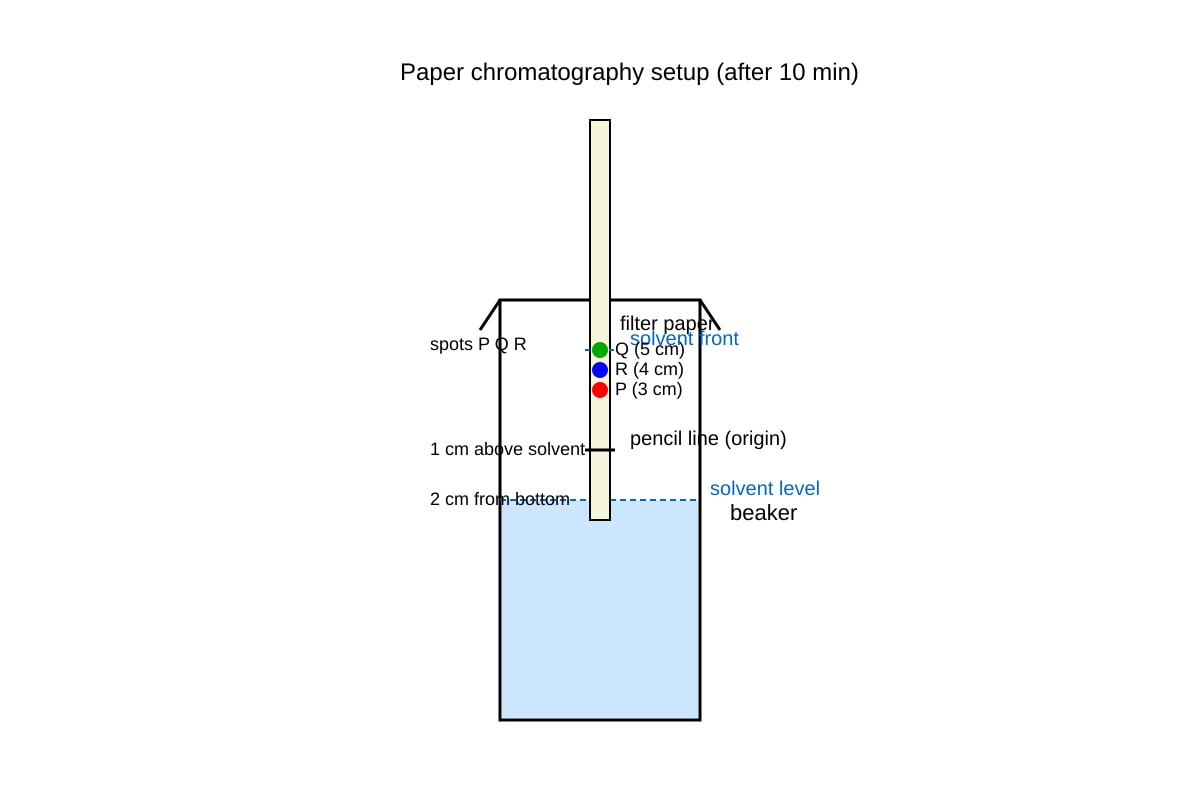
Image pending generation: diagram for Q11.
11. [3 marks] The diagram shows a paper chromatography experiment for three dyes P, Q, R.
(a) Which dye travelled the furthest? [1]
(b) What does a larger distance travelled suggest about the solubility of that dye in the solvent? [1]
(c) State one use of chromatography. [1]
12. [2 marks] The diagram shows the structure of silica (silicon dioxide). It has a giant covalent structure. State two properties of silica that result from this structure.
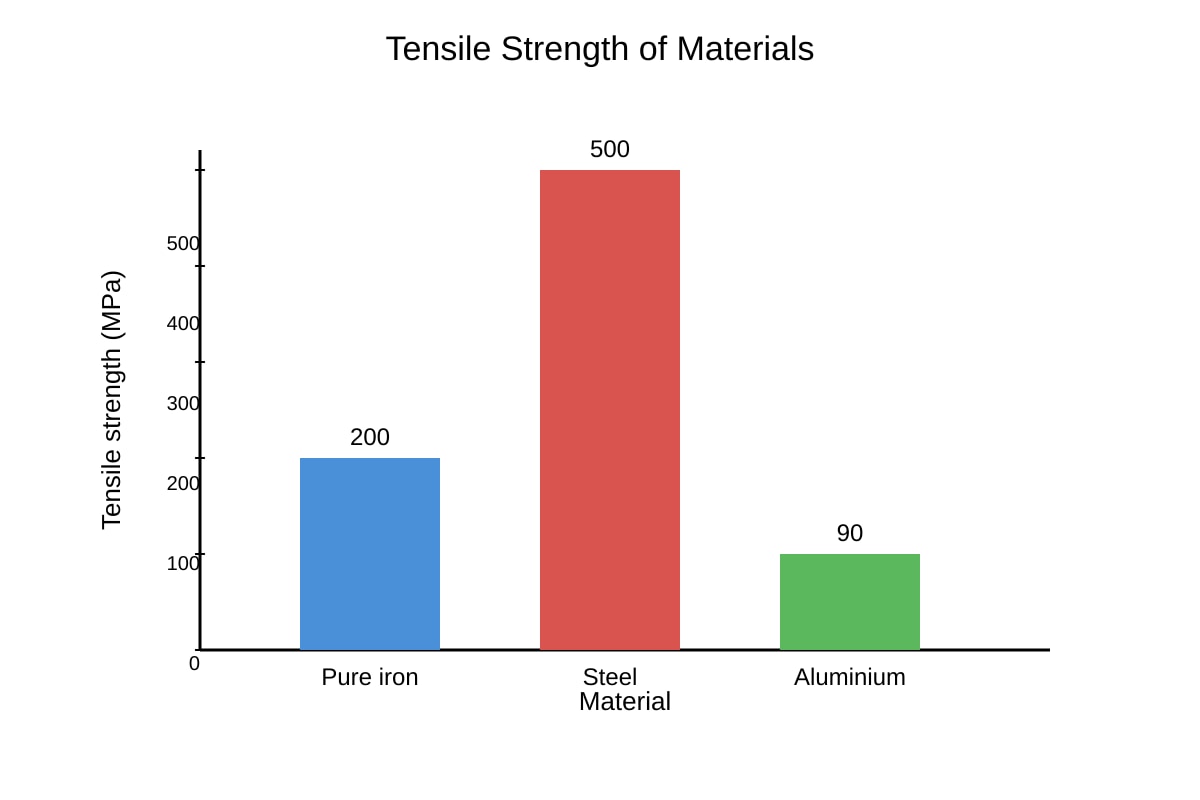
Image pending generation: graph for Q13.
13. [3 marks] The bar chart shows tensile strength of materials.
(a) Which material is strongest? [1]
(b) Explain why steel is stronger than pure iron. [2]
14. [2 marks] State two environmental problems caused by the disposal of non-biodegradable polymers.
Section C: Extended Structured Response (15–20)
15. [3 marks] Describe how you would use paper chromatography to separate the pigments in a green leaf extract. Include the materials and steps.
16. [3 marks] Explain why diamond has a very high melting point. Use ideas about bonding and structure.
17. [4 marks] A student makes an alloy of copper and zinc (brass).
(a) Define an alloy. [1]
(b) Give two reasons why brass is more useful than pure copper for making door handles. [2]
(c) State one property of pure copper that makes it good for electrical wires. [1]
18. [4 marks] The table shows properties of three materials.
| Material | Type | Use |
|---|---|---|
| Polyethene | Polymer | Plastic bag |
| Glass | Ceramic | Window |
| Copper | Metal | Wire |
For each material, state the type of structure (giant covalent, metallic, polymer, ionic) and link one property to its use. [1+1+1+1]
19. [3 marks] Explain the difference between thermosetting and thermosoftening plastics at the molecular level, and state one example of each.
20. [4 marks] A school wants to choose a material for a new outdoor bench.
(a) State two properties the material should have. [2]
(b) Compare wood and recycled plastic for this use, giving one advantage and one disadvantage of each. [2]
Answers
Secondary 3 Combined Science Quiz - Chemistry Materials (Answer Key)
Topic: Chemistry Materials
Total Marks: 40
Note: Content generated from LLM-inferred templates (Stage 4/5). Not derived from past-year papers; syllabus-first with exam-style patterns.
1. [2 marks]
Answer: An alloy is a mixture of a metal with another metal or non-metal. [1] It has improved properties compared with the pure metal. [1]
Teaching note: Alloys are not pure substances; the added element disrupts the layers, making them harder.
2. [1 mark]
Answer: Hard / high melting point / rigid (any one).
Teaching note: Diamond’s giant covalent network makes it extremely hard.
3. [2 marks]
Answer: Graphite has layers of carbon atoms with delocalised electrons between layers. [1] These electrons can move and carry charge. [1]
Teaching note: Unlike diamond, graphite conducts because of free electrons, not ions.
4. [1 mark]
Answer: Metallic bonding.
Teaching note: Positive metal ions in a sea of delocalised electrons.
5. [2 marks]
Answer: Thermosoftening plastics melt when heated and reset on cooling; thermosetting plastics do not melt but char when heated. [2 for clear difference, 1 for partial]
Teaching note: Thermosetting has cross-links; thermosoftening has no cross-links.
6. [1 mark]
Answer: Chromatography.
Teaching note: Paper chromatography separates by solubility and adsorption.
7. [2 marks]
Advantage: Lightweight / cheap / corrosion-resistant. [1]
Disadvantage: Non-biodegradable / from fossil fuels / pollutes. [1]
8. [1 mark]
Answer: CₙH₂ₙ₊₂
Teaching note: Alkanes are saturated hydrocarbons.
9. [3 marks]
Wax: solid [1]; Ice: solid [1]; Iron: solid [1]; Glass: solid [1] (award 3 for any three correct).
All are below their melting points at 25 °C.
10. [3 marks]
Steel (metal) has metallic bonding with delocalised electrons that transfer heat quickly. [1] Plastic has covalent bonds in long chains, poor conductor. [1] So heat travelled along nail but not ruler. [1]
11. [3 marks]
(a) Q [1]
(b) More soluble in the solvent. [1]
(c) To separate mixtures / identify substances / test purity. [1]
12. [2 marks]
High melting point [1]; hard / does not conduct electricity. [1]
From giant covalent network.
13. [3 marks]
(a) Steel [1]
(b) Steel is an alloy of iron with carbon; the carbon atoms disrupt iron layers, making it harder and stronger. [2]
14. [2 marks]
Landfill buildup [1]; ocean pollution / harms wildlife [1].
15. [3 marks]
Materials: filter paper, beaker, solvent, leaf extract, capillary tube. [1]
Steps: grind leaf in solvent, spot on pencil line, place in solvent below line, allow to run, dry. [2]
16. [3 marks]
Diamond has a giant covalent structure of carbon atoms. [1] Each C bonded to 4 others by strong covalent bonds. [1] Much energy needed to break bonds, so high melting point. [1]
17. [4 marks]
(a) Mixture of metal + other element. [1]
(b) Brass harder / more corrosion resistant / nicer colour. [2 for two]
(c) Copper is ductile and conducts electricity. [1]
18. [4 marks]
Polyethene: polymer, flexible so bag. [1]
Glass: giant covalent/ceramic, transparent so window. [1]
Copper: metallic, conducts so wire. [1+1]
19. [3 marks]
Thermosoftening: no cross-links, melts on heating, e.g. polyethene. [1+1]
Thermosetting: cross-linked, does not melt, e.g. bakelite. [1]
20. [4 marks]
(a) Weather-resistant, strong, non-rotting. [2]
(b) Wood: advantage natural/cheap, disadvantage rots. [1] Recycled plastic: advantage durable, disadvantage from oil/less rigid. [1]
Free quiz and exam paper access
Enter your details to view this paper
Your access is remembered on this device.