AI Generated Quiz
Secondary 3 Combined Science Chemistry Materials Quiz
Free Sec 3 Combined Sci Chemistry Materials quiz, DeepSeek AI version, with questions, answers, and O Level-style practice for Singapore students.
These static practice materials are generated from the site's syllabus and paper-generation workflow, with source and model context shown so students and parents can evaluate the material before use.
Questions
Free quiz and exam paper access
Enter your details to view this paper
Your access is remembered on this device.
Answers
Secondary 3 Combined Science Quiz - Chemistry Materials: ANSWER KEY
Total Marks: 40
Section A: Multiple Choice (Questions 1-5, 5 × 1 mark = 5 marks)
1. C. Good conductor of electricity [1] Explanation: Metals are typically good conductors of electricity due to the presence of delocalised electrons.
2. B. A mixture of a metal with one or more other elements [1] Explanation: An alloy is a homogeneous mixture of a metal with other elements (metals or non-metals) designed to enhance properties.
3. B. Reduction with carbon [1] Explanation: Iron is extracted from its ore (iron oxide) in a blast furnace by reduction with carbon (coke).
4. C. Magnesium [1] Explanation: In the reactivity series, magnesium is more reactive than zinc, iron, and copper.
5. C. To increase its resistance to corrosion [1] Explanation: Chromium and nickel form a protective oxide layer on the surface of stainless steel, preventing rusting.
Section B: Structured Questions (Questions 6-10, 15 marks)
6. (a) Substance: X [1] Reason: It has a high melting point and conducts electricity in both solid and molten states, which are characteristic properties of metals. [1]
(b) Substance W is an ionic compound. [1] In the solid state, the ions are held in fixed positions in the giant ionic lattice and cannot move, so it cannot conduct electricity. When molten, the ions are free to move and carry charge, allowing electrical conductivity. [1]
(c) Giant covalent structure / Giant molecular structure with strong covalent bonds. [1]
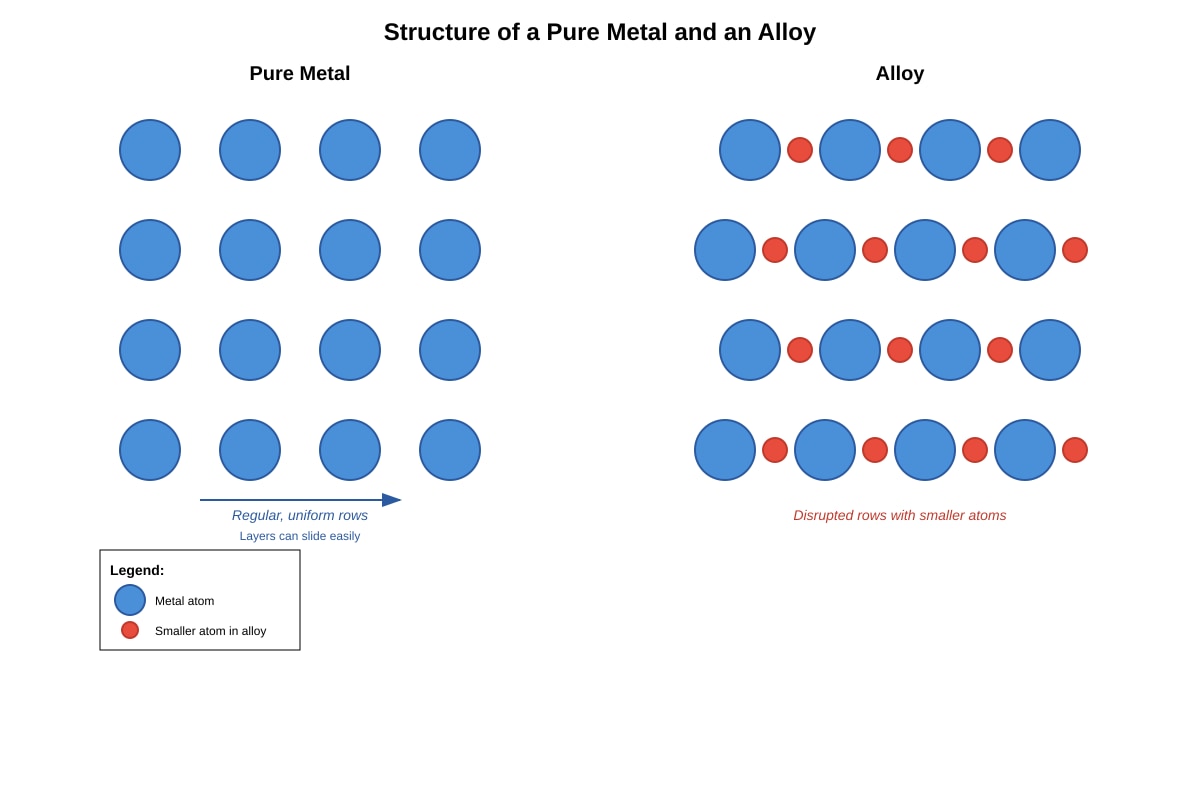
7. (a) In pure copper, the atoms are arranged in regular layers that can slide over each other easily when a force is applied, making it soft and malleable. [1] In bronze, the tin atoms are of a different size to copper atoms. [1] These tin atoms disrupt the regular arrangement of copper atoms, preventing the layers from sliding over each other easily. This makes bronze harder and stronger than pure copper. [1]
(b) Any one of: statues / bells / ship propellers / bearings / tools [1]
8. (a) Any two of: [1 mark each, max 2]
- Calcium sinks in water / moves around on the surface
- Effervescence / bubbles of gas produced
- Calcium dissolves / disappears gradually
- A white precipitate/suspension forms (calcium hydroxide is sparingly soluble)
- Heat is released / the beaker becomes warm
(b) Ca(s) + 2H₂O(l) → Ca(OH)₂(aq) + H₂(g) [2] Award 1 mark for correct reactants and products, 1 mark for correct balancing and state symbols.
(c) Copper is below hydrogen in the reactivity series. [1] Therefore, copper cannot displace hydrogen from dilute acids. Only metals above hydrogen in the reactivity series can react with dilute acids to produce hydrogen gas. [1]
9. (a) Hydrogen [1]
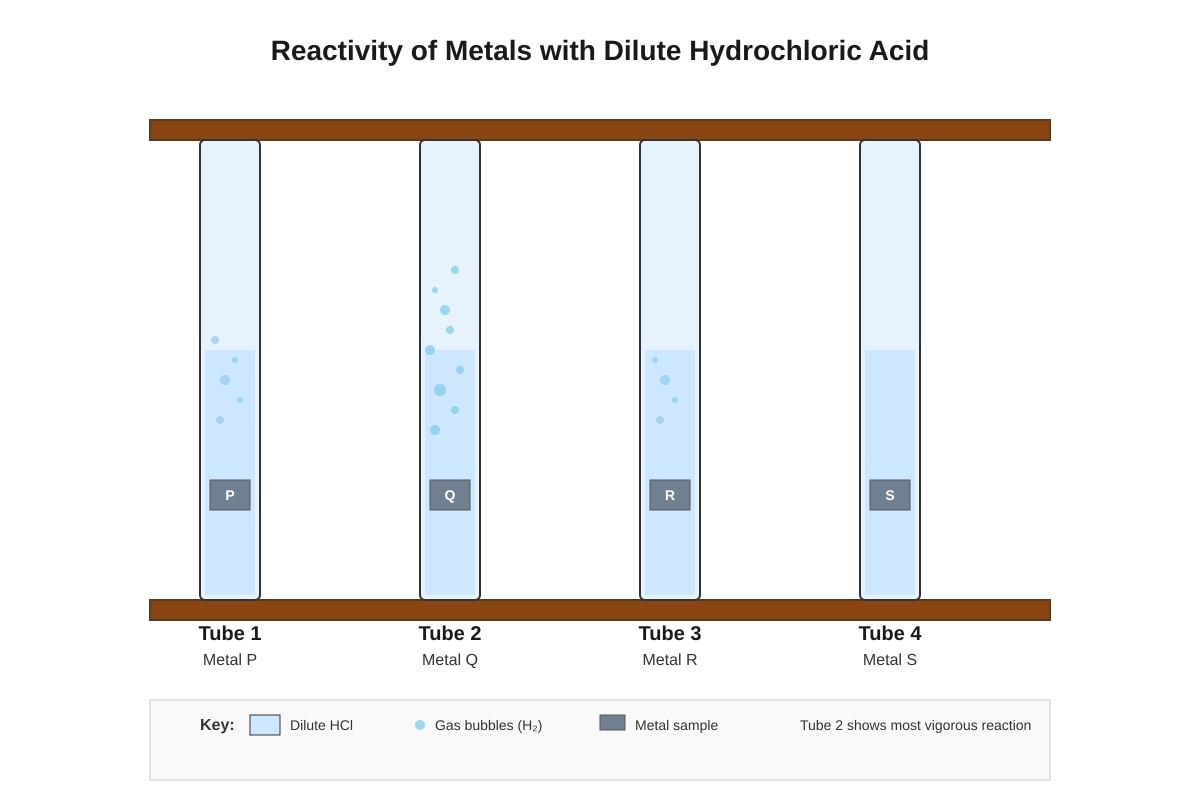
(b) Metal P + hydrochloric acid → metal P chloride + hydrogen [1] Accept: P + hydrochloric acid → P chloride + hydrogen
(c) Most reactive: Q → P → R → S :Least reactive [1] All four must be in correct order for the mark.
(d) Metal S is likely to be copper (or silver, gold, platinum). [1] It does not react with dilute hydrochloric acid, indicating it is below hydrogen in the reactivity series / it is an unreactive metal. [1]
10. (a) Aluminium is more reactive than carbon / aluminium is above carbon in the reactivity series. [1] Therefore, carbon cannot reduce aluminium oxide to aluminium.
(b) Cryolite lowers the melting point of aluminium oxide / dissolves the aluminium oxide. [1] This reduces the energy required for the electrolysis process, making it more economical.
(c) Al³⁺ + 3e⁻ → Al [2] Award 1 mark for correct species (Al³⁺ and Al), 1 mark for correct balancing of electrons.
(d) The graphite anodes react with the oxygen produced during electrolysis. [1] The oxygen oxidises the carbon in the graphite anodes to form carbon dioxide gas (C + O₂ → CO₂), causing the anodes to be gradually consumed and need replacement. [1]
Section C: Data Analysis and Application (Questions 11-15, 10 marks)
11. (a) Mass of iron = (96.0/100) × 500 g = 480 g [1]
(b) Alloy B contains a much higher percentage of chromium (18.0%) and nickel (8.0%) compared to Alloy A (0.5% each). [1] Chromium and nickel form a protective, adherent oxide layer on the surface of the alloy that prevents further corrosion / rusting. The higher the percentage of these elements, the greater the corrosion resistance. [1]
(c) Carbon atoms are smaller than iron atoms and occupy interstitial spaces between the iron atoms in the metal lattice. [1] The presence of carbon atoms disrupts the regular arrangement of iron atoms, preventing the layers of iron atoms from sliding over each other easily. [1] This makes the alloy harder and stronger but less ductile than pure iron. [1]
12. (a) 2PbO(s) + C(s) → 2Pb(l) + CO₂(g) [2] Award 1 mark for correct reactants and products, 1 mark for correct balancing and state symbols. Accept (s) for lead if cooled.
(b) The reducing agent is carbon (C). [1] Carbon loses electrons / is oxidised (oxidation state of C increases from 0 to +4 in CO₂). A reducing agent is a substance that reduces another substance by donating electrons, and is itself oxidised in the process. [1]
(c) Molar mass of PbO = 207 + 16 = 223 g/mol [1] Moles of PbO = 44.6 / 223 = 0.20 mol [1] From equation: 2 mol PbO reacts with 1 mol C Moles of C needed = 0.20 / 2 = 0.10 mol Mass of C = 0.10 × 12 = 1.2 g [1]
13. (a) Element H is most likely to be a non-metal that is a liquid at room temperature. [1] It has a melting point of -7 °C, which is below room temperature (25 °C), so it would be a liquid. It also has poor electrical conductivity, which is a characteristic of non-metals. [1]
(b) In a giant covalent structure, all the outer electrons are used in covalent bonds. [1] There are no delocalised electrons or free ions to carry charge, so it cannot conduct electricity.
14. (a) The type of metal / the identity of the metal. [1]
(b) Any one of: concentration of sulfuric acid / volume of sulfuric acid / surface area of metal / mass of metal / temperature. [1]
(c) Magnesium would produce hydrogen gas at the fastest rate. [1] Magnesium is the most reactive of the three metals (it is above zinc and copper in the reactivity series), so it reacts most vigorously with dilute acids. [1]
15. (a) Any one of: mining bauxite destroys habitats / causes soil erosion / produces large amounts of red mud (toxic waste) / electrolysis requires large amounts of electricity which may be generated from fossil fuels, contributing to carbon emissions. [1]
(b) Recycling aluminium involves simply melting and reshaping the metal. [1] Extracting aluminium from its ore involves electrolysis of molten aluminium oxide, which requires a very high temperature and a large amount of electrical energy to break the strong bonds in the compound. [1]
Section D: Extended Questions (Questions 16-20, 10 marks)
16. (a) Pure metals have a regular arrangement of atoms in layers. [1] When a force is applied, these layers can slide over each other easily without breaking the metallic bonds, making the metal malleable. [1]
(b) In an alloy, the atoms of the added element are of a different size to the atoms of the main metal. [1] These different-sized atoms disrupt the regular layers, preventing the layers from sliding over each other easily when a force is applied. This makes the alloy harder. [1]
17. (a) Zinc acts as a barrier, preventing oxygen and water from reaching the iron surface. [1] If the zinc layer is scratched, the zinc still protects the iron because zinc is more reactive than iron / zinc is above iron in the reactivity series. [1] The zinc corrodes preferentially / acts as a sacrificial metal, losing electrons in preference to the iron, thus preventing the iron from rusting. [1]
(b) Any one of: painting / oiling / greasing / coating with plastic / tin plating / chromium plating / using stainless steel. [1]
18. (a) Ag⁺ + e⁻ → Ag [1]
(b) The silver anode is oxidised / loses electrons to form silver ions (Ag⁺) which enter the solution. [1] This causes the anode to decrease in mass as silver atoms are converted to ions and dissolve. [1]
(c) Any one of: jewellery making / cutlery / car bumpers / preventing corrosion / improving appearance. [1]
19. (a) The grey/silvery zinc metal dissolves / becomes smaller. [1] A reddish-brown / pink deposit of copper metal forms on the zinc or at the bottom of the container. The blue colour of the copper(II) sulfate solution fades / becomes lighter. [1]
(b) Zn(s) + Cu²⁺(aq) → Zn²⁺(aq) + Cu(s) [2] Award 1 mark for correct reactants and products, 1 mark for correct state symbols.
20. (a) Fe₂O₃(s) + 3CO(g) → 2Fe(l) + 3CO₂(g) [2] Award 1 mark for correct reactants and products, 1 mark for correct balancing and state symbols. Accept (s) for iron.
(b) Carbon monoxide is a reducing agent because it reduces iron(III) oxide to iron. [1] In the reaction, carbon monoxide donates electrons / is oxidised (oxidation state of carbon increases from +2 in CO to +4 in CO₂), causing iron(III) oxide to be reduced. [1]
END OF ANSWER KEY