From Real Exams Quiz
Secondary 3 Combined Science Scientific Inquiry Quiz
Free Sec 3 Combined Sci Scientific Inquiry quiz, Kimi2.6 Exam version, with questions, answers, and O Level-style practice for Singapore students.
These static practice materials are generated from the site's syllabus and paper-generation workflow, with source and model context shown so students and parents can evaluate the material before use.
Questions
Free quiz and exam paper access
Enter your details to view this paper
Your access is remembered on this device.
Answers
Secondary 3 Combined Science Quiz - Scientific Inquiry - ANSWER KEY
Section A: Multiple Choice and Short Response
1. The mass / concentration / volume of acid (or any reactant); the temperature of the reaction; the type of acid used. [Any two correct answers, 1 mark each]
Key concept: A fair test requires only one independent variable to change. If surface area changes, all other factors affecting reaction rate must stay constant so that any observed effect can be attributed to surface area alone.
2. Any two from:
- Wear safety goggles to protect eyes from boiling liquid / splashes [1 mark]
- Point the mouth of the test tube away from yourself and others [1 mark]
- Use a test tube holder / clamp to hold the test tube [1 mark]
- Heat gently / move test tube in and out of flame [1 mark]
Marking note: Specific safety action + reason linking to hazard scores full credit. Generic answers without justification may score 0.
3. Mean = or 25.2 cm [1 mark]
Taking repeated measurements improves reliability because:
- Random errors / anomalies can be identified and excluded [1 mark]
- The mean value reduces the effect of random errors, giving a value closer to the true reading [1 mark]
Common mistake: Students often confuse reliability with accuracy. Reliability means consistency; accuracy means closeness to true value.
4. A hypothesis is a tentative, testable explanation for an observation based on scientific knowledge (e.g., "Increasing temperature increases the rate of reaction because particles collide more frequently"). [1 mark]
A prediction is a specific, measurable statement about what will happen in a particular experiment derived from the hypothesis (e.g., "When temperature increases by 10°C, the reaction time will halve"). [1 mark]
Key distinction: Hypothesis explains why; prediction states what will happen.
5. Another factor has become limiting; [1 mark] e.g., carbon dioxide concentration, temperature, or enzyme concentration is now the limiting factor rather than light intensity. [1 mark]
Concept link: At low light, light is the limiting factor. Once light is no longer limiting, other factors restrict the rate. This is the law of limiting factors in photosynthesis.
6. Independent variable: pH of soil [1 mark]
Dependent variable: height of tomato plants (after 8 weeks) [1 mark]
Memory aid: Independent = what you deliberately change (I change); Dependent = what you measure (Data).
7. A control group (plants without the new fertiliser, grown in identical conditions) [1 mark] is needed to compare against the test group, ensuring that any observed difference in growth is due to the fertiliser and not other variables. [1 mark]
Without a control: You cannot establish cause and effect. The fertiliser group's results might differ due to natural variation, not the treatment.
8. Apparatus: thermometer (or temperature probe/data logger) [1 mark]
Variables to control (any two): [1 mark each]
- Initial temperature of hot water
- Volume/mass of hot water used
- Material and dimensions of the container
- Environmental temperature/surroundings
- Thickness of insulating material (if comparing different materials)
- Time period for measuring temperature change
Section B: Data Analysis and Experimental Design
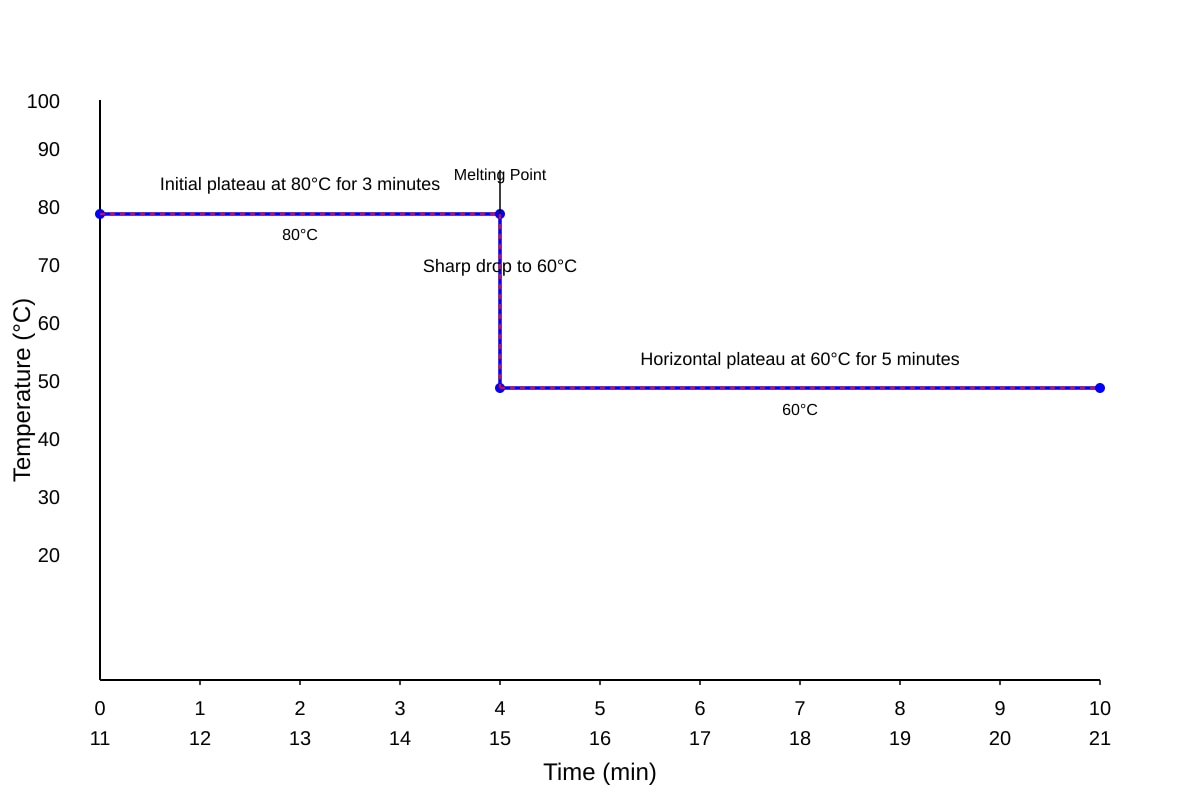
9. (a) 60°C [1 mark] — identified from the horizontal plateau where solid and liquid coexist (phase change).
(b) Between 5 and 10 minutes, the substance is freezing / solidifying (or changing from liquid to solid). [1 mark] During a phase change, energy is lost to the surroundings as latent heat of fusion without temperature change; the internal energy decreases but kinetic energy (temperature) stays constant. [1 mark]
Key concept: Plateaus on heating/cooling curves indicate phase changes at constant temperature. The flat region = latent heat transfer.
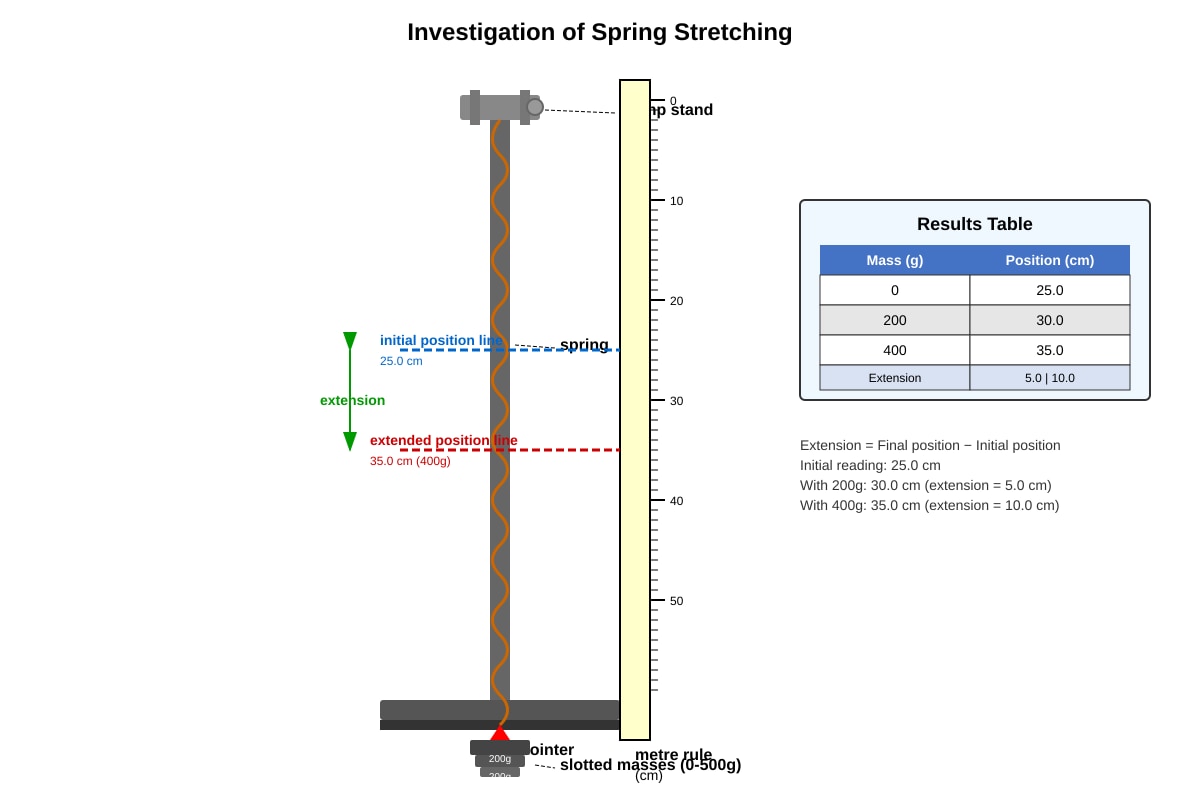
10. (a) Extension = [1 mark]
(b) Hooke's Law states that extension is directly proportional to force/load provided the elastic limit is not exceeded. [1 mark] The data shows doubling the mass from 200g to 400g doubles the extension from 5.0cm to 10.0cm (35.0 − 25.0), indicating proportionality. [1 mark]
Improve reliability: repeat readings with same loads; use identical fresh springs; ensure measurements are taken at eye level to avoid parallax error. [Any one valid, 1 mark]
11. (a) Volume of stone = [1 mark]
(b) Density = mass/volume = [1 mark for method, 1 mark for answer with unit]
(c) Source of error: Water clings to stone when removed / air bubbles trapped on irregular surface / water splashes out. [1 mark]
Effect: Measured volume too large → calculated density too small (since density = mass/volume). [1 mark] Or if water splashes out: measured volume too small → density too large.
Alternative error: Reading parallax on measuring cylinder.
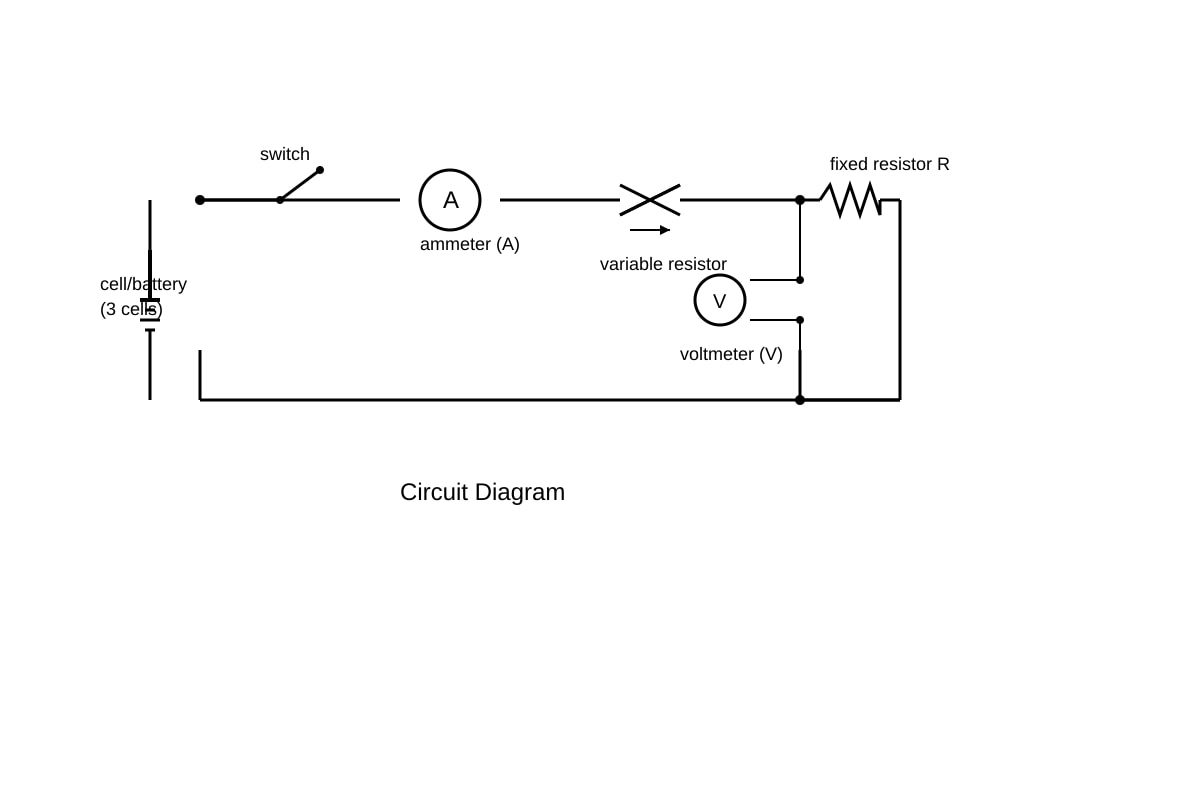
12. (a) Current is the rate of flow of charge. The ammeter must be in series so all charge passing through the circuit also passes through the ammeter, giving the true current through resistor R. [1 mark] If placed in parallel, current would split and the ammeter would not measure the current through R alone; it might also be damaged by excessive current. [1 mark]
(b) Adjust the variable resistance to change the current in the circuit. [1 mark] Record corresponding pairs of ammeter and voltmeter readings, then repeat to obtain at least 6–8 readings spanning the range. [1 mark]
13. (a) Species A: population increases steadily / increases every year [1 mark] Species B: population decreases steadily / decreases every year [1 mark]
(b) Predator-prey relationship or competition [1 mark]
Justification: If A preys on B, more A means more predation pressure on B, causing B's decline. OR if A and B compete for same food/resource, A outcompetes B. [1 mark] The inverse correlation suggests a direct interaction between the populations.
14. Method (4 marks distributed):
- Measure fixed volume (e.g., 50 cm³) of HCl into a conical flask using measuring cylinder [1 mark]
- Warm one sample to required temperature (e.g., 40°C) in water bath, keep other at room temperature; place momentarily in equal volume/molarity acid [1 mark]
- Add magnesium ribbon of equal length/mass to each and start timer [1 mark]
- Measure rate: collect gas in syringe / count bubbles / time for magnesium to dissolve completely / measure gas volume in fixed time [1 mark]
Control variables (must specify two): concentration of HCl, volume of HCl, mass/length of Mg ribbon, surface area of Mg, same apparatus [1 mark each, max 2; included above or stated separately]
Marking note: Clear sequence, measurable outcome, and explicit controls required for full marks.
Section C: Evaluation and Scientific Communication
15. Scientific knowledge is never "proved" absolutely; it is supported by evidence and always open to revision. [1 mark] Improved wording: "The results support the hypothesis" or "The data are consistent with the hypothesis." [1 mark]
Nature of Science (NOS): Scientific knowledge is reliable but subject to change with new evidence.
16. Timing 10 oscillations and dividing reduces the percentage error in the measured time. [1 mark] The reaction time error (typically ±0.2 s) is spread over 10 oscillations, making the error per oscillation smaller. Timing one swing includes a large percentage error relative to the short time interval. [1 mark]
Calculation example: If reaction time error = 0.4 s, for T = 0.8 s: % error = 50%. For 10T = 8.0 s: % error = 5%, giving T with 5% error.
17. [0.5 mark]
Rearranging: [1 mark working, 0.5 mark answer with unit]
Check: This is close to the accepted value for aluminium (~900 J/kg°C), confirming reasonableness.
18. Any two valid reasons: [1 mark each]
- To check for reproducibility — different scientists in different locations should get similar results
- To identify systematic errors or bias in the original study
- To verify with larger sample sizes — original may be too small
- To conduct double-blind trials reducing placebo effects
- To check for side effects over longer periods
- Peer review and independent replication are foundations of scientific validation
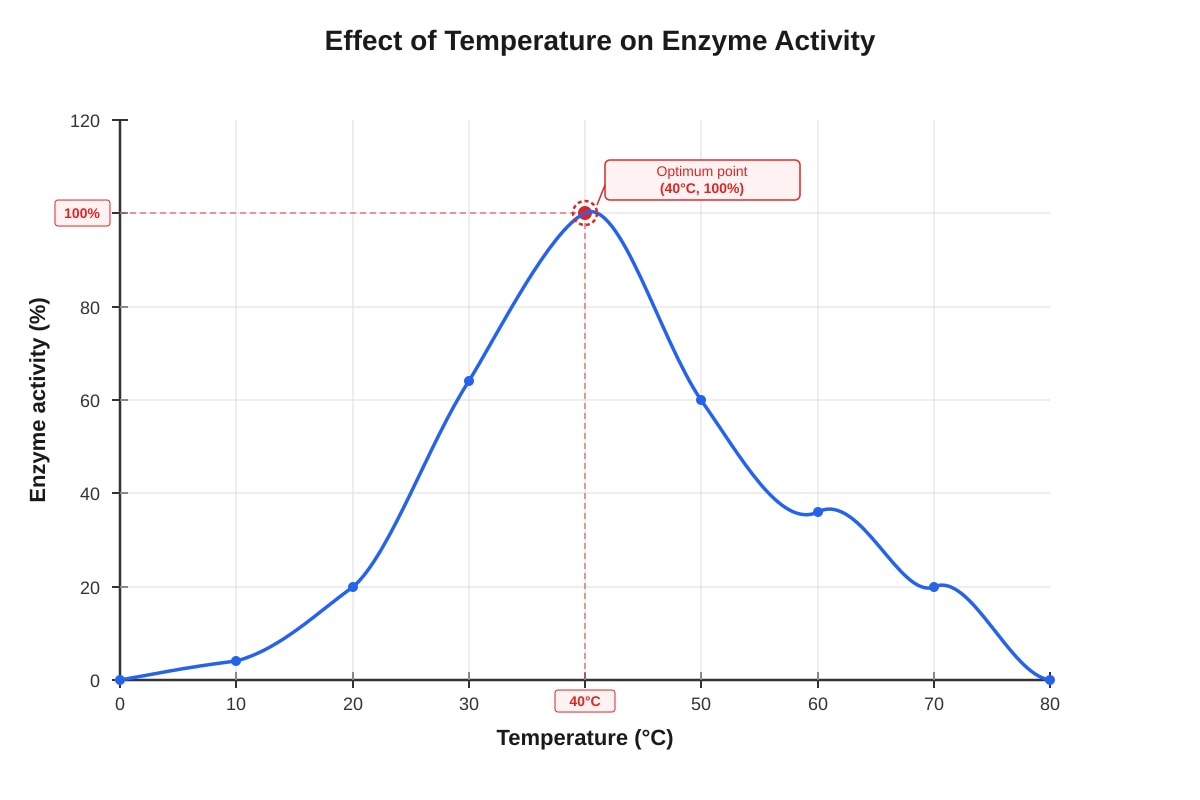
19. (a) 40°C [1 mark]
(b) Above the optimum, the kinetic energy of molecules is excessive; [1 mark] the increased vibration breaks the hydrogen bonds and other interactions holding the enzyme's specific tertiary structure / active shape. The enzyme denatures, so substrate no longer fits; rate decreases, and the reaction eventually stops. [1 mark]
Key concept: Enzymes are proteins with specific 3D shapes. High temperature causes denaturation — a permanent structural change, not just reversible unfolding.
20. Three weaknesses with improvements: [1 mark for each valid weakness + improvement pair]
| Weakness | Improvement |
|---|---|
| Only 10 students; small sample size | Use larger sample (e.g., 50+ students) for statistical validity |
| No control group for comparison | Test another group under identical conditions without music |
| Student uses herself as control; different person | Same students tested with and without music (repeated measures design), or matched participants |
| Individual differences in baseline memory ability | Random allocation to groups; or measure baseline memory first |
| "Music" not operationalised (type, volume, genre vary) | Specify and control: e.g., classical music at 60 dB |
| Experimenter expectation effects | Double-blind procedure where neither researcher nor participants know condition |
[Any three valid pairs, 1 mark each]
END OF ANSWER KEY