From Real Exams Quiz
Secondary 3 Combined Science Physical Sciences Quiz
Free Sec 3 Combined Sci Physical Sciences quiz, Kimi2.6 Exam version, with questions, answers, and O Level-style practice for Singapore students.
These static practice materials are generated from the site's syllabus and paper-generation workflow, with source and model context shown so students and parents can evaluate the material before use.
Questions
Free quiz and exam paper access
Enter your details to view this paper
Your access is remembered on this device.
Answers
Secondary 3 Combined Science Quiz - Physical Sciences: Answer Key
Total Marks: 40 marks
Section A: Multiple Choice (Questions 1–5)
| Question | Answer | Explanation |
|---|---|---|
| 1 | B) 10.0 J | Using . Common error: forgetting to multiply all three values or using without checking the given value. |
| 2 | B) Sound energy → Electrical energy | A microphone converts sound waves (vibrations in air) into electrical signals. The key is recognizing the input energy and output energy correctly. |
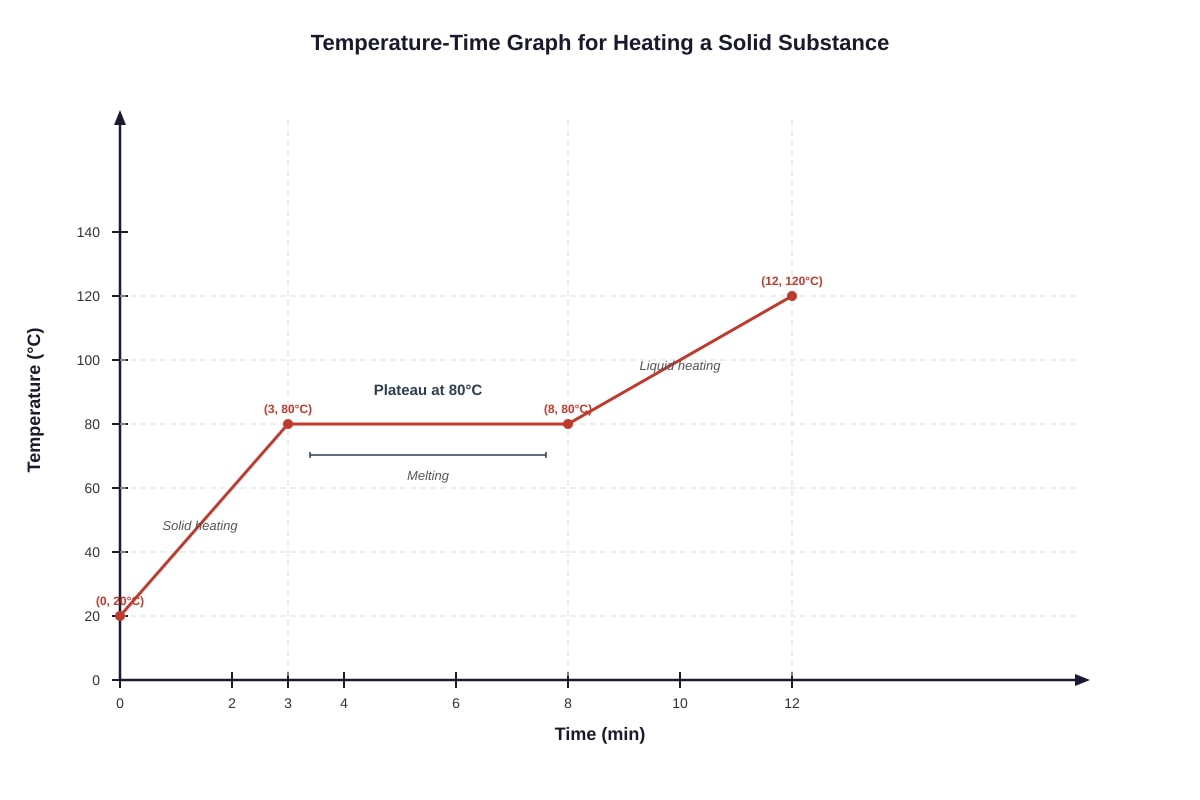
| 3 | B) From 3 to 8 minutes only | The horizontal plateau at 80°C indicates a phase change (melting). During phase change, heat energy (latent heat) is absorbed to overcome intermolecular forces and break bonds, without raising temperature. Before and after this plateau, kinetic energy increases and temperature rises. |
| 4 | B) The calculated value will be lower than the true value due to heat loss to surroundings | Using , if some heat escapes to surroundings, the effective reaching the aluminium is less than measured, making smaller than it should be for the true . Actually, re-thinking: if we use the measured (which includes heat lost, so ), then . Since is also lower due to heat loss, the ratio may be complex. More directly: if we assume all electrical energy heats the metal, but actually some is lost, then for the measured , we calculate . Since , the calculated is higher than true value. Correct answer: A) |
| 5 | A) 18 000 W | Power = Force × Velocity = . Since speed is constant, driving force equals total resistive force, so power output equals power to overcome resistance. |
Correction for Q4: The correct answer is A) The calculated value will be higher than the true value due to heat loss to surroundings.
Reasoning: The student calculates using the measured electrical energy and the measured temperature rise . Due to heat loss, the actual temperature rise of the aluminium is less than it would be if all energy stayed in the block. So is smaller than ideal. Since , a smaller gives a larger calculated . The measured is correct (from electrical measurements), but it's distributed to both aluminium and surroundings, so less heating occurs.
Section B: Short Answer and Structured Questions (Questions 6–15)
6. State the Principle of Conservation of Energy. [1]
Answer: Energy cannot be created or destroyed; it can only be changed from one form to another. [1]
Teaching note: The total energy in a closed/isolated system remains constant. This principle applies to all energy transformations. Common error: stating only half the principle (e.g., "energy cannot be created" without mentioning conversion).
7.
(a) Calculate the gravitational potential energy of the bob at its release point. [2]
Answer: [1] [1]
Teaching note: Gravitational potential energy depends on mass, gravitational field strength, and vertical height above a reference point. Always include units.
(b) State the kinetic energy of the bob when it passes through the lowest point. [1]
Answer: 3.2 J [1] (or "equal to the initial potential energy")
Teaching note: By conservation of energy, maximum converts to maximum at the lowest point (where relative to that point, or minimum height in the swing).
(c) Explain why, in practice, the bob does not quite reach the same height on the other side. [2]
Answer:
- Air resistance acts against the motion of the pendulum [1]
- Some energy is lost to surroundings as thermal energy/sound due to friction at the pivot and air resistance [1]
- Therefore, total mechanical energy decreases, so maximum height on the other side is less
Teaching note: Real systems are not perfectly isolated. Energy dissipation occurs through friction (at pivot) and drag (air resistance). This energy is transferred to the surroundings, raising their thermal energy slightly.
8.
(a) Calculate the electrical energy supplied to the kettle in this time. [2]
Answer: [1] [1]
Teaching note: Time must be in seconds for power in watts. Common error: using 3 minutes directly without converting to 180 seconds.
(b) Calculate the theoretical temperature rise expected. [2]
Answer: [1] [1]
Teaching note: The formula relates energy transfer to temperature change. This is theoretical — in practice, not all energy heats the water.
(c) Explain why the actual temperature rise of the water is less than your answer to part (b). [1]
Answer: Heat is lost to the kettle itself (heating the metal), to the surroundings (air), and through evaporation of some water. [1]
Teaching note: Energy conservation still applies — the 360 kJ is distributed, not all going into water's thermal energy.
9.
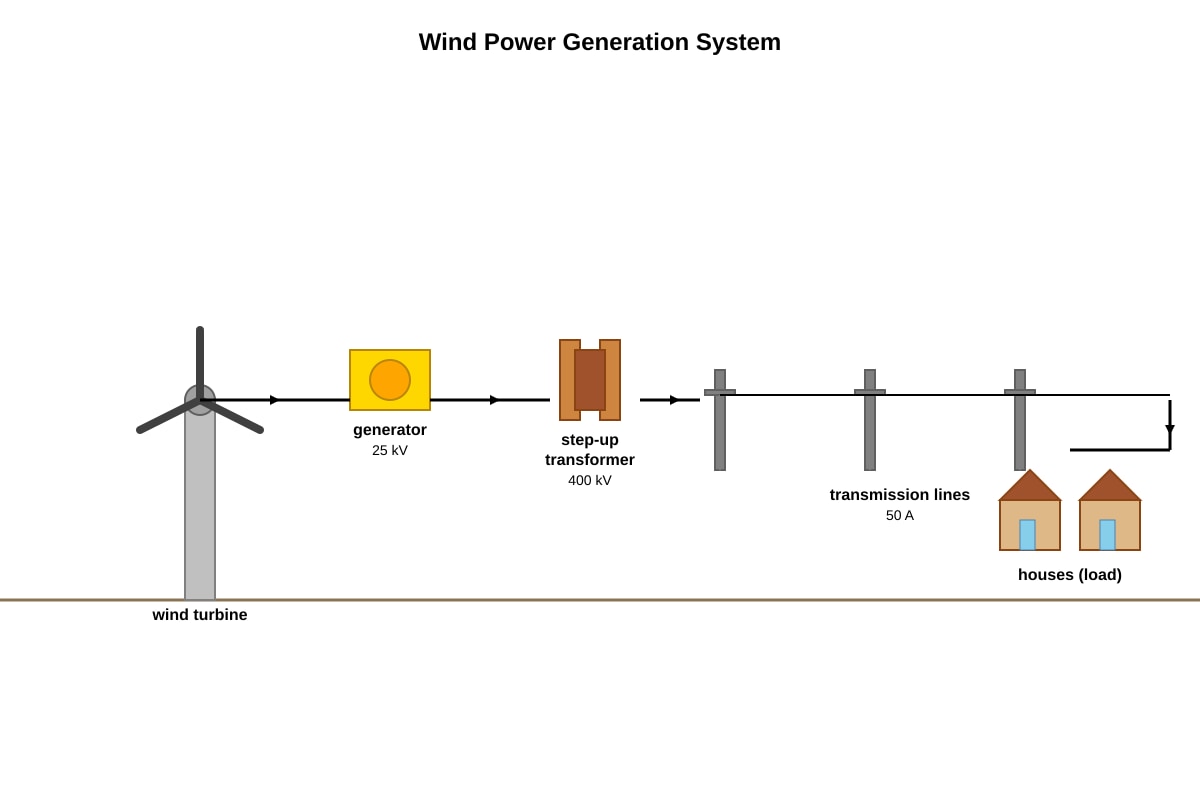
(a) State the main energy change that occurs in the wind turbine. [1]
Answer: Kinetic energy of wind → Kinetic energy of turbine blades → Electrical energy (generator) [1]
Teaching note: Accept "kinetic energy to electrical energy" as simplified answer. The intermediate step involves mechanical rotation driving the generator.
(b) Explain why a step-up transformer is used before the electricity is transmitted along the long-distance power lines. [2]
Answer:
- To increase voltage and therefore decrease current for the same power () [1]
- This reduces power loss in transmission lines since , so lower current means less heat dissipation in the cables [1]
Teaching note: This is a crucial real-world application of transformers. Power is constant (ignoring transformer losses), so increasing tenfold decreases tenfold, and losses decrease by factor of 100.
(c) Calculate the power loss in the transmission lines if their total resistance is . [2]
Answer: (given), [1] [1]
Teaching note: Use for power loss in resistive transmission lines. Alternative would use voltage drop across lines, not transmission voltage.
10.
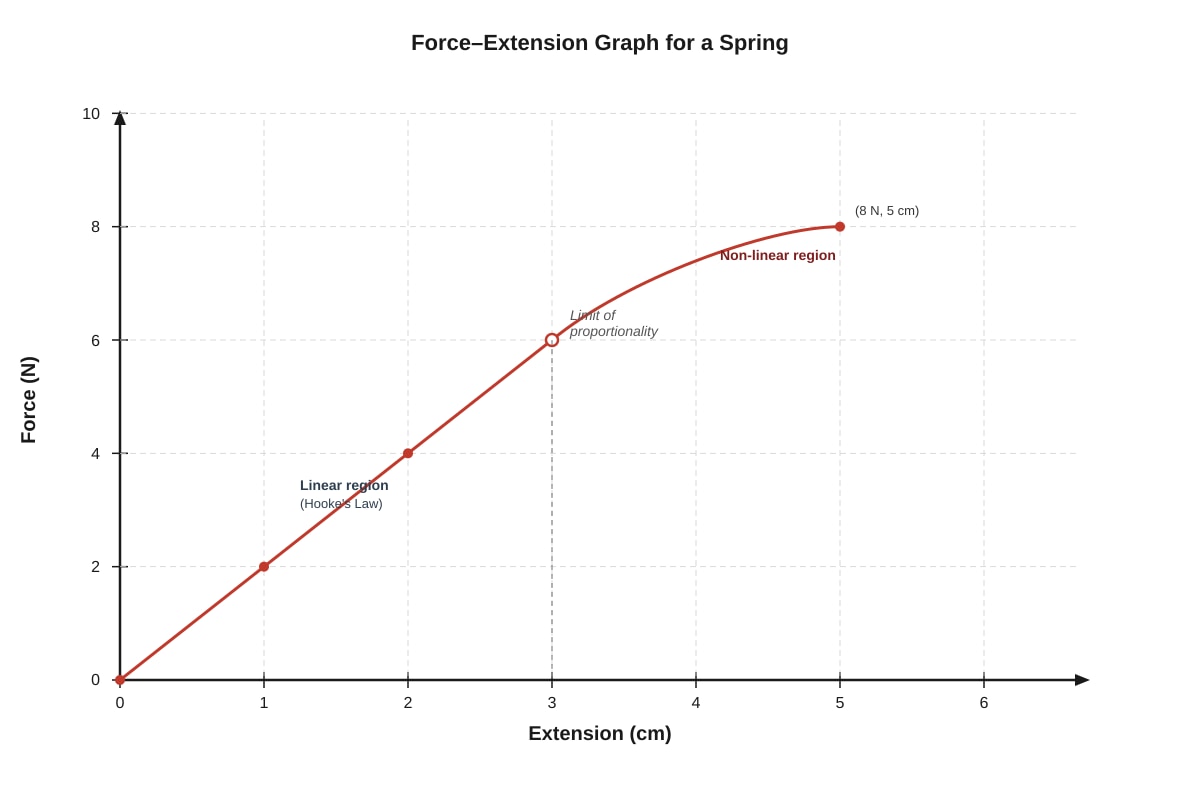
(a) State the range of force over which the spring obeys Hooke's Law. [1]
Answer: 0 to 6 N (or "up to 6 N") [1]
Teaching note: Hooke's Law () applies to the linear (straight-line) portion of the graph. Beyond this, permanent deformation may occur.
(b) Calculate the spring constant for the linear region. [2]
Answer: [1 — note unit conversion: 3 cm = 0.03 m] [1]
Teaching note: Spring constant has units of N/m. Must convert extension from cm to m for standard SI units. Alternative: keep in N/cm giving 2 N/cm, but N/m is preferred.
(c) Explain why the graph becomes non-linear at higher forces. [1]
Answer: The spring has exceeded its limit of proportionality / elastic limit; permanent deformation is starting to occur; molecular bonds are being stretched beyond their linear response region. [1]
Teaching note: Beyond the elastic limit, Hooke's Law no longer applies. The spring may not return to original length when force is removed.
11.
(a) Explain why the freezer needs to remove energy continuously even though its temperature stays constant. [2]
Answer:
- Heat continuously enters the freezer from the warmer surroundings by conduction through walls, convection when door opens, and radiation [1]
- This heat must be removed to maintain the below-zero temperature; the energy removed equals the thermal energy gain from surroundings [1]
Teaching note: Thermal equilibrium with surroundings would mean warms to room temperature. The refrigeration cycle must continuously pump heat "uphill" from cold interior to warmer exterior.
(b) Calculate the energy that must be removed to freeze completely 0.5 kg of water initially at 0°C. [2]
Answer: [1 — using Joules for consistency, or note kJ] [1]
Teaching note: At 0°C, water is at its freezing point, so only latent heat of fusion needs removal, not sensible cooling. Using : .
12.
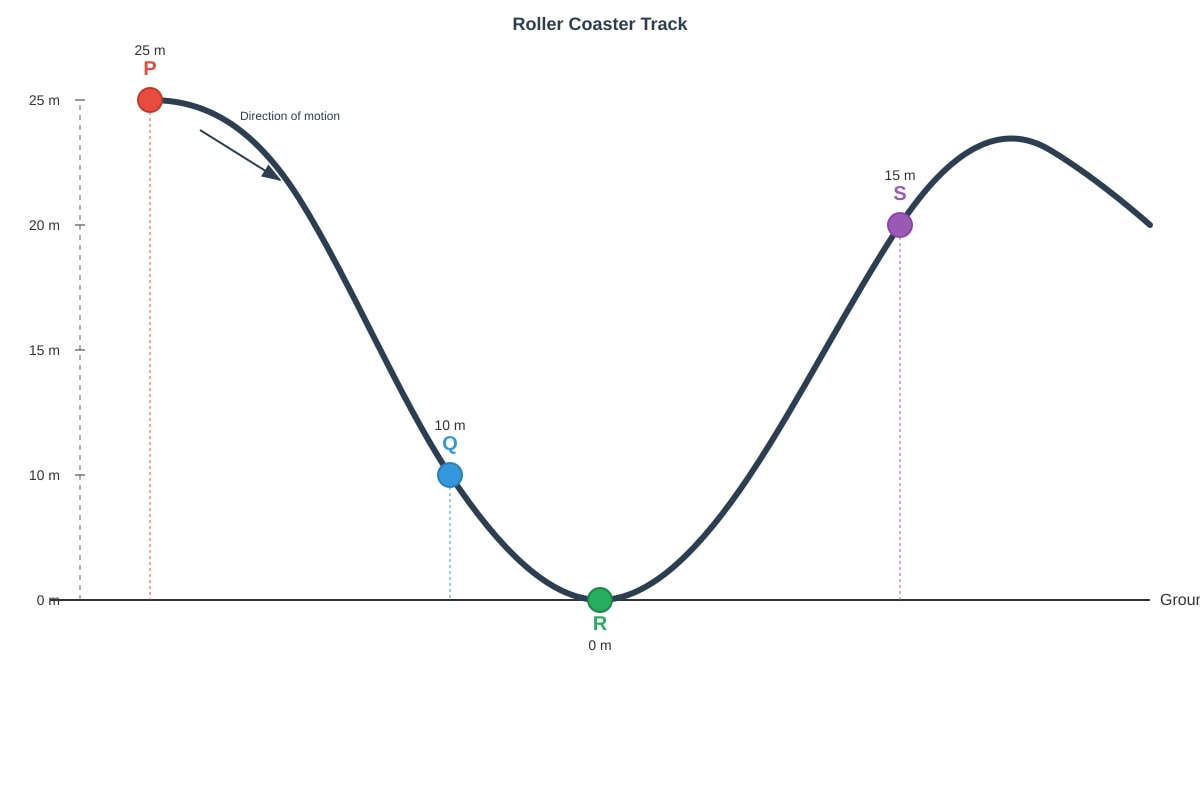
(a) Calculate the speed of the car at R, assuming no energy is lost. [3]
Answer: Loss in = Gain in [1] [1 — height loss from P to R is 25 m] [1]
Teaching note: Mass cancels out — all objects fall at same rate (neglecting air resistance). Initial kinetic energy is zero (starts from rest). The height difference matters, not absolute heights.
(b) Calculate the total energy lost due to friction and air resistance between P and R. [2]
Answer: Actual at R = [1] Initial = Energy lost = [1]
Teaching note: Alternatively: actual kJ, theoretical kJ, difference is 44 kJ. Lost energy becomes thermal energy in track, wheels, and air.
(c) Explain whether the car can reach point S without additional energy being supplied. [2]
Answer:
- Theoretical at S would require [1]
- But energy has been lost; actual energy available is only 81 000 J at R, and more is lost traveling from R to S
- Since 75 kJ < 125 kJ (initial), but significant energy is already lost by R, insufficient energy remains to reach S at 15 m (needs 75 kJ) after further losses [1]
- Conclusion: No, the car cannot reach S without additional energy / a motorized section is needed [1]
Actually re-marking: [2] total available:
- State that energy is lost throughout track [1]
- Compare required at S (75 kJ) with available energy, concluding insufficient due to losses [1]
Teaching note: Even without the detailed calculation, the key insight is that friction/ drag losses mean total mechanical energy decreases continuously, so height reached must steadily decrease from the ideal.
13.
(a) Calculate the useful power output of the motor. [2]
Answer: Useful work done = [1] Useful power = [1]
Teaching note: "Useful" means against gravity only. Power = work/time. Constant speed means force = weight, no acceleration.
(b) Calculate the electrical power input to the motor. [1]
Answer: [1]
(c) Calculate the efficiency of the motor. [2]
Answer: [1] [1]
Teaching note: Efficiency can be calculated using either power (instantaneous) or energy (over same time period). Must remember to express as percentage if asked for "efficiency" in percentage terms.
(d) Explain why the efficiency is less than 100%. [1]
Answer: Some electrical energy is converted to thermal energy (heating the motor coils) and to sound energy due to friction and resistance in the motor mechanism. [1]
14.
(a) List two precautions to minimize experimental error. [2]
Answer: Any two from:
- Insulate the apparatus/use a lid to reduce heat loss to surroundings [1]
- Stir the water/ice to ensure even temperature distribution [1]
- Start timing only when melting begins at steady rate [1]
- Use a sensitive thermometer with appropriate range [1]
- Dry the ice before adding to prevent dilution/water already melting [1]
(b) Explain why timing starts only after ice begins to melt steadily. [1]
Answer: Initial melting may be irregular; ice needs to reach 0°C throughout and establish thermal equilibrium; ensures all electrical energy goes into latent heat of fusion, not warming ice. [1]
15.
(a) Determine the amplitude of the wave. [1]
Answer: 4 mm (or 0.004 m) [1]
Teaching note: Amplitude is maximum displacement from equilibrium position — peak value from graph, not peak-to-peak.
(b) Determine the frequency of the wave. [2]
Answer: Period (from graph: one complete cycle) [1] [1]
Teaching note: Frequency is cycles per second. Period is time for one complete oscillation. From graph: zero to zero through peak and trough, or peak-to-peak.
(c) Calculate the speed of the wave if its wavelength is 2.0 m. [2]
Answer: [1] [1]
Teaching note: The wave equation relates wave speed to frequency and wavelength. Applicable to all wave types.
Section C: Data Analysis and Extended Response (Questions 16–20)
16.
(a) Complete the table. [2]
Answer:
| Drop height / m | Bounce height / m | |
|---|---|---|
| 0.40 | 0.28 | 0.70 |
| 0.60 | 0.42 | 0.70 |
| 0.80 | 0.54 | 0.68 |
| 1.00 | 0.68 | 0.68 |
| 1.20 | 0.82 | 0.68 |
[2 marks: 1 for at least 3 correct, 2 for all correct or all correctly calculated with minor rounding differences acceptable]
Teaching note: Calculations: 0.28/0.40 = 0.70, 0.42/0.60 = 0.70, 0.54/0.80 = 0.675 ≈ 0.68, 0.68/1.00 = 0.68, 0.82/1.20 = 0.683 ≈ 0.68
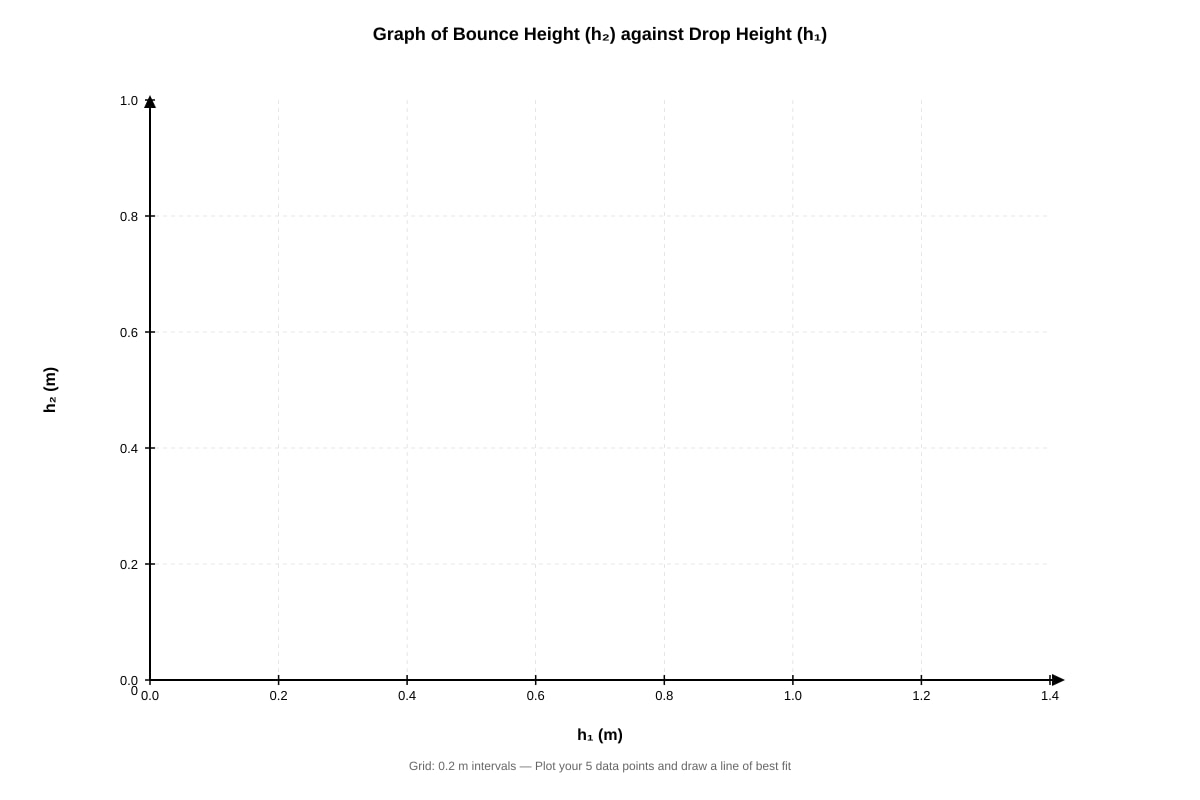
(b) Graph plotting. [2]
Expected features for marking:
- Correct axes with labels and units [1]
- All points plotted accurately (± half grid square) [1]
- Best fit straight line passing through or near origin with positive gradient
(c) Prediction from graph. [1]
Answer: Any value in range 0.98–1.02 m (or approximately 1.0 m) [1]
Teaching note: Extrapolate line to m, read off . Using the trend (ratio ~0.68), m.
(d) Evaluate the claim that is constant. [2]
Answer:
- The ratio is approximately constant at about 0.68–0.70 [1]
- However, there is a slight decreasing trend (0.70 → 0.68) as drop height increases, suggesting the ratio is not perfectly constant [1]
- This may be due to increased air resistance at higher speeds/ greater energy losses at higher impacts
- Conclusion: Claim is approximately true but not exactly; the small variation is significant enough to question strict constancy
17.
(a) Calculate the gravitational potential energy lost by the water each second. [2]
Answer: [1] (per second, so power available = 1.2 MW) [1]
Teaching note: "Each second" with mass flow rate of gives power directly in Watts: .
(b) Calculate the overall efficiency. [2]
Answer: [1] [1]
Teaching note: 900 kW = 900 000 W. Input power is 1.2 MW = 1 200 000 W.
(c) Explain two practical reasons why efficiency is not 100%. [2]
Answer: Any two from:
- Some kinetic energy of water is retained in the flow / not all converted to turbine motion [1]
- Friction in turbine bearings and generator [1]
- Turbulence and water splash losses [1]
- Electrical resistance in generator coils / heating losses (I²R) [1]
- Transformer losses if step-up/down used [1]
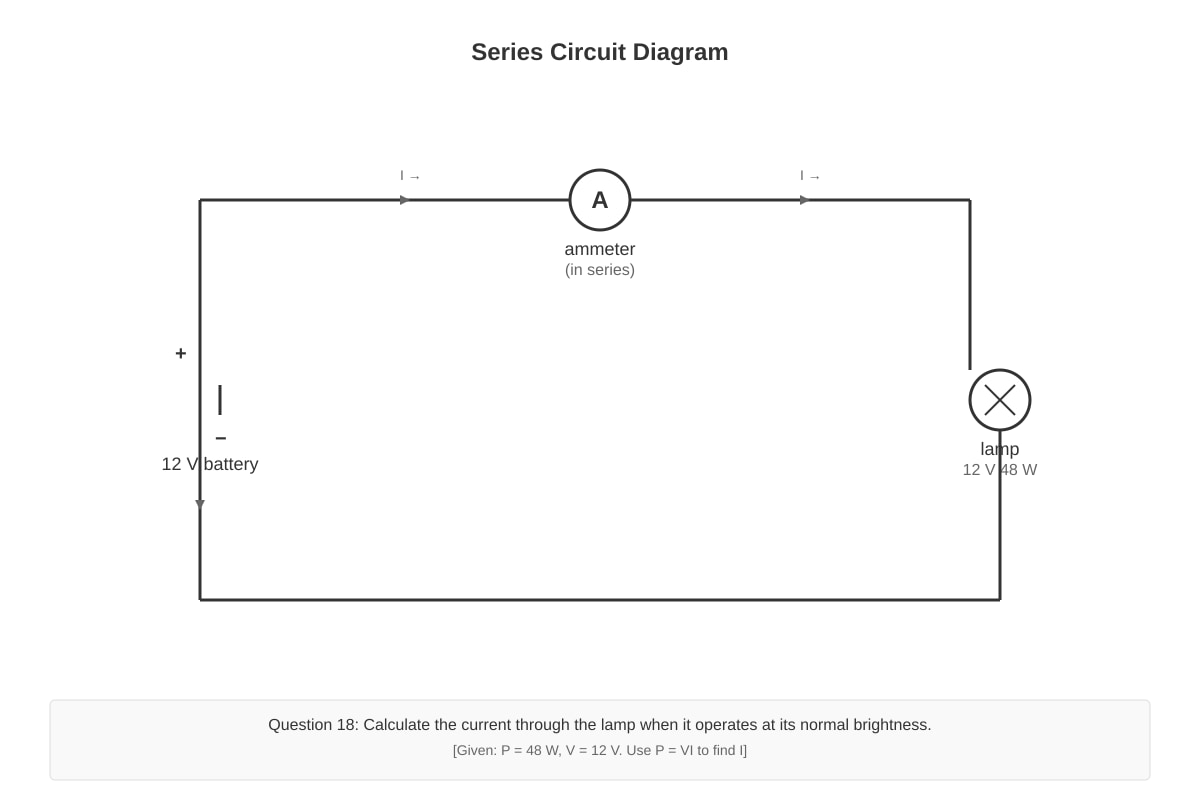
18.
(a) Calculate the current. [2]
Answer: [1] [1]
(b) Calculate the resistance. [2]
Answer: [1, or use ] [1]
Teaching note: Can use from part (a) or directly. Both should give same answer — good check.
(c) Explain why resistance is lower when cold. [2]
Answer:
- The filament is made of metal (tungsten) [1]
- Metal resistance increases with temperature due to increased lattice ion vibrations, which impede electron flow [1]
- At lower temperature, ions vibrate less, so electrons move more freely, resistance is lower [1]
- At switch-on, current is therefore higher than operating current (can cause "burnout" if filament weak)
Marking: Metal identification [1], temperature-resistance relationship explanation [1]
19.
(a) Calculate work done by braking force. [2]
Answer: Using work-energy theorem: [1] [1]
Teaching note: Braking force does negative work, removing kinetic energy. Magnitude is 240 kJ. All car's kinetic energy is dissipated.
(b) Calculate average braking force. [2]
Answer: [1] [1]
(c) Explain why stopping distance is 160 m at double speed, not 80 m. [3]
Answer: At :
- New [1]
- This is 4 times the original kinetic energy (since increases by factor of 4)
- Work needed =
- Same force N: [1]
- Key reason: Kinetic energy depends on , so doubling speed quadruples energy; with same braking force, stopping distance is proportional to initial kinetic energy, hence 4× original [1]
Teaching note: This is a crucial road safety concept — stopping distance increases as speed squared, not linearly.
20.
(a) Explain why solar energy is renewable. [1]
Answer: The Sun's energy is continuously replenished / will last for billions of years / not depleted by human use / naturally occurring energy flow from sun. [1]
(b) Two reasons for natural gas dominance. [2]
Answer: Any two from:
- Singapore has limited land for other power generation [1]
- Natural gas power stations are efficient and quick to adjust output [1]
- Established infrastructure and supply chains for natural gas import [1]
- Reliable and controllable supply unlike intermittent solar [1]
- Historically cost-effective compared to alternatives [1]
(c) Evaluate replacing natural gas with solar. [3]
Answer:
| Points | Marks |
|---|---|
| Advantages of solar: renewable, low carbon emissions, reduces climate change impact, fuel cost is zero | [1] for any advantage explained |
| Limitations: Singapore's small land area limits solar farm scale; cloudy weather reduces efficiency and consistency; solar is intermittent (no power at night, reduced on cloudy days); current technology requires large areas for significant output; energy storage needed | [1] for any limitation specific to Singapore context |
| Need for backup/transition: solar cannot fully replace without massive storage infrastructure; natural gas provides reliable baseload; a mix is more practical than complete replacement | [1] for balanced evaluation/conclusion |
Sample evaluated response: "While solar energy would reduce Singapore's carbon emissions and is renewable, completely replacing natural gas is impractical. Singapore's high population density and small land area severely limit available space for solar installations. The consistently cloudy tropical weather reduces solar panel efficiency to below optimal levels. Solar energy is also intermittent — no generation occurs at night or during heavy storms. Without vast battery storage systems, which are expensive and resource-intensive, Singapore would face electricity supply risks. A more realistic approach is maximizing solar where possible (rooftops, reservoirs) while maintaining natural gas for reliability, gradually transitioning as storage technology improves."
Teaching note: Good evaluation requires specific context application, not generic pros/cons. Singapore's constraints are geographical (small, dense, cloudy) and practical (reliability needs).
END OF ANSWER KEY