From Real Exams Quiz
Secondary 3 Combined Science Physical Sciences Quiz
Free Sec 3 Combined Sci Physical Sciences quiz, HY3 Exam version, with questions, answers, and O Level-style practice for Singapore students.
These static practice materials are generated from the site's syllabus and paper-generation workflow, with source and model context shown so students and parents can evaluate the material before use.
Questions
Secondary 3 Combined Science Quiz - Physical Sciences
Name: _______________________
Class: _______________________
Date: _______________________
Score: _______ / 40
Duration: 60 minutes
Total Marks: 40
Instructions:
- Answer all 20 questions.
- Section A: Multiple-choice style short items (1 mark each).
- Section B: Structured short answers (2–3 marks each).
- Section C: Data and calculation items (3–4 marks each).
- Show working where calculations are involved.
- Write clearly in the spaces provided.
Section A (Questions 1–5, 1 mark each)
1. State the Principle of Conservation of Energy.
2. A 2 kg object is lifted to a height of 5 m. What form of energy does it gain?
3. In a simple circuit, what quantity does a voltmeter measure?
4. Name the force that pulls a book downward when placed on a table.
5. What is the SI unit for power?
Section B (Questions 6–10, 2 marks each)
6. A ball of mass 0.5 kg is dropped from rest and hits the ground at 10 m s⁻¹. Calculate its kinetic energy just before impact.
Working: __________________________________________________
Answer: ___________________________________________________
7. Describe how energy is converted when a bicycle rider pedals uphill.
8. State one function and one adaptation of xylem in plants.
Function: __________________________________________________
Adaptation: _______________________________________________
9. Explain why a potato strip placed in pure water becomes rigid after two hours.
10. A toy car is pushed across a rough floor and stops. Name the force that opposes motion and state where the kinetic energy goes.
Force: ____________________________________________________
Energy becomes: ___________________________________________
Section C (Questions 11–20, 3–4 marks each)
11. A 12 V battery is connected to a resistor of 4 Ω. Calculate the current and the power dissipated.
Working: __________________________________________________
Current: ________ A Power: ________ W
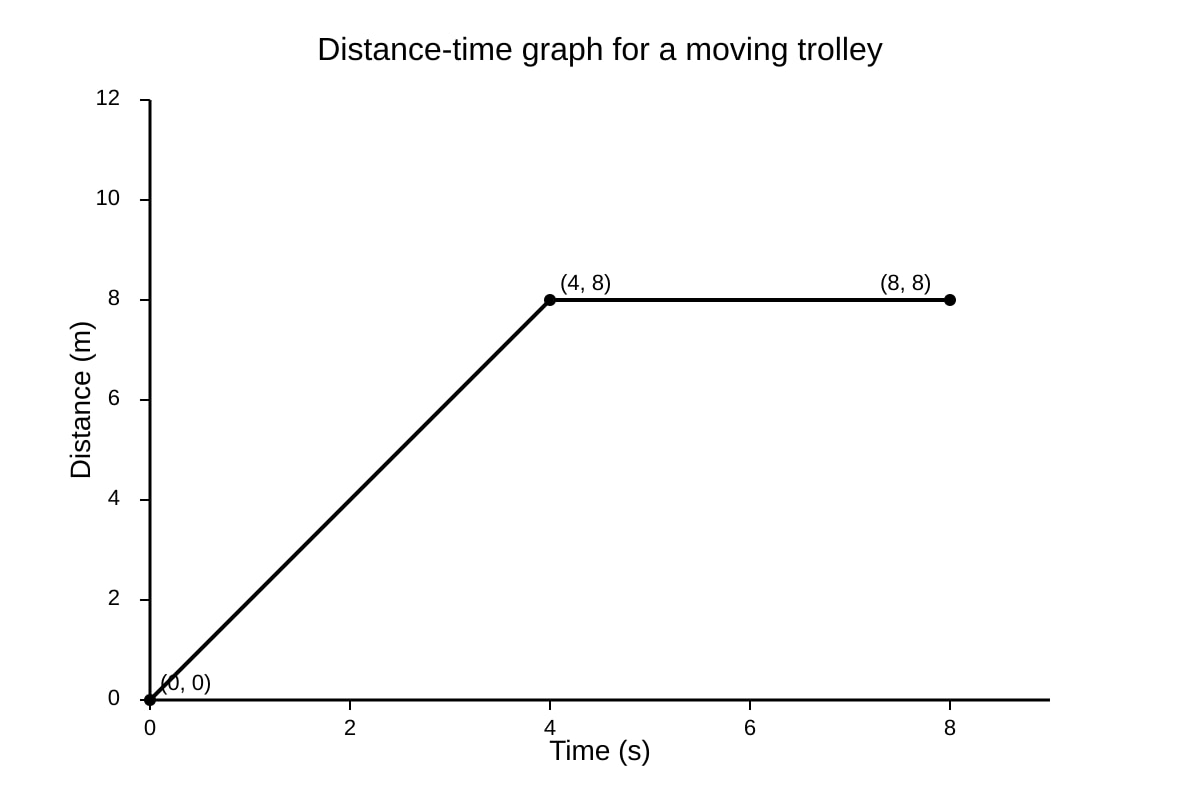
12.

Generated graph for Q12.
Using the graph, calculate the speed of the trolley during the first 4 s. (3 marks)
Working: __________________________________________________
Answer: ___________________________________________________
13. A block of mass 3 kg is pulled with a force of 15 N on a frictionless surface. Find the acceleration and the work done in moving it 6 m. (4 marks)
Working: __________________________________________________
Acceleration: ________ m s⁻² Work: ________ J
14. Explain the energy changes in a solar-powered calculator. (3 marks)
15. A pendulum swings from its highest point A to lowest point B. State the energy transformation and why total mechanical energy is conserved ignoring air resistance. (3 marks)
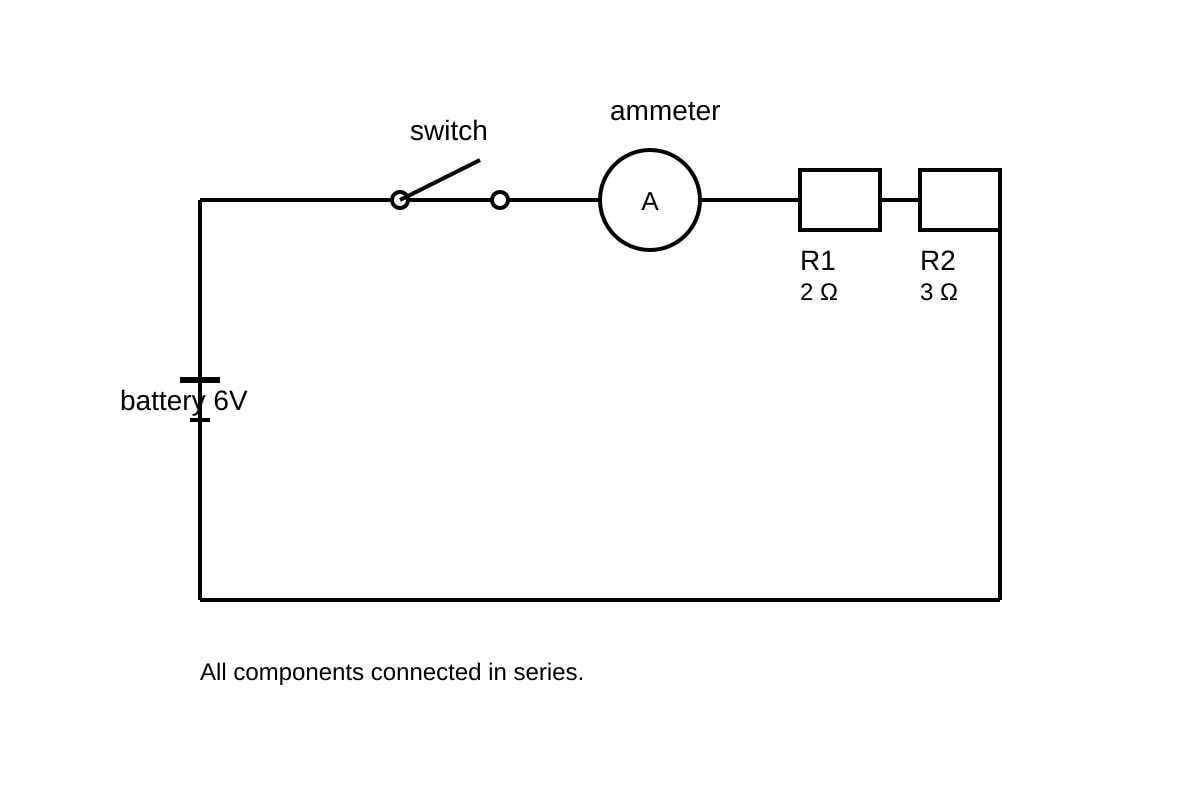
16.

Generated experimental_setup for Q16.
Calculate total resistance and current in the circuit. (3 marks)
Working: __________________________________________________
Total R: ________ Ω Current: ________ A
17. A student lifts a 10 N load by 2 m using a pulley. If she does 25 J of work, calculate efficiency. (3 marks)
Working: __________________________________________________
Answer: ___________________________________________________
18. Describe the pathway of water through a plant from soil to leaf. (5 marks)
19. A heater of 1000 W runs for 5 minutes. Calculate energy transferred. (3 marks)
Working: __________________________________________________
Answer: ___________________________________________________
20. State the main force responsible for red dye rising in a cut shoot experiment and explain one adaptation of xylem aiding this. (3 marks)
Force: ____________________________________________________
Adaptation: _______________________________________________
Answers
Answer Key: Secondary 3 Combined Science Quiz - Physical Sciences
Total Marks: 40
Duration: 60 minutes
Section A (1 mark each)
1. Energy cannot be created or destroyed, only converted from one form to another; total energy in a closed system is constant.
Teaching note: This is the Principle of Conservation of Energy. Common mistake: saying energy is "lost" instead of converted.
2. Gravitational potential energy.
Teaching note: Lifting increases height → GPE = mgh increases.
3. Potential difference (voltage).
Teaching note: Voltmeter connected in parallel measures V.
4. Weight (gravitational force / gravity).
Teaching note: Earth pulls object down with weight = mg.
5. Watt (W).
Teaching note: Power = energy/time, unit J/s = W.
Section B (2 marks each)
6. KE = ½mv² = ½ × 0.5 × 10² = 25 J.
Answer: 25 J.
Teaching note: Substitute m=0.5, v=10. Mark: 1 for formula, 1 for answer.
7. Chemical energy in rider → kinetic energy of bicycle + gravitational potential energy uphill + thermal energy (heat) due to effort.
Teaching note: 2 marks for naming at least two conversions correctly.
8. Function: transports water/minerals from roots. Adaptation: lignified walls / hollow tube.
Teaching note: 1 mark each. Do not confuse with phloem.
9. Water has higher water potential than potato → water enters by osmosis → cells turgid → rigid. (2 marks: 1 for osmosis direction, 1 for turgid result)
Teaching note: Must mention osmosis and water potential gradient.
10. Friction; becomes thermal energy (heat).
Teaching note: 1 mark each.
Section C
11. (4 marks total: 2 for current, 2 for power)
I = V/R = 12/4 = 3 A.
P = VI = 12 × 3 = 36 W.
Answer: Current 3 A, Power 36 W.
Teaching note: Ohm's law and power formula.
12. (3 marks) Speed = distance/time = 8 m / 4 s = 2 m s⁻¹.
Teaching note: From graph segment (0,0)-(4,8). 1 mark graph read, 2 for calc.
13. (4 marks) a = F/m = 15/3 = 5 m s⁻². W = Fd = 15 × 6 = 90 J.
Answer: a=5, W=90 J.
Teaching note: Newton's 2nd law and work formula.
14. (3 marks) Solar (light) energy → electrical energy (solar cell) → used to power calculator (kinetic? no, electrical to light/display).
Marking: 1 per energy form named and linked.
15. (3 marks) GPE at A → KE at B. Total mechanical energy constant as no external work (air resistance ignored).
Teaching note: 1 transform, 2 explanation.
16. (3 marks) R_total = 2+3 = 5 Ω. I = V/R = 6/5 = 1.2 A.
Answer: 5 Ω, 1.2 A.
17. (3 marks) Useful = 10×2 = 20 J. Efficiency = 20/25 × 100% = 80%.
Answer: 80%.
18. (5 marks) Root hair absorbs (1) → cortex/endodermis (1) → xylem (1) → up stem (1) → stomata transpire (1).
19. (3 marks) E = Pt = 1000 × (5×60) = 300 000 J = 300 kJ.
Answer: 300 kJ.
20. (3 marks) Transpiration pull / capillarity (1). Xylem: hollow lumen (1) continuous (1).
Free quiz and exam paper access
Enter your details to view this paper
Your access is remembered on this device.