From Real Exams Quiz
Secondary 3 Combined Science Physical Sciences Quiz
Free Sec 3 Combined Sci Physical Sciences quiz, DeepSeek Exam version, with questions, answers, and O Level-style practice for Singapore students.
These static practice materials are generated from the site's syllabus and paper-generation workflow, with source and model context shown so students and parents can evaluate the material before use.
Questions
Free quiz and exam paper access
Enter your details to view this paper
Your access is remembered on this device.
Answers
Secondary 3 Combined Science Quiz - Physical Sciences — Answer Key
Total Marks: 50
Section A: Short Answer (Questions 1–5)
1. State the Principle of Conservation of Energy. [2 marks]
Answer:
- Energy cannot be created or destroyed. [1]
- Energy can only be converted/transferred from one form to another. / The total energy in a closed system remains constant. [1]
Marking notes: Award 1 mark for each key idea. Accept "transformed" or "changed" as equivalent to "converted".
2. A student measures the length of a table as 1.50 m using a metre rule. State the precision of this measurement. [1 mark]
Answer:
- 0.01 m / 1 cm / ±0.5 cm [1]
Marking notes: The measurement is given to 2 decimal places in metres, indicating precision to the nearest 0.01 m (1 cm). Accept any equivalent expression of precision.
3. Distinguish between scalar and vector quantities. Give one example of each. [2 marks]
Answer:
- Scalar quantities have magnitude only; vector quantities have both magnitude and direction. [1]
- Scalar example: mass / speed / distance / time / energy / temperature (any valid scalar) [0.5]
- Vector example: force / velocity / displacement / acceleration / weight / momentum (any valid vector) [0.5]
Marking notes: Award 1 mark for correct distinction. Award 0.5 mark each for correct examples. Examples must be clearly labelled as scalar or vector.
4. A force of 20 N is applied to an object of mass 5.0 kg. Calculate the acceleration of the object. [2 marks]
Answer:
- F = ma → a = F/m [1]
- a = 20 / 5.0 = 4.0 m/s² [1]
Marking notes: Award 1 mark for correct formula/substitution. Award 1 mark for correct answer with units. Accept 4 m/s².
5. State two factors that affect the pressure exerted by a solid object on a surface. [2 marks]
Answer:
- The force applied / weight of the object [1]
- The area of contact / surface area in contact with the surface [1]
Marking notes: Award 1 mark for each correct factor. Accept "mass" as equivalent to force/weight if linked to weight.
Section B: Structured Response (Questions 6–15)
6. A car accelerates uniformly from rest to 20 m/s in 10 seconds.
(a) Calculate the acceleration of the car. [2 marks]
Answer:
- a = (v - u) / t [1]
- a = (20 - 0) / 10 = 2.0 m/s² [1]
Marking notes: Award 1 mark for correct formula/substitution. Award 1 mark for correct answer with units.
(b) Calculate the distance travelled by the car during this time. [2 marks]
Answer:
- s = ut + ½at² OR s = ½(u + v)t [1]
- s = 0 × 10 + ½ × 2.0 × 10² = 100 m OR s = ½(0 + 20) × 10 = 100 m [1]
Marking notes: Award 1 mark for correct formula/substitution. Award 1 mark for correct answer with units.
7. A student investigates the turning effect of forces using a metre rule pivoted at its centre. A 2.0 N weight is hung at the 20 cm mark on one side.
(a) State the principle of moments. [1 mark]
Answer:
- For an object in equilibrium, the sum of clockwise moments about a pivot equals the sum of anticlockwise moments about the same pivot. [1]
Marking notes: Accept any clear statement of the principle. Must mention equilibrium/balance and equality of moments.
(b) Calculate the force that must be applied at the 80 cm mark on the opposite side to balance the rule. [3 marks]
Answer:
- Distance of 2.0 N weight from pivot = 50 - 20 = 30 cm [1]
- Anticlockwise moment = 2.0 × 30 = 60 N cm [1]
- Distance of applied force from pivot = 80 - 50 = 30 cm
- Clockwise moment = F × 30
- F × 30 = 60 → F = 2.0 N [1]
Marking notes: Award 1 mark for correct distance calculation. Award 1 mark for correct moment calculation. Award 1 mark for correct force. Accept working in metres (0.30 m) with equivalent answer.
8. A rectangular block of mass 12 kg has dimensions 0.30 m × 0.20 m × 0.10 m. It rests on a table with its largest face in contact with the table surface.
(a) Calculate the weight of the block. (Take g = 10 N/kg) [1 mark]
Answer:
- W = mg = 12 × 10 = 120 N [1]
Marking notes: Award 1 mark for correct answer with units.
(b) Calculate the pressure exerted by the block on the table. [3 marks]
Answer:
- Largest face area = 0.30 × 0.20 = 0.060 m² [1]
- P = F/A [1]
- P = 120 / 0.060 = 2000 Pa / 2.0 × 10³ Pa [1]
Marking notes: Award 1 mark for correct area calculation. Award 1 mark for correct formula/substitution. Award 1 mark for correct answer with units. Accept N/m² as equivalent to Pa.
9. Explain, in terms of the kinetic particle model, why the pressure of a gas in a sealed container increases when the temperature of the gas is raised. [3 marks]
Answer:
- When temperature increases, gas particles gain kinetic energy and move faster. [1]
- Faster-moving particles collide with the walls of the container more frequently. [1]
- Each collision also exerts a greater force on the walls (greater change in momentum). / The increased frequency and force of collisions results in greater pressure. [1]
Marking notes: Award 1 mark for each key idea. Must link particle behaviour to pressure increase. Accept "harder collisions" as equivalent to greater force.
10. A student sets up an experiment to investigate the transfer of thermal energy. A metal rod is heated at one end, and small pieces of wax are attached at equal intervals along the rod.
(a) Name the process by which thermal energy is transferred along the metal rod. [1 mark]
Answer:
- Conduction [1]
Marking notes: Must be exactly "conduction".
(b) Explain how this process occurs in terms of particles. [2 marks]
Answer:
- Particles at the heated end gain kinetic energy and vibrate more vigorously. [1]
- These vibrations are passed to neighbouring particles through collisions, transferring energy along the rod. [1]
Marking notes: Award 1 mark for increased vibration. Award 1 mark for transfer via collisions/neighbouring particles. Accept reference to free electrons in metals as an additional mechanism.
11. A ray of light travels from air into a glass block. The angle of incidence is 45° and the angle of refraction is 28°.
(a) State what is meant by refraction of light. [1 mark]
Answer:
- Refraction is the bending/changing direction of light as it passes from one medium to another of different optical density. [1]
Marking notes: Must mention change in direction and change in medium/density.
(b) Explain why the light ray bends towards the normal when entering the glass block. [2 marks]
Answer:
- Glass is optically denser than air, so light travels more slowly in glass. [1]
- When light enters the denser medium, it slows down and bends towards the normal. [1]
Marking notes: Award 1 mark for identifying speed change. Award 1 mark for linking speed change to direction of bending.
12. A student uses a convex lens of focal length 10 cm to form an image of a distant object on a screen.
(a) State the nature of the image formed on the screen. [1 mark]
Answer:
- Real, inverted, and diminished [1]
Marking notes: Award 1 mark for all three descriptors. Accept "real and inverted" for 1 mark; "diminished" is implicit for distant objects.
(b) Calculate the distance between the lens and the screen when a sharp image is formed. [1 mark]
Answer:
- Distance = focal length = 10 cm [1]
Marking notes: For a distant object, the image is formed at the focal point. Award 1 mark for 10 cm.
(c) The student replaces the lens with one of focal length 15 cm. State and explain how the distance between the lens and the screen must be adjusted to obtain a sharp image. [2 marks]
Answer:
- The screen must be moved further away from the lens / distance must be increased to 15 cm. [1]
- A lens with longer focal length converges light less strongly, so the image is formed further from the lens. [1]
Marking notes: Award 1 mark for correct adjustment. Award 1 mark for correct explanation linking focal length to image distance.
13. An electric circuit consists of a 12 V battery connected to two resistors of 4 Ω and 6 Ω in series.
(a) Calculate the total resistance of the circuit. [1 mark]
Answer:
- R_total = 4 + 6 = 10 Ω [1]
Marking notes: Award 1 mark for correct answer with units.
(b) Calculate the current flowing through the circuit. [2 marks]
Answer:
- I = V / R [1]
- I = 12 / 10 = 1.2 A [1]
Marking notes: Award 1 mark for correct formula/substitution. Award 1 mark for correct answer with units.
(c) Calculate the potential difference across the 6 Ω resistor. [2 marks]
Answer:
- V = IR [1]
- V = 1.2 × 6 = 7.2 V [1]
Marking notes: Award 1 mark for correct formula/substitution. Award 1 mark for correct answer with units. Accept alternative method using potential divider principle.
14. A student investigates electromagnetic induction by moving a bar magnet into a coil of wire connected to a sensitive galvanometer.
(a) State what is observed on the galvanometer when the magnet is moved quickly into the coil. [1 mark]
Answer:
- The galvanometer pointer deflects (showing a current) / A reading is observed. [1]
Marking notes: Must indicate a deflection/reading. Accept "needle moves" or "current is induced".
(b) State two ways in which the magnitude of the induced current can be increased. [2 marks]
Answer:
- Any two from:
- Move the magnet faster / increase speed of movement [1]
- Use a stronger magnet / increase magnetic field strength [1]
- Increase the number of turns in the coil [1]
- Use a coil with a soft iron core [1]
Marking notes: Award 1 mark for each correct method. Maximum 2 marks.
15. A transformer has 500 turns in its primary coil and 50 turns in its secondary coil. The primary coil is connected to a 240 V a.c. supply.
(a) State the type of transformer described. [1 mark]
Answer:
- Step-down transformer [1]
Marking notes: Must be "step-down".
(b) Calculate the output voltage across the secondary coil. [2 marks]
Answer:
- V_s / V_p = N_s / N_p [1]
- V_s / 240 = 50 / 500 → V_s = 240 × (50/500) = 24 V [1]
Marking notes: Award 1 mark for correct formula/substitution. Award 1 mark for correct answer with units.
Section C: Data Interpretation and Application (Questions 16–20)
16. A student investigates the relationship between the extension of a spring and the force applied.
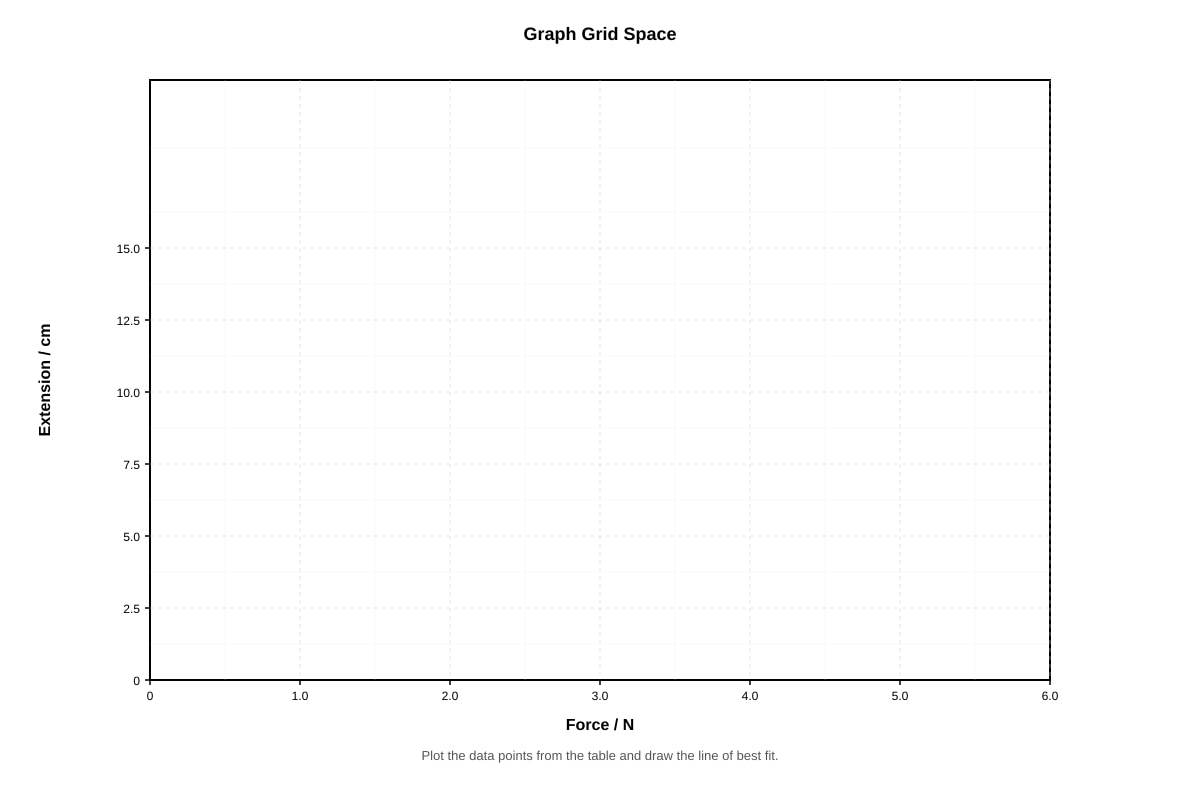
(a) Plot a graph of extension (y-axis) against force (x-axis) on the grid provided below. Label both axes with appropriate scales and units. [3 marks]
Answer:
- Correct axes: Extension/cm on y-axis, Force/N on x-axis [1]
- Appropriate linear scales using most of the grid [1]
- All 6 points plotted correctly (±½ small square) [1]
Marking notes: Award 1 mark for each criterion. Points: (0,0), (1.0,2.5), (2.0,5.0), (3.0,7.5), (4.0,10.0), (5.0,12.5).
(b) Using your graph, determine the extension when the force is 3.5 N. [1 mark]
Answer:
- Extension = 8.75 cm (accept 8.7–8.8 cm) [1]
Marking notes: Award 1 mark for correct reading from graph within tolerance.
(c) State the relationship between force and extension shown by the data. [1 mark]
Answer:
- Extension is directly proportional to force. / Force and extension show a linear relationship passing through the origin. [1]
Marking notes: Must indicate proportionality or linear relationship through origin.
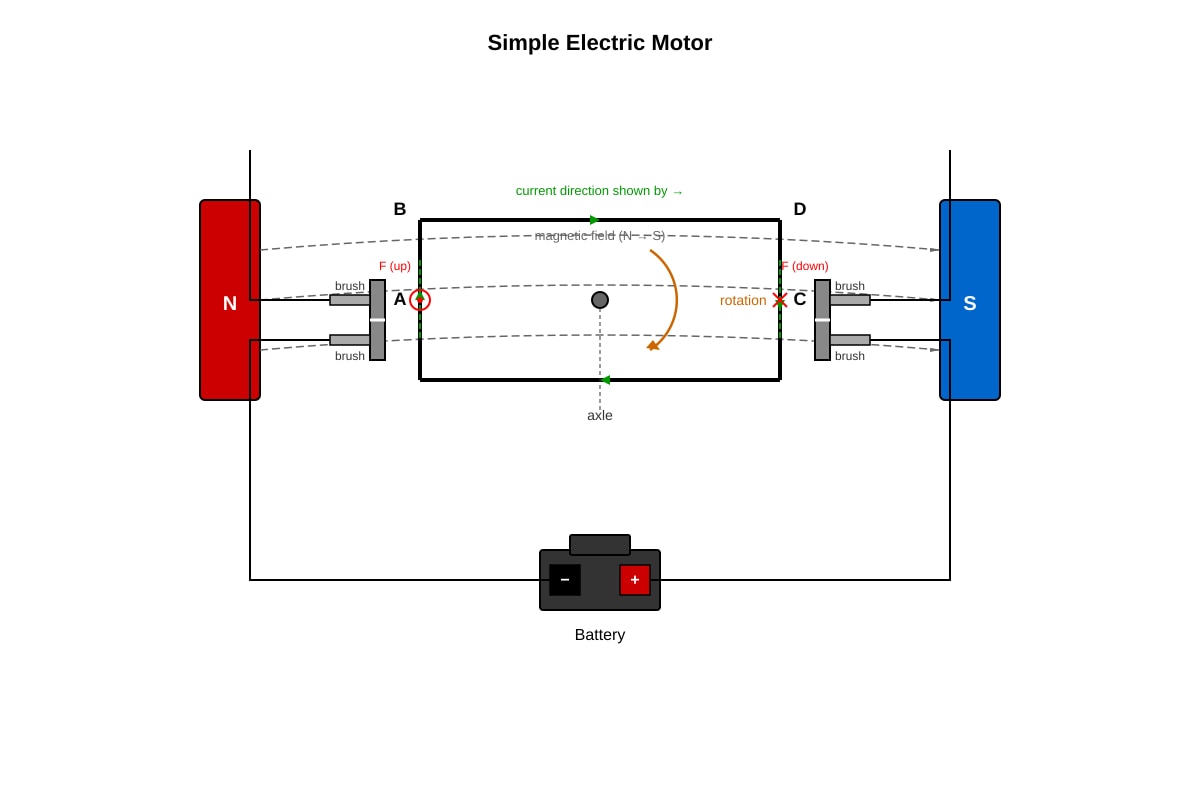
17. The diagram below shows a simple electric motor.
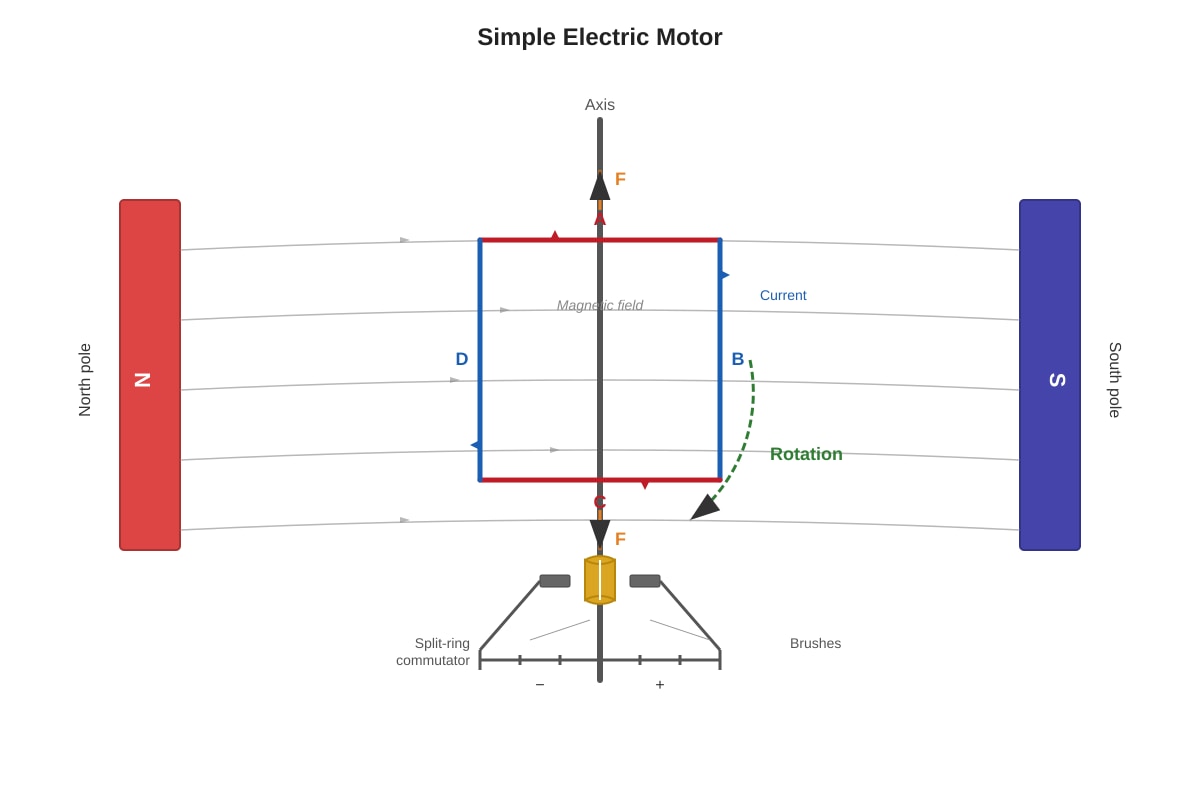
Generated diagram for this question.
(a) State the direction of the force acting on side AB of the coil using Fleming's left-hand rule. [1 mark]
Answer:
- Upwards / Out of the page (depending on diagram orientation) [1]
Marking notes: Direction must be consistent with standard motor diagram. Accept "up" or "down" as appropriate to the diagram shown.
(b) Explain why the coil continues to rotate in the same direction. [2 marks]
Answer:
- The commutator reverses the direction of current in the coil every half-turn. [1]
- This ensures the force on each side of the coil always acts in the same rotational direction, maintaining continuous rotation. [1]
Marking notes: Award 1 mark for mentioning commutator reversing current. Award 1 mark for linking this to continuous rotation.
(c) Suggest one way to increase the speed of rotation of the motor. [1 mark]
Answer:
- Any one from:
- Increase the current / potential difference [1]
- Use a stronger magnet [1]
- Increase the number of turns in the coil [1]
- Use a soft iron core [1]
Marking notes: Award 1 mark for any valid method.
18. A student investigates the cooling of hot water in two identical beakers.
(a) Calculate the rate of temperature decrease for the uncovered beaker between 0 and 4 minutes. Give your answer in °C/min. [2 marks]
Answer:
- Temperature decrease = 80 - 65 = 15 °C [1]
- Rate = 15 / 4 = 3.75 °C/min [1]
Marking notes: Award 1 mark for correct temperature difference. Award 1 mark for correct rate with units.
(b) Explain why the wrapped beaker cools more slowly than the uncovered beaker. [2 marks]
Answer:
- Cotton wool is a poor conductor of heat / a good insulator. [1]
- It traps air, reducing heat loss by conduction and convection. / It reduces the rate of thermal energy transfer to the surroundings. [1]
Marking notes: Award 1 mark for identifying cotton wool as an insulator. Award 1 mark for explaining mechanism (traps air/reduces conduction/convection).
(c) State one variable that must be kept constant to ensure a fair comparison. [1 mark]
Answer:
- Any one from:
- Initial temperature of water [1]
- Volume/mass of water [1]
- Type/size of beaker [1]
- Room temperature / surrounding conditions [1]
Marking notes: Award 1 mark for any valid controlled variable.
19. A student sets up a circuit to investigate the resistance of a filament lamp.
(a) Calculate the resistance of the filament lamp when the potential difference is 2.0 V. [2 marks]
Answer:
- R = V / I [1]
- R = 2.0 / 0.35 = 5.71 Ω (accept 5.7 Ω) [1]
Marking notes: Award 1 mark for correct formula/substitution. Award 1 mark for correct answer with units. Accept 5.7 Ω.
(b) Describe how the resistance of the filament lamp changes as the potential difference increases. [1 mark]
Answer:
- The resistance increases. [1]
Marking notes: Must indicate increase. Accept "resistance increases as p.d. increases".
(c) Explain why the resistance changes in this way. [2 marks]
Answer:
- As current increases, the filament gets hotter / temperature increases. [1]
- The increased temperature causes increased vibration of metal ions in the filament, which impedes electron flow, increasing resistance. [1]
Marking notes: Award 1 mark for linking to temperature increase. Award 1 mark for explaining effect on resistance (ion vibration/electron flow).
20. A student investigates the efficiency of an electric motor used to lift a mass.
(a) Calculate the useful work done by the motor in lifting the mass. [2 marks]
Answer:
- Weight = mg = 0.50 × 10 = 5.0 N [1]
- Work done = force × distance = 5.0 × 1.5 = 7.5 J [1]
Marking notes: Award 1 mark for correct weight calculation. Award 1 mark for correct work done with units. Accept alternative method using mgh directly.
(b) Calculate the electrical energy supplied to the motor. [2 marks]
Answer:
- E = VIt [1]
- E = 6.0 × 0.80 × 5.0 = 24 J [1]
Marking notes: Award 1 mark for correct formula/substitution. Award 1 mark for correct answer with units.
(c) Calculate the efficiency of the motor. [2 marks]
Answer:
- Efficiency = (useful work output / energy input) × 100% [1]
- Efficiency = (7.5 / 24) × 100% = 31.25% (accept 31.3% or 31%) [1]
Marking notes: Award 1 mark for correct formula/substitution. Award 1 mark for correct answer with % sign. Accept 31.25%, 31.3%, or 31%.
END OF ANSWER KEY