From Real Exams Quiz
Secondary 3 Combined Science Chemistry Materials Quiz
Free Sec 3 Combined Sci Chemistry Materials quiz, Kimi2.6 Exam version, with questions, answers, and O Level-style practice for Singapore students.
These static practice materials are generated from the site's syllabus and paper-generation workflow, with source and model context shown so students and parents can evaluate the material before use.
Questions
Free quiz and exam paper access
Enter your details to view this paper
Your access is remembered on this device.
Answers
Secondary 3 Combined Science Quiz - Chemistry Materials
ANSWER KEY
Total Marks: 40
Section A: Multiple Choice
1. C – Malleable and ductile [1]
Teaching note: Metals are characterised by their ability to be hammered into sheets (malleable) and drawn into wires (ductile), due to the layers of metal ions that can slide over each other without breaking the metallic bond.
2. B – Low melting point and forms acidic oxides [1]
Teaching note: Non-metals typically have lower melting points than metals (sulfur melts at 115°C) and their oxides dissolve in water to form acidic solutions. Most non-metals are poor conductors and are brittle when solid.
3. B – Reactivity increases down the group [1]
Teaching note: As you go down Group I, the outer electron is further from the nucleus and more shielded by inner electron shells. The attraction between the nucleus and the outer electron weakens, so the electron is lost more easily, increasing reactivity.
4. C – A non-metal [1]
Teaching note: The properties listed (no conductivity, brittle, low melting point) are classic non-metal characteristics. Ceramics and polymers are also brittle and poor conductors, but polymers specifically often have very low melting points and are used for insulation.
5. B – Filtration followed by crystallisation [1]
Teaching note: Sand is insoluble in water while copper(II) sulfate is soluble. Filtration separates insoluble sand from the copper(II) sulfate solution. Crystallisation then produces pure copper(II) sulfate crystals by slow evaporation, giving better crystal quality than simple evaporation.
Section B: Short Answer
6. Any two from: [2]
- Metals are good conductors of heat and electricity; non-metals are poor conductors
- Metals are malleable and ductile; non-metals are brittle
- Metals have high melting points (generally); non-metals have low melting points (generally)
- Metals are shiny (lustrous); non-metals are dull
Marking: 1 mark each for any two valid differences with correct direction (metal property vs non-metal property).
7. Any two from: [2]
- Aluminium has a lower density than copper, making the cables lighter and easier to support
- Aluminium is more resistant to corrosion than copper, lasting longer with less maintenance
- Aluminium is more abundant, making long cable runs more economical overall despite higher per-kg cost
Marking: 1 mark each for correct property linked to the application of overhead cables.
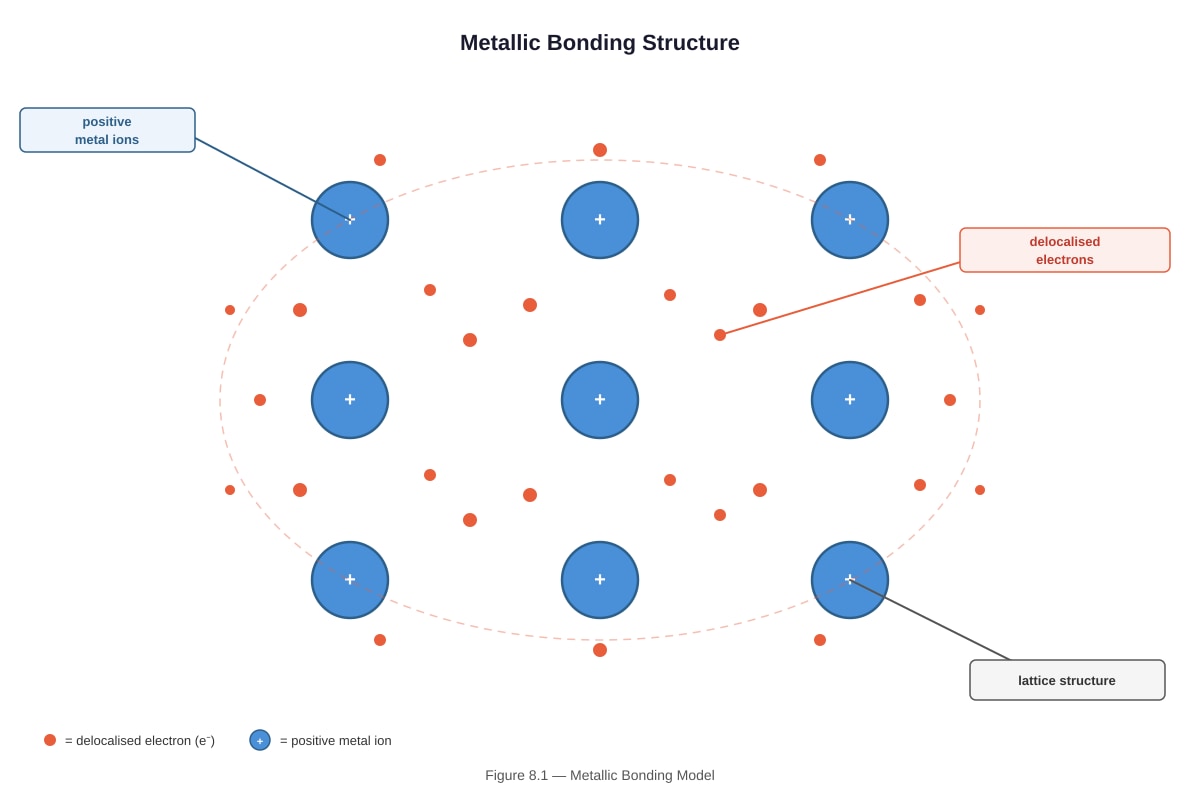
8. (a) Left label: positive ions / cations / metal ions [1]
Right label: delocalised electrons / sea of electrons
Marking: 1 mark for both labels correct.
(b) Metals conduct electricity because the delocalised electrons are free to move throughout the structure. [1] When a potential difference is applied, these mobile electrons drift towards the positive terminal, carrying charge. [1]
Teaching note: The metallic bond consists of positive metal ions held together by electrostatic attraction to a "sea" of delocalised electrons. These electrons are not attached to any particular ion, enabling electrical conduction. Do not accept "electrons flow" without reference to delocalisation or mobility.
9. (a) Haematite (Fe₂O₃) [1]
Teaching note: Haematite is the most common iron ore. Magnetite (Fe₃O₄) is also accepted in some syllabuses.
(b) Fe₂O₃ + 3CO → 2Fe + 3CO₂ [2]
Marking: 1 mark for correct formulae, 1 mark for correct balancing. Accept multiples.
(c) Limestone (calcium carbonate) decomposes to form calcium oxide, which reacts with silica impurities to form calcium silicate (slag). [1] This slag is less dense than molten iron and floats on top, allowing it to be removed easily. [1]
Teaching note: CaCO₃ → CaO + CO₂, then CaO + SiO₂ → CaSiO₃. The slag formation removes acidic impurities.
10. (a) The type of metal used / identity of the metal [1]
(b) Measure the volume of hydrogen gas produced over time [1] using a gas syringe or inverted burette/measuring cylinder in water [1]. Compare initial rates from the slope of volume-time graphs. OR Measure mass loss of the reaction mixture over time. [1]
Marking: 1 mark for valid measurement method, 1 mark for valid comparison approach.
(c) Magnesium > Zinc > Copper [1]
Teaching note: This follows the reactivity series. Magnesium is above zinc, which is above hydrogen; copper is below hydrogen and does not react with dilute acids.
11. (a) An alloy is a mixture of a metal with other elements (usually other metals) designed to improve properties. [1]
(b) The chromium forms a protective oxide layer on the surface. [1] This layer is passive and prevents oxygen and water from reaching the iron underneath, stopping rust formation. [1]
Teaching note: Nickel also contributes to corrosion resistance and maintains the structure at high temperatures.
12. (a) Substance Q [1]. It has a very low melting point and does not conduct electricity in any state, indicating simple covalent molecules with weak intermolecular forces. [1]
(b) Substance R [1]. It conducts electricity when solid and molten, has a high melting point, and is likely a metal with delocalised electrons throughout its structure. [1]
(c) Substance P [1]. It conducts electricity when molten but not when solid, indicating ionic bonding with mobile ions in the liquid state but fixed ions in the solid lattice. [1]
Marking: 1 mark for correct identification, 1 mark for correct reasoning in each part.
13. (a) The hydrocarbons must be vaporised so they can rise up the fractionating column as gases. [1]
(b) The mixture is heated and enters the fractionating column. [1] Different hydrocarbons have different boiling points; as vapours rise, they cool and condense at different heights. [1] Shorter hydrocarbons (lower boiling points) condense near the top; longer hydrocarbons (higher boiling points) condense near the bottom. [1]
Teaching note: This separates by boiling point, which correlates with molecular size and chain length.
14. (a) Addition polymerisation [1]
(b) Repeating unit: —CH₂—CH₂— or drawn with brackets and n [2]
   H   H
   |   |
—C—C—
   |   |
   H   H
Marking: 1 mark for correct carbon backbone, 1 mark for correct hydrogen arrangement and recognition as repeating unit.
(c) Polymers have very long chains of strong C—C bonds that micro-organisms cannot easily break down. [1]
Section C: Structured Response
15. (a) Magnesium, Aluminium, Zinc [3]
Marking: 1 mark each in correct order. Accept: Mg, Al, Zn.
(b) Zinc (or chosen metal): Extracted by reduction with carbon in a furnace [1] because it is less reactive than carbon, so carbon can displace it from its oxide. [1]
Teaching note: For aluminium (too reactive for carbon reduction), accept electrolysis as correct method with reason. For magnesium, accept electrolysis of molten chloride.
(c) ZnO + C → Zn + CO [2]
Marking: 1 mark for correct formulae, 1 mark for balancing. Type: Redox reaction / reduction / displacement reaction [1 mark within the 2, or accept as separate statement].
16. (a) Copper is below hydrogen in the reactivity series, so it cannot displace hydrogen from acids. [1]
(b) Moles of H₂ = 72.0 cm³ ÷ 24000 cm³/mol = 0.00300 mol [1]
Mole ratio Zn : H₂ = 1 : 1, so moles of Zn = 0.00300 mol [1]
Mass of Zn = 0.00300 × 65 = 0.195 g [1]
Marking: 1 mark for correct mole calculation, 1 mark for mole ratio, 1 mark for final mass with unit. Accept 0.195 g or 0.20 g (2 sig figs).
(c) Mass of Cu = 5.00 − 0.195 = 4.805 g [1]
Percentage Cu = (4.805 ÷ 5.00) × 100 = 96.1% (accept 96%)
Marking: 1 mark for correct method and answer. Error carried forward (ecf) from (b) accepted.
17. (a) Aluminium has a much lower density (2.70 vs 7.85 g/cm³) [1], making aircraft significantly lighter for the same volume of material, improving fuel efficiency and payload capacity. [1]
Teaching note: Also accept good corrosion resistance as valid alternative, but density is the primary factor for aircraft bodies.
(b) Titanium has excellent resistance to corrosion and is biocompatible (not rejected by body tissues) [1]. The high tensile strength allows for small, durable implants. For medical applications, the benefits outweigh the high cost. [1]
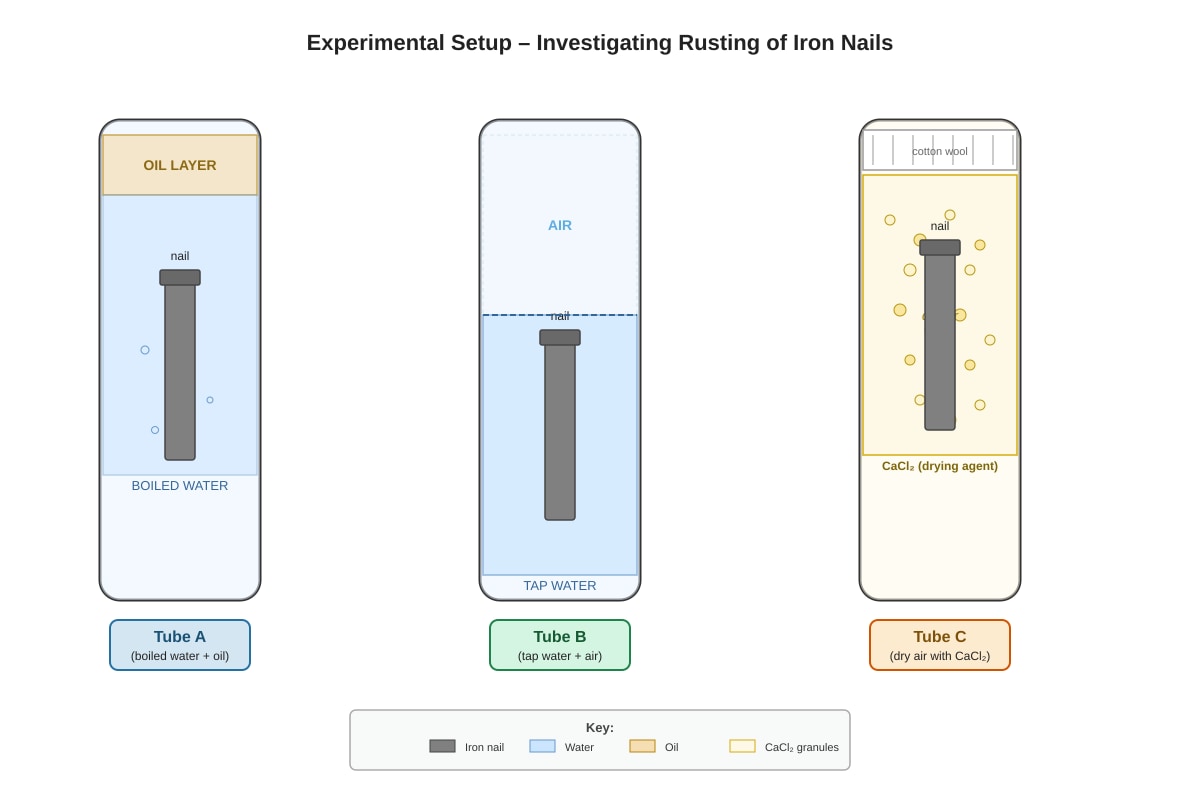
18. (a) Tube B only [1]. Rusting requires both oxygen (air) and water [1]. Tube A has no oxygen (boiled water removes dissolved air; oil prevents air re-entering). Tube C has no water (dry air, CaCl₂ absorbs moisture). Only Tube B has both conditions present. [1]
(b) Any valid method:
- Painting/greasing/oiling/plastic coating – creates a physical barrier preventing oxygen and water from reaching the iron surface [1+1]
- Galvanising/sacrificial protection – zinc more reactive than iron, corrodes preferentially protecting iron [1+1]
- Cathodic protection – attach more reactive metal [1+1]
Marking: 1 mark for method, 1 mark for explanation of how it prevents rusting.
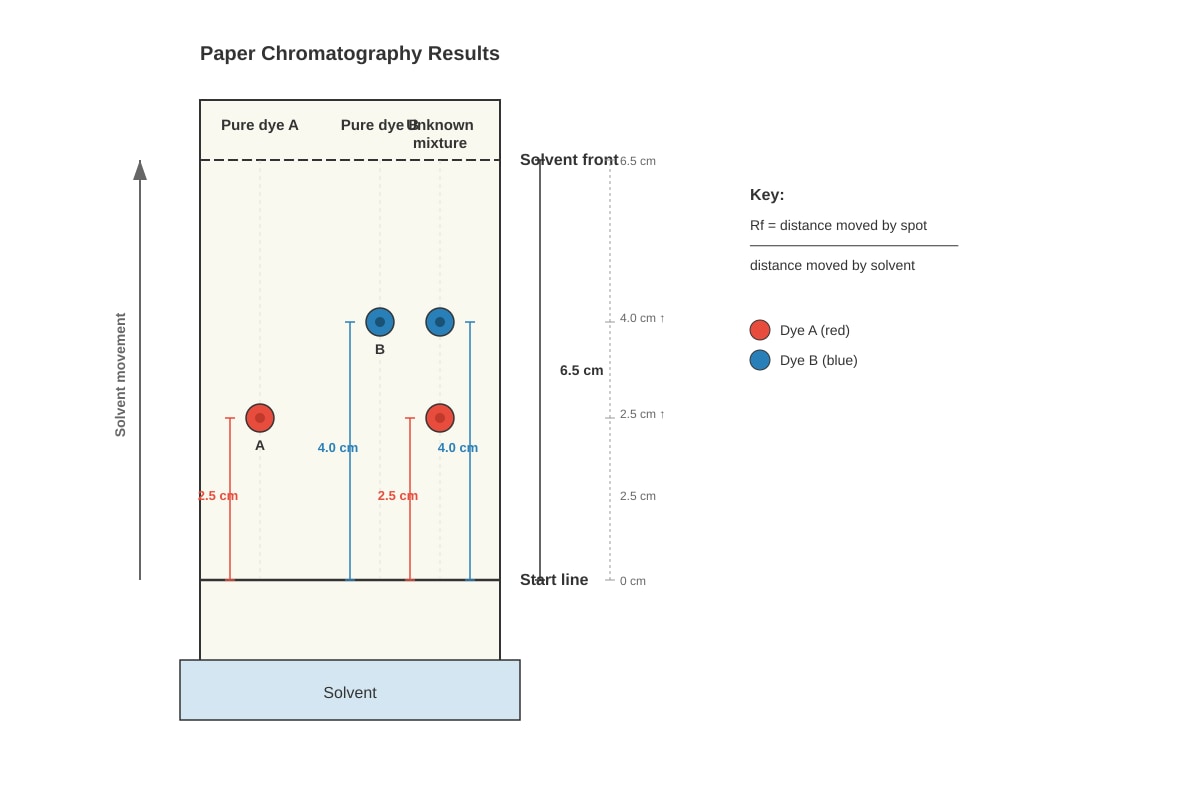
19. (a) Rf = distance moved by substance ÷ distance moved by solvent [1]
Rf = 4.0 ÷ 6.5 = 0.62 (accept 0.615 or 0.62) [1]
Marking: 1 mark for correct formula or method, 1 mark for correct answer to 2 sig figs minimum.
(b) The unknown mixture contains both dye A and dye B (pure dyes match Rf values). [1]
(c) To prevent the samples from dissolving into the solvent before development begins, which would ruin the separation. [1]
20. (a) Silicon dioxide has a giant covalent structure with strong covalent bonds between silicon and oxygen atoms. [1] These bonds extend throughout the structure in a 3D network; a large amount of energy is needed to break many strong bonds, giving a very high melting point. [1]
(b) (i) In diamond, each carbon atom is covalently bonded to four other carbon atoms in a rigid tetrahedral arrangement. [1] This 3D network of strong bonds makes it very hard to deform or break apart. [1]
(ii) In graphite, each carbon atom is bonded to three others in hexagonal layers, with the fourth electron delocalised between layers. [1] These delocalised electrons are free to move along the layers, carrying charge when a potential difference is applied. [1]
Teaching note: Emphasise that both have strong covalent bonds within their structures (hence both high melting points), but the arrangement determines the other properties. Layers in graphite slide due to weak London forces between layers, making it soft.
END OF ANSWER KEY