AI Generated Exam Paper
Secondary 3 Combined Science Practice Paper 5
Free Kimi AI-generated Sec 3 Combined Sci Practice Paper 5 with questions, answers, and O Level-style practice for Singapore students preparing for exams.
These static practice materials are generated from the site's syllabus and paper-generation workflow, with source and model context shown so students and parents can evaluate the material before use.
Questions
TuitionGoWhere Practice Paper - Combined Science Secondary 3
TuitionGoWhere Practice Paper (AI)
Subject: Combined Science (Physical Sciences focus) Level: Secondary 3 Paper: Practice Paper (Version 5 of 5) Duration: 1 hour 15 minutes Total Marks: 75
Name: _________________________________ Class: ______________ Date: ______________
Instructions to Candidates
- Write your name, class, and date in the spaces provided above.
- Answer ALL questions.
- Write your answers in the spaces provided. Show all working clearly.
- Marks are allocated for correct method even if the final answer is wrong.
- The use of an approved electronic calculator is expected, where appropriate.
- This paper consists of TWO sections: Section A and Section B.
- Section A: Questions 1–10 (30 marks)
- Section B: Questions 11–17 (45 marks)
SECTION A [30 marks]
Answer ALL questions. Each question carries 3 marks unless otherwise stated.
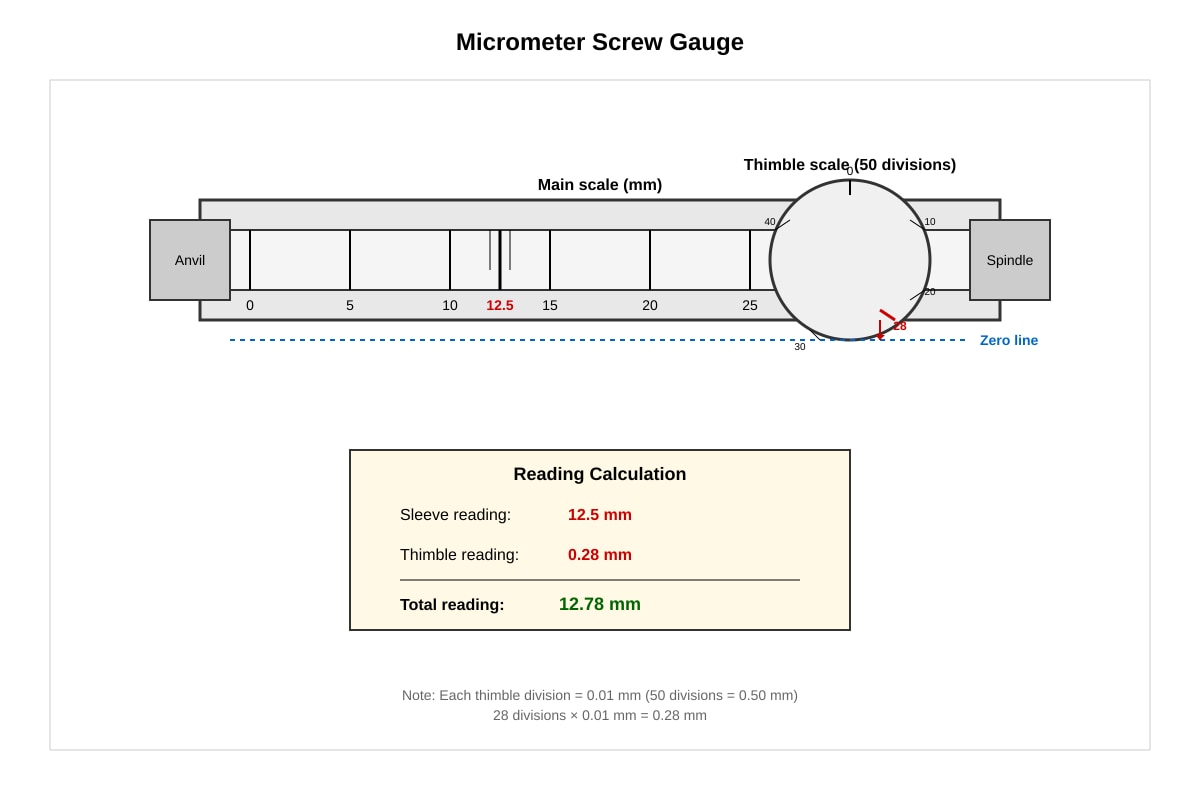
1. A student measures the thickness of a textbook using a micrometer screw gauge. The reading is shown below.
<image_placeholder> id: Q1-fig1 type: diagram linked_question: Q1 description: A micrometer screw gauge showing the sleeve scale and thimble scale labels: Main scale (mm), thimble scale (50 divisions), zero line, 12.5 mm sleeve reading, 0.28 mm thimble reading values: Sleeve shows 12.5 mm, thimble shows 0.28 mm must_show: Clear sleeve scale markings, thimble scale with 28th division aligned, zero line position, how to add readings </image_placeholder>
(a) State the reading shown on the micrometer. [1]
(b) Explain why using a micrometer gives a more precise measurement than using a metre rule. [2]
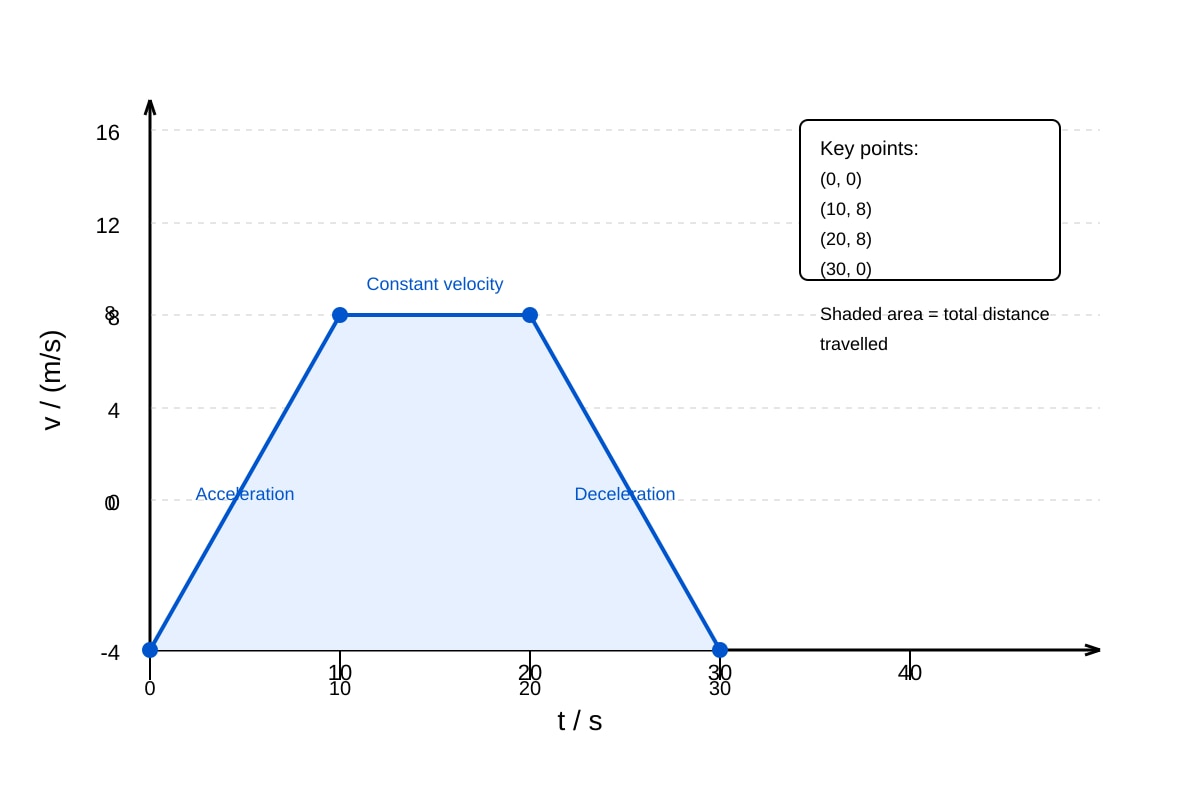
2. A cyclist travels along a straight road. The velocity-time graph for part of the journey is shown.
<image_placeholder> id: Q2-fig1 type: graph linked_question: Q2 description: Velocity-time graph with straight line segments labels: t/s on x-axis, v/(m/s) on y-axis, points at (0,0), (10,8), (20,8), (30,0) values: Acceleration phase 0-10s to 8 m/s, constant velocity 10-20s, deceleration 20-30s to rest must_show: All axis labels with units, three distinct segments, numerical values at key points, shaded area under graph </image_placeholder>
(a) Calculate the acceleration during the first 10 seconds. [1]
(b) Calculate the total distance travelled during the 30 seconds. [2]
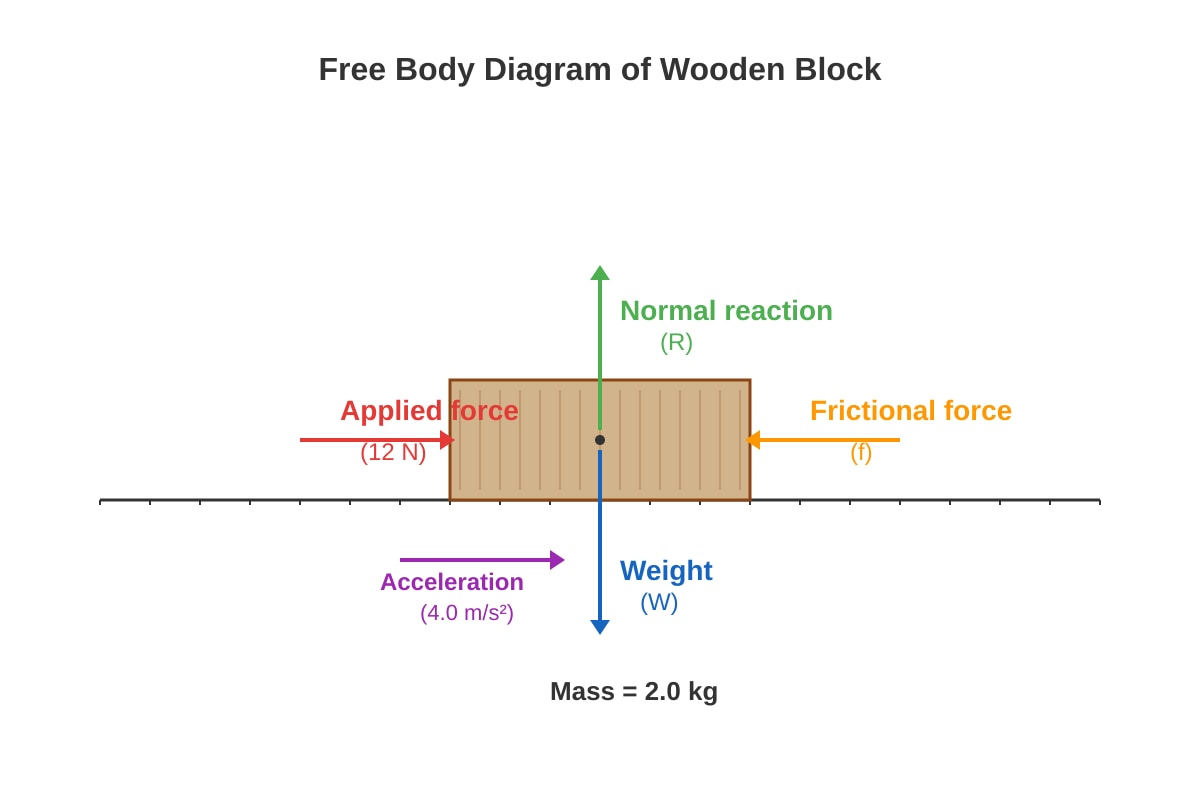
3. A wooden block of mass 2.0 kg is pulled along a horizontal surface by a force of 12 N. The block accelerates at 4.0 m/s².
<image_placeholder> id: Q3-fig1 type: diagram linked_question: Q3 description: Free body diagram of wooden block being pulled horizontally labels: Applied force (12 N), frictional force (f), weight (W), normal reaction (R), acceleration arrow values: Mass 2.0 kg, applied force 12 N, acceleration 4.0 m/s² must_show: All four forces labelled with correct directions, block dimensions not critical, surface shown horizontal </image_placeholder>
(a) Calculate the resultant force acting on the block. [1]
(b) Determine the magnitude of the frictional force opposing the motion. [2]
4. A simple pendulum has a length of 1.0 m and a bob of mass 0.20 kg. It is displaced so that the bob rises 0.15 m above its lowest position.
(a) Calculate the gravitational potential energy gained by the bob at its maximum displacement. (Take g = 10 N/kg) [2]
(b) State the kinetic energy of the bob at its lowest position, assuming no energy losses. [1]
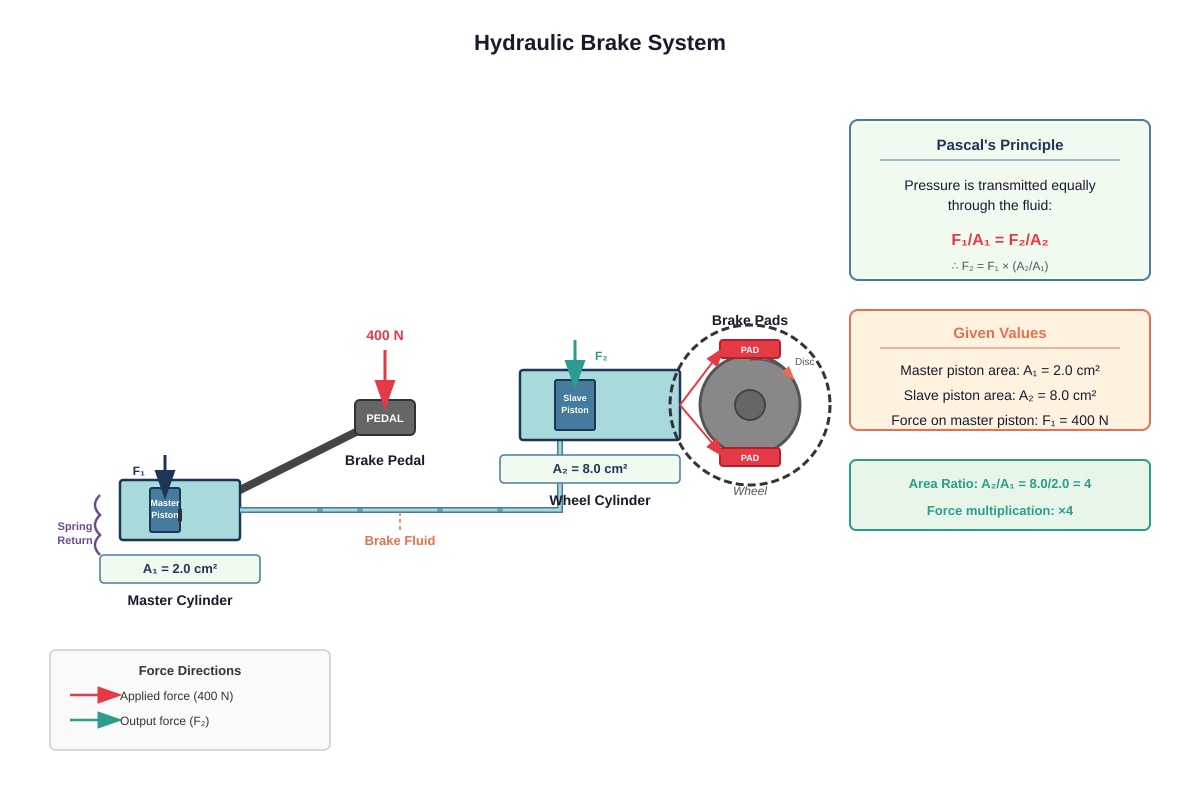
5. The diagram shows a hydraulic brake system.
<image_placeholder> id: Q5-fig1 type: diagram linked_question: Q5 description: Hydraulic brake system with master cylinder and wheel cylinder labels: Master piston (small, 2.0 cm²), slave piston (large, 8.0 cm²), brake pedal, brake fluid, brake pads, spring return values: Master piston area 2.0 cm², slave piston area 8.0 cm², force on master piston 400 N must_show: Both cylinders with areas labelled, connecting pipe filled with fluid, force arrows, lever mechanism </image_placeholder>
(a) State the principle that makes a hydraulic system able to transmit force. [1]
(b) Calculate the force exerted by the slave piston. [2]
6. The temperature of 0.50 kg of water is raised from 20°C to 80°C using an electric heater. The specific heat capacity of water is 4200 J/(kg·°C).
(a) Calculate the energy supplied by the heater, assuming no heat losses. [2]
(b) The heater has a power rating of 210 W. Calculate the minimum time needed to heat the water. [1]
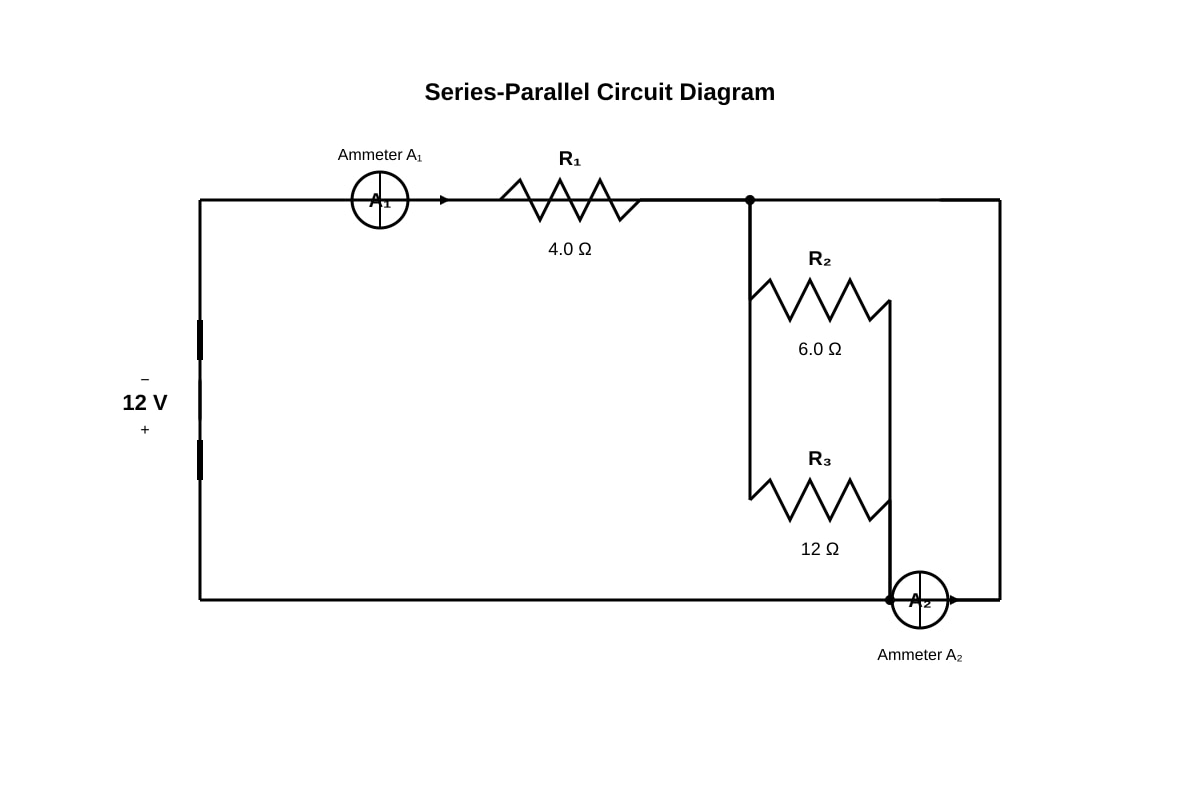
7. The circuit diagram shows three resistors connected to a 12 V battery.
<image_placeholder> id: Q7-fig1 type: circuit_diagram linked_question: Q7 description: Series-parallel circuit with three resistors labels: 12 V battery, R₁ = 4.0 Ω, R₂ = 6.0 Ω in series with parallel branch containing R₃ = 12 Ω values: Battery 12 V, R₁ = 4.0 Ω, R₂ = 6.0 Ω, R₃ = 12 Ω, ammeters A₁ and A₂ must_show: Complete circuit with correct connections, all resistor values, two ammeter positions, battery polarity </image_placeholder>
(a) Calculate the total resistance of the circuit. [2]
(b) Determine the reading on ammeter A₁. [1]
8. A sound wave travels through air with a speed of 330 m/s. The wave has a wavelength of 0.66 m.
(a) Calculate the frequency of the sound wave. [2]
(b) Explain what happens to the speed of the sound wave when it enters water, and state whether the wavelength increases, decreases, or stays the same. [1]
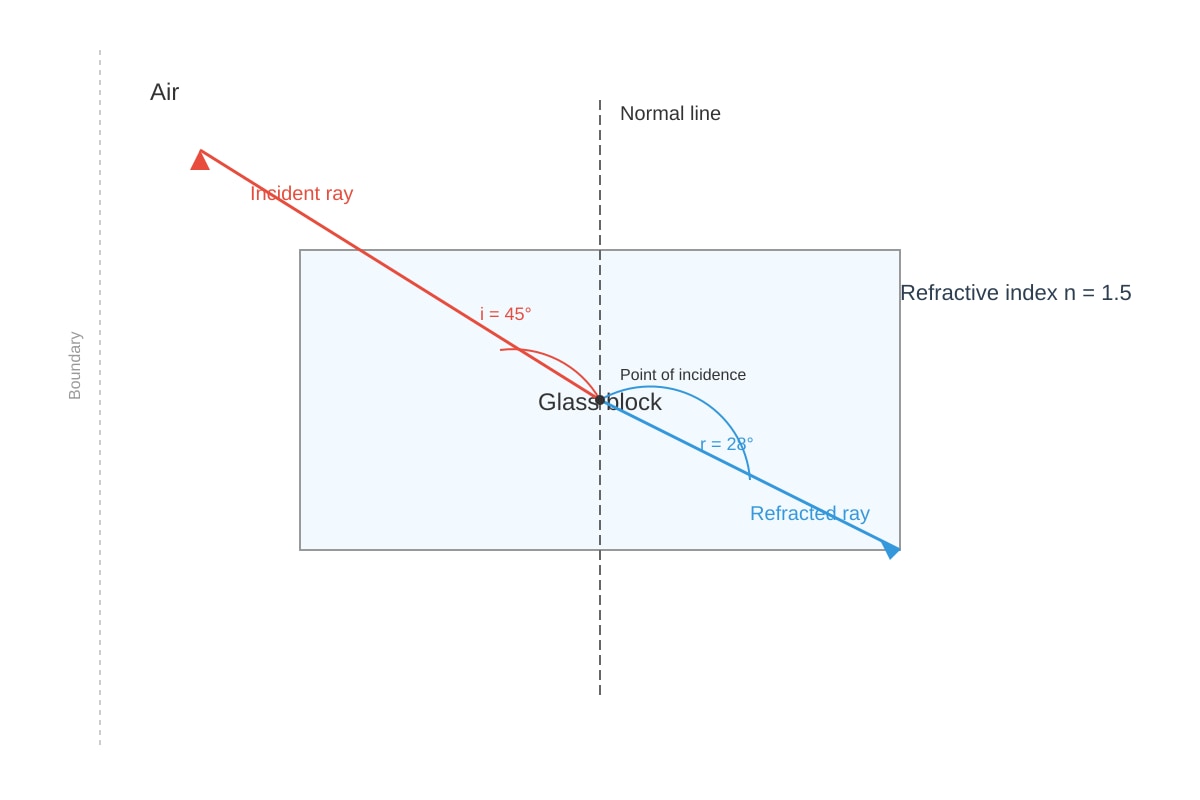
9. The diagram shows a ray of light passing from air into a glass block.
<image_placeholder> id: Q9-fig1 type: diagram linked_question: Q9 description: Refraction of light at air-glass boundary labels: Normal line, angle of incidence (i) = 45°, angle of refraction (r), refractive index n values: Incident angle 45°, refracted angle shown as 28° (for verification), refractive index 1.5 must_show: Incident ray, refracted ray, normal at point of incidence, both angles labelled, glass block shape </image_placeholder>
(a) State the formula relating refractive index to the angles of incidence and refraction. [1]
(b) Given that the refractive index of glass is 1.5, calculate the angle of refraction when light enters from air. [2]
10. A transformer has 400 turns on the primary coil and 80 turns on the secondary coil. The input voltage is 240 V a.c.
(a) Calculate the output voltage. [2]
(b) State ONE assumption made in your calculation. [1]
SECTION B [45 marks]
Answer ALL questions. Marks for each part are shown in brackets.
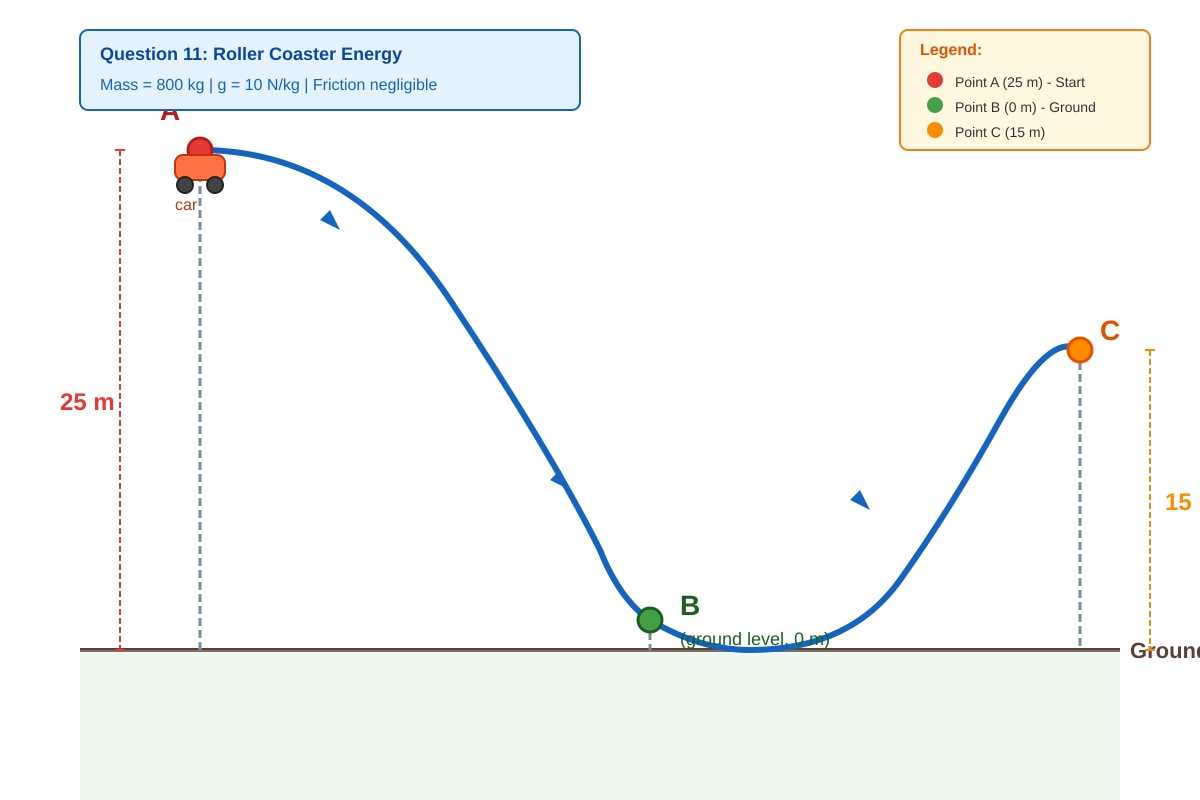
11. A roller coaster car of mass 800 kg is released from rest at point A, 25 m above the ground. It descends to point B, then rises to point C, 15 m above the ground. Frictional forces are negligible.
<image_placeholder> id: Q11-fig1 type: diagram linked_question: Q11 description: Roller coaster track profile showing three points A, B, C labels: Point A (25 m), Point B (ground level, 0 m), Point C (15 m), ground level reference, car shown at A values: Height at A = 25 m, height at C = 15 m, mass 800 kg, g = 10 N/kg must_show: Vertical heights marked clearly, curved track shape, reference ground level, position of all three labelled points </image_placeholder>
(a) State the principle of conservation of energy. [2]
(b) Calculate the gravitational potential energy of the car at point A. [2]
(c) Calculate the speed of the car at point B. [3]
(d) The car continues to point C. Calculate its speed at point C. [2]
(e) In practice, frictional forces are not negligible. Explain how the actual speed at point B would compare with your calculated value. [2]
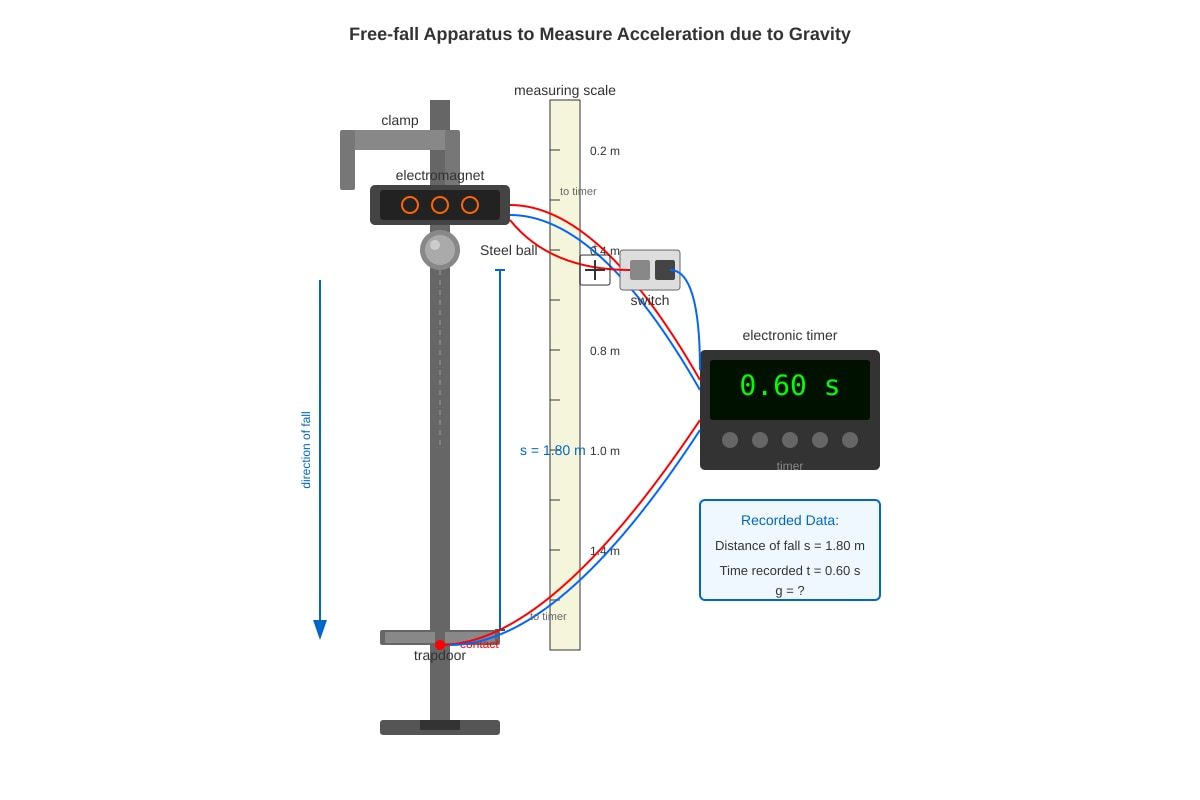
12. The diagram shows an experiment to measure the acceleration due to gravity using a falling object.
<image_placeholder> id: Q12-fig1 type: experimental_setup linked_question: Q12 description: Free-fall apparatus with timer and electromagnet labels: Steel ball, electromagnet, trapdoor, timer, switch, measuring scale, stand, clamp values: Distance of fall s = 1.80 m, time recorded t = 0.60 s, g to be determined must_show: Complete apparatus arrangement, electromagnet holding ball, trapdoor with contact below, electronic timer connection, scale for measuring height </image_placeholder>
(a) Describe how the electromagnet and timer are used to measure the time of fall. [2]
(b) Calculate the experimental value of g using the equation . [2]
(c) The accepted value of g is 9.81 m/s². Suggest TWO reasons why the experimental value might be lower. [2]
(d) Explain how repeating the measurement and calculating a mean improves the result. [2]
13. A car of mass 1200 kg is travelling at 20 m/s when the driver applies the brakes. The car comes to rest in 8.0 seconds.
(a) Calculate the deceleration of the car. [2]
(b) Calculate the braking force required. [2]
(c) The distance travelled during braking is 80 m. Calculate the work done by the braking force. [2]
(d) State what happens to the kinetic energy of the car during braking. [1]
(e) Explain why the temperature of the brake pads increases. [2]
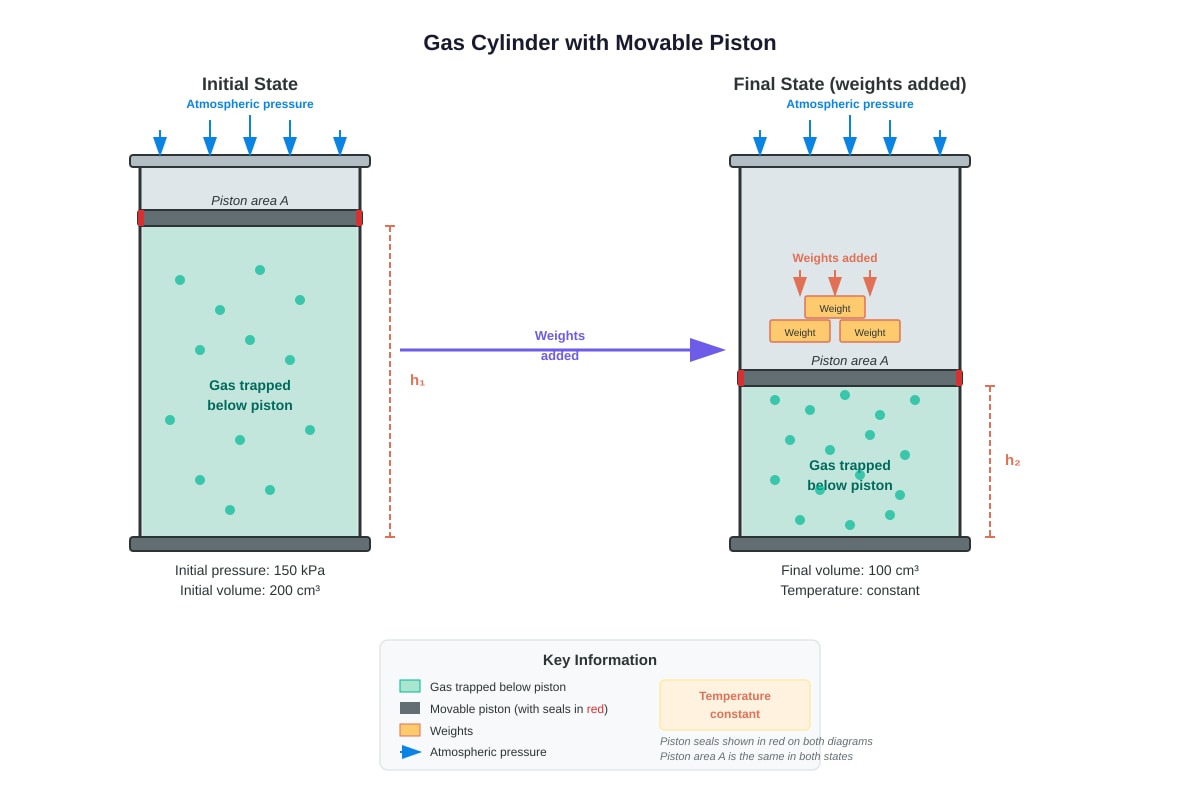
14. The diagram shows a cylinder containing a fixed mass of gas at constant temperature. The piston is free to move.
<image_placeholder> id: Q14-fig1 type: diagram linked_question: Q14 description: Gas cylinder with movable piston labels: Gas trapped below piston, weights on piston, atmospheric pressure, piston area A, initial height h₁, final height h₂ values: Initial pressure 150 kPa, initial volume 200 cm³, final volume 100 cm³, temperature constant, weights added must_show: Cylinder with gas region clearly labelled, movable piston with seals, weights stacked on piston, initial and final positions marked, pressure/volume labels </image_placeholder>
(a) State Boyle's law in words. [2]
(b) The initial pressure is 150 kPa and the initial volume is 200 cm³. A weight is added, reducing the volume to 100 cm³ at constant temperature. Calculate the new pressure. [3]
(c) Explain, in terms of molecular motion, why the pressure increases when the volume is decreased. [3]
(d) State what would happen to the pressure if the gas were heated while keeping the volume constant. [1]
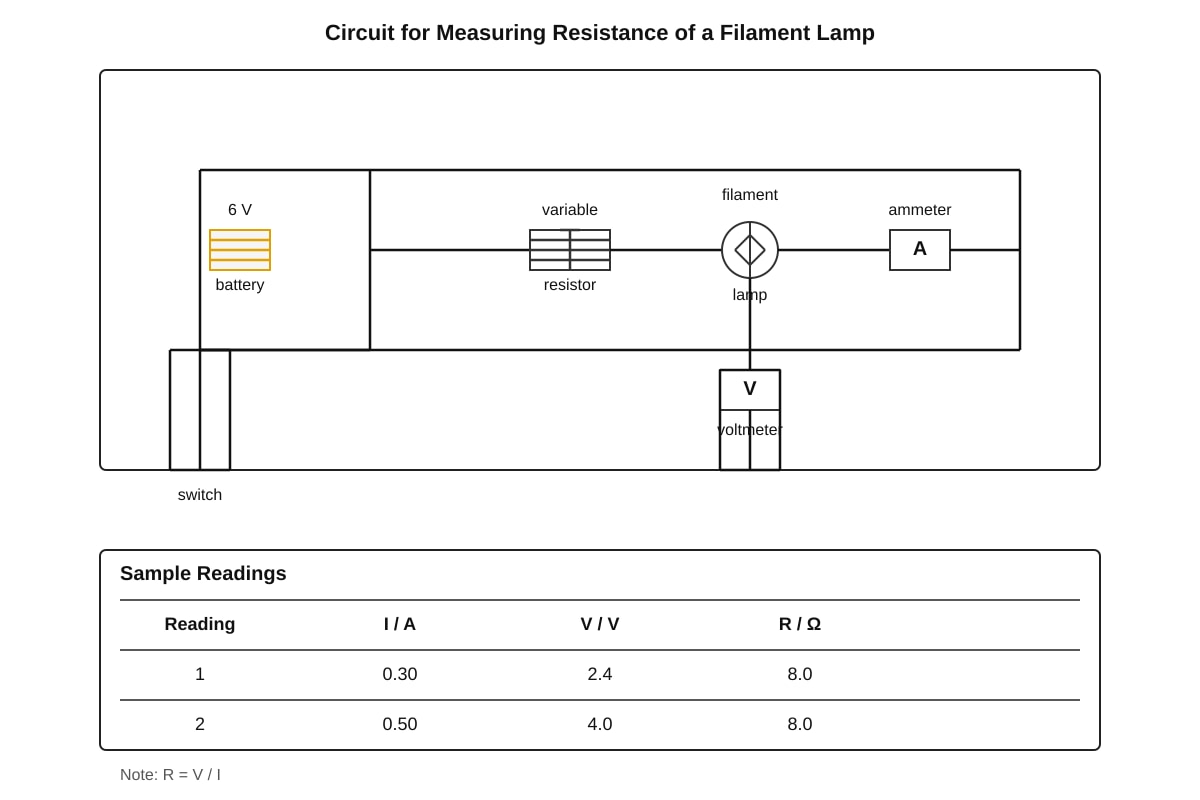
15. A student sets up the circuit shown to investigate how the resistance of a filament lamp changes with the current through it.
<image_placeholder> id: Q15-fig1 type: circuit_diagram linked_question: Q15 description: Circuit for measuring resistance of filament lamp labels: 6 V battery, variable resistor, filament lamp, ammeter, voltmeter, switch values: Typical readings shown: I = 0.30 A, V = 2.4 V; I = 0.50 A, V = 4.0 V must_show: Complete circuit with correct meter positions, variable resistor symbol, all components properly connected, table of sample readings </image_placeholder>
(a) Draw the circuit symbol for a variable resistor. [1]
(b) Explain why the ammeter is connected in series and the voltmeter in parallel with the lamp. [2]
(c) Using the readings I = 0.30 A and V = 2.4 V, calculate the resistance of the lamp. [2]
(d) A second set of readings gives I = 0.50 A and V = 4.0 V. Calculate the new resistance and state whether the resistance has increased or decreased. [2]
(e) Explain why the resistance of the filament lamp changes as the current increases. [3]
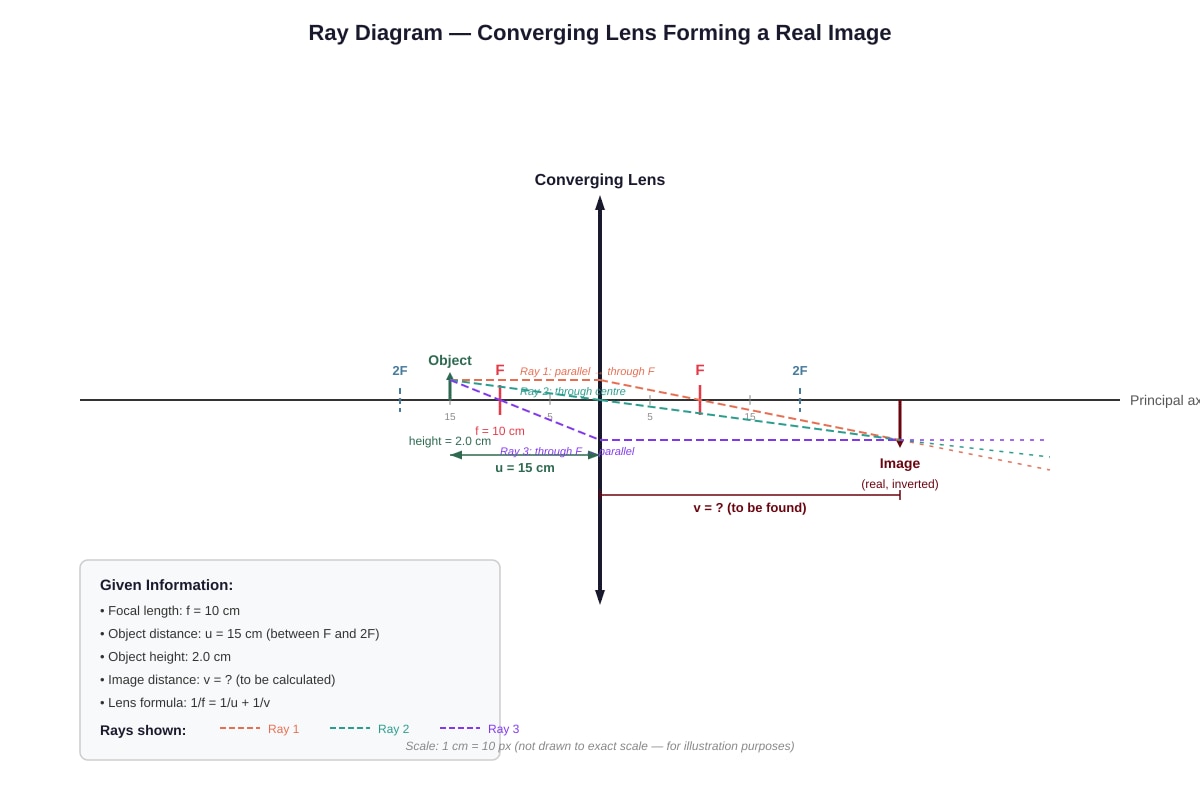
16. The diagram shows a converging lens forming an image of an object.
<image_placeholder> id: Q16-fig1 type: ray_diagram linked_question: Q16 description: Ray diagram for converging lens forming real image labels: Object (height 2.0 cm), converging lens (f = 10 cm), image, principal axis, focal points F on both sides, 2F points, u = 15 cm, v to be found values: Focal length f = 10 cm, object distance u = 15 cm, object height 2.0 cm, image distance and height to be determined must_show: Principal axis horizontal, lens vertical at centre, F and 2F marked both sides, object arrow placed between F and 2F, three standard rays traced to find image location </image_placeholder>
(a) On the diagram, label the focal length and mark it as f. [1]
(b) State the three properties of the image formed (real/virtual, magnified/diminished, upright/inverted). [2]
(c) Using the lens formula , calculate the image distance v. [3]
(d) Calculate the magnification of the image. [2]
(e) Suggest ONE application of a converging lens used in this way. [1]
17. Read the following information about nuclear power and answer the questions that follow.
Nuclear power plants generate electricity using energy released from nuclear fission. In this process, a heavy nucleus such as uranium-235 splits into two smaller nuclei, releasing a large amount of energy. The energy heats water to produce steam, which drives turbines connected to generators.
Nuclear fission releases approximately 8 × 10¹³ J per kilogram of uranium-235. By comparison, burning coal releases approximately 3 × 10⁷ J per kilogram. This means that a very small mass of nuclear fuel can produce the same energy as a very large mass of coal.
However, nuclear power produces radioactive waste that must be stored safely for many thousands of years. There are also concerns about the risk of accidents and the potential for nuclear materials to be used in weapons.
(a) State the name of the process described in which a heavy nucleus splits into smaller nuclei. [1]
(b) Calculate how many times more energy is released per kilogram by nuclear fission compared to burning coal. [2]
(c) A nuclear power plant produces 2.4 × 10⁹ W of electrical power. Calculate the energy output in one day (24 hours). [2]
(d) Explain why radioactive waste from nuclear power plants is difficult to dispose of safely. [2]
(e) Suggest TWO reasons why some countries choose to use nuclear power despite the risks. [2]
(f) Nuclear fusion is another possible future energy source. Describe ONE difference between nuclear fusion and nuclear fission. [2]
END OF PAPER
Answers
TuitionGoWhere Practice Paper Answer Key - Combined Science Secondary 3
Version 5 of 5
SECTION A
1. (a) Reading = 12.5 + 0.28 = 12.78 mm [1]
(b) The micrometer can measure to 0.01 mm precision [1], while a metre rule only measures to 1 mm precision [1]. The micrometer's screw mechanism and smaller division scale allow finer discrimination between close measurements.
2. (a) Acceleration = gradient = = 0.80 m/s² [1]
(b) Distance = area under graph [1]
- Triangle: m
- Rectangle: m
- Triangle: m
- Total = 160 m [1]
3. (a) Resultant force = 8.0 N [1]
(b) Resultant force = Applied force − Frictional force [1]
- , so 4.0 N [1]
4. (a) GPE = 0.30 J [2]
- (1 mark for correct formula, 1 mark for final answer with units)
(b) By conservation of energy, KE at lowest point = GPE at highest point = 0.30 J [1]
5. (a) Pascal's principle: pressure applied to an enclosed fluid is transmitted undiminished to every portion of the fluid and the walls of the containing vessel [1]
(b) [1]
- 1600 N [1]
6. (a) [1]
- 126 000 J (or 126 kJ) [1]
(b) 600 s (or 10 minutes) [1]
7. (a) R₂ and R₃ in parallel: [1]
- Ω
- Total R = 8.0 Ω [1]
(b) 1.5 A [1]
8. (a) , so 500 Hz [2]
- (1 mark for formula, 1 mark for answer)
(b) Speed increases in water (sound travels faster in denser media) [0.5]. Wavelength increases since and frequency stays constant [0.5] = 1 mark
9. (a) [1]
(b) [1]
- 28.1° (accept 28°) [1]
10. (a) , so 48 V [2]
- (1 mark for correct ratio, 1 mark for answer)
(b) Assumption: No energy losses (100% efficient transformer) / OR No flux leakage / OR Perfect magnetic coupling [1]
SECTION B
11. (a) Principle of conservation of energy: energy cannot be created or destroyed, only converted from one form to another [1]; the total energy in a closed system remains constant [1] = 2 marks
(b) GPE = [1] 200 000 J (or 200 kJ) [1] = 2 marks
(c) GPE at A = KE at B (conservation of energy) [1]
- [1]
- 22.4 m/s [1] = 3 marks
- (Accept 22 m/s; allow ecf from part (b))
(d) Loss of GPE from A to C = J [1]
- This becomes KE at C:
- 14.1 m/s [1] = 2 marks
- (Alternative: GPE at C = 120 000 J, so KE at C = 200 000 − 120 000 = 80 000 J)
(e) Friction does work against the motion / friction dissipates energy as heat [1]; so actual speed will be less than calculated value [1] = 2 marks
12. (a) The electromagnet holds the steel ball until the timer is started [1]; when the current is switched off, the ball falls and the electromagnet releases, simultaneously starting the timer; the ball hits the trapdoor, breaking the circuit and stopping the timer [1] = 2 marks
(b) , so [1]
- 10 m/s² [1] = 2 marks
(c) Any TWO from:
- Air resistance acts on the falling ball, slowing it slightly
- Reaction time in operating/start/stop mechanisms
- Ball not released from rest (initial push or remaining magnetization)
- Timer delay in starting or stopping
- Measured distance not exact (ball height, trapdoor thickness) [2 marks, 1 each]
(d) Random errors (unpredictable variations) average out when taking the mean [1]; repeating reduces uncertainty / gives a more reliable estimate of the true value [1] = 2 marks
13. (a) [1] −2.5 m/s² (deceleration = 2.5 m/s²) [1] = 2 marks
(b) [1] 3000 N [1] = 2 marks
- (Accept ecf from (a); positive value for braking force)
(c) [1] 240 000 J (or 240 kJ) [1] = 2 marks
- (Or using work-energy: J)
(d) Kinetic energy is converted to heat / thermal energy (and sound) in the brake pads, discs, and surroundings [1]
(e) Friction between brake pads and discs does work against the motion [1]; this work done converts kinetic energy to thermal energy, raising the temperature of the brake pads [1] = 2 marks
14. (a) Boyle's law: For a fixed mass of gas at constant temperature, the pressure is inversely proportional to the volume [2]
- (2 marks for complete statement with all conditions; 1 mark if one element missing)
(b) [1]
- [1]
- 300 kPa [1] = 3 marks
(c) When volume decreases, molecules have less distance to travel between walls [1]; molecules hit the walls more frequently [1]; each collision still transfers the same momentum, so greater force per unit area (pressure) results [1] = 3 marks
- (Alternative: same number of molecules in smaller space → higher number density → more collisions per second)
(d) Pressure would increase (at constant volume, higher temperature means faster molecules hitting walls more frequently and with greater force) [1]
15. (a) Circuit symbol: rectangular box with arrow diagonally across it, or rheostat symbol [1]
(b) Ammeter: must be in series so all current flows through it to measure the total circuit current [1]; Voltmeter: must be in parallel so it measures potential difference across the lamp only, without changing the circuit current [1] = 2 marks
(c) [1] 8.0 Ω [1] = 2 marks
(d) 8.0 Ω [1]; Resistance has stayed the same / no change [1] = 2 marks
- (Note: If resistance appears unchanged in these values, accept; typical filament lamp shows increase, but with these specific values the resistance is constant. Students should note this is unusual for a lamp and might indicate limited data range or approximations. Alternative valid answer: if student observes slight increase to 8.0 from 8.0, state "stayed approximately constant")
(e) As current increases, the filament gets hotter [1]; metal resistance increases with temperature [1]; so the lamp's resistance rises as current increases (non-ohmic behaviour) [1] = 3 marks
- (For these specific values: if resistance stayed same, explain that at these operating points the temperature may be similar, or the values are simplified. In reality, a lamp's resistance increases significantly from cold.)
16. (a) Focal length: distance from lens centre to F [1] (marking of f on diagram required)
(b) Image properties: real, magnified, inverted [2]
- (2 correct = 2 marks; 1 correct = 1 mark; 0 correct = 0 marks)
(c) [1]
- [1]
- 30 cm [1] = 3 marks
(d) [1] 2 [1] = 2 marks
- (Or , so image height = 4.0 cm)
(e) Projector / camera / magnifying glass (when object between F and lens) / eye [1]
- (Note: for this configuration with real image, projector or photocopier is most appropriate)
17. (a) Nuclear fission [1]
(b) Ratio = [1] 2.7 × 10⁶ (approximately 2.7 million times) [1] = 2 marks
- (Accept )
(c) Energy = Power × time = [1]
- 2.07 × 10¹⁴ J (or J) [1] = 2 marks
(d) Radioactive waste remains hazardous for thousands of years [1]; requires secure, long-term storage that won't leak into environment / groundwater / must withstand geological changes and human interference [1] = 2 marks
(e) Any TWO from:
- Very high energy density / small fuel mass needed
- No greenhouse gas emissions during operation / low carbon footprint
- Reliable baseload power (not intermittent like solar/wind)
- Fuel supply can be reliable / not weather-dependent
- Reduces dependence on fossil fuels [2 marks, 1 each]
(f) Fusion: light nuclei combine (fuse) to form heavier nuclei releasing energy [1]; Fission: heavy nucleus splits into smaller fragments [1] = 2 marks
- (Or: fusion requires extremely high temperatures/pressures; fusion produces less radioactive waste; fusion uses hydrogen isotopes not uranium)
END OF ANSWER KEY