AI Generated Exam Paper
Secondary 3 Combined Science Practice Paper 4
Free Sec 3 Combined Sci Practice Paper 4, HY3 AI version, with questions, answers, and O Level-style practice for Singapore students.
These static practice materials are generated from the site's syllabus and paper-generation workflow, with source and model context shown so students and parents can evaluate the material before use.
Questions
TuitionGoWhere Practice Paper - Combined Science Secondary 3
TuitionGoWhere Practice Paper (AI) — Version 4 of 5
Subject: Combined Science
Level: Secondary 3
Paper: Practice Paper (Physical Sciences Focus)
Duration: 1 hour 15 minutes
Total Marks: 65
Name: ________________________
Class: ____________
Date: ____________
Instructions:
- This practice paper covers Physical Sciences topics for Secondary 3 Combined Science.
- Answer all questions in the spaces provided.
- Show your working clearly for calculation questions.
- Use a calculator where appropriate.
- Marks for each question are shown in brackets [ ].
Section A: Multiple Choice and Short Answer (1–8) [20 marks]
1. Which of the following is a scalar quantity? [1]
A. Force
B. Velocity
C. Mass
D. Acceleration
2. State the SI unit for energy. [1]
3. A book of mass 1.2 kg is lifted vertically by 0.50 m. Calculate the gain in gravitational potential energy. (Take g=10 m s−2) [2]
4. Define the term "density". [1]
5. A metal block has mass 400 g and volume 80 cm3. Calculate its density in g cm−3. [2]
6. State one example of a longitudinal wave. [1]
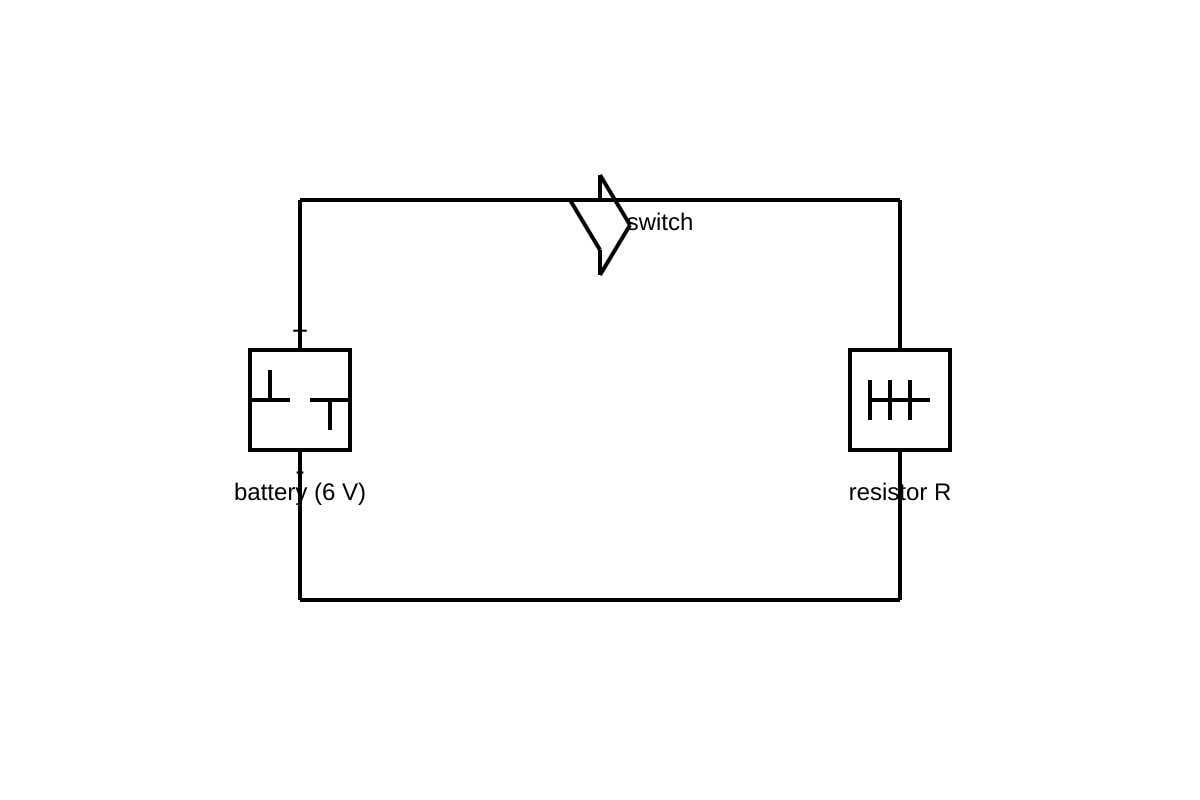
7. The diagram shows a simple circuit.
Image pending generation: diagram for Q7.
State the function of the resistor in the circuit. [1]
8. Calculate the current flowing through the resistor in Q7 if its resistance is 12 Ω. [2]
Section B: Structured Questions (9–14) [25 marks]
9. A ball of mass 0.40 kg is dropped from a height of 5.0 m. Using the principle of conservation of energy, calculate the kinetic energy of the ball just before it hits the ground. (Take g=10 m s−2) [3]
10. (a) State the Principle of Conservation of Energy. [1]
(b) A pendulum swings from its highest point A to the lowest point B. At A, it has 2.0 J of gravitational potential energy and no kinetic energy. Assuming no air resistance, state the kinetic energy at B. [1]
11. A student places a potato strip into a concentrated salt solution. After 2 hours, the strip becomes soft and bent.
(a) Explain this observation using the terms "water potential" and "osmosis". [2]
(b) What is the term for this condition of the plant cells? [1]
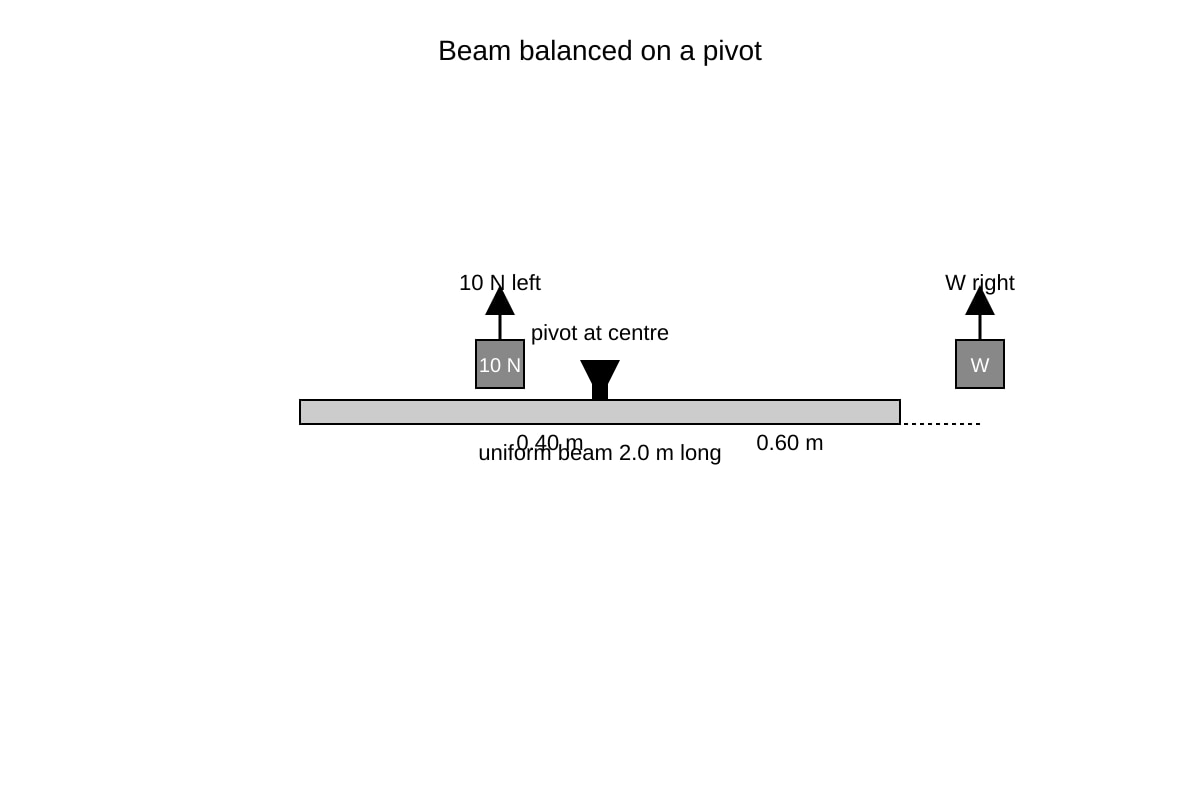
12. The diagram shows a beam balanced on a pivot.
Image pending generation: diagram for Q12.
Calculate the weight W needed to balance the beam. [3]
13. Describe the pathway of oxygenated blood from the lungs to the body tissues, including the role of the left ventricle and aortic valve. [4]
14. A 2.0 kg object is pushed across a horizontal surface with a constant force of 6.0 N. It moves 3.0 m in 4.0 s.
(a) Calculate the work done by the force. [2]
(b) Calculate the power developed. [2]
Section C: Extended Response (15–20) [20 marks]
15. Compare aerobic and anaerobic respiration in human muscle cells by providing word equations and explaining three differences between the processes. [6]
16. A roller coaster car of mass 500 kg starts from rest at a height of 20 m and moves down a frictionless track.
(a) Calculate the gravitational potential energy at the top. [2]
(b) Using conservation of energy, find the speed at the bottom. [3]
17. Explain how xylem transports water from roots to leaves, and state one adaptation of xylem for this function. [4]
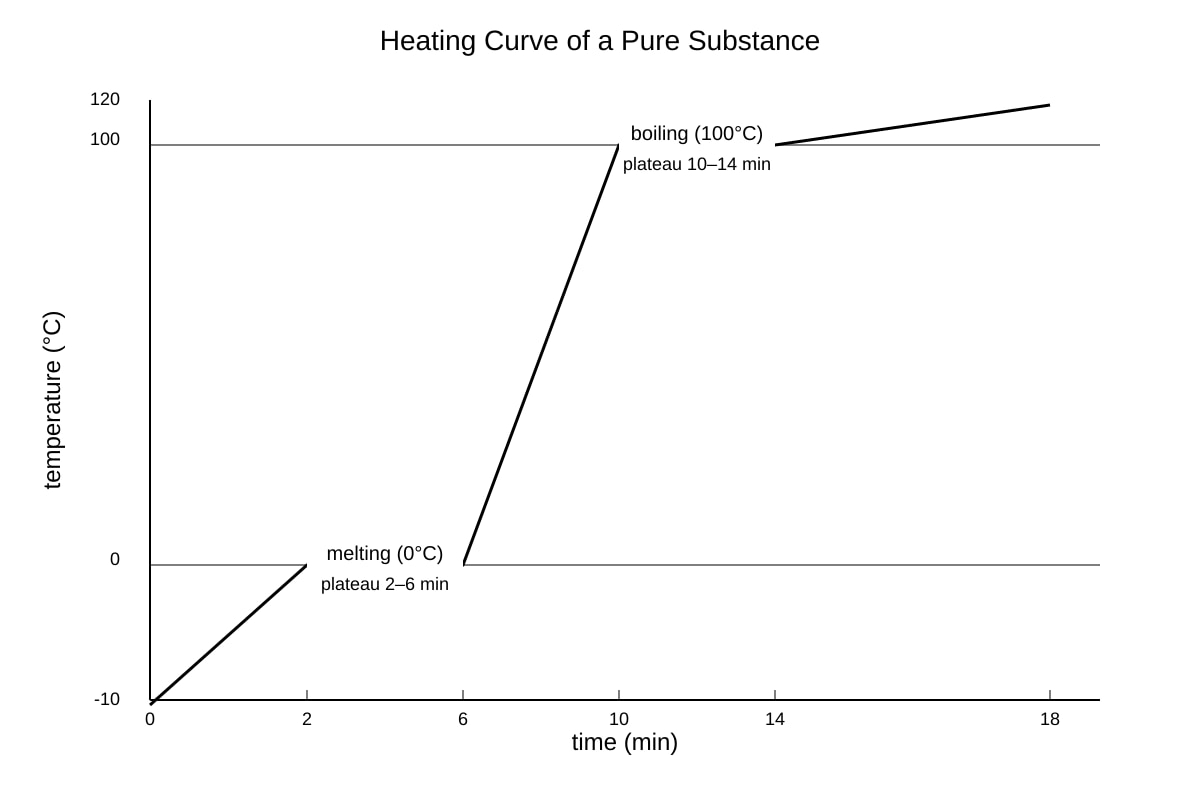
18. The graph shows the heating curve of a pure substance.
Image pending generation: graph for Q18.
(a) What is the melting point of the substance? [1]
(b) Explain what is happening to the particles during the plateau from 2 to 6 min. [2]
19. State three methods of heat transfer and give one everyday example of each. [6]
20. A circuit consists of two resistors, R1=4 Ω and R2=6 Ω, connected in parallel to a 12 V battery.
(a) Calculate the total resistance of the combination. [2]
(b) Calculate the total current from the battery. [2]
Answers
TuitionGoWhere Practice Paper Answer Key — Combined Science Secondary 3 (Version 4)
Total Marks: 65
Section A: Multiple Choice and Short Answer (1–8) [20 marks]
1. C [1]
Teaching note: Scalar quantities have magnitude only. Mass has no direction, unlike force, velocity, acceleration (vectors).
Common mistake: Confusing speed (scalar) with velocity (vector).
2. Joule (J) [1]
Teaching note: Energy in SI is measured in joules.
3. [2]
GPE=mgh=1.2×10×0.50=6.0 J
Marks: 1 for formula/substitution, 1 for answer with unit.
4. Density is mass per unit volume. [1]
Teaching note: ρ=Vm.
5. [2]
ρ=Vm=80400=5.0 g cm−3
Marks: 1 for method, 1 for answer.
6. Sound wave [1]
(Also acceptable: ultrasound, seismic P-wave.)
7. To oppose/limit current [1]
Teaching note: Resistor controls current flow.
8. [2]
I=RV=126=0.50 A
Marks: 1 method, 1 answer.
Section B: Structured Questions (9–14) [25 marks]
9. [3]
PEtop=mgh=0.40×10×5.0=20 J [1]
By conservation of energy, KEbottom=PEtop [1]
KE=20 J [1]
10.
(a) Energy cannot be created or destroyed, only converted from one form to another; total energy in a closed system is constant. [1]
(b) 2.0 J [1] (no loss, so all PE → KE)
11.
(a) Water potential is lower in salt solution than in potato cells [1]; water leaves cells by osmosis [1].
(b) Plasmolysis [1]
12. [3]
Clockwise moment = 10×0.40=4.0 N m [1]
Anticlockwise moment = W×0.60 [1]
For balance: W×0.60=4.0⇒W=6.7 N [1]
13. [4]
- Oxygenated blood from lungs via pulmonary veins to left atrium [1]
- Left atrium contracts, blood to left ventricle [1]
- Left ventricle contracts, pressure rises [1]
- Aortic valve opens, blood into aorta to body [1]
14.
(a) [2] W=Fd=6.0×3.0=18 J (1 method, 1 ans)
(b) [2] P=tW=4.018=4.5 W (1 method, 1 ans)
Section C: Extended Response (15–20) [20 marks]
15. [6]
Aerobic: Glucose + Oxygen → Carbon dioxide + Water + Energy [2]
Anaerobic: Glucose → Lactic acid + Energy [2]
Differences:
- Aerobic uses O₂, anaerobic does not [1]
- Aerobic produces CO₂ + H₂O, anaerobic produces lactic acid [1]
- Aerobic yields more energy [1]
16.
(a) [2] PE=mgh=500×10×20=100000 J (1 sf, 1 ans)
(b) [3] KE=21mv2=100000 [1]; v2=5002×100000=400 [1]; v=20 m s−1 [1]
17. [4]
Pathway: root hair → cortex → xylem → leaves via transpiration [3]; adaptation: lignified walls / hollow lumen [1].
18.
(a) 0°C [1]
(b) [2] Particles gain energy, break bonds, change from solid to liquid at constant temp [2].
19. [6]
Conduction (e.g., metal spoon in hot soup) [2]
Convection (e.g., boiling water) [2]
Radiation (e.g., sun warming skin) [2]
20.
(a) [2] RT1=41+61=125⇒RT=2.4 Ω
(b) [2] I=2.412=5.0 A
Free quiz and exam paper access
Enter your details to view this paper
Your access is remembered on this device.