AI Generated Exam Paper
Secondary 3 Combined Science Practice Paper 4
Free Sec 3 Combined Sci Practice Paper 4, DeepSeek AI version, with questions, answers, and O Level-style practice for Singapore students.
These static practice materials are generated from the site's syllabus and paper-generation workflow, with source and model context shown so students and parents can evaluate the material before use.
Questions
Free quiz and exam paper access
Enter your details to view this paper
Your access is remembered on this device.
Answers
TuitionGoWhere Practice Paper - Combined Science Secondary 3
Answer Key and Marking Scheme
Subject: Combined Science (Physics, Chemistry) Level: Secondary 3 Paper: Practice Paper – Physical Sciences Version: 4 of 5 Total Marks: 65
Section A: Multiple Choice and Short Answer (20 marks)
1. D. Velocity [1 mark]
Explanation: Velocity has both magnitude and direction, making it a vector quantity. Mass, speed, and energy are scalar quantities.
2. 0.1 cm / 1 mm [1 mark]
Explanation: The precision of a measuring instrument is the smallest division on its scale. A ruler with millimetre markings has a precision of 1 mm or 0.1 cm.
3. Energy cannot be created or destroyed [1 mark]. It can only be converted from one form to another / The total energy in a closed system remains constant [1 mark]. [Total: 2 marks]
Marking notes: Award 1 mark for stating energy cannot be created or destroyed. Award 1 mark for stating energy is converted/transferred or that total energy is constant. Accept equivalent phrasing.
4. Acceleration = change in velocity / time taken a = (v – u) / t = (20 – 0) / 5 [1 mark] a = 4 m/s² [1 mark] [Total: 2 marks]
Marking notes: Award 1 mark for correct substitution into formula. Award 1 mark for correct answer with units. Accept 4.0 m/s².
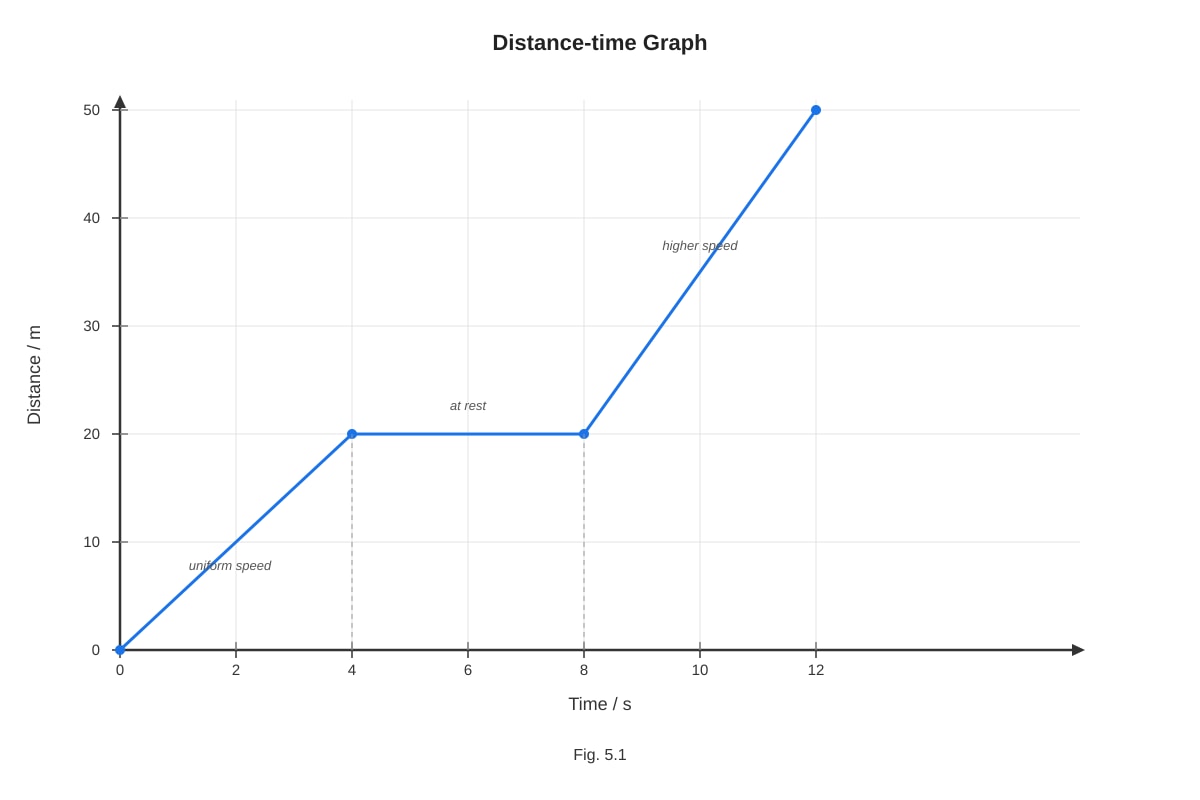
5. (a) The object is stationary / at rest / not moving [1 mark].
(b) Speed = distance / time = 20 / 4 [1 mark] = 5 m/s [1 mark]. [Total: 3 marks]
Marking notes for (a): Accept "constant distance" or "zero speed". For (b): Award 1 mark for correct formula and substitution, 1 mark for correct answer with units.
6. (a) Resultant force = 50 N – 10 N = 40 N to the right [1 mark].
(b) F = ma → 40 = 10 × a [1 mark] → a = 4 m/s² [1 mark]. [Total: 3 marks]
Marking notes: Award marks for correct direction in (a). For (b), award 1 mark for correct substitution, 1 mark for correct answer with units.
7. Pressure in a liquid increases with depth / P = hρg [1 mark]. At the base of the dam, the depth of water is greatest, so the pressure exerted by the water is highest [1 mark]. The dam must be thicker at the base to withstand this greater pressure and prevent structural failure [1 mark]. [Total: 3 marks]
Marking notes: Award 1 mark for stating relationship between depth and pressure. Award 1 mark for linking depth to pressure at the base. Award 1 mark for explaining why thickness is needed.
8. (a) Conduction [1 mark].
(b) Heat energy is transferred from the hot soup to the spoon particles in contact with the soup [1 mark]. These particles vibrate more vigorously and transfer energy to neighbouring particles along the spoon through particle collisions, eventually reaching the handle [1 mark]. [Total: 3 marks]
Marking notes: For (b), award 1 mark for describing energy transfer to particles in contact, 1 mark for describing particle-to-particle transfer along the spoon.
9. Newton's Third Law: For every action, there is an equal and opposite reaction / When object A exerts a force on object B, object B exerts an equal and opposite force on object A [1 mark]. When the rocket pushes exhaust gases downwards (action), the exhaust gases exert an equal and opposite force upwards on the rocket (reaction), propelling the rocket upwards [1 mark]. [Total: 2 marks]
Marking notes: Award 1 mark for correct statement of the law. Award 1 mark for correctly identifying the action-reaction pair and explaining the upward motion.
Section B: Structured Questions (25 marks)
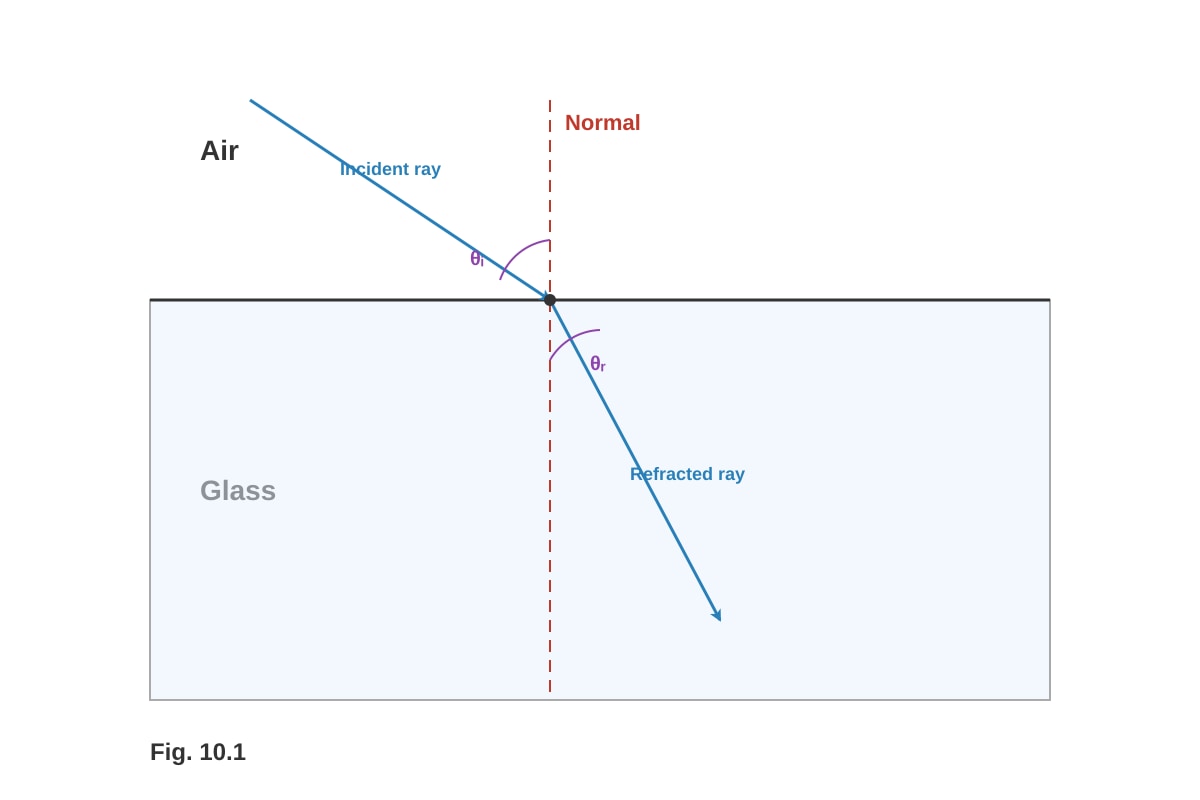
10. (a) Refraction [1 mark].
(b) Light travels at different speeds in different media / Light travels slower in glass than in air [1 mark]. This change in speed causes the ray to change direction / bend towards the normal [1 mark].
(c) Change in direction = 45° – 28° = 17° [1 mark].
(d) Diagram should show:
- Ray emerging from glass block parallel to the incident ray [1 mark]
- Ray bending away from the normal as it exits [1 mark]
- Correct labels: incident ray, refracted ray (in glass), emergent ray, normal(s), angle of incidence, angle of refraction, angle of emergence [1 mark] [Total: 7 marks]
Marking notes for (d): Award 1 mark for parallel emergent ray, 1 mark for correct bending direction, 1 mark for correct and complete labels.
11. (a) As depth increases, pressure increases / Pressure is directly proportional to depth [1 mark].
(b) P = hρg = 0.4 × 1000 × 9.8 [1 mark] = 3920 Pa [1 mark].
(c) Pressure at 0.8 m = 7840 Pa [1 mark]. Since pressure is directly proportional to depth, doubling the depth from 0.4 m to 0.8 m will double the pressure from 3920 Pa to 7840 Pa [1 mark].
(d) Ensure the pressure sensor is held vertically / Ensure readings are taken at eye level / Repeat readings and take average / Ensure no air bubbles are trapped [1 mark – accept any one reasonable precaution]. [Total: 6 marks]
Marking notes: For (c), award 1 mark for correct prediction, 1 mark for valid explanation using proportionality. For (d), accept any valid experimental precaution.
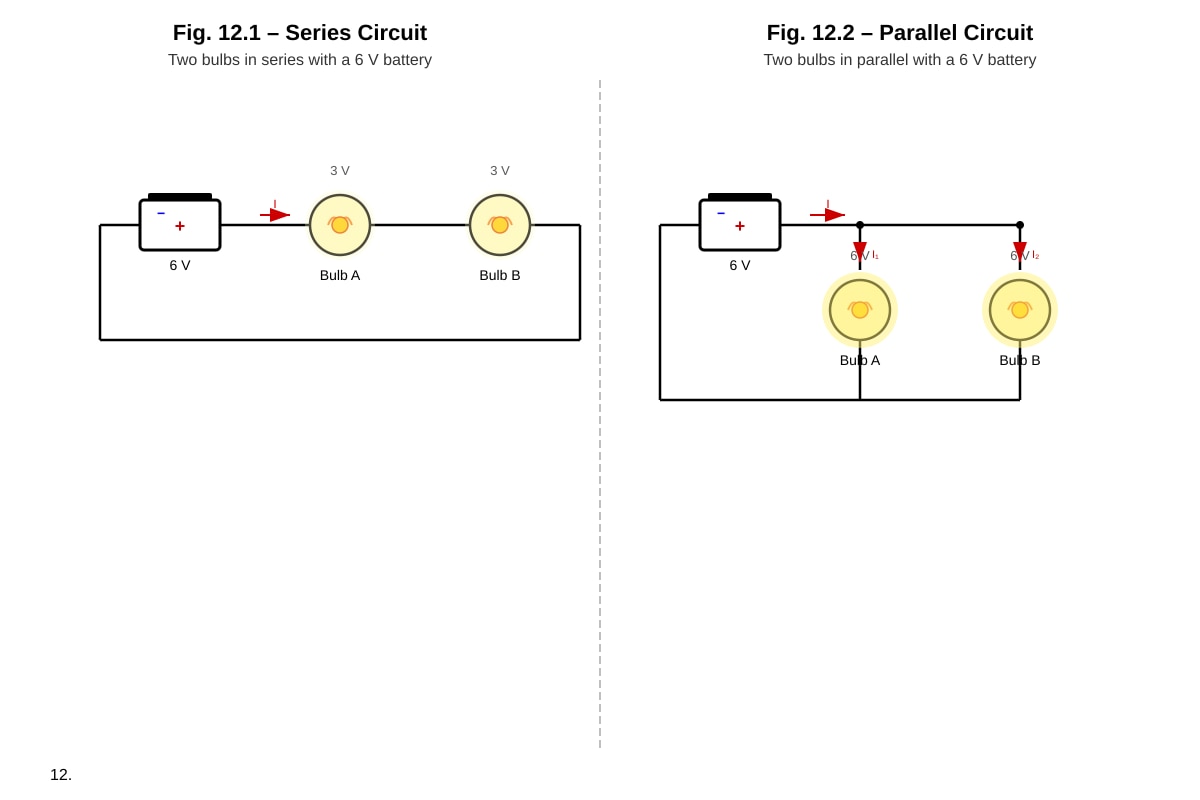
12. (a) The bulbs in parallel (Fig. 12.2) are brighter than the bulbs in series (Fig. 12.1) [1 mark].
(b) In series, the voltage is shared between the two bulbs, so each bulb receives only 3 V [1 mark]. In parallel, each bulb receives the full 6 V from the battery [1 mark]. Since brightness depends on power (P = IV or P = V²/R), and power increases with voltage, the parallel bulbs are brighter [1 mark].
(c) Each appliance can be switched on/off independently / If one appliance fails, the others continue to work / Each appliance receives the full mains voltage [1 mark – accept any one valid advantage]. [Total: 5 marks]
Marking notes: For (b), award marks for correct voltage analysis in each circuit and linking voltage to brightness/power.
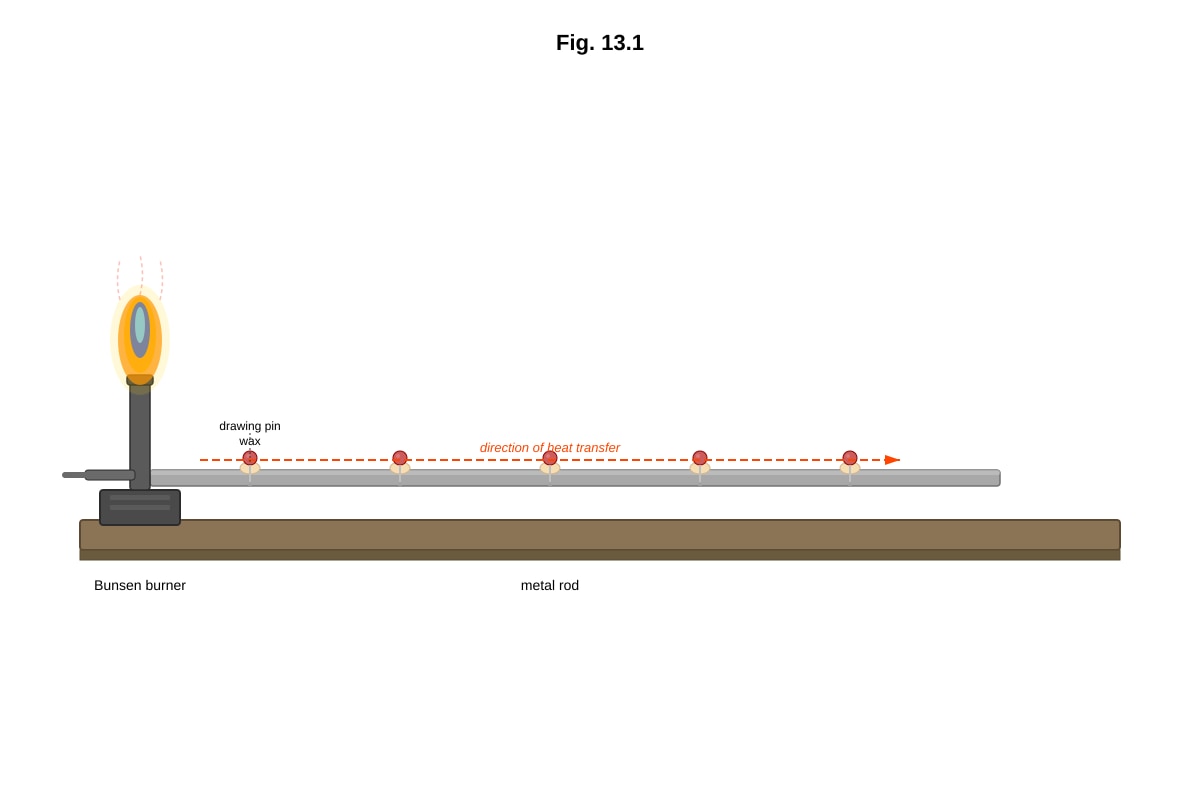
13. (a) The drawing pins will fall off in order starting from the end nearest the Bunsen burner [1 mark]. Heat is conducted along the rod from the hot end to the cooler end. The wax holding the nearest pin melts first, so that pin falls first, followed by the next, and so on [1 mark].
(b) The pins on the glass rod would take much longer to fall off / might not fall off at all [1 mark]. Glass is a poor conductor of heat (an insulator), so heat is not conducted efficiently along the rod [1 mark].
(c) Radiation [1 mark]. Radiation is the transfer of heat by electromagnetic waves (infrared radiation), which can travel through a vacuum and do not require a medium/particles [1 mark]. [Total: 6 marks]
Marking notes: For (a), award 1 mark for correct order, 1 mark for explanation linking conduction to melting wax. For (b), award 1 mark for comparison, 1 mark for explanation using conductivity.
Section C: Data-Based and Extended Response Questions (20 marks)
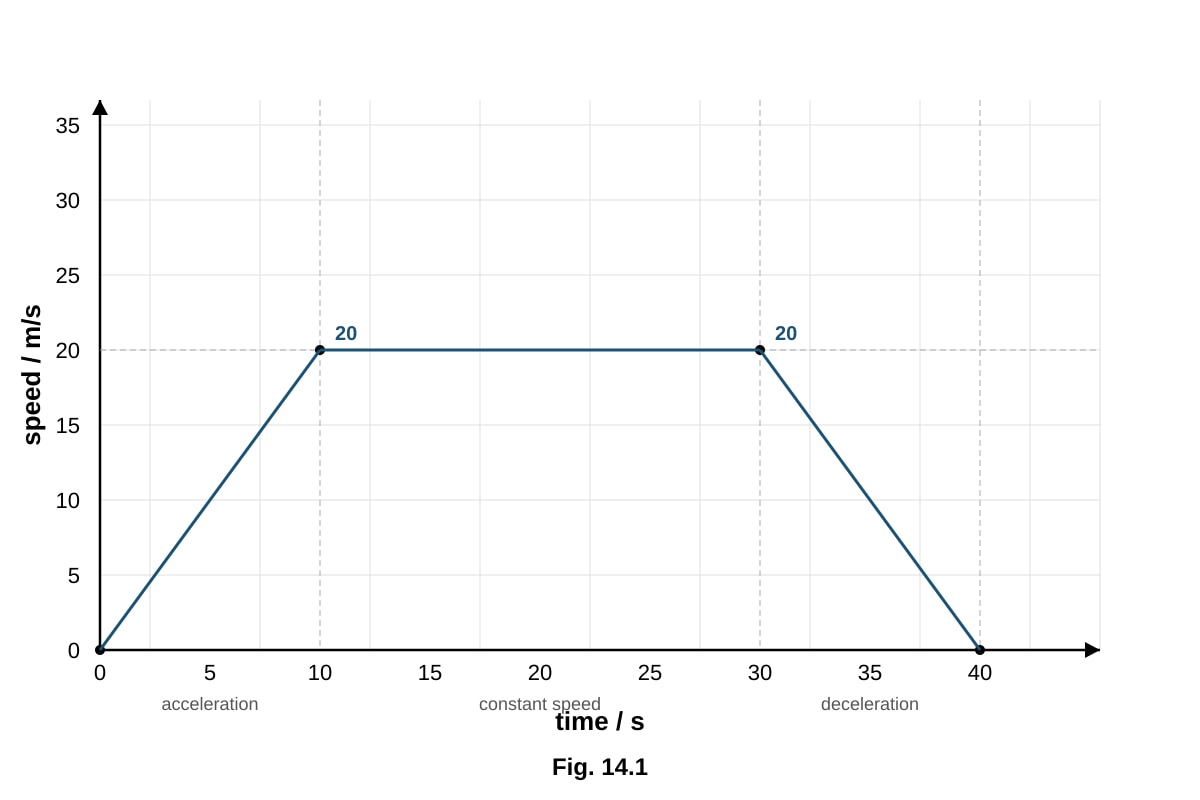
14. (a) The car is accelerating uniformly / moving with constant acceleration from rest [1 mark].
(b) Distance = area under graph = ½ × base × height = ½ × 10 × 20 [1 mark] = 100 m [1 mark].
(c) Distance from 10–30 s = area of rectangle = 20 × 20 = 400 m [1 mark] Distance from 30–40 s = area of triangle = ½ × 10 × 20 = 100 m [1 mark] Total distance = 100 + 400 + 100 = 600 m [1 mark].
(d) Deceleration = change in velocity / time = (0 – 20) / 10 [1 mark] = –2 m/s² / deceleration of 2 m/s² [1 mark]. [Total: 8 marks]
Marking notes: Award marks for correct method even if arithmetic is slightly off. Accept 2 m/s² for deceleration (magnitude only).
15. (a) The water in container A (wide shallow dish) evaporated faster / took less time than in container B (narrow beaker) [1 mark]. Container A has a larger surface area exposed to the air, so evaporation occurs more quickly [1 mark].
(b) The water in container C (warm location) evaporated faster / took less time than in container B [1 mark]. Higher temperature increases the kinetic energy of water molecules, so more molecules have enough energy to escape from the liquid surface, increasing the rate of evaporation [1 mark].
(c) The conclusion is valid [1 mark]. The experiment compares containers with different surface areas (A vs B) and different temperatures (B vs C), and the results show that both factors affect evaporation time [1 mark].
(d) Repeat the experiment and calculate average times / Use the same volume of water more precisely / Control other variables like air movement/humidity [1 mark – accept any one reasonable suggestion]. [Total: 7 marks]
Marking notes: For (c), accept "valid" or "partially valid" with appropriate reasoning. Award marks for linking experimental design to conclusion.
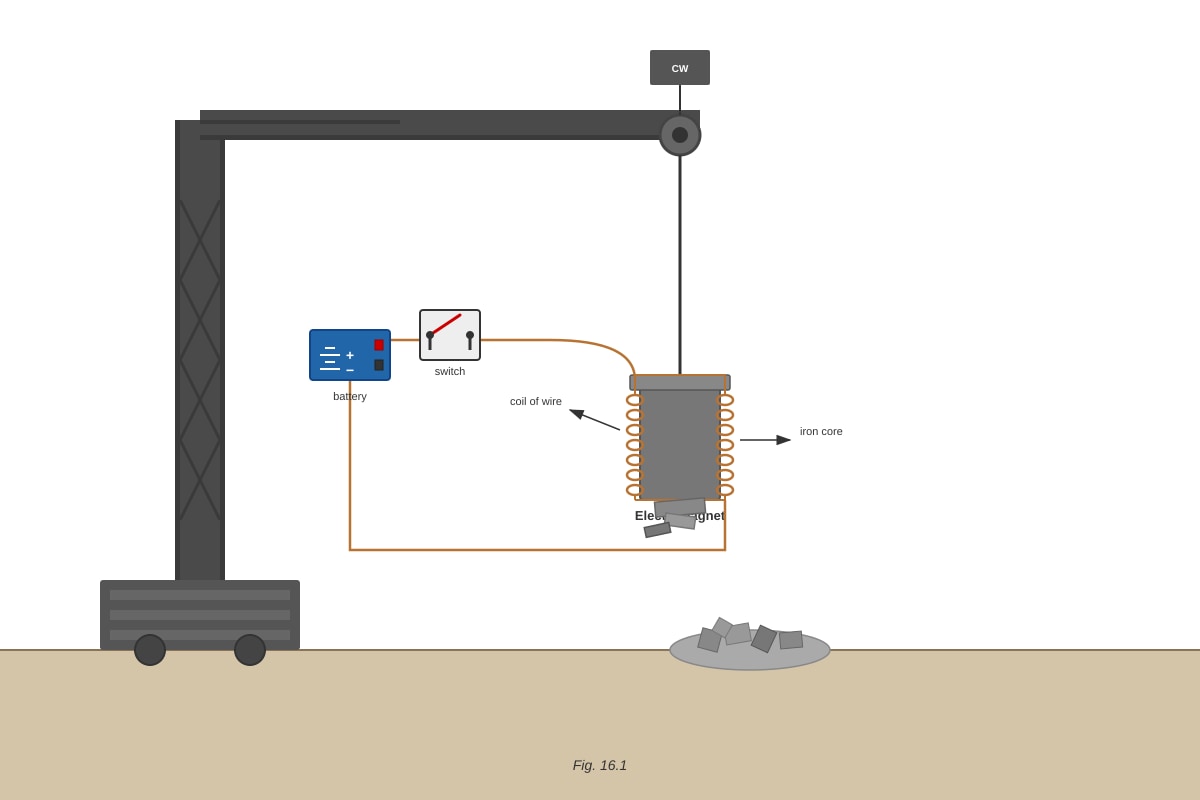
16. (a) Iron is a soft magnetic material that is easily magnetised and demagnetised [1 mark]. When the current is switched off, the iron core loses most of its magnetism, releasing the scrap metal. Steel is a hard magnetic material that retains magnetism and would not release the metal easily [1 mark].
(b) The scrap iron contains small regions called magnetic domains [1 mark]. When placed in the magnetic field of the electromagnet, these domains align in the direction of the field [1 mark]. This alignment causes the scrap iron to become an induced magnet, which is then attracted to the electromagnet [1 mark].
(c) Increase the current in the coil / Increase the number of turns of wire in the coil [2 marks – 1 mark each].
(d) The magnetism can be switched on and off / The strength of the electromagnet can be varied [1 mark – accept any one valid advantage]. [Total: 8 marks]
Marking notes: For (a), award 1 mark for identifying iron as soft magnetic material, 1 mark for explaining why this is advantageous. For (b), award 1 mark for domains, 1 mark for alignment, 1 mark for induced magnetism.
17. (a) Energy cannot be created or destroyed; the total amount of energy before and after any transfer/transformation remains the same [1 mark].
(b) Efficiency = (useful energy output / total energy input) × 100% [1 mark] Efficiency = (10 / 100) × 100% = 10% [1 mark].
(c) The thermal energy is not useful because the purpose of the light bulb is to produce light, not heat [1 mark]. The thermal energy could be useful in a heater or an incubator where heat is the desired output [1 mark – accept any reasonable example]. [Total: 5 marks]
Marking notes: For (b), award 1 mark for correct formula/substitution, 1 mark for correct answer. Accept 0.1 or 10%.
18. (a) Graph should show:
- Correct axes: Extension (cm) on y-axis, Force (N) on x-axis [1 mark]
- Appropriate scales and labels with units [1 mark]
- First three points plotted correctly (1.0, 2.0), (2.0, 4.0), (3.0, 6.0) [1 mark]
- Best-fit straight line through first three points and origin, extended as dashed line [1 mark]
(b) Extension is directly proportional to force / Hooke's Law is obeyed [1 mark].
(c) The spring has exceeded its elastic limit / limit of proportionality [1 mark]. The spring has undergone plastic deformation and will not return to its original length when the force is removed [1 mark].
(d) Limit of proportionality / Elastic limit [1 mark]. [Total: 7 marks]
Marking notes: For (a), award marks as indicated. Accept minor plotting errors within 1 mm. For (c), accept either "elastic limit" or "limit of proportionality".
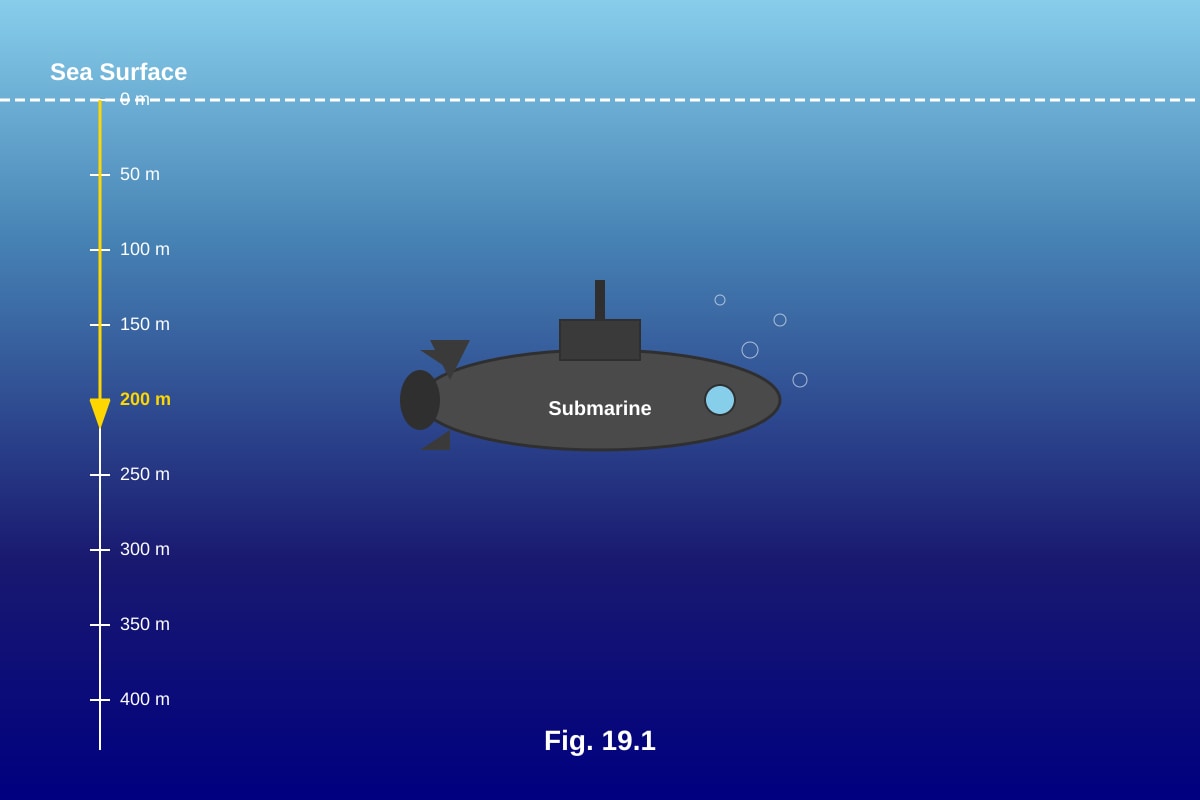
19. (a) P = hρg = 200 × 1030 × 9.8 [1 mark] P = 2,018,800 Pa / 2.02 × 10⁶ Pa (approximately) [1 mark].
(b) The pressure at a depth of 200 m is very large [1 mark]. The hull must be strong enough to withstand this high external pressure without collapsing / to prevent water from crushing the submarine [1 mark].
(c) As the submarine rises, the depth of water above it decreases. Since pressure in a liquid increases with depth / P = hρg, the pressure decreases as depth decreases [1 mark]. [Total: 5 marks]
Marking notes: For (a), award 1 mark for correct substitution, 1 mark for correct answer with units. Accept 2,018,800 Pa or 2.02 × 10⁶ Pa or equivalent.
20. (a) Ohm's Law: The current through a conductor is directly proportional to the potential difference (voltage) across it, provided the temperature (and other physical conditions) remain constant [1 mark].
(b) R = V / I Using any data point, e.g., V = 2.0 V, I = 0.40 A: R = 2.0 / 0.40 = 5.0 Ω [1 mark for correct substitution, 1 mark for correct answer with units]. [Total: 2 marks]
(c) Current = 1.00 A [1 mark]. Since the resistor obeys Ohm's Law, current is directly proportional to voltage. When voltage increases from 4.0 V to 5.0 V (×1.25), current increases from 0.80 A to 1.00 A (×1.25) / R = 5.0 Ω, so I = V/R = 5.0/5.0 = 1.00 A [1 mark].
(d) Sketch: A curve starting from the origin, initially straight then curving towards the voltage axis / showing decreasing gradient [1 mark]. As current increases, the filament gets hotter [1 mark]. The resistance of the filament increases with temperature, so the current does not increase proportionally with voltage / the graph curves [1 mark]. [Total: 7 marks]
Marking notes: For (d), award 1 mark for correct sketch shape, 1 mark for linking to temperature increase, 1 mark for linking increased resistance to curve shape.
END OF ANSWER KEY
This answer key was generated by TuitionGoWhere AI to accompany the corresponding practice paper. Mark allocations are indicative and align with typical O-Level Combined Science marking schemes.