AI Generated Exam Paper
Secondary 3 Combined Science Practice Paper 2
Free Sec 3 Combined Sci Practice Paper 2, Kimi2.6 AI version, with questions, answers, and O Level-style practice for Singapore students.
These static practice materials are generated from the site's syllabus and paper-generation workflow, with source and model context shown so students and parents can evaluate the material before use.
Questions
Free quiz and exam paper access
Enter your details to view this paper
Your access is remembered on this device.
Answers
TuitionGoWhere Practice Paper - Combined Science Secondary 3: Answer Key
Version: 2 of 5
Total Marks: 60
Section A: Multiple Choice and Short Answer (22 marks)
1. C (250 W)
- Working:
- Weight = mg = 50 kg × 10 N/kg = 500 N
- Work done = Force × distance = 500 N × 4 m = 2 000 J
- Power = Work / time = 2 000 J / 8 s = 250 W
- Alternative: Power = (mgh)/t = (50 × 10 × 4) / 8 = 250 W
- Marking: [1] for correct working/method, [1] for correct answer
- Teaching note: Power measures rate of energy transfer. Common error: forgetting g and using mass instead of weight/force, or confusing height with distance along stairs.
[2 marks]
2. D (Its velocity changes by equal amounts in equal times)
- Explanation:
- Constant acceleration means Δv/Δt = a = constant. Thus velocity changes by equal amounts in equal times [1]
- A is wrong: speed changes with acceleration (unless circular motion, not specified)
- B is wrong: constant velocity means zero acceleration
- C is wrong: zero net force means equilibrium (Newton's First Law), zero acceleration
- Teaching note: Acceleration is the rate of change of velocity. "Constant acceleration" is the definition of uniform acceleration—velocity-time graph is straight line.
[2 marks]
3. Energy for vaporisation
- Working: Energy = mass × specific latent heat of vaporisation = 0.5 kg × 2 260 kJ/kg = 1 130 kJ (or 1 130 000 J)
- Marking: [1] correct formula, [1] correct answer with unit
- Teaching note: During boiling at 100 °C, all energy goes into breaking intermolecular bonds (latent heat), not raising temperature. This is why steam burns are severe—steam carries extra latent heat energy.
[2 marks]
4. Conduction in saucepan handle
- Answer points:
- Heat from stove is conducted through metal of pan to handle [1]
- Metal is a good conductor / particles in metal are closely packed with free electrons [1]
- Thermal energy transferred by particle vibrations and free electron movement through the material [1]
- Marking: [1] each valid point to maximum [3]
- Teaching note: Conduction requires material medium. Metals conduct well due to free electrons; wood/plastic handles insulate. The energy transfer is kinetic energy passed between vibrating particles and mobile electrons—no bulk movement of material.
[3 marks]
5. Circuit calculations
(a) Resistance
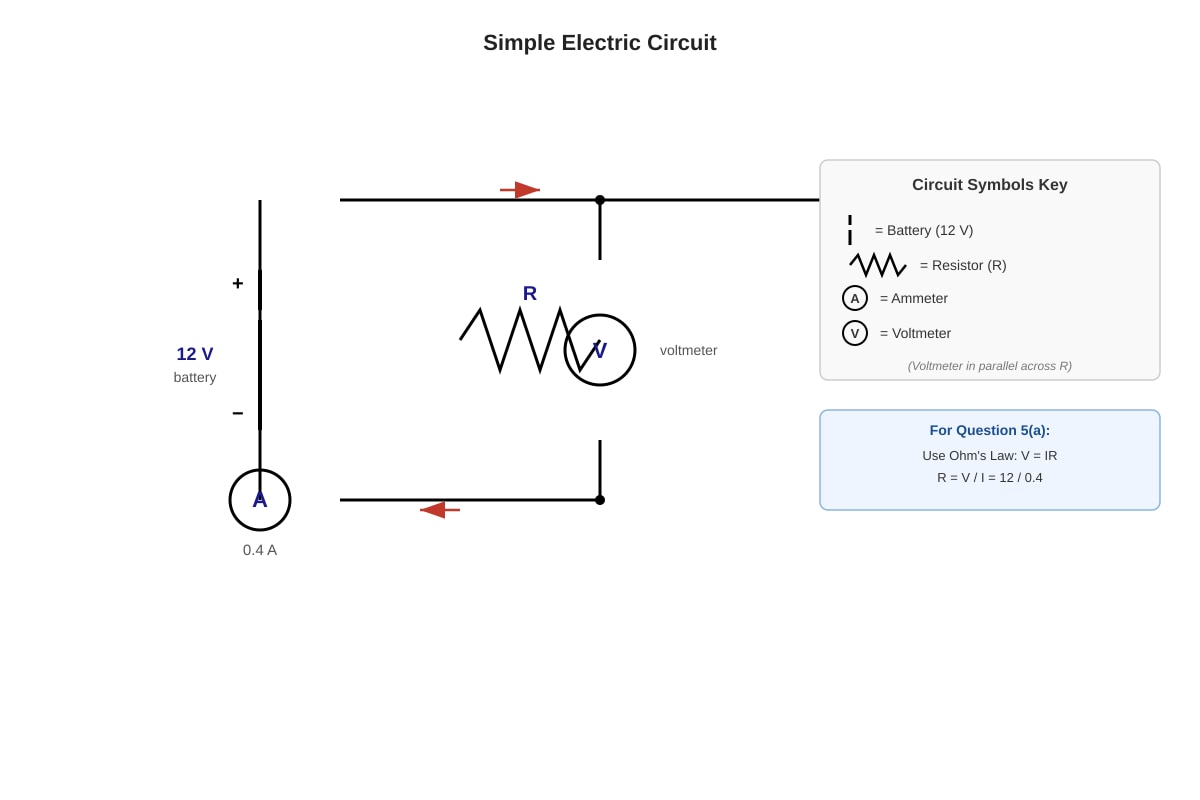
- Working: R = V/I = 12 V / 0.4 A = 30 Ω
- Marking: [1] Ohm's Law formula, [1] correct answer with unit
- Teaching note: Voltmeter reads potential difference across resistor; ammeter reads current through series circuit. Ohm's Law (V = IR) applies to ohmic conductors at constant temperature.
[2 marks]
(b) Power dissipated
- Working: P = VI = 12 V × 0.4 A = 4.8 W
- Alternatively: P = I²R = (0.4)² × 30 = 0.16 × 30 = 4.8 W
- Or: P = V²/R = 144/30 = 4.8 W
- Marking: [1] correct formula, [1] correct answer with unit
- Teaching note: All three power formulas are equivalent when combined with V = IR. Choose based on given quantities. Power represents rate of energy dissipation as heat in resistor.
[2 marks]
6. Increasing evaporation rate
- Answer (any two):
- Increase temperature of liquid [1]
- Increase surface area exposed to air [1]
- Increase air flow / wind speed over surface [1]
- Reduce humidity / moisture in surrounding air [1]
- Marking: [1] each valid method, maximum [2]
- Teaching note: Evaporation occurs at surface when particles with sufficient kinetic energy escape. Higher temperature = more particles have escape energy. Greater surface area = more escape opportunities. Air flow removes saturated air, maintaining concentration gradient.
[2 marks]
7. Ice melting calculations
(a) Energy to melt ice
- Working: Q = mL = 0.5 kg × 334 kJ/kg = 167 kJ (or 167 000 J)
- Marking: [1] correct formula, [1] correct answer with unit
- Teaching note: Note mass conversion: 500 g = 0.5 kg. Latent heat calculation uses mass in kg with specific latent heat in kJ/kg, giving answer in kJ.
[2 marks]
(b) Rate of energy transfer
- Working: Rate = Energy / time = 167 000 J / 500 s = 334 W (or 0.334 kW)
- Marking: [1] correct method, [1] correct answer with unit
- Note: If 167 kJ used: 167 000/500 = 334 W, or using kJ: 167/0.5 = 334 kJ/min—not standard, so prefer SI unit approach.
[2 marks]
8. Solid versus gas particle explanation
- Answer points:
- In solids: particles are held in fixed positions by strong forces / closely packed in regular arrangement [1]
- Particles can only vibrate about fixed points, maintaining definite shape [1]
- In gases: particles are far apart with negligible forces between them [1]
- Particles move freely and randomly, filling available space, so no definite shape [1]
- Marking: [1] each valid point, maximum [3]
- Teaching note: The key distinction is force strength and particle spacing. Solids: strong forces, fixed positions, vibrate only. Liquids: moderate forces, close but mobile. Gases: weak forces, far apart, free movement.
[3 marks]
Section B: Structured Problems and Calculations (24 marks)
9. Roller coaster energy
(a) GPE at point A
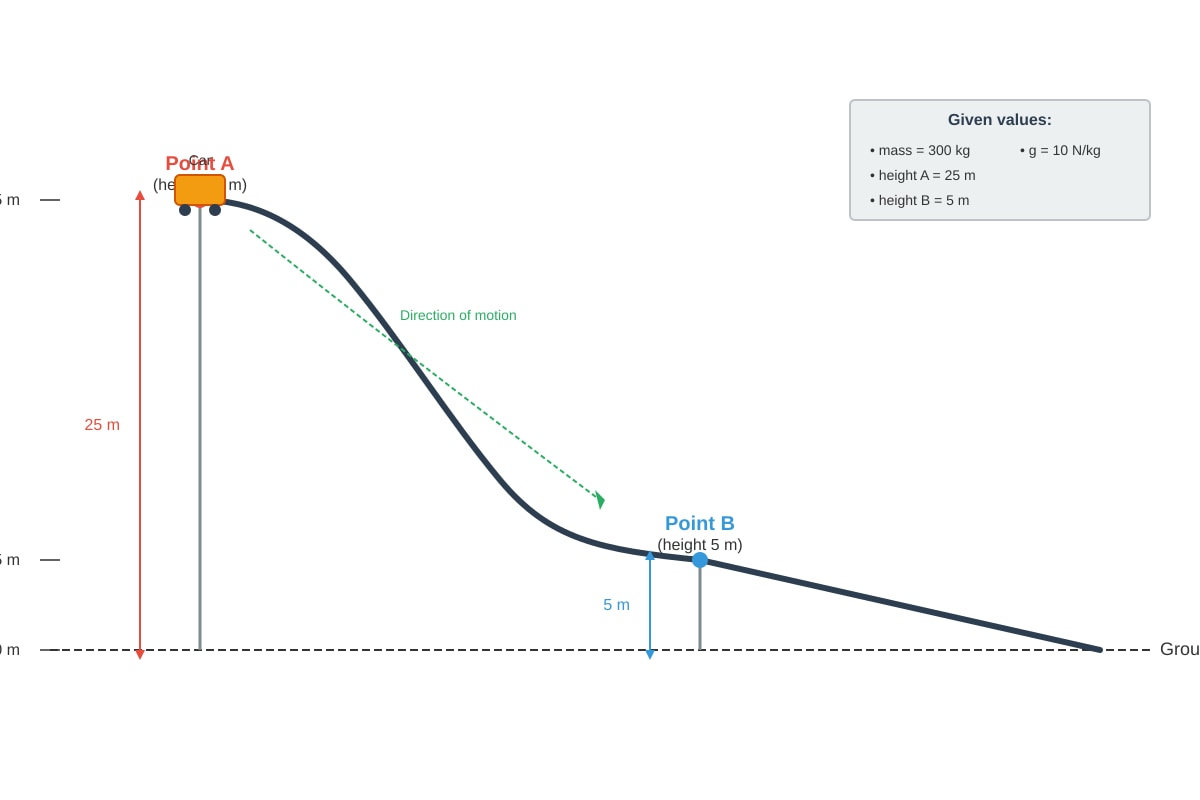
- Working: GPE = mgh = 300 kg × 10 N/kg × 25 m = 75 000 J (or 75 kJ)
- Marking: [1] formula, [1] answer with unit
- Reference level: Ground (0 m)
[2 marks]
(b) KE and speed at point B
- Working:
- By conservation of energy: Loss in GPE = Gain in KE (assuming no energy losses)
- Loss in GPE = mg(h_A − h_B) = 300 × 10 × (25 − 5) = 300 × 10 × 20 = 60 000 J
- KE at B = 60 000 J [1]
- ½mv² = 60 000
- ½ × 300 × v² = 60 000
- 150v² = 60 000
- v² = 400
- v = 20 m/s [1]
- Marking breakdown: [1] conservation principle stated, [1] correct energy difference calculation, [1] KE value, [1] correct speed with unit
- Teaching note: Can also calculate: GPE at B = 300 × 10 × 5 = 15 000 J; KE = 75 000 − 15 000 = 60 000 J. Both methods valid.
[4 marks]
(c) Energy "lost"
- Working:
- Expected KE at B (no losses) = 60 000 J from part (b)
- Actual speed = 18 m/s, so actual KE = ½ × 300 × (18)² = 150 × 324 = 48 600 J
- Energy lost = 60 000 − 48 600 = 11 400 J
- Alternatively: energy lost = ½m(v_expected² − v_actual²) = ½ × 300 × (400 − 324) = 150 × 76 = 11 400 J
- Marking: [1] correct actual KE calculation, [1] subtraction from expected, [1] correct final answer with unit
- Teaching note: "Lost" energy is converted to thermal energy (friction, air resistance) and sound. It is dissipated to surroundings. This demonstrates real systems are never 100% efficient.
[3 marks]
10. Gas law investigation
(a) p × V calculations
| Pressure / kPa | Volume / cm³ | p × V / kPa·cm³ |
|---|---|---|
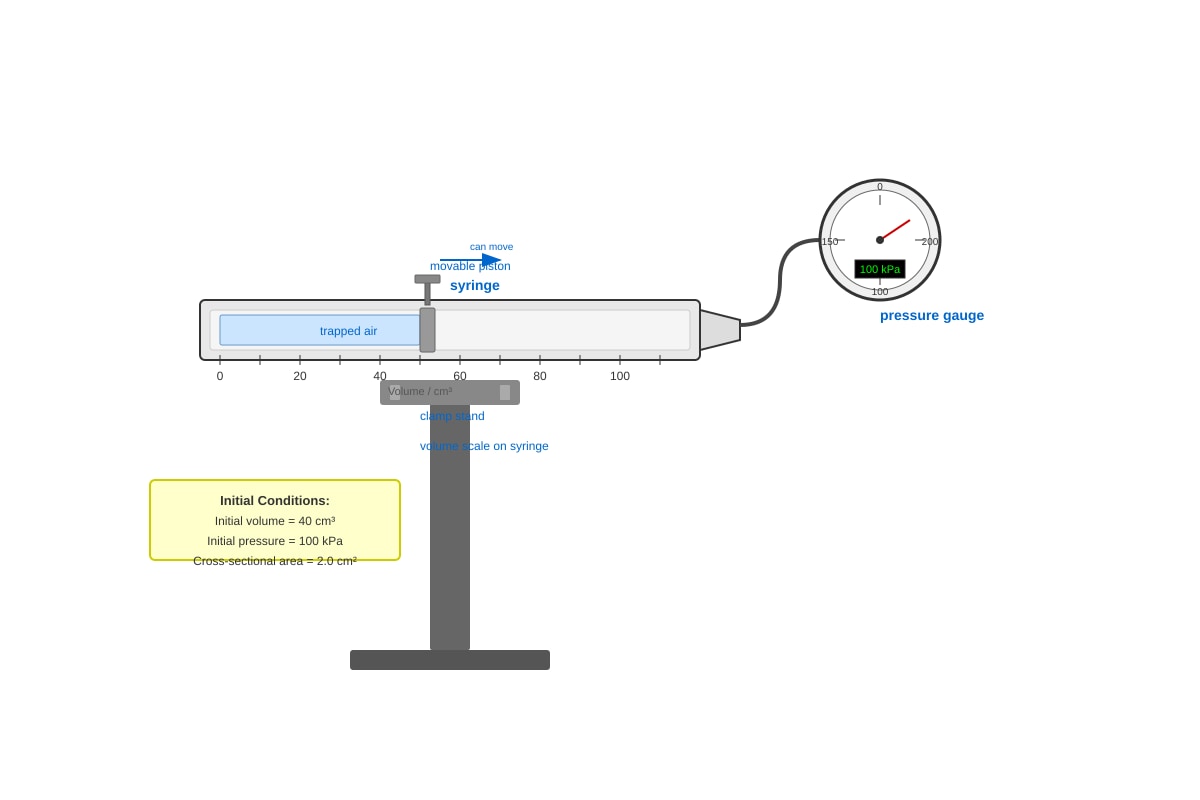
| 100 | 40 | 4 000 |
| 125 | 32 | 4 000 |
| 167 | 24 | 4 008 ≈ 4 000 |
| 250 | 16 | 4 000 |
- Marking: [1] for at least 3 correct within rounding, [1] for recognition that pV ≈ constant (4 000 kPa·cm³)
- Note: 167 × 24 = 4 008, which rounds to 4 000 or shows slight experimental variation.
[2 marks]
(b) Gas law
- Answer: Boyle's Law
- Marking: [1] correct name
[1 mark]
(c) Results evaluation
- Answer points:
- p × V is approximately constant (≈ 4 000 kPa·cm³) [1]
- This supports Boyle's Law, which states pV = constant at constant temperature for fixed mass of gas [1]
- Small variations due to experimental errors: temperature may not have stayed perfectly constant, or measurement uncertainties in reading pressure/volume [1]
- Marking: [1] each valid point
- Teaching note: Boyle's Law (p ∝ 1/V at constant T) is one of the gas laws. The constant depends on amount of gas and temperature. For ideal gases it's exact; real gases approximate this well at moderate pressures.
[3 marks]
(d) Pressure increase at constant volume
- Answer points:
- Heating increases kinetic energy / speed of gas particles [1]
- Particles collide with container walls more frequently [1]
- And with greater force / greater momentum change per collision [1]
- Pressure = force/area, so pressure increases since area is constant [1]
- Marking: [1] each valid point, maximum [3]
- Teaching note: This describes Gay-Lussac's Law (p ∝ T at constant V). Both collision frequency AND collision force increase—students often miss the force increase. Temperature (Kelvin) is directly proportional to average kinetic energy of particles.
[3 marks]
11. Diver energy calculations
(a) GPE on platform
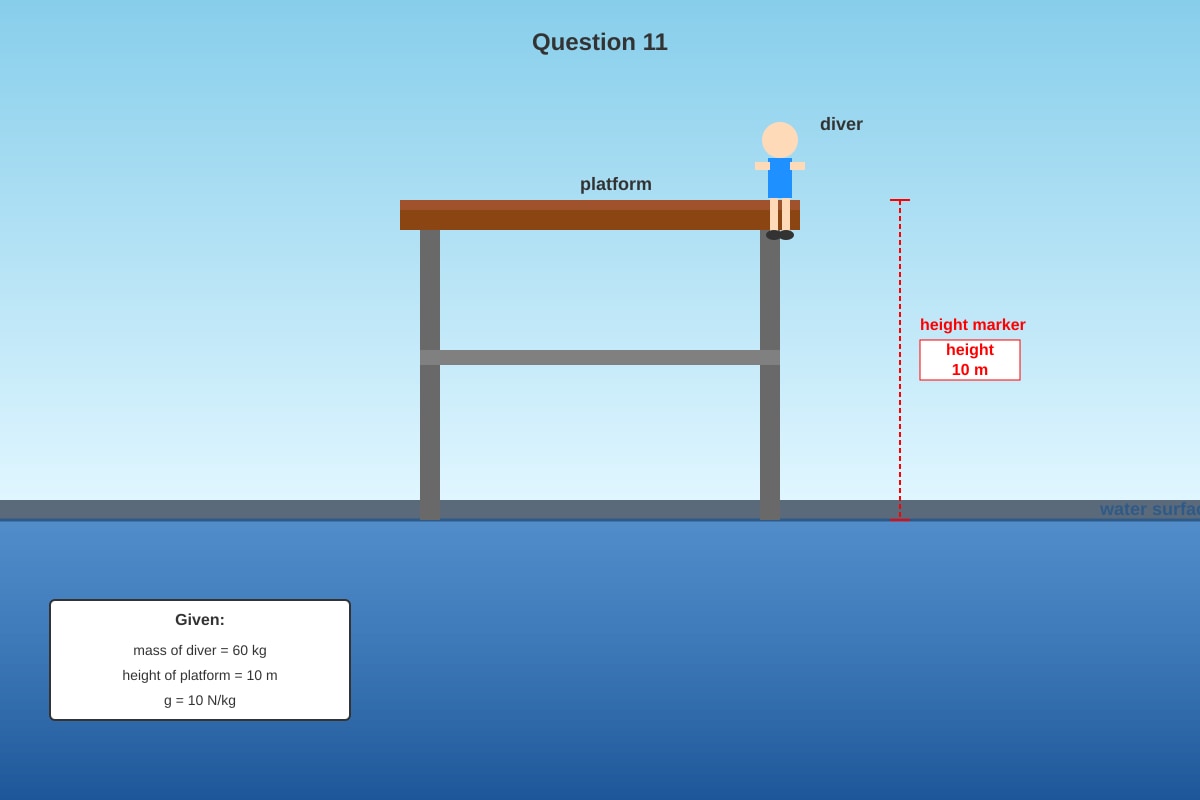
- Working: GPE = mgh = 60 kg × 10 N/kg × 10 m = 6 000 J
- Marking: [1] formula, [1] answer with unit
[2 marks]
(b) Maximum height above platform
- Working:
- Initial KE at jump = ½mu² = ½ × 60 × (2)² = 30 × 4 = 120 J
- At maximum height, all KE converted to extra GPE (velocity becomes zero momentarily)
- mgh_max = 120 J
- 60 × 10 × h = 120
- h = 120 / 600 = 0.2 m
- Maximum height above platform = 0.2 m (20 cm)
- Alternative using kinematics: v² = u² + 2as; 0 = 4 + 2(−10)s; s = 0.2 m
- Marking: [1] correct initial KE, [1] energy conversion principle, [1] correct height with unit
- Teaching note: The jumper doesn't need to calculate from water surface—they asked for height above platform. Common error: using total height (10 m) in calculation or adding to 10 m for total above water.
[3 marks]
(c) Speed entering water
-
Working:
- Total energy at start (platform + jump): GPE = 6 000 J, KE = 120 J, Total = 6 120 J
- At water surface (h = 0), all energy is KE: ½mv² = 6 120
- ½ × 60 × v² = 6 120
- 30v² = 6 120
- v² = 204
- v = √204 ≈ 14.3 m/s
Alternative using full height:
- Total height fallen = 10 + 0.2 = 10.2 m (or use energy method with 6 120 J)
- Using v² = u² + 2gh with u = 2 m/s upward initially... actually complex; energy method cleaner.
- Or: loss in GPE from max height (10.2 m) = 60 × 10 × 10.2 = 6 120 J = ½ × 60 × v² → v = 14.3 m/s
-
Marking: [1] correct total energy, [1] equation setup, [1] correct answer with unit
-
Range: 14.1–14.3 m/s acceptable depending on rounding
[3 marks]
Section C: Data Analysis and Application (14 marks)
12. Water heating experiment
(a) Graph plotting
-
Expected marking:
- [1] Correct axes: temperature / °C (y-axis), time / s (x-axis)
- [1] Suitable scale with points plotted accurately (±½ small square)
- [1] Best-fit straight line or smooth curve through early points, noting deviation later
-
Teaching note: The data shows linear heating initially (constant gradient) then curve as approach to boiling or heat losses increase. Points: (0,20), (30,26), (60,32), (90,38), (120,44), (150,50), (180,55).
[3 marks]
(b) Gradient in first 150 seconds
- Method: Draw tangent or use points at t = 0 and t = 150 s
- Calculation: Gradient = Δθ/Δt = (50 − 20) / (150 − 0) = 30/150 = 0.2 °C/s (or 1 °C per 5 s)
- Alternative using other points on straight portion: e.g., (60,32) to (150,50): (50−32)/(150−60) = 18/90 = 0.2 °C/s
- Marking: [1] method shown on graph (construction lines), [1] correct gradient with unit
[2 marks]
(c) Specific heat capacity from gradient
-
Working:
- Power = 400 W, so energy per second = 400 J
- In time Δt, energy supplied = 400 × Δt
- Temperature rise rate = 0.2 °C/s, so in time Δt, Δθ = 0.2 × Δt
- Using E = mcΔθ: 400 × Δt = 0.2 kg × c × (0.2 × Δt)
- 400 = 0.2 × c × 0.2
- 400 = 0.04c
- c = 400 / 0.04 = 10 000 J/(kg·°C)...
Wait—let me recheck: mass = 200 g = 0.2 kg
- Rate of energy supply: 400 J/s
- Rate of temperature rise: 0.2 °C/s
- So for 1 s: 400 = 0.2 × c × 0.2
- c = 400 / (0.2 × 0.2) = 400 / 0.04 = 10 000... this seems high.
Re-examine gradient: (50−20)/150 = 30/150 = 0.2 °C/s = 1/5 °C/s
Energy in 150 s = 400 × 150 = 60 000 J Temperature rise = 30 °C c = E / (mΔθ) = 60 000 / (0.2 × 30) = 60 000 / 6 = 10 000... still high.
Actually 10,000 is 2.4× accepted value of 4,200. Check data: 400W heating 200g water for 150s should raise by about 400×150/(0.2×4200) = 60,000/840 ≈ 71°C. The data shows 30°C, suggesting significant heat losses or lower power.
With given data: c = 60 000 / 6 = 10 000 J/(kg·°C) is the calculated value from experimental data.
Or using gradient method:
- mc(dθ/dt) = Power, assuming no losses
- c = P / [m × (dθ/dt)] = 400 / (0.2 × 0.2) = 10 000 J/(kg·°C)
-
Marking: [1] correct energy calculation or rate equation, [1] correct substitution, [1] answer with unit
-
Teaching note: This overestimate demonstrates experimental heat losses. Real c_water = 4,200 J/(kg·°C). The difference shows energy not going into water—loss to container, air, evaporation.
[3 marks]
(d) Temperature rise slowing
- Answer points:
- Heat losses to surroundings increase as temperature difference increases [1]
- Or: evaporation rate increases at higher temperatures, removing more energy [1]
- Or: heater efficiency decreases / not all heat reaching water as system warms [1]
- Marking: [1] each valid point, maximum [2]
- Teaching note: Newton's Law of Cooling: rate of heat loss ∝ temperature difference. As water heats above room temperature, it loses heat faster, so net heating rate decreases. Also, more vigorous evaporation at higher temperatures removes latent heat.
[2 marks]
13. Solar panel analysis
(a) Total solar power incident
- Working: Power = Intensity × Area = 800 W/m² × 20 m² = 16 000 W (or 16 kW)
- Marking: [1] formula, [1] answer with unit
- Teaching note: Solar irradiance (intensity) is power per unit area. Singapore receives about 800–1,000 W/m² at noon on clear days.
[2 marks]
(b) Electrical power output
- Working: Electrical power = Efficiency × Input power = 0.15 × 16 000 W = 2 400 W (or 2.4 kW)
- Marking: [1] multiplication by efficiency, [1] correct answer with unit
- Teaching note: Commercial solar panels typically have 15–22% efficiency. The rest becomes thermal energy warming the panels.
[2 marks]
(c) Suitability factors for Singapore
-
Positive factors:
- Singapore receives strong, consistent solar insolation year-round (equatorial location, ~12 hours daylight) [1]
- No seasonal variation in day length, unlike temperate countries [1]
- High cloud cover but still significant diffuse solar radiation [1]
-
Limiting factors:
- Limited land area for large solar farms (small island, competing land uses) [1]
- High rise buildings may shade lower structures [1]
- Intermittency: no generation at night; energy storage needed [1]
- High humidity and cloud cover reduce efficiency compared to desert locations [1]
- Urban heat island effect may slightly reduce panel efficiency [1]
-
Marking: [1] each relevant factor discussed in context, maximum [4]
-
Must include: at least one positive and one limiting factor for balanced discussion
-
Teaching note: Singapore's "SolarNova" program targets 2 GWp solar by 2030, using rooftops, reservoirs, and offshore areas to overcome land constraints. The 4 Switches energy strategy recognizes solar as key but not sole solution.
[4 marks]
FINAL MARKS CHECK
| Section | Marks |
|---|---|
| A | 22 |
| B | 24 |
| C | 14 |
| Total | 60 |
END OF ANSWER KEY