From Real Exams Exam Paper
Secondary 3 Combined Science Semestral Assessment 2 (End of Year) Paper 5
Free Sec 3 Combined Sci SA2 Paper 5, Kimi2.6 Exam version, with questions, answers, and O Level-style practice for Singapore students.
These static practice materials are generated from the site's syllabus and paper-generation workflow, with source and model context shown so students and parents can evaluate the material before use.
Questions
Free quiz and exam paper access
Enter your details to view this paper
Your access is remembered on this device.
Answers
TuitionGoWhere Practice Paper - Combined Science Secondary 3
SA2 Practice (Version 5 of 5) — MARKING SCHEME
Total Marks: 60
SECTION A [20 marks]
1 Answer: B
Explanation: When running up stairs, chemical energy stored in muscles (from food) is converted into both kinetic energy (motion of running) and gravitational potential energy (gain in height). Option A misses the kinetic energy component. Option C incorrectly suggests no energy input is needed. Option D has the wrong starting energy form.
Common mistake: Students often forget that movement involves kinetic energy as well as potential energy gain.
[1 mark]
2 Answer: B
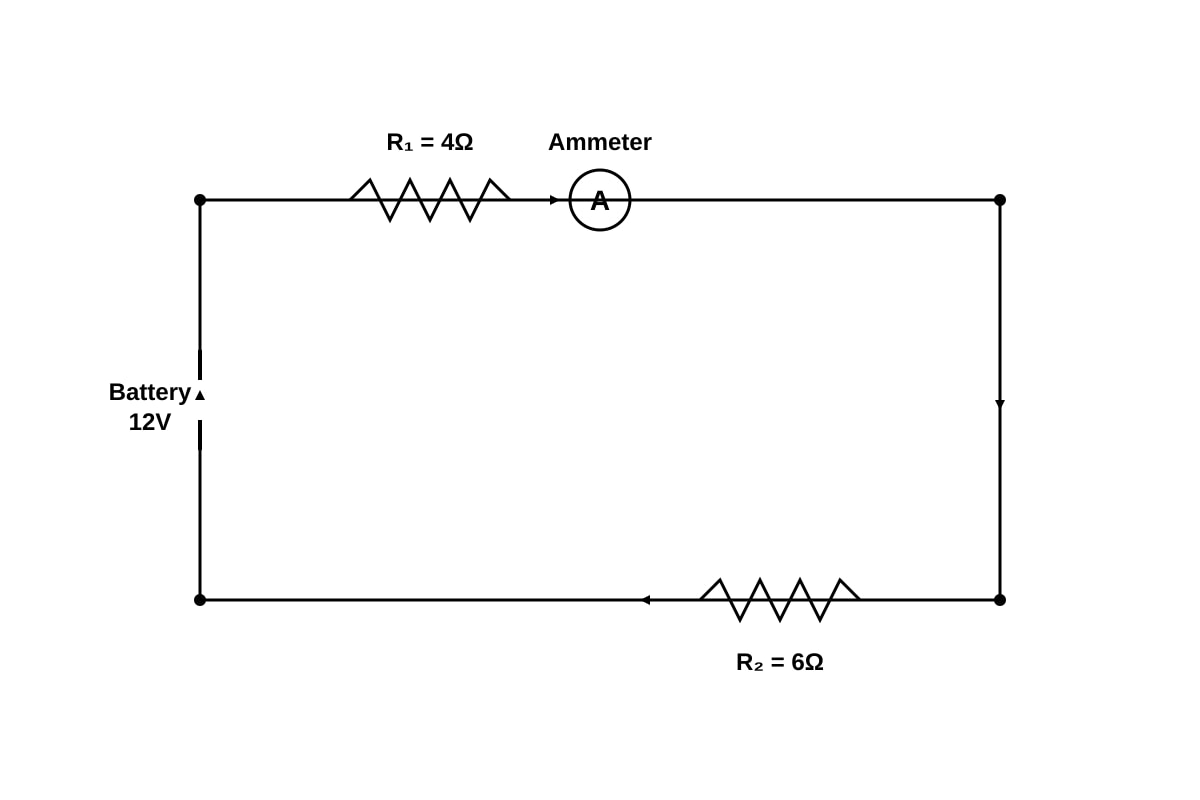
Explanation: For resistors in series, total resistance R_total = R₁ + R₂ = 4 + 6 = 10 Ω.
Using Ohm's Law: I = V/R = 12/10 = 1.2 A
Working:
- R_total = 4 + 6 = 10 Ω
- I = 12/10 = 1.2 A
[1 mark]
3 Answer: C
Explanation: Wave speed v = f × λ = 5 × 2 = 10 m/s
The wave equation v = fλ relates frequency (f), wavelength (λ), and wave speed (v). This is a fundamental relationship for all wave types.
[1 mark]
4 Answer: C
Explanation: An echo is the reflection of sound from a hard surface. Light reflection creates images, not echoes. Refraction involves bending at boundaries, and diffraction involves bending around obstacles—neither produces echoes.
[1 mark]
5 Answer: B
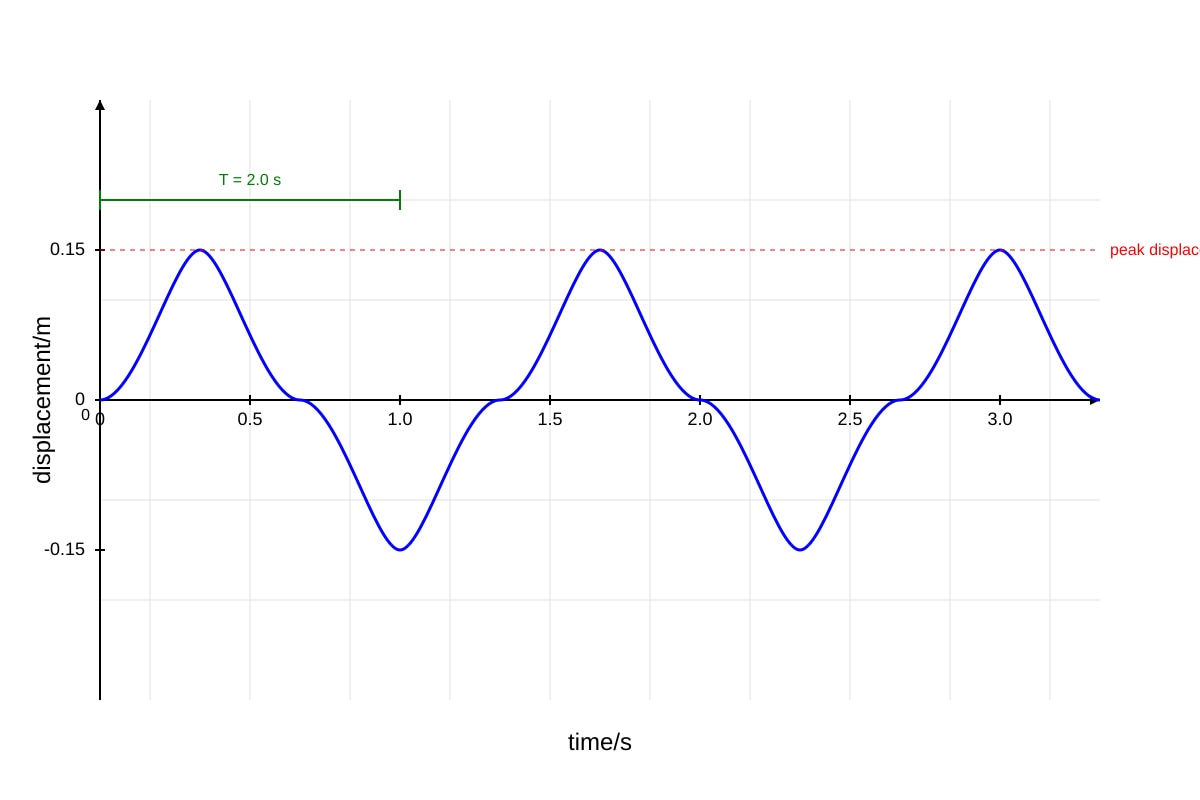
Explanation: From the graph, the period T = 2.0 s (time for one complete oscillation). Frequency f = 1/T = 1/2.0 = 0.50 Hz
Working:
- Read period from graph: distance between adjacent peaks = 2.0 s
- f = 1/T = 1/2.0 = 0.50 Hz
Common mistake: Students may read the period incorrectly or confuse period with frequency.
[1 mark]
6 Answer: A
Explanation: Using E = mcΔθ:
c = E/(mΔθ) = 8400/(2 × 10) = 8400/20 = 420 J/(kg·°C)
Working:
- c = 8400 / (2 × 10) = 8400/20 = 420 J/(kg·°C)
[1 mark]
7 Answer: A
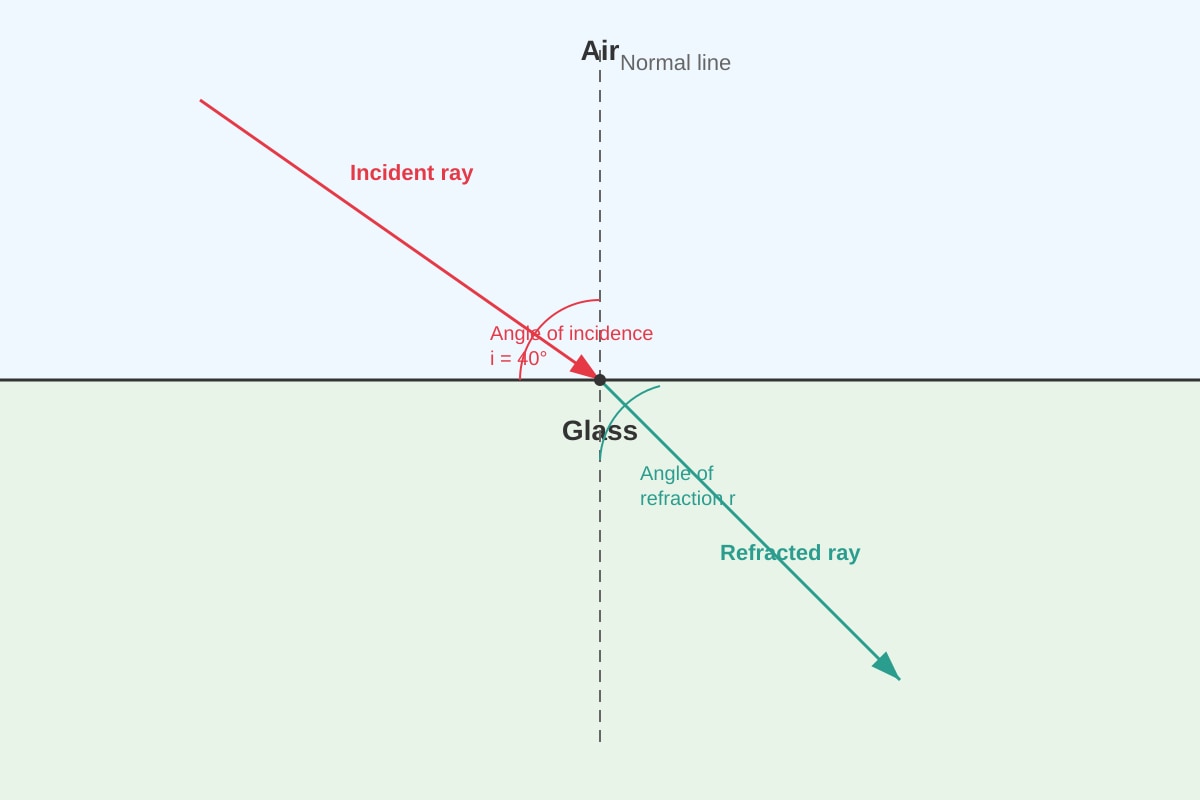
Explanation: Using Snell's Law: n = sin(i)/sin(r)
sin(r) = sin(i)/n = sin(40°)/1.5 = 0.6428/1.5 = 0.4285
r = sin⁻¹(0.4285) = 25.4°
Working:
- sin(40°) = 0.6428
- sin(r) = 0.6428/1.5 = 0.4285
- r = sin⁻¹(0.4285) = 25.4°
Light bends towards the normal when entering a denser medium (glass), so r < i. This eliminates options B, C, and D immediately.
[1 mark]
8 Answer: A
Explanation: Power = Energy/Time, so 1 Watt = 1 Joule/1 Second = J/s
Option B (N·m) is the unit of work/energy (joule). Option C (kg·m/s) is momentum. Option D (N/m²) is pressure (pascal).
[1 mark]
9 Answer: C
Explanation: For a transformer: Vₛ/Vₚ = Nₛ/Nₚ
Vₛ = Vₚ × (Nₛ/Nₚ) = 12 × (800/200) = 12 × 4 = 48 V
Working:
- Turns ratio = 800/200 = 4
- Vₛ = 12 × 4 = 48 V
This is a step-up transformer (more secondary turns than primary turns).
[1 mark]
10 Answer: A
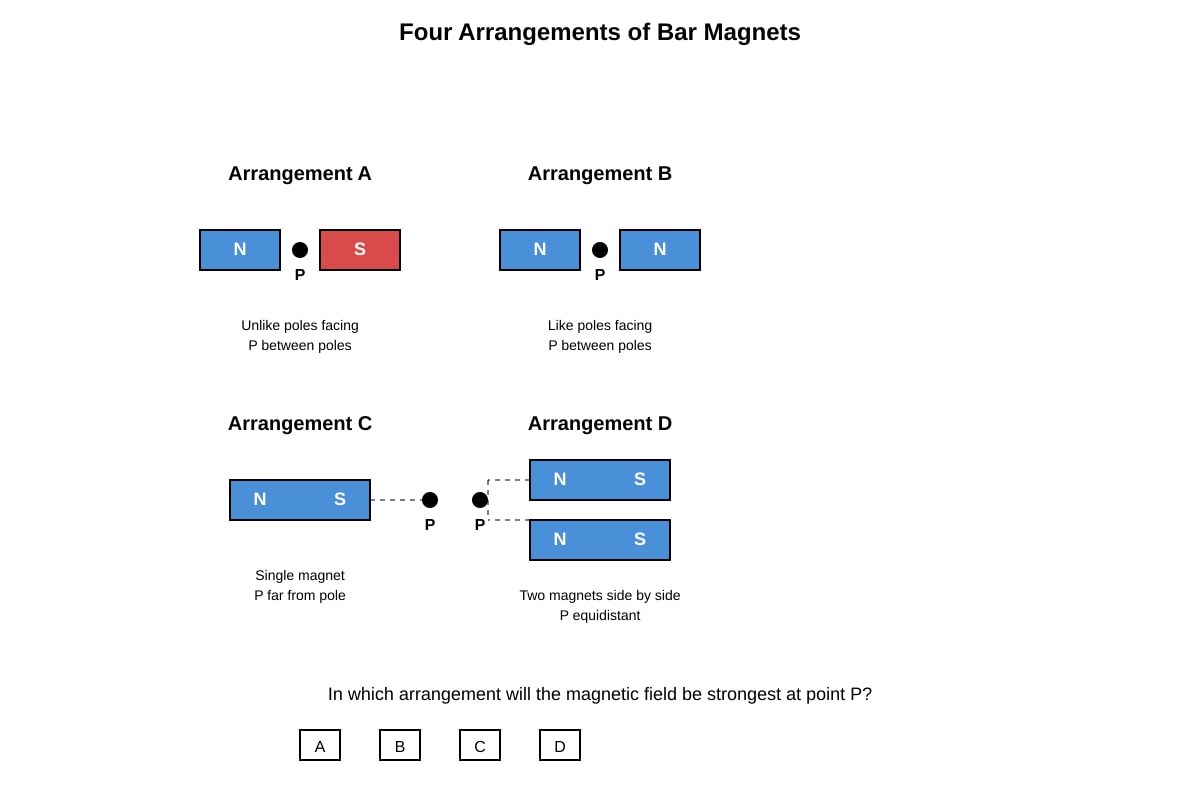
Explanation: Magnetic field is strongest where unlike poles face each other closely (Arrangement A: N-S facing S-N). In this arrangement, magnetic field lines are concentrated and pass directly from N to S across the small gap. Like poles repel and weaken the field between them (B), while single magnets or distant arrangements produce weaker fields at the point of interest (C, D).
[1 mark]
SECTION B [30 marks]
11
(a) GPE = mgh = 800 × 10 × 25 = 200 000 J (or 2.0 × 10⁵ J)
Marking:
- [1] correct substitution
- [1] correct answer with unit
Common mistake: Forgetting to include g or using g = 9.8/10 inconsistently. This paper specifies g = 10 N/kg.
[2 marks]
(b) Using conservation of energy: Loss in GPE = Gain in KE
mgh_loss = ½mv²
h_loss = 25 - 5 = 20 m
800 × 10 × 20 = ½ × 800 × v²
160 000 = 400v²
v² = 400
v = 20 m/s
Alternative method:
- GPE at 5 m = 800 × 10 × 5 = 40 000 J
- KE at 5 m = 200 000 - 40 000 = 160 000 J
- ½mv² = 160 000; v² = 400; v = 20 m/s
Marking:
- [1] correct height difference or energy conservation principle stated
- [1] correct equation and substitution
- [1] correct final answer with unit
[3 marks]
(c) Any two from:
- Air resistance opposes motion and does work against the car, dissipating energy as heat
- Friction between wheels and track/wheels and axles converts kinetic energy to thermal energy
- Sound energy is produced by vibrations of the track and wheels
Marking: [1] per valid reason, up to [2]
[2 marks]
12
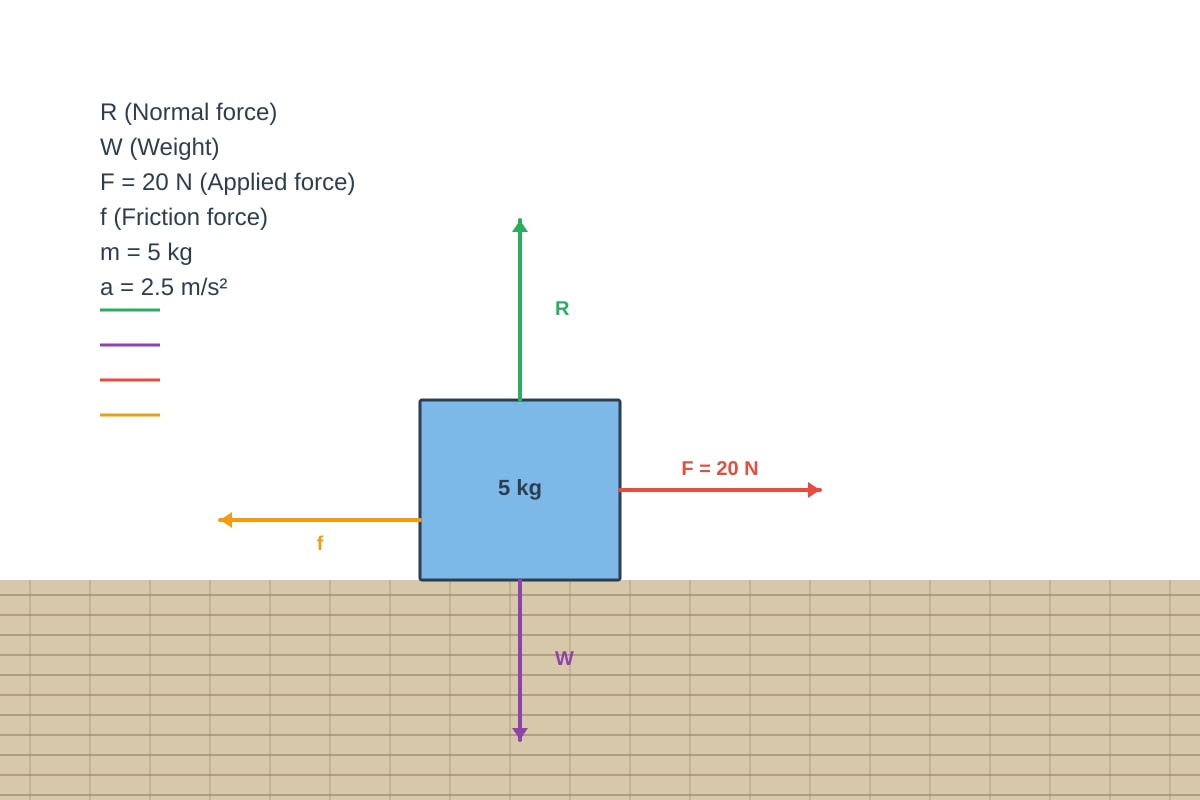
(a) Net force = ma = 5 × 2.5 = 12.5 N
Marking: [1] correct answer with unit
[1 mark]
(b) Using F_net = F_applied - F_friction
F_friction = F_applied - F_net = 20 - 12.5 = 7.5 N
Working:
- F_net = ma = 12.5 N (from part a)
- 12.5 = 20 - f
- f = 20 - 12.5 = 7.5 N
Marking:
- [1] correct method/equation
- [1] correct answer with unit
[2 marks]
(c) From Newton's Second Law (F = ma), acceleration is directly proportional to net force when mass is constant. When applied force increases to 30 N while friction stays at 7.5 N, the net force increases to 30 - 7.5 = 22.5 N. Since a = F_net/m, the acceleration increases proportionally.
Marking:
- [1] states that net force increases (or F_net = 22.5 N calculated)
- [1] links increased net force to increased acceleration via F = ma
Key concept: Acceleration depends on net force, not just applied force. Students must mention that friction remains constant or that net force increases.
[2 marks]
13
(a)
| Length L / m | 0.20 | 0.40 | 0.60 | 0.80 | 1.00 |
|---|---|---|---|---|---|
| Period T / s | 0.90 | 1.26 | 1.55 | 1.79 | 2.00 |
| T² / s² | 0.81 | 1.59 | 2.40 | 3.20 | 4.00 |
Calculated values:
- 0.40 m: T² = 1.26² = 1.5876 ≈ 1.59 (or 1.6)
- 0.60 m: T² = 1.55² = 2.4025 ≈ 2.40
- 0.80 m: T² = 1.79² = 3.2041 ≈ 3.20
- 1.00 m: T² = 2.00² = 4.00
Marking: [½] per correct value, rounded to 2 or 3 significant figures. Accept reasonable rounding.
[2 marks]
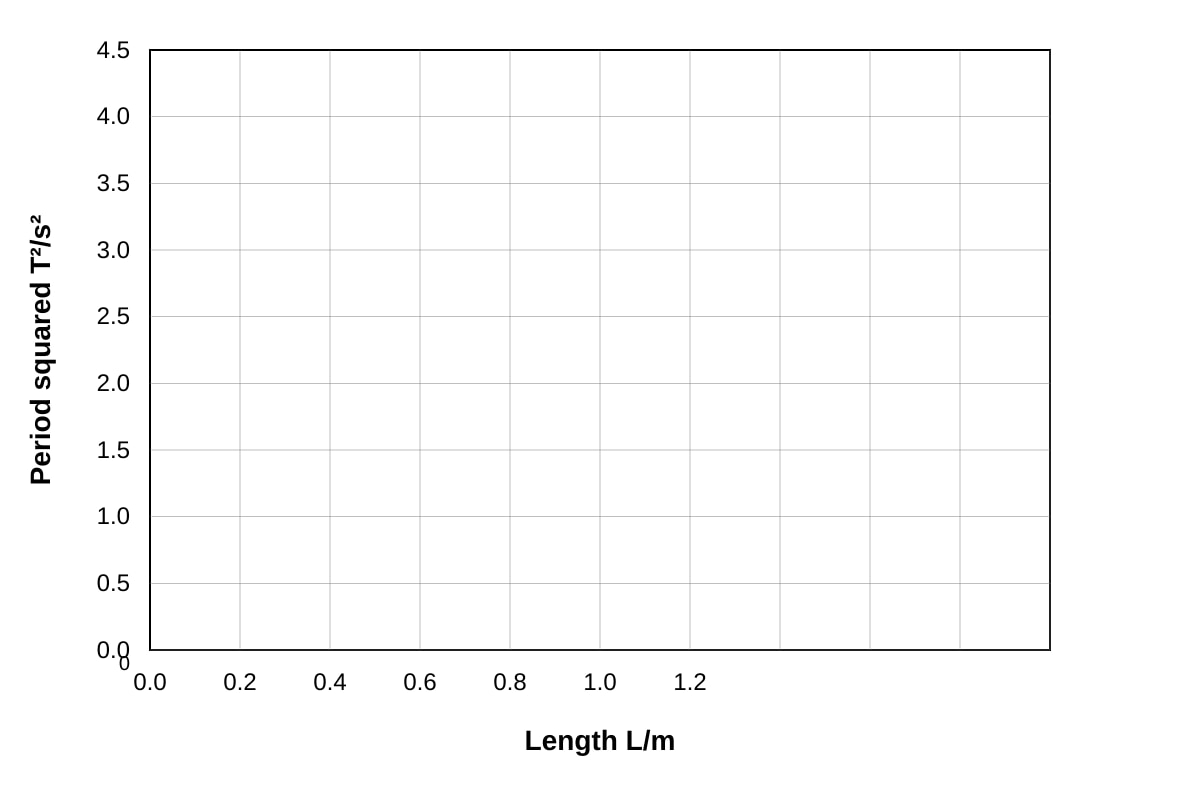
(b) Graph should show:
- Points plotted correctly (within half a small square)
- Straight line of best fit through origin (or nearly through origin)
- Important: Do not force line through origin if points suggest small intercept; however, theoretical line passes through origin
Image pending generation: graph for Q13(b).
Marking:
- [1] correct plotting of all points
- [1] correct axes labels with units
- [1] suitable scale and line of best fit
[3 marks]
(c) When T = 1.8 s, T² = 3.24 s²
From graph: reading at T² = 3.24 gives L ≈ 0.80-0.82 m (accept 0.78-0.84 m depending on line of best fit)
Working:
- T² = 1.8² = 3.24 s²
- Read across from T² = 3.24 to line of best fit, then down to L-axis
Marking:
- [1] correct calculation of T² = 3.24
- [1] correct reading from graph with unit
[2 marks]
(d) From T² = (4π²/g) × L, the gradient of T² vs L graph = 4π²/g
Gradient ≈ 4.0 s²/m (from graph: rise/run = 4.00/1.00 = 4.0)
g = 4π²/gradient = 4π²/4.0 = π² ≈ 9.87 m/s² (or approximately 9.8-10 m/s² depending on gradient)
Accept values in range 9.5-10.5 m/s²
Working:
- Gradient = Δ(T²)/ΔL = (4.00 - 0)/(1.00 - 0) = 4.0 s²/m
- g = 4π²/4.0 = 9.87 m/s²
Marking:
- [1] identifies gradient = 4π²/g or equivalent
- [1] correct gradient from graph (or 4.0 s²/m stated)
- [1] correct calculation of g with unit
[3 marks]
14
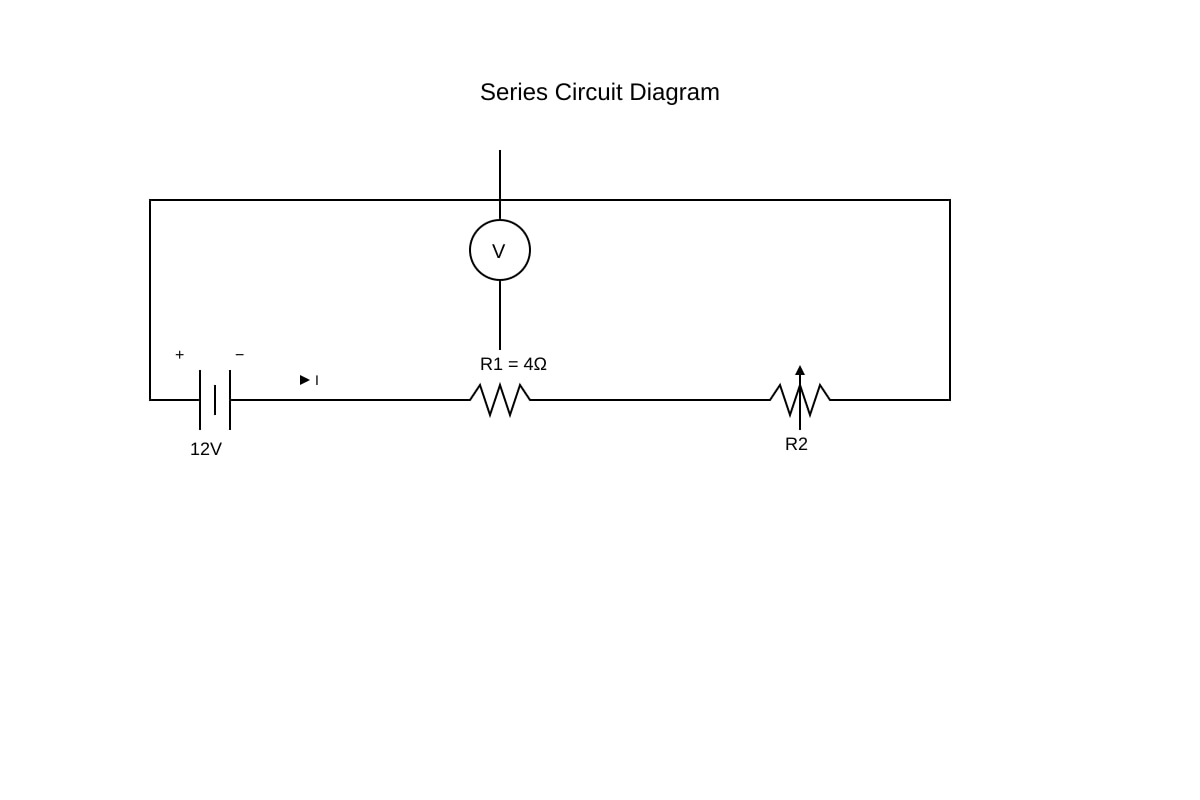
(a)(i) R_total = R₁ + R₂ = 4 + 8 = 12 Ω
Marking: [1] correct answer with unit
[1 mark]
(a)(ii) I = V/R_total = 12/12 = 1.0 A
Working:
- Total resistance = 12 Ω
- I = 12/12 = 1.0 A
Marking:
- [1] correct equation and substitution
- [1] correct answer with unit
[2 marks]
(a)(iii) V = IR = 1.0 × 4 = 4.0 V
Or using potential divider: V = 12 × (4/12) = 4.0 V
Marking:
- [1] correct method/equation
- [1] correct answer with unit
[2 marks]
(b) The voltmeter reading increases when the voltage share across the 4 Ω resistor increases. This happens when the variable resistance is decreased, which increases the total current (I = V/R_total). Since V = IR for the fixed resistor, larger current means larger voltage across it.
Alternative explanation: Decreasing R₂ reduces R_total, so current increases. The potential divider formula V₁ = V × R₁/(R₁+R₂) shows V₁ increases as R₂ decreases.
Marking:
- [1] states variable resistor should be decreased
- [1] explains via increased current or potential divider reasoning
[2 marks]
15
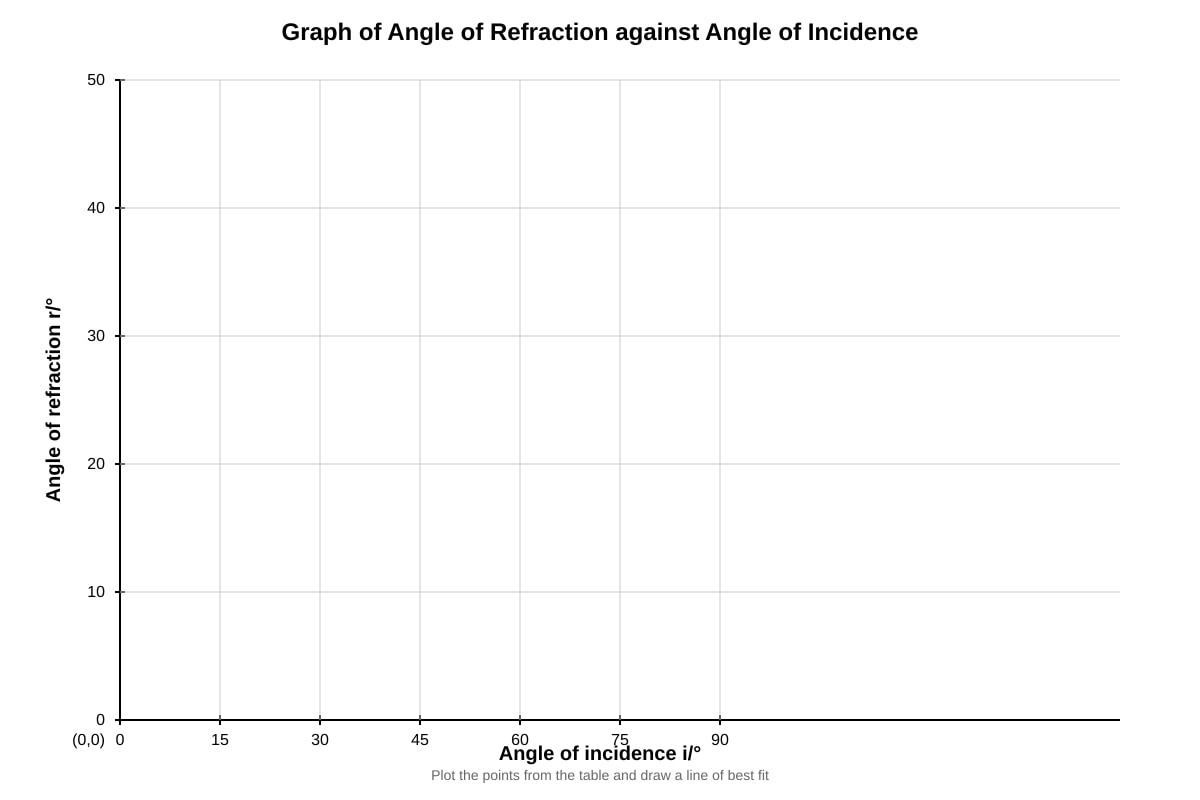
(a) Graph should show:
- All six points plotted
- Smooth curve (not straight line) drawn through points
- Curve bending away from linear, showing decreasing gradient
Image pending generation: graph for Q15(a).
Marking:
- [1] correct plotting of all points
- [1] smooth curve of best fit (not straight line)
[2 marks]
(b) From graph, at i = 50°, r ≈ 32-34°
Accept reasonable estimate from correctly drawn curve.
Marking: [1] for value consistent with candidate's graph (±2°)
[1 mark]
(c) The angle of refraction cannot exceed the critical angle for the air-plastic boundary, beyond which total internal reflection would occur. From the data, as i increases, r increases more slowly and appears to approach a maximum around 40-42° (the value at i = 75° is 40°, and the curve is flattening).
Marking:
- [1] identifies critical angle/total internal reflection as the limiting factor
- [1] estimates maximum r ≈ 40-45° from data trend
[2 marks]
16 Method:
- Place the bar magnet on a sheet of paper and draw around it
- Sprinkle iron filings evenly over the paper
- Gently tap the paper to allow filings to align with the magnetic field
- Observe that filings cluster most densely near the poles (N and S ends), forming concentrated patterns
Explanation: Iron filings become induced magnets and align with field lines. The density of filings indicates field strength—closer spacing means stronger field. Near poles, field lines converge, creating the densest patterns.
Alternative with plotting compass: Use plotting compass to trace field lines, noting shorter compass needle deflection steps needed near poles (smaller circles), indicating stronger field.
Marking:
- [1] appropriate method described (iron filings or plotting compass)
- [1] observation that filings are densest near poles / compass deflections indicate stronger field
- [1] explanation linking observation to magnetic field strength or field line concentration
[3 marks]
SECTION C [10 marks]
17
(a) KE = ½mv² = ½ × 1200 × 15² = 600 × 225 = 135 000 J (or 1.35 × 10⁵ J)
Working:
- KE = ½ × 1200 × 225
- = 600 × 225
- = 135 000 J
Marking:
- [1] correct substitution
- [1] correct answer with unit
[2 marks]
(b) Using work-energy principle: Work done by braking force = Initial KE (final KE = 0)
F × d = KE
F × 45 = 135 000
F = 135 000/45 = 3000 N
Alternative using kinematics:
- v² = u² + 2as; 0 = 225 + 2a(45); a = -2.5 m/s²
- F = ma = 1200 × 2.5 = 3000 N
Marking:
- [1] correct principle stated (work-energy or F=ma with a found)
- [1] correct substitution and working
- [1] correct answer with unit
[3 marks]
18
(a) Ultrasound is a longitudinal wave because:
- The particles of the medium vibrate parallel to the direction of wave travel (or energy transfer)
- It consists of compressions and rarefactions in the medium, not transverse displacements
Marking:
- [1] particles vibrate parallel to propagation direction
- [1] mention of compressions and rarefactions (or pressure variations)
[2 marks]
(b) The pulse travels to the boundary and back, so total distance = 2 × depth
Total distance = speed × time = 1500 × 4.0 × 10⁻⁵ = 0.06 m
Depth = 0.06/2 = 0.030 m (= 3.0 cm)
Working:
- Total distance = 1500 × 4.0 × 10⁻⁵ = 0.06 m
- One-way distance (depth) = 0.06/2 = 0.03 m = 3.0 cm
Marking:
- [1] recognizes total distance is twice depth (or uses time/2)
- [1] correct calculation of distance
- [1] correct depth with unit (m or cm acceptable if consistent)
Common mistake: Forgetting to divide by 2, giving 0.06 m or 6.0 cm.
[3 marks]
TOTAL MARKS: 60
Section A: 10 × 1 = 10 marks
Section B: 11 + 12 + 13 + 14 + 15 + 16 = 2+3+2 + 1+2+2 + 2+3+2+3 + 1+2+2+2 + 2+1+2 + 3 = 30 marks
Section C: 17 + 18 = 2+3 + 2+3 = 10 marks
Total: 10 + 30 + 10 = 60 marks ✓