From Real Exams Exam Paper
Secondary 3 Combined Science Semestral Assessment 2 (End of Year) Paper 5
Free Sec 3 Combined Sci SA2 Paper 5, HY3 Exam version, with questions, answers, and O Level-style practice for Singapore students.
These static practice materials are generated from the site's syllabus and paper-generation workflow, with source and model context shown so students and parents can evaluate the material before use.
Questions
TuitionGoWhere Exam Practice (AI) — Combined Science Secondary 3
SA2 Practice Paper — Physical Sciences (Version 5 of 5)
School: TuitionGoWhere Secondary School (AI)
Subject: Combined Science
Level: Secondary 3
Paper: SA2 Practice — Physical Sciences
Version: 5
Duration: 60 minutes
Total Marks: 60
Name: ______________________
Class: _________
Date: ____________
Instructions
- Answer all questions in the spaces provided.
- Show your working clearly for calculation questions.
- Use SI units where required.
- Section A: 10 short questions (1–2 marks each).
Section B: 6 structured questions (3–5 marks each).
Section C: 4 data/interpretation questions (3–5 marks each).
Section A (10 questions, 15 marks)
1. State the Principle of Conservation of Energy. [2]
2. A box of mass 4.0 kg is lifted vertically by 2.0 m. Calculate the gain in gravitational potential energy. (g=10 N/kg) [2]
3. Name the force that opposes motion between two surfaces in contact. [1]
4. A car travels 100 m in 5.0 s at constant speed. What is its speed? [1]
5. State one form of energy that is stored in a stretched rubber band. [1]
6. Give the formula for pressure exerted by a solid. [1]
7. An object is in equilibrium under three forces. State what is true about the resultant force. [1]
8. A spring extends by 0.05 m when a 2.0 N force is applied. State Hooke’s Law in words. [1]
9. Calculate the density of a block of mass 0.60 kg and volume 2.0×10⁻⁴ m3. [2]
10. State the direction of the frictional force on a book sliding to the right on a table. [1]
Section B (6 questions, 27 marks)
11. A 2.0 kg object is dropped from rest and falls 20 m.
(a) Calculate the loss in gravitational potential energy. [2]
(b) State the gain in kinetic energy assuming no air resistance. [1]
(c) Find the speed just before impact. [2]
12. Describe how blood from the lungs is forced into the aorta, naming the chambers and valves involved. [4]
13. A wooden plank is used as a lever to lift a load.
(a) Define moment of a force. [1]
(b) State the principle of moments for a body in equilibrium. [1]
(c) A force of 50 N is applied 0.80 m from the pivot. Calculate the moment. [2]
14. Explain why a potato strip placed in pure water becomes rigid and bends a horizontal plastic rod upward after two hours. Use the term water potential. [3]
15. A circuit consists of a 6.0 V battery and a resistor of 12 Ω.
(a) Calculate the current. [2]
(b) Calculate the power dissipated. [2]
(c) State one safety feature in household circuits. [1]
16. A student investigates pressure in liquids.
(a) State how pressure in a liquid depends on depth. [1]
(b) A tank contains water to a depth of 3.0 m. Calculate the pressure at the bottom. (ρ=1000 kg/m3, g=10 N/kg) [3]
Section C (4 questions, 18 marks)
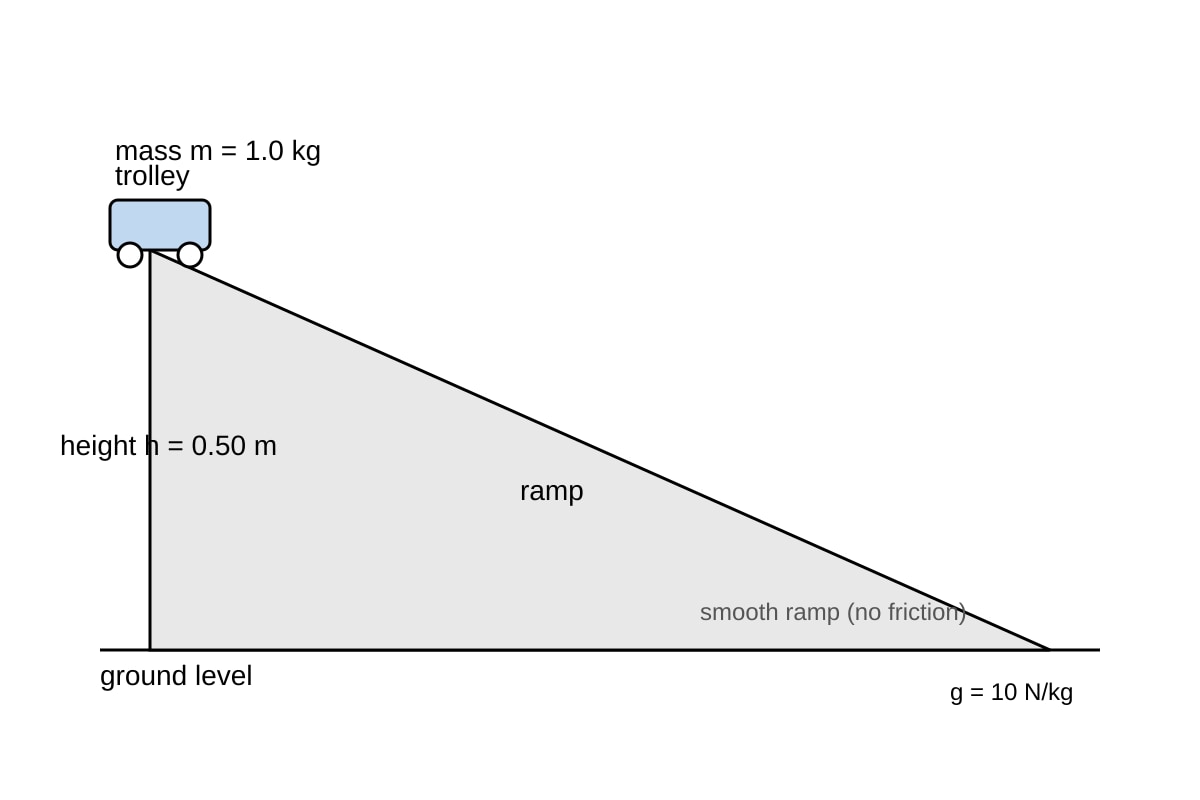
17. The diagram shows a trolley of mass 1.0 kg moving down a frictionless ramp from height 0.50 m.
Image pending generation: diagram for 17.
(a) Calculate the gravitational potential energy at the top. [2]
(b) State the kinetic energy at the bottom. [1]
(c) Find the speed at the bottom. [2]
18. Read the data table of a falling object:
| Time (s) | Speed (m/s) |
|---|---|
| 0.0 | 0.0 |
| 1.0 | 10.0 |
| 2.0 | 20.0 |
(a) Calculate the acceleration. [2]
(b) State the type of motion. [1]
(c) Explain how the data shows constant acceleration. [2]
19. A shoot of a plant is placed in a beaker with red dye. After 30 minutes the stem turns red.
(a) State the main force responsible for the rise of dye. [1]
(b) Name the tissue carrying the dye. [1]
(c) Describe the pathway of water from soil to leaf. [5]
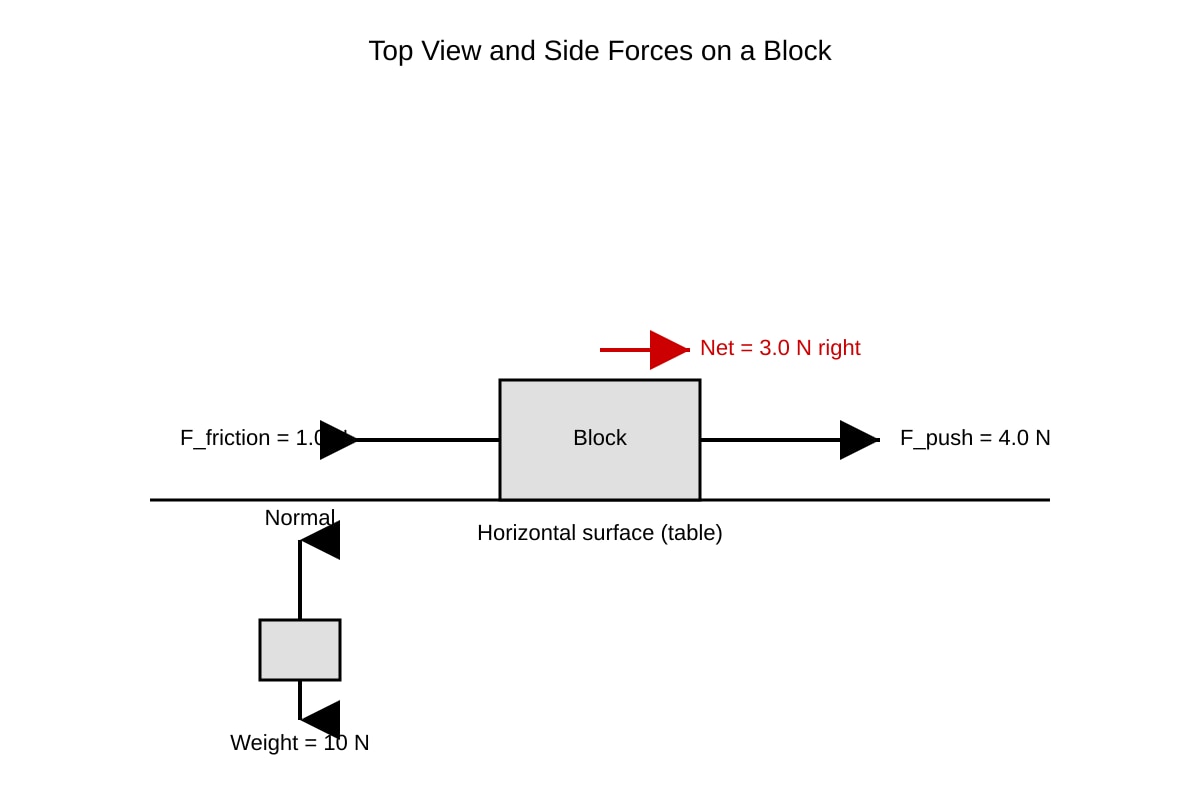
20. A 10 N block is pushed across a table with 4.0 N force and friction is 1.0 N.
Image pending generation: diagram for 20.
(a) Calculate the resultant force. [2]
(b) State the direction of acceleration. [1]
(c) If mass is 2.0 kg, find acceleration. [2]
Answers
TuitionGoWhere Exam Practice (AI) — Combined Science Secondary 3
SA2 Practice Paper — Physical Sciences (Version 5) — Answer Key
Total Marks: 60
Section A
1. [2] Energy cannot be created or destroyed, only converted from one form to another; total energy in a closed system is constant.
Teaching note: Conservation of energy means the total amount stays the same, only changes form (e.g., electrical to light). Common mistake: saying energy is “lost”.
2. [2] Ep=mgh=4.0×10×2.0=80 J.
Method: Substitute mass, g, height. Unit joule (J).
3. [1] Friction.
4. [1] v=td=5.0100=20 m/s.
5. [1] Elastic potential energy.
6. [1] P=AF (pressure = force / area).
7. [1] Resultant force is zero.
8. [1] Extension is directly proportional to applied force (up to limit of proportionality).
9. [2] ρ=Vm=2.0×10−40.60=3000 kg/m3.
10. [1] To the left (opposes motion to the right).
Section B
11. [6]
(a) [2] ΔEp=mgh=2.0×10×20=400 J.
(b) [1] 400 J (no air resistance, GPE loss = KE gain).
(c) [2] KE=21mv2⇒400=21(2.0)v2⇒v2=400⇒v=20 m/s.
12. [4] Oxygenated blood returns from lungs via pulmonary veins to left atrium [1]; left atrium contracts raising pressure [1]; blood flows to left ventricle [1]; left ventricle contracts forcing blood through aortic valve into aorta [1].
13. [6]
(a) [1] Moment = force × perpendicular distance from pivot.
(b) [1] Sum of clockwise moments = sum of anticlockwise moments.
(c) [2] M=Fd=50×0.80=40 N⋅m.
14. [3] Water has higher water potential than potato [1]; water enters potato by osmosis [1]; potato becomes turgid and pushes rod upward [1].
15. [5]
(a) [2] I=RV=126.0=0.50 A.
(b) [2] P=VI=6.0×0.50=3.0 W.
(c) [1] Fuse / earth wire / circuit breaker.
16. [4]
(a) [1] Pressure increases with depth.
(b) [3] P=ρgh=1000×10×3.0=30000 Pa (or 3.0×10⁴ Pa).
Section C
17. [5]
(a) [2] Ep=mgh=1.0×10×0.50=5.0 J.
(b) [1] 5.0 J.
(c) [2] 21mv2=5.0⇒v2=10⇒v=3.16 m/s (accept 3.2).
Image must show height and mass as labelled.
18. [5]
(a) [2] a=ΔtΔv=2.0−0.020.0−0.0=10 m/s2.
(b) [1] Uniform acceleration.
(c) [2] Speed increases by equal amount (10 m/s) each second, showing constant rate.
19. [7]
(a) [1] Transpiration pull (or capillary action).
(b) [1] Xylem.
(c) [5] Water absorbed by root hair [1]; through cortex to xylem [1]; up stem in xylem [1]; to leaves [1]; exits via stomata (transpiration) [1].
20. [5]
(a) [2] Fnet=4.0−1.0=3.0 N.
(b) [1] To the right.
(c) [2] a=mF=2.03.0=1.5 m/s2.
Image must show arrows with correct directions and values.
Free quiz and exam paper access
Enter your details to view this paper
Your access is remembered on this device.