From Real Exams Exam Paper
Secondary 3 Combined Science Semestral Assessment 2 (End of Year) Paper 5
Free Sec 3 Combined Sci SA2 Paper 5, DeepSeek Exam version, with questions, answers, and O Level-style practice for Singapore students.
These static practice materials are generated from the site's syllabus and paper-generation workflow, with source and model context shown so students and parents can evaluate the material before use.
Questions
Free quiz and exam paper access
Enter your details to view this paper
Your access is remembered on this device.
Answers
TuitionGoWhere Practice Paper – Combined Science Secondary 3
SA2 Examination, Version 5 – Answer Key and Marking Scheme
TuitionGoWhere Secondary School (AI)
Subject: Combined Science (Physics, Chemistry, Biology) Level: Secondary 3 Paper: SA2 (Semester 2 Assessment) Total Marks: 60
Section A: Multiple Choice and Short Answer (20 marks)
1. C – Energy cannot be created or destroyed; it can only be converted from one form to another. [1 mark]
Marking note: Award 1 mark for correct option only.
2. (a) As the distance from the lamp increases, the number of bubbles per minute decreases / the rate of photosynthesis decreases. [1 mark]
Marking note: Accept any clear statement of inverse relationship. Do not award mark for simply restating data without describing the trend.
(b) Any one of:
- Temperature of the water
- Concentration of carbon dioxide in the water
- Type/species of aquatic plant
- Volume of water used
[1 mark]
Marking note: Award 1 mark for any valid controlled variable. Do not accept "light intensity" or "distance from lamp" as these are the independent variable.
(c) To prevent heat from the lamp from affecting the temperature of the water / to ensure that temperature is kept constant / to ensure that only light intensity is changed. [1 mark]
Marking note: Award 1 mark for any answer that clearly identifies the heat shield as controlling temperature as a variable.
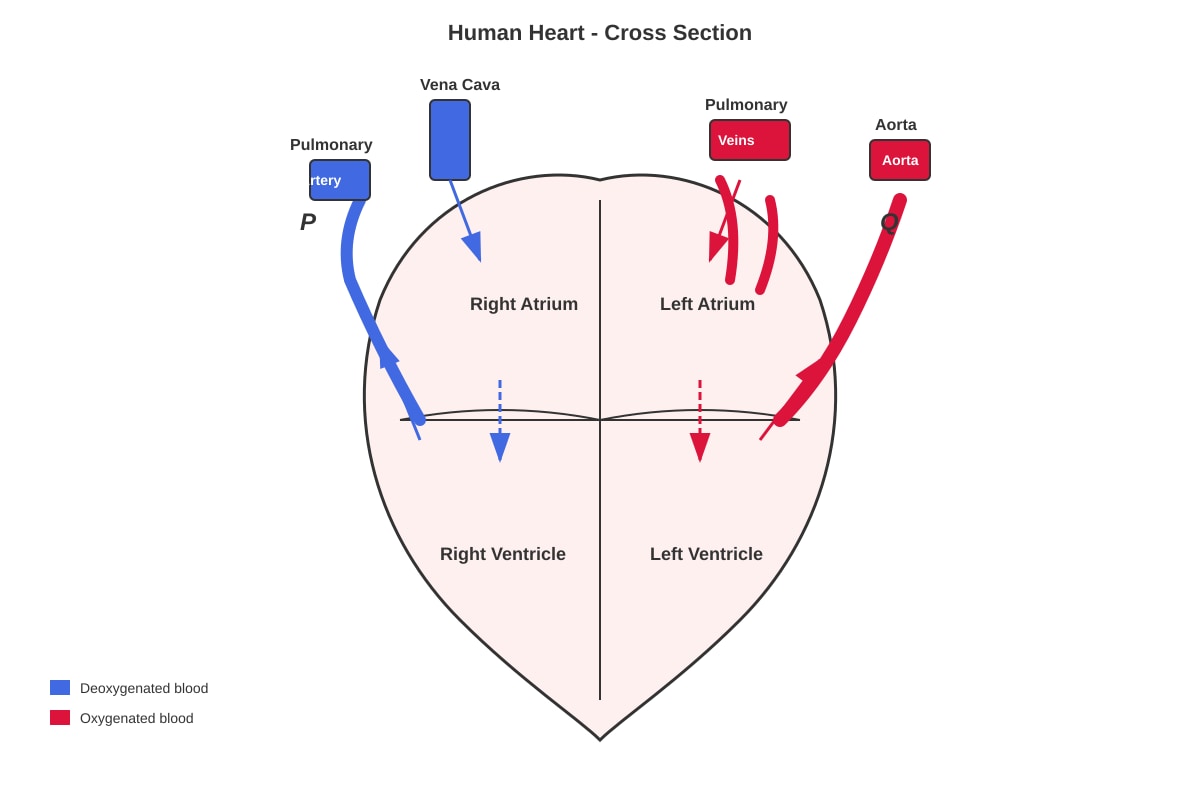
3. (a) P: Pulmonary veins [1 mark] Q: Aorta [1 mark]
Marking note: Award 1 mark for each correct label. Accept "pulmonary vein" (singular).
(b) Oxygenated blood returns from the lungs to the left atrium via the pulmonary veins [1 mark]. The left atrium contracts, increasing pressure and forcing blood into the left ventricle [1 mark]. The left ventricle contracts, increasing pressure and forcing blood through the aortic valve into the aorta [1 mark].
Marking note: Award 1 mark for each distinct step. Accept alternative phrasing that clearly describes the pathway and role of pressure/contraction. Do not award marks for descriptions that omit the role of atrial or ventricular contraction.
4. (a) The water potential in the distilled water is higher than the water potential in the potato cells [1 mark]. Water enters the potato cells by osmosis [1 mark]. The potato cells become turgid and expand, exerting pressure on the plastic rod, causing it to bend downwards [1 mark].
Marking note: Award 1 mark for each component. Accept "water concentration" as equivalent to "water potential" at this level. Do not award marks for answers that do not mention osmosis.
(b) Turgid / The cell membrane is pressed against the cell wall. [1 mark]
Marking note: Award 1 mark for "turgid" or an equivalent description. Do not accept "plasmolysed" or "flaccid".
5. (a) The amount of amino acids increases because proteins/polypeptides are digested by protease enzymes into amino acids in the small intestine [1 mark]. The amount then decreases because amino acids are absorbed into the blood through the wall of the small intestine [1 mark].
Marking note: Award 1 mark for digestion explanation and 1 mark for absorption explanation. Accept "protease" or "peptidase" as the enzyme name.
(b) Amylase / Pancreatic amylase [1 mark]
Marking note: Award 1 mark for "amylase". Accept "pancreatic amylase" or "salivary amylase" (though salivary amylase acts mainly in the mouth).
6. (a) Equation 2 represents aerobic respiration [1 mark]. This is because it requires/uses oxygen / it produces carbon dioxide and water (not lactic acid) [1 mark].
Marking note: Award 1 mark for correct identification and 1 mark for a valid reason. Accept any reason that correctly distinguishes aerobic from anaerobic respiration.
(b) During vigorous/strenuous exercise / when oxygen supply to muscles is insufficient / during sprinting or heavy lifting. [1 mark]
Marking note: Award 1 mark for any valid situation where anaerobic respiration occurs in human muscles.
Section B: Structured Questions (20 marks)
7. (a) 2ZnS(s) + 3O₂(g) → 2ZnO(s) + 2SO₂(g) [2 marks]
Marking note: Award 1 mark for correct formulae and balancing, and 1 mark for correct state symbols. Deduct 1 mark if state symbols are missing or incorrect. Accept fractional coefficients if correctly balanced.
(b) 2ZnO(s) + C(s) → 2Zn(s) + CO₂(g) [2 marks]
Marking note: Award 1 mark for correct formulae and balancing, and 1 mark for correct state symbols. Deduct 1 mark if state symbols are missing or incorrect.
(c) Molar mass of ZnO = 65 + 16 = 81 g/mol [1 mark] Moles of ZnO = 9.70 ÷ 81 = 0.1198 mol [1 mark for correct calculation] From equation (b), 2 mol ZnO produces 2 mol Zn, so mole ratio is 1:1. Moles of Zn produced = 0.1198 mol Mass of Zn = 0.1198 × 65 = 7.79 g (to 3 significant figures) [1 mark for correct final answer with units]
Marking note: Award marks for correct method even if final answer is slightly different due to rounding. Accept 7.8 g or 7.79 g. Deduct 1 mark if units are missing from final answer.
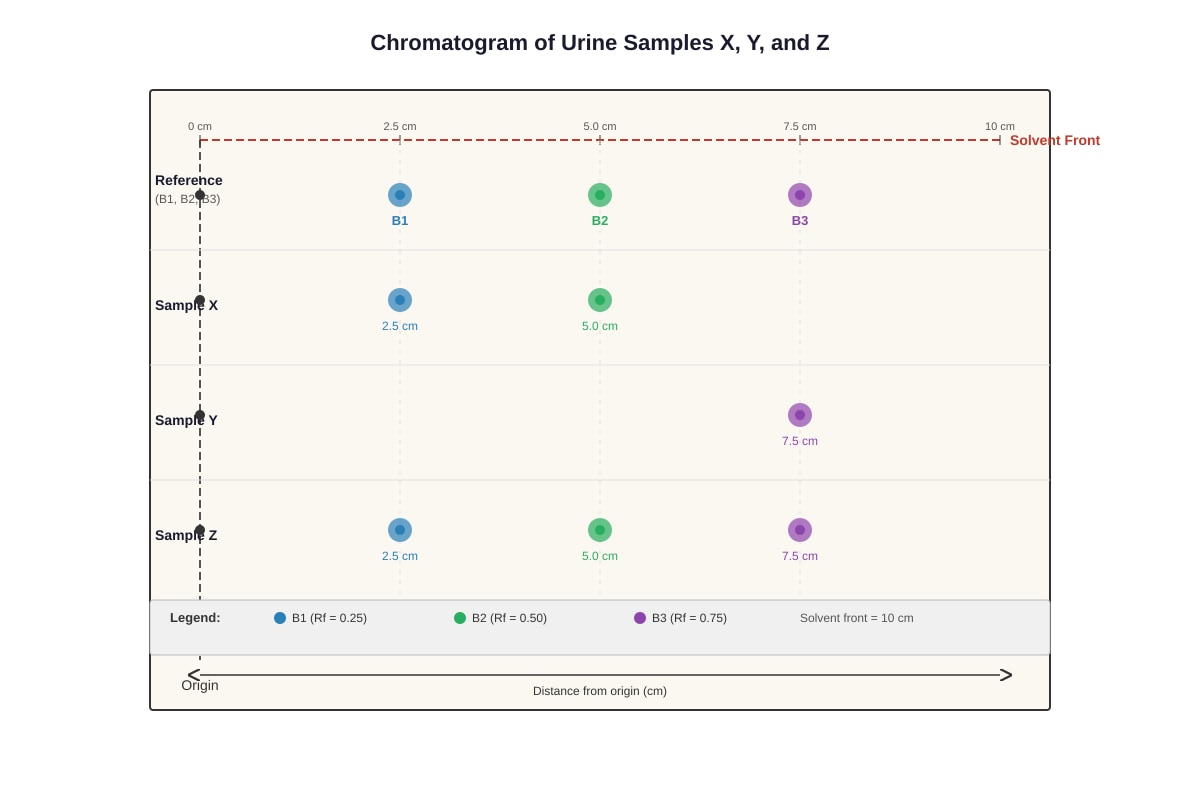
8. (a) Rf = distance travelled by substance ÷ distance travelled by solvent front [1 mark] Rf of B2 = 5.0 cm ÷ 10.0 cm = 0.50 [1 mark]
Marking note: Award 1 mark for correct formula or method, and 1 mark for correct answer. Accept 0.5.
(b) Athlete Y and Athlete Z [1 mark]
Marking note: Award 1 mark for both athletes correctly identified. Do not award half marks.
(c) Athlete Z's urine sample contains all three banned substances (B1, B2, and B3) [1 mark], indicating that Athlete Z has taken multiple banned substances / has the most severe doping offence [1 mark].
Marking note: Award 1 mark for identifying that all three substances are present, and 1 mark for explaining the implication. Accept any reasonable explanation of why multiple banned substances is more serious.
9. (a) Plasmolysed [1 mark]
Marking note: Award 1 mark for "plasmolysed". Accept "plasmolysis" or "the cell is plasmolysed".
(b) The concentrated sucrose solution has a lower water potential than the cell sap/cytoplasm of the plant cell [1 mark]. Water moves out of the cell by osmosis, from a region of higher water potential to a region of lower water potential [1 mark]. As water leaves the cell, the vacuole shrinks and the cell membrane/cytoplasm pulls away from the cell wall [1 mark].
Marking note: Award 1 mark for each component. Accept "water concentration" as equivalent to "water potential". Do not award marks if osmosis is not mentioned.
(c) If the cell is transferred to distilled water, the water potential outside the cell would be higher than inside the cell [1 mark]. Water would enter the cell by osmosis, causing the cell to become turgid again / the cell membrane would press against the cell wall [1 mark].
Marking note: Award 1 mark for identifying the direction of water movement and 1 mark for describing the outcome (turgid).
10. (a) ZnCO₃(s) + 2HNO₃(aq) → Zn(NO₃)₂(aq) + CO₂(g) + H₂O(l) [2 marks]
Marking note: Award 1 mark for correct formulae and balancing, and 1 mark for correct state symbols. Deduct 1 mark if state symbols are missing or incorrect.
(b) ZnCO₃(s) + 2H⁺(aq) → Zn²⁺(aq) + CO₂(g) + H₂O(l) [2 marks]
Marking note: Award 1 mark for correct reactants and products (excluding spectator ions), and 1 mark for correct balancing and state symbols. Spectator ions (NO₃⁻) should be omitted. Deduct 1 mark if spectator ions are included.
Section C: Data Analysis and Extended Response (20 marks)
11. (a) Transpiration pull [1 mark]
Marking note: Award 1 mark for "transpiration pull". Accept "transpiration" alone. Do not accept "root pressure" as the main force.
(b) Water is absorbed from the soil by the root hair cells [1 mark]. Water moves through the cortex and endodermis of the root [1 mark]. Water enters the xylem vessels in the root [1 mark]. Water is transported up the stem through the xylem vessels [1 mark]. Water reaches the leaves and exits through the stomata as water vapour by transpiration [1 mark].
Marking note: Award 1 mark for each distinct step. Accept alternative phrasing that clearly describes the pathway. Do not award marks for descriptions that omit the role of root hair cells or stomata.
(c) Function: Transport water and mineral salts from roots to other parts of the plant / Provide mechanical support [1 mark] Adaptation: Lignified walls for strength / Hollow lumen (no cross-walls) for continuous water transport / Narrow diameter for capillarity [1 mark]
Marking note: Award 1 mark for a correct function and 1 mark for a correct adaptation. The adaptation must be linked to the stated function or be a valid structural feature of xylem.
12. (a) The lock-and-key hypothesis states that the active site of an enzyme has a specific shape that is complementary to the shape of its substrate [1 mark]. Glycogen (the substrate) fits into the active site of glycogen phosphorylase, forming an enzyme-substrate complex [1 mark]. The enzyme catalyses the breakdown of glycogen to glucose-1-phosphate [1 mark]. The products are released, and the enzyme remains unchanged and can be reused [1 mark].
Marking note: Award 1 mark for each component. Accept alternative phrasing that clearly explains the lock-and-key model. Do not award marks for descriptions that do not mention the specificity of the active site or the formation of the enzyme-substrate complex.
(b) Test tube D has a pH of 3.0, which is far from the optimum pH of glycogen phosphorylase [1 mark]. The extreme pH denatures the enzyme / changes the shape of the active site, so the substrate (glycogen) can no longer fit into the active site, reducing the rate of reaction [1 mark].
Marking note: Award 1 mark for identifying pH as the factor and 1 mark for explaining denaturation or change in active site shape. Accept "the enzyme is denatured" as sufficient explanation if linked to pH.
(c) Very little or no glucose-1-phosphate would be produced / approximately 0 mmol [1 mark]. At 55 °C, the high temperature would denature the enzyme / the enzyme would lose its specific shape, and the active site would no longer be complementary to the substrate [1 mark].
Marking note: Award 1 mark for correct prediction and 1 mark for explanation involving denaturation at high temperature. Accept "0 mmol" or "negligible amount".
13. (a) Graph plotting [3 marks]:
- 1 mark for correct axes: x-axis labelled "Time (s)" and y-axis labelled "Volume of hydrogen gas (cm³)" with appropriate scales
- 1 mark for all points plotted correctly (±1 mm tolerance)
- 1 mark for smooth curve of best fit drawn through the points
Marking note: Award marks as indicated. If axes are unlabelled or scales are inappropriate, deduct 1 mark. If points are incorrectly plotted, deduct 1 mark per error up to a maximum of 1 mark. If a straight line is drawn instead of a curve, deduct 1 mark.
(b) Approximately 34–35 cm³ (accept 33–36 cm³) [1 mark]
Marking note: Award 1 mark for a value within the acceptable range, read correctly from the candidate's graph. The value must be consistent with the graph drawn.
(c) All the magnesium has been used up / the reaction is complete / the limiting reactant (magnesium) has been completely consumed [1 mark].
Marking note: Award 1 mark for any answer that correctly identifies that the reaction has stopped because the magnesium is used up. Do not accept "the acid has run out" as hydrochloric acid is in excess.
(d) Curve P should:
- Start at the origin (0,0) [1 mark]
- Rise more steeply than the original curve initially
- Reach the same final volume (48 cm³) but in a shorter time
- Level off before the original curve
[2 marks]
Marking note: Award 1 mark for a steeper initial gradient, and 1 mark for reaching the same final volume in a shorter time. The curve must be clearly labelled "P". If the curve exceeds the final volume of 48 cm³, do not award the second mark.
End of Answer Key
Total marks: 60