From Real Exams Exam Paper
Secondary 3 Combined Science Semestral Assessment 2 (End of Year) Paper 4
Free Sec 3 Combined Sci SA2 Paper 4, DeepSeek Exam version, with questions, answers, and O Level-style practice for Singapore students.
These static practice materials are generated from the site's syllabus and paper-generation workflow, with source and model context shown so students and parents can evaluate the material before use.
Questions
Free quiz and exam paper access
Enter your details to view this paper
Your access is remembered on this device.
Answers
TuitionGoWhere Practice Paper – Combined Science Secondary 3
SA2 Version 4 – Answer Key and Marking Scheme
Total Marks: 70
Section A: Physical Sciences – Physics (25 marks)
1. (a) State the principle of conservation of energy. [1]
Answer: Energy cannot be created or destroyed. It can only be converted/transferred from one form to another. The total energy in a closed/isolated system remains constant.
Marking notes:
- Award [1] for stating both that energy cannot be created or destroyed AND that it is converted/transferred, OR that total energy remains constant.
- Accept: "Energy is neither created nor destroyed, only changed from one form to another."
1. (b) Calculate the kinetic energy of the bob at the lowest point. [2]
Working:
- Total energy at P = GPE at P + KE at P = 2.5 J + 0 J = 2.5 J
- By conservation of energy, total energy at lowest point = 2.5 J
- Total energy at lowest point = GPE at lowest point + KE at lowest point
- 2.5 J = 0.4 J + KE
- KE = 2.5 J – 0.4 J = 2.1 J
Answer: 2.1 J
Marking notes:
- Award [1] for stating or showing that total energy is conserved (total energy = 2.5 J).
- Award [1] for correct calculation and answer with unit.
- Accept 2.1 J with correct working.
2. (a) Explain why the box moves with constant velocity even though a force is applied. [2]
Answer: The applied force is balanced by an equal and opposite frictional force acting on the box. Since the resultant/net force on the box is zero, according to Newton's First Law, the box continues moving at constant velocity.
Marking notes:
- Award [1] for stating that friction opposes the applied force / forces are balanced.
- Award [1] for linking to zero resultant force and constant velocity / Newton's First Law.
2. (b) Calculate the weight of the box. [1]
Working: Weight = mass × gravitational field strength = 6.0 kg × 10 N/kg = 60 N
Answer: 60 N
Marking notes:
- Award [1] for correct answer with unit.
3. (a) Calculate the maximum pressure the block can exert on the table. [3]
Working:
- Weight of block = mg = 4.0 kg × 10 N/kg = 40 N
- Force on table = 40 N
- Maximum pressure occurs when area of contact is smallest.
- Smallest area = 0.10 m × 0.05 m = 0.0050 m²
- Pressure = Force / Area = 40 N / 0.0050 m² = 8000 Pa (or 8.0 × 10³ Pa)
Answer: 8000 Pa (or 8.0 kPa)
Marking notes:
- Award [1] for calculating weight/force (40 N).
- Award [1] for identifying the smallest area (0.0050 m²).
- Award [1] for correct pressure calculation with unit.
3. (b) State one way the block can be positioned to exert the minimum pressure on the table. [1]
Answer: Place the block so that the largest face (0.20 m × 0.10 m) is in contact with the table.
Marking notes:
- Award [1] for stating the largest area face should be in contact.
- Accept: "Place the 0.20 m × 0.10 m face on the table."
4. (a) Calculate the total energy supplied by the heater. [2]
Working:
- Time = 10 minutes = 10 × 60 = 600 s
- Energy = Power × Time = 50 W × 600 s = 30,000 J (or 30 kJ)
Answer: 30,000 J (or 30 kJ)
Marking notes:
- Award [1] for correct conversion of time to seconds.
- Award [1] for correct calculation with unit.
4. (b) Calculate the final temperature of the water, assuming no heat loss. [3]
Working:
- Energy supplied = 30,000 J
- Mass of water = 500 g = 0.50 kg
- E = mcΔθ
- 30,000 = 0.50 × 4200 × Δθ
- Δθ = 30,000 / (0.50 × 4200) = 30,000 / 2100 = 14.3 °C (to 1 d.p.)
- Final temperature = 25 °C + 14.3 °C = 39.3 °C
Answer: 39.3 °C (accept 39 °C or 39.3 °C)
Marking notes:
- Award [1] for correct substitution into E = mcΔθ.
- Award [1] for correct calculation of temperature rise (14.3 °C).
- Award [1] for adding to initial temperature with correct final answer and unit.
5. (a) State what is meant by refraction of light. [1]
Answer: Refraction is the bending/changing direction of light as it passes from one medium to another of different optical density.
Marking notes:
- Award [1] for stating bending/change in direction AND change in medium/optical density.
5. (b) Explain why the light ray bends towards the normal as it enters the glass block. [2]
Answer: Glass is optically denser than air. When light enters the glass, its speed decreases. This causes the light ray to bend towards the normal.
Marking notes:
- Award [1] for stating that glass is optically denser / light slows down in glass.
- Award [1] for linking decreased speed to bending towards the normal.
6. (a) Calculate the total resistance in the circuit. [1]
Working: R_total = R₁ + R₂ = 4 Ω + 8 Ω = 12 Ω
Answer: 12 Ω
Marking notes:
- Award [1] for correct answer with unit.
6. (b) Calculate the current flowing through the circuit. [2]
Working: I = V / R = 12 V / 12 Ω = 1.0 A
Answer: 1.0 A
Marking notes:
- Award [1] for correct formula/substitution.
- Award [1] for correct answer with unit.
6. (c) Calculate the potential difference across R₂. [2]
Working: V = IR = 1.0 A × 8 Ω = 8.0 V
Answer: 8.0 V
Marking notes:
- Award [1] for correct formula/substitution.
- Award [1] for correct answer with unit.
- Accept alternative method using potential divider principle.
Section B: Physical Sciences – Chemistry (25 marks)
7. (a) Write a balanced chemical equation for roasting of zinc sulfide. [2]
Answer: 2ZnS(s) + 3O₂(g) → 2ZnO(s) + 2SO₂(g)
Marking notes:
- Award [1] for correct reactants and products.
- Award [1] for correct balancing and state symbols.
- Accept: 2ZnS(s) + 3O₂(g) → 2ZnO(s) + 2SO₂(g)
7. (b) Write a balanced chemical equation for reduction of zinc oxide. [2]
Answer: 2ZnO(s) + C(s) → 2Zn(s) + CO₂(g)
OR ZnO(s) + C(s) → Zn(s) + CO(g)
Marking notes:
- Award [1] for correct reactants and products.
- Award [1] for correct balancing and state symbols.
- Accept either equation with CO₂ or CO as product, provided it is balanced.
7. (c) Calculate the mass of zinc extracted from 9.7 g of ZnS. [3]
Working:
- Mᵣ of ZnS = 65 + 32 = 97
- Moles of ZnS = 9.7 g / 97 g/mol = 0.10 mol
- From equation: 2 mol ZnS → 2 mol Zn, so mole ratio is 1:1
- Moles of Zn = 0.10 mol
- Mass of Zn = 0.10 mol × 65 g/mol = 6.5 g
Answer: 6.5 g
Marking notes:
- Award [1] for calculating Mᵣ of ZnS and moles of ZnS.
- Award [1] for using correct mole ratio.
- Award [1] for correct mass of Zn with unit.
8. (a) Write a balanced chemical equation for the reaction. [2]
Answer: CaCO₃(s) + 2HCl(aq) → CaCl₂(aq) + CO₂(g) + H₂O(l)
Marking notes:
- Award [1] for correct reactants and products.
- Award [1] for correct balancing and state symbols.
8. (b) Write the ionic equation for this reaction. [2]
Answer: CaCO₃(s) + 2H⁺(aq) → Ca²⁺(aq) + CO₂(g) + H₂O(l)
Marking notes:
- Award [1] for correct reactants (CaCO₃ and H⁺).
- Award [1] for correct products, balancing, and state symbols.
- Spectator ions (Cl⁻) must not be included.
8. (c) Calculate the volume of CO₂ produced. [3]
Working:
- Mᵣ of CaCO₃ = 40 + 12 + (3 × 16) = 100
- Moles of CaCO₃ = 2.0 g / 100 g/mol = 0.020 mol
- From equation: 1 mol CaCO₃ → 1 mol CO₂
- Moles of CO₂ = 0.020 mol
- Volume of CO₂ = 0.020 mol × 24 dm³/mol = 0.48 dm³ (or 480 cm³)
Answer: 0.48 dm³ (or 480 cm³)
Marking notes:
- Award [1] for calculating moles of CaCO₃.
- Award [1] for using correct mole ratio.
- Award [1] for correct volume with unit.
9. (a) State which dye(s) are present in ink sample A. [1]
Answer: Dye X only.
Marking notes:
- Award [1] for correctly identifying dye X.
- Accept: "X" or "Dye X."
9. (b) Identify the dyes in ink sample B. [1]
Answer: Dyes X and Y.
Marking notes:
- Award [1] for correctly identifying both dyes X and Y.
9. (c) Calculate the Rf value of dye Y. [2]
Working: Rf = distance travelled by substance / distance travelled by solvent front = 4.8 cm / 8.0 cm = 0.60
Answer: 0.60 (or 0.6)
Marking notes:
- Award [1] for correct formula/substitution.
- Award [1] for correct answer (no units required for Rf).
10. (a) State one observation during the reaction. [1]
Answer: Effervescence / bubbles of gas produced / magnesium ribbon dissolves/disappears / magnesium ribbon becomes smaller.
Marking notes:
- Award [1] for any one correct observation.
10. (b) Explain, using collision theory, why the rate decreases as the reaction proceeds. [2]
Answer: As the reaction proceeds, the concentration of sulfuric acid decreases. This means there are fewer hydrogen ions per unit volume. The frequency of effective collisions between reactant particles decreases, so the rate of reaction decreases.
Marking notes:
- Award [1] for stating that concentration of acid/reactant decreases.
- Award [1] for linking to decreased frequency of effective collisions.
10. (c) Suggest one change to increase the initial rate of reaction. [1]
Answer: Use magnesium powder instead of ribbon (increase surface area) / Heat the acid (increase temperature) / Use a catalyst.
Marking notes:
- Award [1] for any one correct suggestion.
- Accept: "Use powdered magnesium" or "Warm the acid."
Section C: Physical Sciences – Biology (20 marks)
11. (a) Name the blood vessels labelled P and Q. [2]
Answer:
- P: Pulmonary vein
- Q: Aorta
Marking notes:
- Award [1] for each correct answer.
11. (b) Describe the pathway of blood from the lungs to the aorta. [4]
Answer:
- Oxygenated blood returns from the lungs to the left atrium via the pulmonary veins. [1]
- The left atrium contracts, increasing pressure and pushing blood into the left ventricle. [1]
- The left ventricle contracts, increasing pressure further. [1]
- Blood is forced through the aortic valve/semilunar valve into the aorta and then to the rest of the body. [1]
Marking notes:
- Award [1] for each distinct step.
- Accept answers that mention pressure changes and valve function.
12. (a) Explain why the potato strip in 0.0 mol/dm³ sucrose solution increased in length. [3]
Answer:
- The water potential of the solution (pure water) is higher than the water potential of the potato cells. [1]
- Water enters the potato cells by osmosis. [1]
- The cells become turgid, causing the potato strip to increase in length. [1]
Marking notes:
- Award [1] for identifying water potential gradient.
- Award [1] for stating osmosis.
- Award [1] for linking to turgidity and increase in length.
12. (b) Describe the state of the potato cells in 0.8 mol/dm³ sucrose solution. [2]
Answer: The cells are plasmolysed. The cell membrane/cytoplasm has shrunk/pulled away from the cell wall due to water leaving the cells by osmosis.
Marking notes:
- Award [1] for stating "plasmolysed."
- Award [1] for describing cell membrane shrinking away from cell wall.
12. (c) Estimate the concentration of sucrose solution with the same water potential as the potato cells. [2]
Answer: Approximately 0.28–0.32 mol/dm³. This is the concentration at which there is no change in length (0 mm change), meaning no net movement of water by osmosis.
Marking notes:
- Award [1] for a value between 0.28 and 0.32 mol/dm³.
- Award [1] for explaining that no change in length indicates equal water potential / no net osmosis.
13. (a) Suggest how the student could vary the light intensity. [1]
Answer: Change the distance of the lamp from the plant / Use lamps of different power/wattage / Use different numbers of lamps.
Marking notes:
- Award [1] for any one correct method.
13. (b) State the purpose of the glass heat shield. [1]
Answer: To prevent heat from the lamp from affecting the temperature of the plant/water / To ensure temperature is kept constant / To ensure temperature is a controlled variable.
Marking notes:
- Award [1] for stating that it controls temperature or prevents heating.
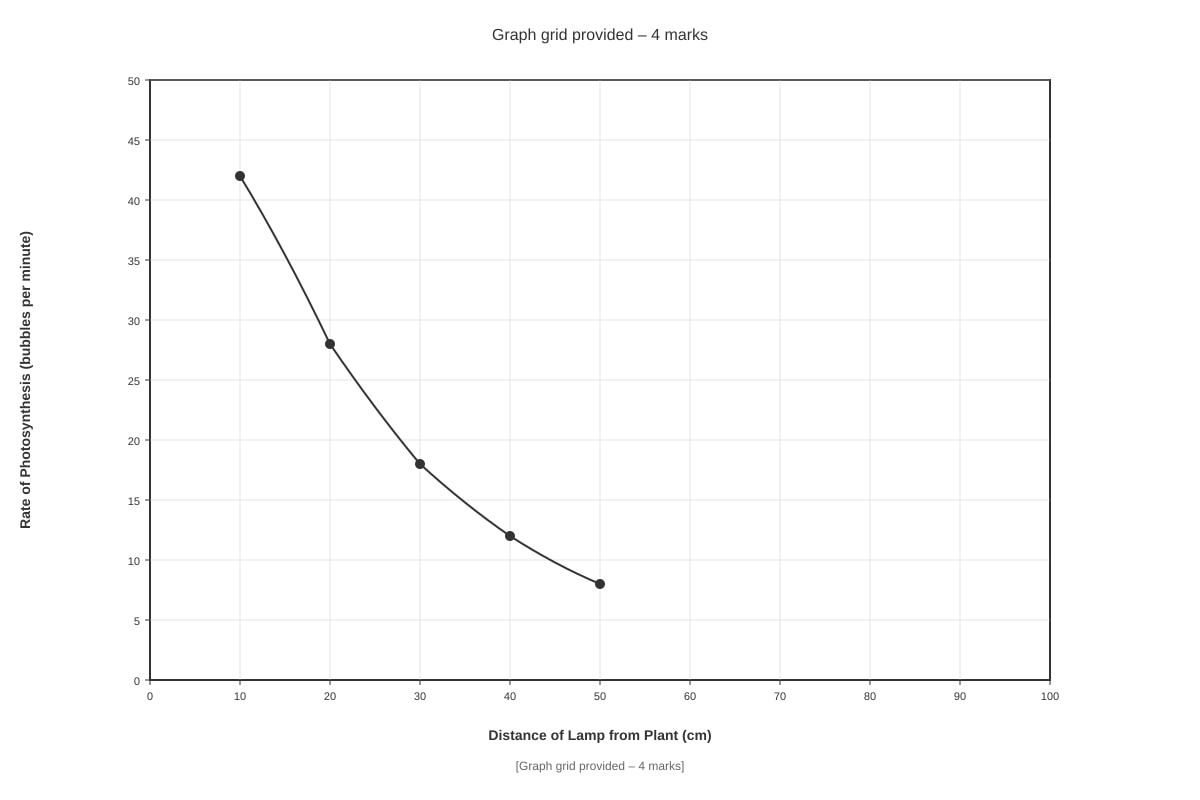
13. (c) Plot a graph of the results. [4]
Graph requirements:
- X-axis: Distance of lamp (cm) – linear scale from 0 to 50 [1]
- Y-axis: Number of bubbles per minute – linear scale from 0 to 50 [1]
- All 5 points plotted correctly (± half a small square) [1]
- Smooth curve or appropriate line of best fit drawn [1]
Marking notes:
- Award marks as indicated above.
- Deduct [1] if axes are not labelled with quantities and units.
13. (d) Describe the relationship shown by the data. [1]
Answer: As the distance of the lamp increases, the rate of photosynthesis (number of bubbles per minute) decreases. / The rate of photosynthesis decreases with increasing distance from the light source.
Marking notes:
- Award [1] for stating the inverse relationship.
14. (a) State one difference between inhaled and exhaled air. [1]
Answer: Exhaled air contains less oxygen / more carbon dioxide / more water vapour than inhaled air.
Marking notes:
- Award [1] for any one correct difference.
14. (b) Explain why exhaled air contains less oxygen than inhaled air. [2]
Answer: Oxygen is used by body cells for aerobic respiration. In the lungs, oxygen diffuses from the alveoli into the blood, while carbon dioxide diffuses from the blood into the alveoli to be exhaled. Therefore, exhaled air has a lower oxygen concentration.
Marking notes:
- Award [1] for stating that oxygen is used for respiration.
- Award [1] for linking to gas exchange in the lungs/alveoli.
END OF ANSWER KEY
© TuitionGoWhere Secondary School (AI) – SA2 Version 4 Marking Scheme