From Real Exams Exam Paper
Secondary 3 Combined Science Semestral Assessment 2 (End of Year) Paper 3
Free Kimi AI-generated Sec 3 Combined Sci SA2 Paper 3 with questions, answers, and O Level-style practice for Singapore students preparing for exams.
These static practice materials are generated from the site's syllabus and paper-generation workflow, with source and model context shown so students and parents can evaluate the material before use.
Questions
TuitionGoWhere Practice Paper - Combined Science Secondary 3
TuitionGoWhere Exam Practice (AI) Version 3 of 5
Subject: Combined Science
Level: Secondary 3
Paper: SA2 Practice Paper
Duration: 1 hour 15 minutes
Total Marks: 60
Name: _________________________ Class: __________ Date: __________
INSTRUCTIONS TO CANDIDATES
- Write your name, class, and date in the spaces provided above.
- Answer ALL questions.
- Write your answers in the spaces provided.
- All essential working must be shown. Marks will not be awarded for final answers without working.
- Calculator may be used where appropriate.
- The use of writing paper is not allowed.
SECTION A: Multiple Choice Questions [10 marks]
Answer ALL questions. Each question carries 1 mark. Write your answers in the spaces provided.
1–5
1. A student pushes a box across a rough horizontal floor at constant speed. Which statement about the energy changes is correct?
A) The kinetic energy of the box increases.
B) The work done by the student is converted entirely to kinetic energy.
C) The work done by the student is converted to thermal energy due to friction.
D) The gravitational potential energy of the box decreases.
Answer: ______
2. A ball is thrown vertically upwards. At its maximum height, which energy statement is true? (Ignore air resistance.)
A) The ball has maximum kinetic energy and zero gravitational potential energy.
B) The ball has zero kinetic energy and maximum gravitational potential energy.
C) The ball has equal kinetic and gravitational potential energy.
D) The ball has zero total energy.
Answer: ______
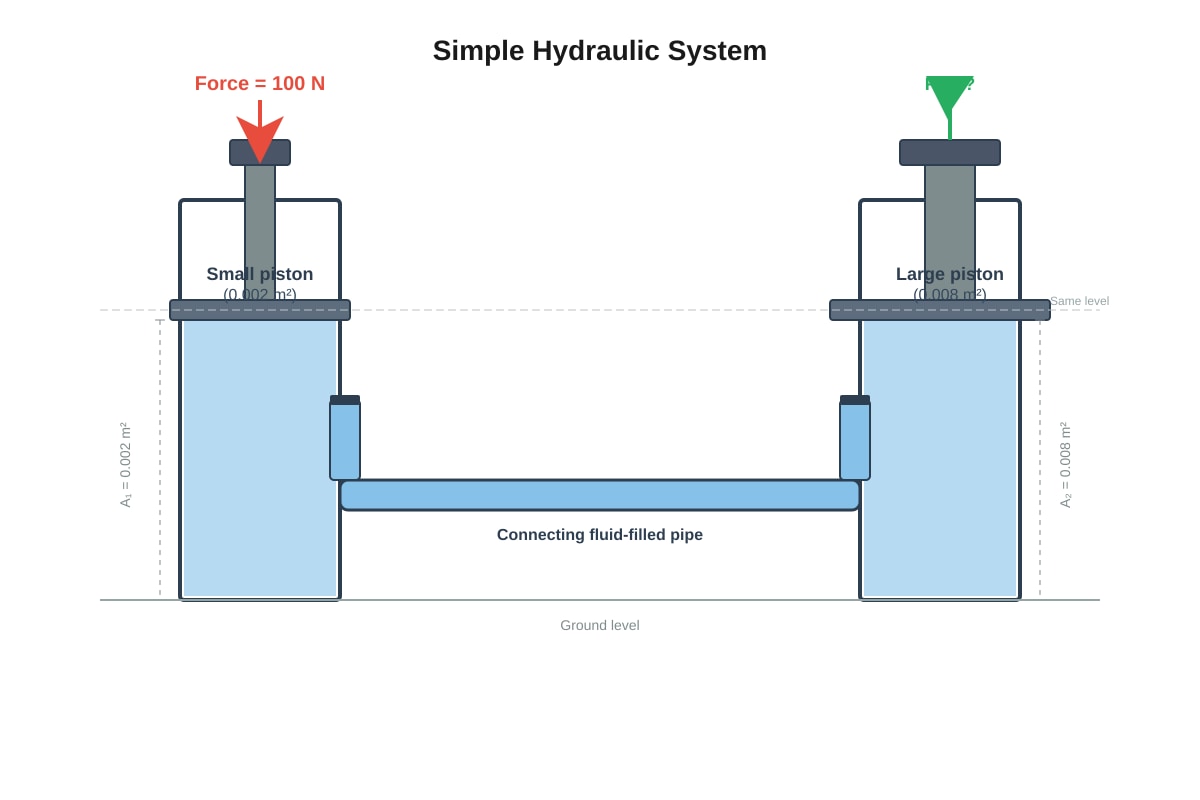
3. The diagram shows a simple hydraulic system.
<image_placeholder> id: Q3-fig1 type: diagram linked_question: Q3 description: Simple hydraulic system with two connected cylinders of different cross-sectional areas. The smaller cylinder has a narrow piston with area 0.002 m², the larger cylinder has a wide piston with area 0.008 m². A force of 100 N is applied to the small piston. labels: Small piston (0.002 m²), Large piston (0.008 m²), Force = 100 N on small piston, Connecting fluid-filled pipe values: A₁ = 0.002 m², A₂ = 0.008 m², F₁ = 100 N must_show: Both pistons clearly labelled with areas, direction of applied force, fluid connection between cylinders, pistons at same horizontal level </image_placeholder>
What is the force exerted by the large piston?
A) 25 N
B) 400 N
C) 500 N
D) 800 N
Answer: ______
4. A metal block of mass 2.0 kg is heated from 20°C to 120°C. The specific heat capacity of the metal is 450 J/(kg·°C). How much thermal energy is supplied?
A) 9 000 J
B) 45 000 J
C) 90 000 J
D) 108 000 J
Answer: ______
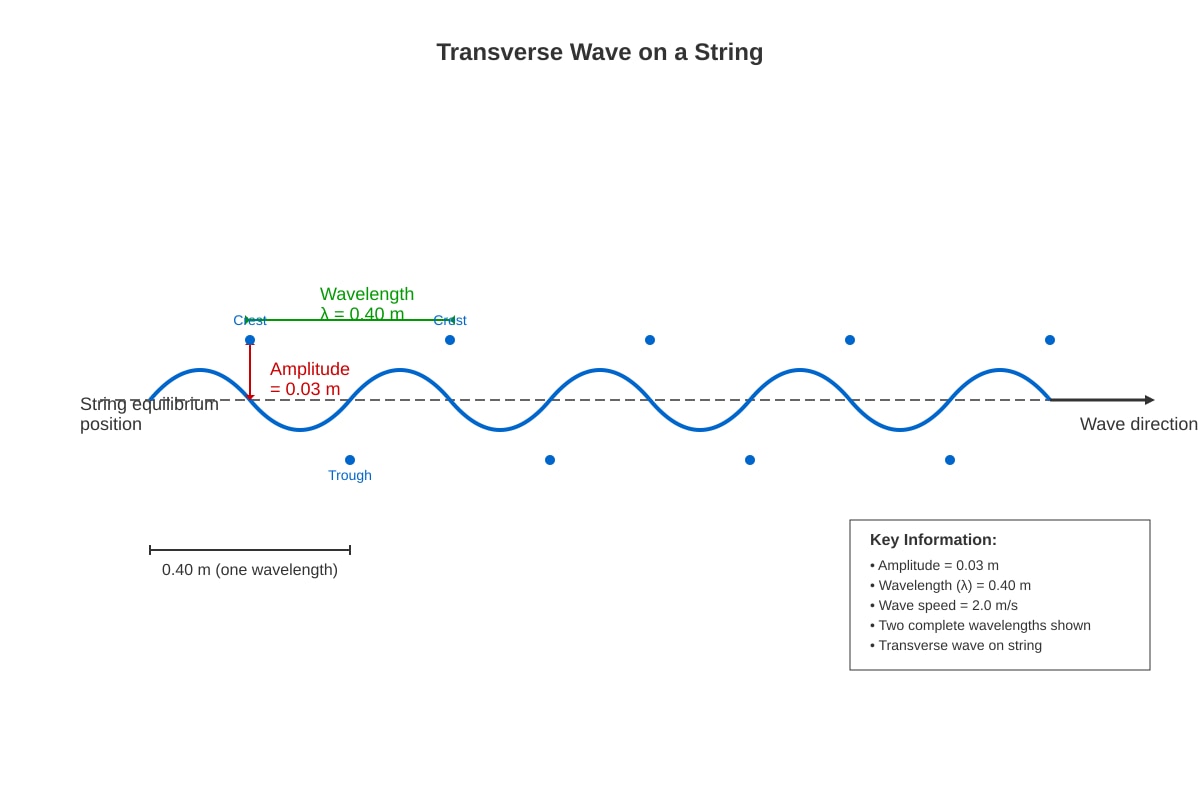
5. The diagram shows a wave on a string at a particular instant.
<image_placeholder> id: Q5-fig1 type: diagram linked_question: Q5 description: Snapshot of a transverse wave on a horizontal string showing two complete wavelengths. The amplitude is marked as 0.03 m and the wavelength is marked as 0.40 m. labels: Amplitude = 0.03 m, Wavelength = 0.40 m, String equilibrium position (dashed horizontal line) values: Amplitude = 0.03 m, Wavelength λ = 0.40 m must_show: One complete wave cycle clearly marked, amplitude labelled from equilibrium to crest, wavelength labelled from crest to crest, arrow indicating wave direction to the right </image_placeholder>
If the wave speed is 2.0 m/s, what is the frequency of the wave?
A) 0.80 Hz
B) 1.25 Hz
C) 5.0 Hz
D) 6.25 Hz
Answer: ______
SECTION B: Structured Questions [35 marks]
Answer ALL questions in the spaces provided.
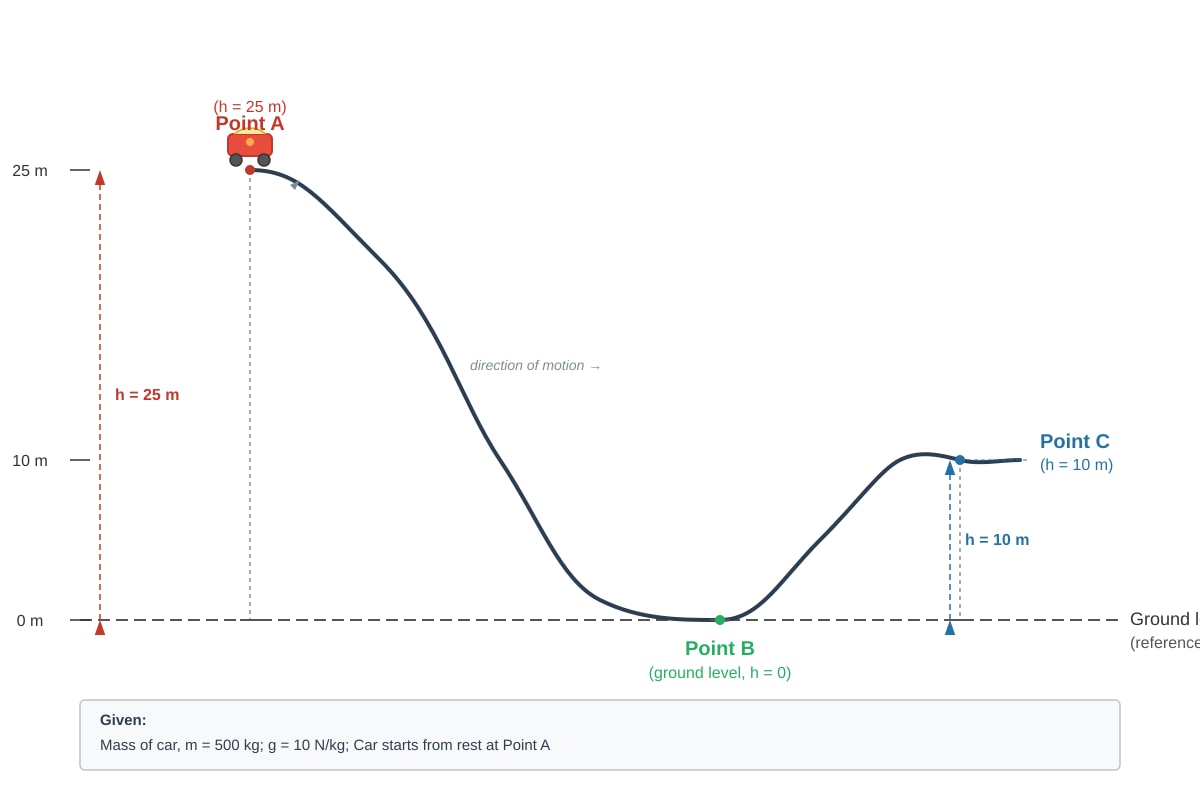
6. A roller coaster car of mass 500 kg starts from rest at point A, which is 25 m above the ground.
<image_placeholder> id: Q6-fig1 type: diagram linked_question: Q6 description: Roller coaster track profile showing three labelled points. Point A is at the highest point (25 m above ground). Point B is at ground level (0 m). Point C is at 10 m above ground. The track curves smoothly between points. A roller coaster car is shown at point A. labels: Point A (h = 25 m), Point B (ground level, h = 0), Point C (h = 10 m), Ground level reference line values: h_A = 25 m, h_B = 0 m, h_C = 10 m, mass m = 500 kg, g = 10 N/kg must_show: Clearly labelled heights at each point, vertical dimension arrows with values, roller coaster car at point A, smooth track profile between points </image_placeholder>
(a) Calculate the gravitational potential energy of the car at point A. [2]
(b) The car descends to point B. Assuming no energy losses, calculate the speed of the car at point B. [3]
(c) In practice, the car reaches point B with a speed of 18 m/s. Calculate the energy lost due to friction and air resistance. [3]
(d) The car continues to point C. Explain why the car can reach point C even though some energy has been lost. [2]
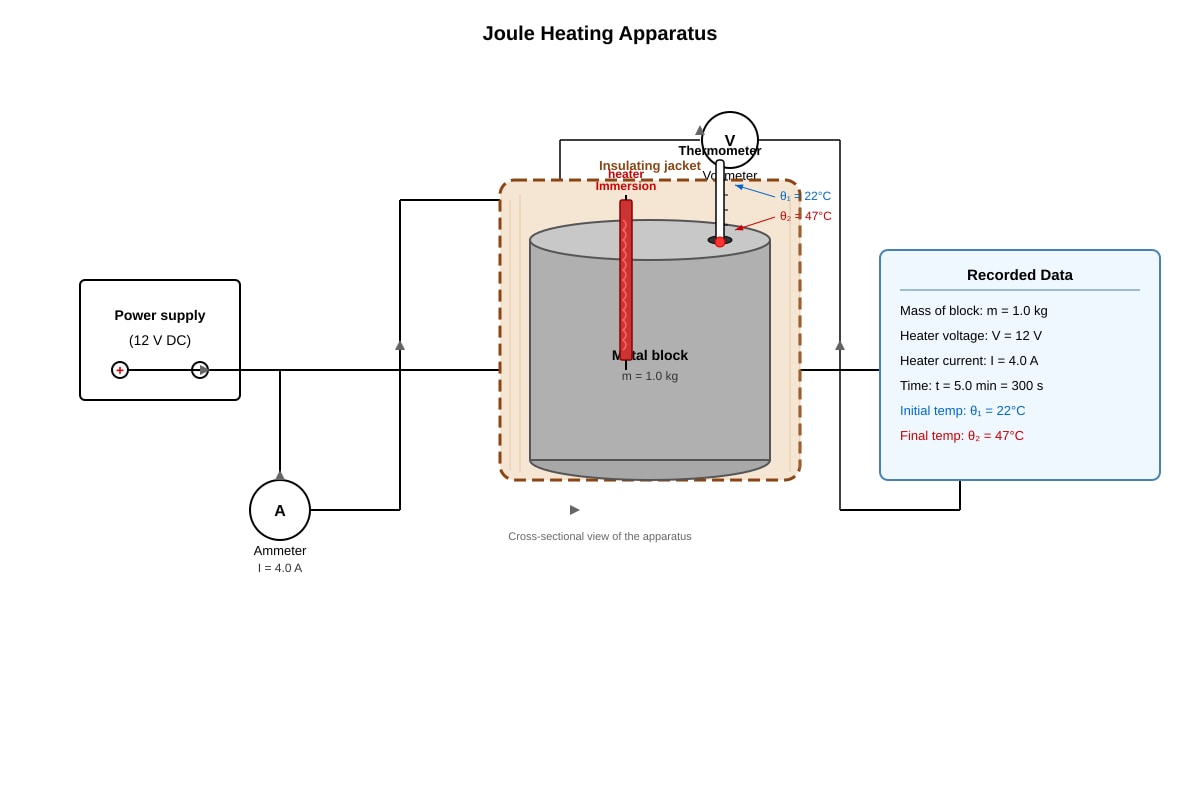
7. The diagram shows a Joule heating experiment to determine the specific heat capacity of a metal block.
<image_placeholder> id: Q7-fig1 type: experimental_setup linked_question: Q7 description: Joule heating apparatus with an immersion heater inserted into a cylindrical metal block, a thermometer in a hole in the block, an ammeter and voltmeter connected to the heater, and a power supply. Insulating material surrounds the block. labels: Immersion heater, Metal block, Thermometer, Ammeter, Voltmeter, Power supply (12 V DC), Insulating jacket, Initial temperature θ₁, Final temperature θ₂ values: Mass of block m = 1.0 kg, Heater voltage V = 12 V, Heater current I = 4.0 A, Time t = 5.0 min = 300 s, θ₁ = 22°C, θ₂ = 47°C must_show: Complete circuit with correct meter symbols and positions, heater inside block, thermometer in separate hole, insulation surrounding block, clear labels for all components </image_placeholder>
(a) State the energy principle used in this experiment to find specific heat capacity. [1]
(b) Calculate the electrical energy supplied to the heater in 5.0 minutes. [2]
(c) Calculate the specific heat capacity of the metal block. Assume no heat is lost to the surroundings. [3]
(d) Explain why the insulated jacket is important for accurate results. Suggest one other modification to improve the accuracy of the experiment. [2]
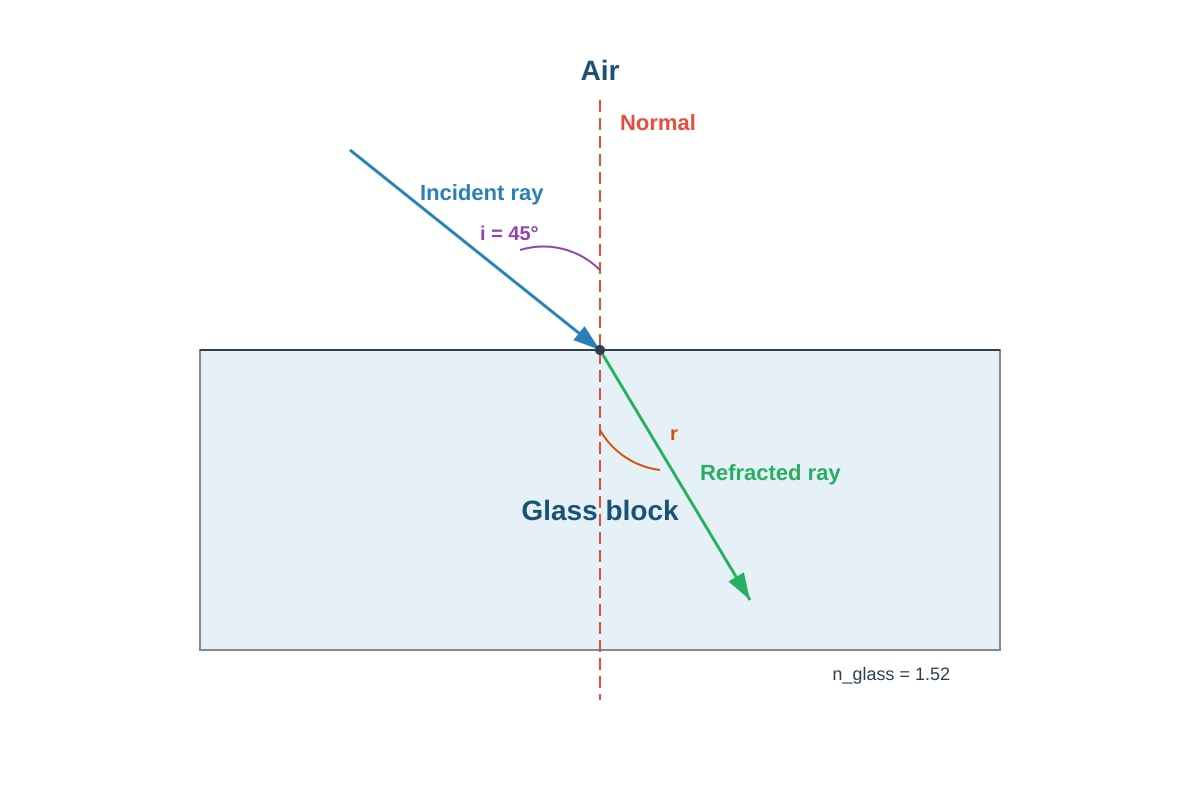
8. The diagram shows a ray of light passing from air into a glass block.
<image_placeholder> id: Q8-fig1 type: diagram linked_question: Q8 description: Light ray diagram showing refraction at a flat air-glass boundary. A ray enters the glass block from air at an angle, bends toward the normal, and travels through the glass. The normal line is shown perpendicular to the boundary. Incident ray, refracted ray, and normal are labelled. labels: Air, Glass block, Normal (dashed line at 90° to boundary), Incident ray, Refracted ray, Angle of incidence i = 45°, Angle of refraction r values: Angle of incidence i = 45°, Refractive index of glass n_glass = 1.52 must_show: Clear boundary between air and glass, normal line perpendicular to boundary, incident and refracted rays with arrows, angles labelled with arcs, glass block with thickness shown </image_placeholder>
(a) State Snell's Law for refraction. [2]
(b) Calculate the angle of refraction r when light enters the glass from air. [3]
(c) Explain what happens to the speed and wavelength of light as it enters the glass from air. [2]
(d) If the angle of incidence in air is increased to 60°, calculate the new angle of refraction. [2]
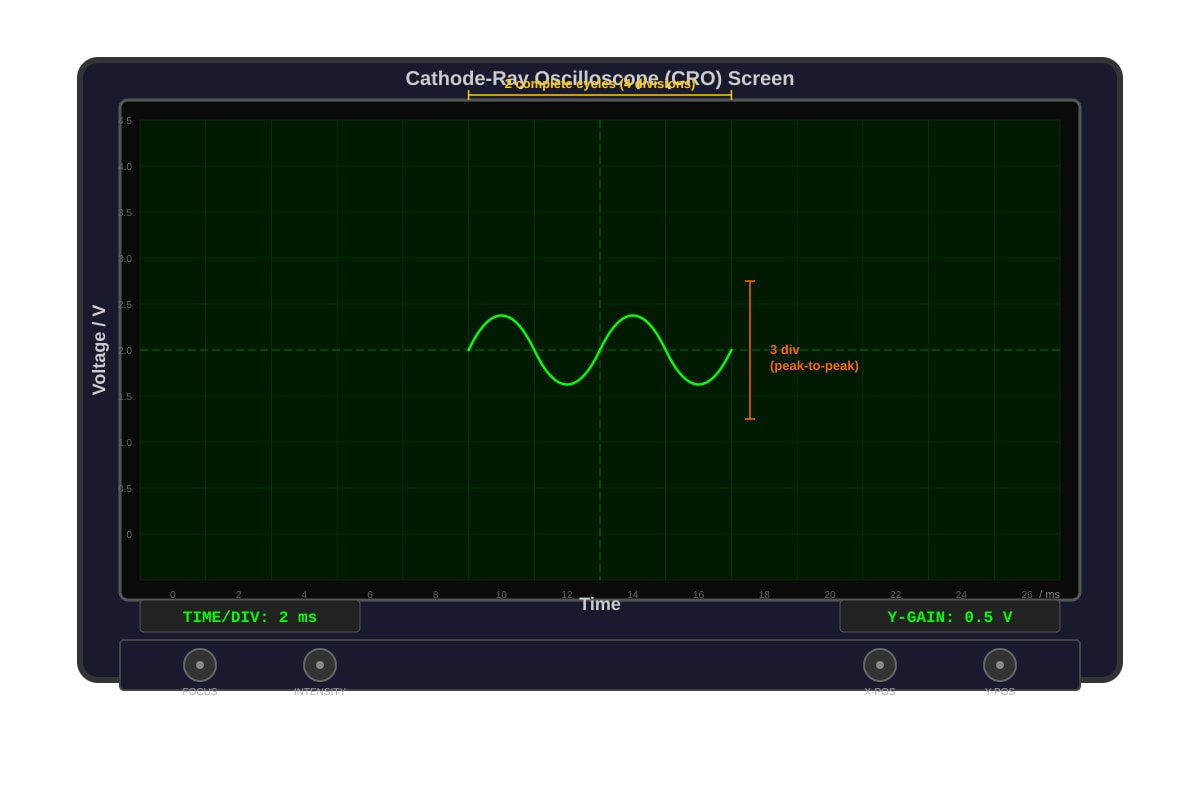
9. The diagram shows a sound wave from a tuning fork displayed on a cathode-ray oscilloscope (CRO).
<image_placeholder> id: Q9-fig1 type: diagram linked_question: Q9 description: CRO screen display showing two complete cycles of a sinusoidal wave. The time-base is set to 2 ms/div and the Y-gain is 0.5 V/div. The wave occupies 4 horizontal divisions for two complete cycles and 3 vertical divisions peak-to-peak. labels: CRO screen with grid, Time-base = 2 ms/div, Y-gain = 0.5 V/div, Wave trace showing two complete cycles, Horizontal axis (time), Vertical axis (voltage) values: Time-base: 2 ms/div, Y-gain: 0.5 V/div, 2 complete cycles span 4 horizontal divisions, Peak-to-peak height = 3 divisions must_show: Grid lines on CRO screen, sinusoidal wave trace, settings clearly labelled, at least two complete cycles visible, axes labelled </image_placeholder>
(a) Calculate the period of the sound wave. [2]
(b) Calculate the frequency of the tuning fork. [2]
(c) Calculate the amplitude of the sound wave in volts. [2]
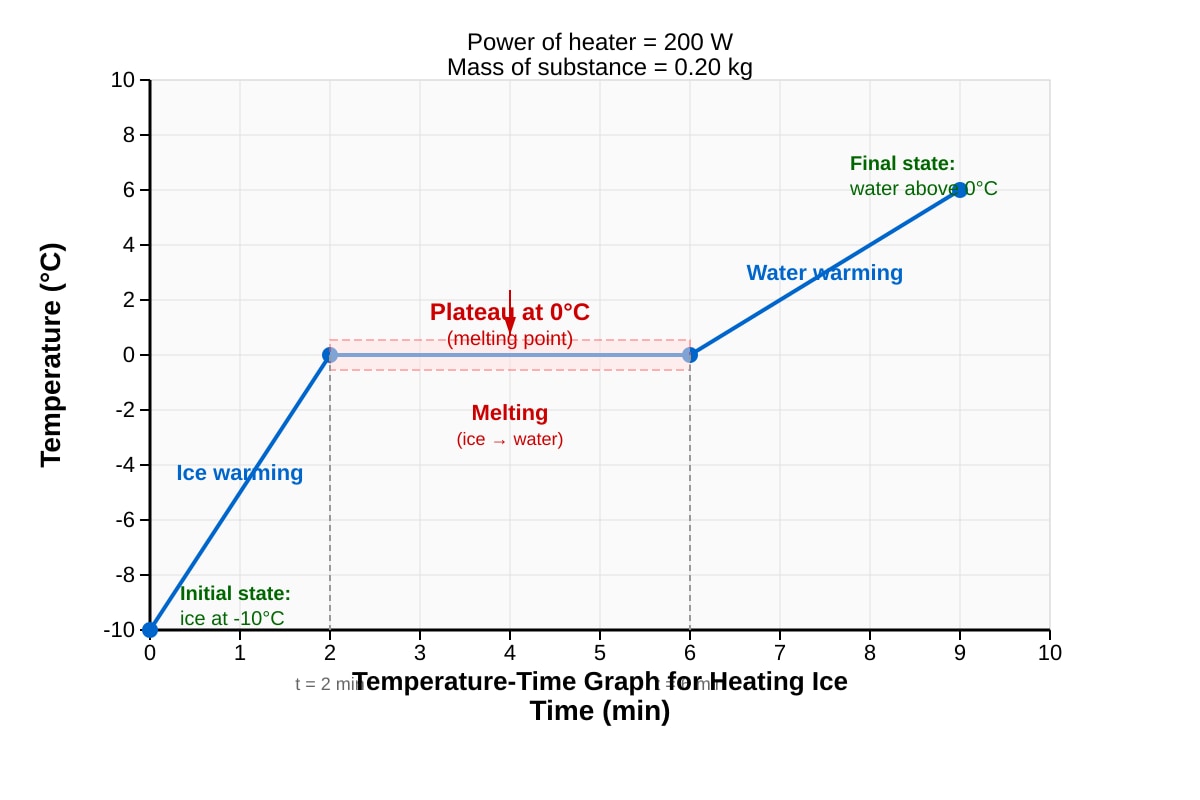
10. The graph shows how the temperature of 0.20 kg of a substance changes as it is heated at a steady rate.
<image_placeholder> id: Q10-fig1 type: graph linked_question: Q10 description: Temperature-time graph for heating a substance. The graph starts at -10°C, rises steadily to 0°C, stays constant at 0°C for 4 minutes, then rises steadily again. The substance is ice being heated to water. labels: Temperature (°C) on y-axis, Time (min) on x-axis, Plateau at 0°C (melting point), Initial state: ice at -10°C, Final state: water above 0°C values: Horizontal section at 0°C from t = 2 min to t = 6 min, Temperature rises from -10°C to 0°C in first 2 min, Rises above 0°C after 6 min, Power of heater = 200 W must_show: Labelled axes with units, clear plateau region at 0°C, linear sections before and after phase change, data points or clear line showing shape </image_placeholder>
(a) State what is happening to the substance between t = 2 min and t = 6 min. [1]
(b) Explain why the temperature stays constant during this period even though heating continues. [2]
(c) Calculate the total energy supplied by the heater between t = 2 min and t = 6 min. [2]
(d) Using your answer to (c), calculate the specific latent heat of fusion of the substance. [3]
11. The diagram shows a simple d.c. motor with a single coil of wire.
<image_placeholder> id: Q11-fig1 type: diagram linked_question: Q11 description: Simple DC motor diagram showing a rectangular coil ABCD on a pivot between two permanent magnets (N and S poles). A split-ring commutator connects to brushes and a DC power supply. The coil is shown in horizontal position. labels: Coil ABCD (A and B on left side, C and D on right side), N pole (above), S pole (below), Split-ring commutator, Brushes, DC power supply, Pivot/axis of rotation, Direction of conventional current shown in coil sides values: Magnetic field direction from N to S shown, Current in AB flowing into page (away), Current in CD flowing out of page (toward) must_show: Clear N and S poles, coil with labelled vertices, commutator split rings with gap at top and bottom, brushes contacting commutator, complete circuit to DC supply, magnetic field lines or arrow direction, current direction arrows on coil sides </image_placeholder>
(a) State the energy conversion that takes place in an electric motor. [1]
(b) Explain why the coil experiences a turning effect (torque) when current flows. [3]
(c) Explain the purpose of the split-ring commutator. [2]
SECTION C: Data Analysis and Application [15 marks]
Answer ALL questions in the spaces provided.
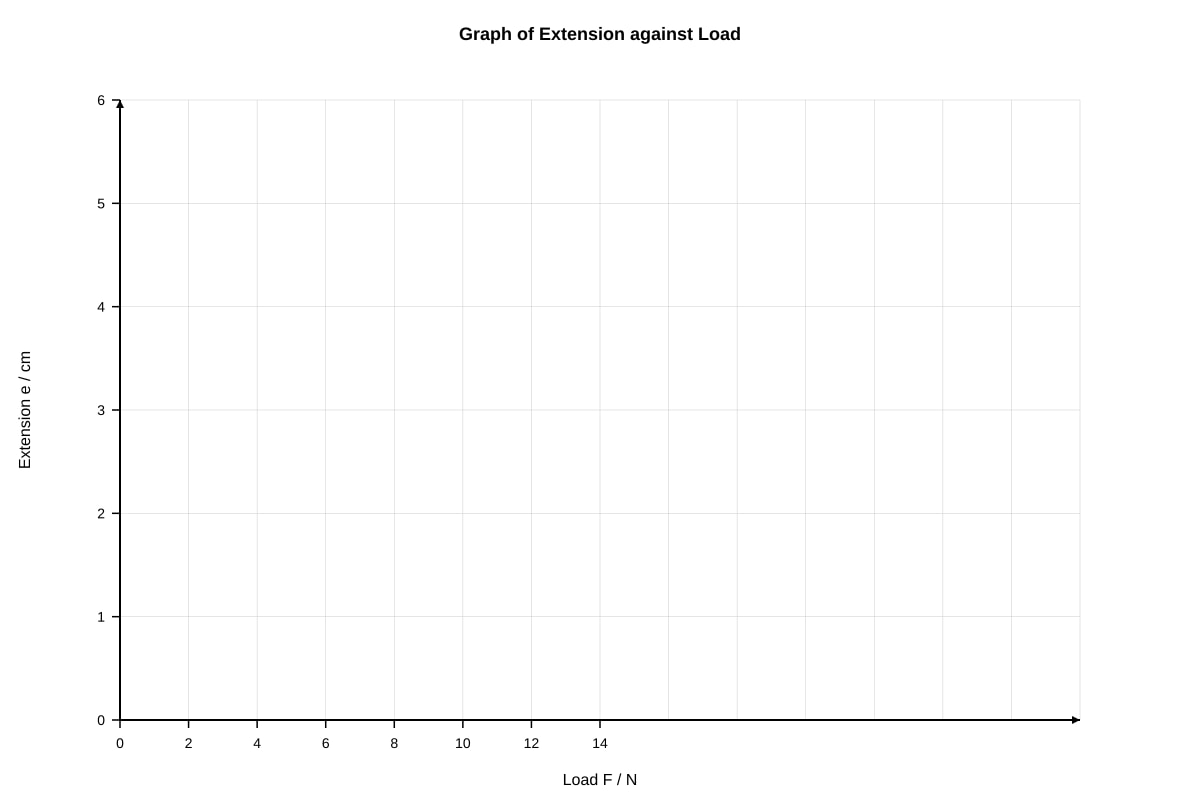
12. A student investigates how the extension of a spring varies with the load applied. The results are shown in the table.
| Load F (N) | 0 | 2.0 | 4.0 | 6.0 | 8.0 | 10.0 | 12.0 |
|---|---|---|---|---|---|---|---|
| Extension e (cm) | 0 | 0.8 | 1.6 | 2.4 | 3.2 | 4.0 | 5.6 |
(a) Plot these results on the grid below. [2]
<image_placeholder> id: Q12-fig1 type: graph linked_question: Q12 description: Blank graph grid with axes for student to plot spring extension data. Pre-labelled axes: x-axis Load F (N) from 0 to 14, y-axis Extension e (cm) from 0 to 6. labels: x-axis: Load F / N (0, 2, 4, 6, 8, 10, 12, 14), y-axis: Extension e / cm (0, 1, 2, 3, 4, 5, 6) values: Grid lines at each unit, origin at (0,0) must_show: Clearly labelled axes with units and scales, grid squares for plotting, enough space for all data points to be plotted </image_placeholder>
(b) The student removes the 12.0 N load and replaces it with an unknown load. The extension is now 3.6 cm. Use your graph to estimate the unknown load, showing your working. [2]
(c) Determine the spring constant k in N/cm for the linear region of the graph. [2]
(d) Suggest why the point for 12.0 N does not fit the same pattern as the other points. [2]
13. The table shows data for different power stations.
| Power Station | Energy Source | Power Output (MW) | Efficiency (%) | CO₂ emissions (kg/MWh) |
|---|---|---|---|---|
| A | Coal | 600 | 35 | 820 |
| B | Natural gas | 400 | 50 | 350 |
| C | Nuclear | 1000 | 33 | 0 |
| D | Solar (photovoltaic) | 50 | 15 | 0 |
(a) Calculate the total energy input required per hour for Power Station A to maintain its power output. [3]
(b) A town requires 200 MW of electrical power. Compare the environmental impact of using Power Station B versus Power Station D to supply this demand, considering both efficiency and land use. [3]
(c) Explain why Power Station C has zero CO₂ emissions but still produces thermal pollution. [2]
14. Read the following passage about a new roller coaster design.
Engineers are designing a roller coaster with a "launch" system using electromagnetic linear motors instead of a traditional chain lift. The launch track is 80 m long and the 4000 kg train must reach 30 m/s at the end of the launch. The electromagnetic system is 75% efficient. After launch, the train climbs a 45 m high hill.
(a) Calculate the kinetic energy of the train at the end of the launch. [2]
(b) Calculate the minimum energy that must be supplied by the electromagnetic system. [2]
(c) Explain whether the train will successfully reach the top of the 45 m hill after launch, assuming 10% of its kinetic energy is lost to friction and air resistance during the climb. Support your answer with a calculation. [3]
END OF PAPER
Total: 60 marks
Answers
TuitionGoWhere Practice Paper - Combined Science Secondary 3
Version 3 of 5 - ANSWER KEY
SECTION A: Multiple Choice Questions [10 marks]
1. Answer: C
Explanation: At constant speed, kinetic energy is constant (not increasing, so A is wrong). The student does work against friction, and this work is converted to thermal energy (internal energy) of the floor and box. Not all work becomes kinetic energy—that would require acceleration. Gravitational potential energy stays constant on a horizontal floor. Common mistake: thinking "work done" automatically means kinetic energy gain. At constant velocity, net force is zero, so all applied work goes against friction.
2. Answer: B
Explanation: At maximum height, the ball momentarily stops before falling back down. Kinetic energy () is zero because . All the initial kinetic energy has been converted to gravitational potential energy (), which is at its maximum. Total energy (kinetic + potential) remains constant if air resistance is ignored. Common mistake: confusing "maximum height" with having maximum speed—it's actually minimum (zero) speed.
3. Answer: B
Explanation: Using Pascal's principle for hydraulic systems: pressure is transmitted equally throughout the fluid.
Common mistake: dividing by 4 instead of multiplying, or confusing which area goes on top.
4. Answer: C
Explanation: Using :
Common mistake: forgetting to calculate temperature change (, not 120°C) or mixing up mass and specific heat capacity values.
5. Answer: C
Explanation: Using , so Hz.
SECTION B: Structured Questions [35 marks]
6. (a) [2 marks]
Marking: Formula [1], correct substitution and answer with unit [1]
6. (b) [3 marks]
By conservation of energy: at A = at B (assuming no energy loss)
Marking: Statement of energy conservation or correct equating [1], correct formula/substitution [1], correct answer [1]
6. (c) [3 marks]
Actual kinetic energy at B: J
Expected kinetic energy (from part a): 125 000 J
Energy lost = J = J
Marking: Correct actual calculation [1], correct subtraction [1], correct answer with unit [1]
Common mistake: Using in or forgetting to square the velocity.
6. (d) [2 marks]
The car can reach point C because:
- Point C is at 10 m, which requires J [1]
- The car still has 81 000 J of kinetic energy at B, which is greater than 50 000 J needed [1]
- Even after losses, sufficient energy remains to reach the lower height of point C
7. (a) [1 mark]
Principle of conservation of energy: electrical energy supplied by heater = thermal energy gained by block (assuming no heat losses)
Or:
7. (b) [2 marks]
Marking: Formula [1], correct answer [1]
7. (c) [3 marks]
Using :
Marking: Correct [1], correct rearrangement [1], correct answer with unit [1]
Common mistake: Using time in minutes instead of seconds, or using wrong temperature change.
7. (d) [2 marks]
The insulated jacket reduces heat loss to the surroundings [1], ensuring that electrical energy ≈ thermal energy gained by block.
Other modification: Stir the metal block gently to ensure uniform temperature distribution; or use a more sensitive thermometer; or allow more time for temperature to stabilize before recording. [1]
8. (a) [2 marks]
Snell's Law:
Or in words: The ratio of the sine of the angle of incidence to the sine of the angle of refraction is constant for a given pair of media / equals the refractive index.
Marking: Correct formula or statement [1], correct definition of terms [1]
8. (b) [3 marks]
Marking: Correct formula/substitution [1], correct calculation of sin r [1], correct answer [1]
8. (c) [2 marks]
As light enters glass: speed decreases [1] because glass is optically denser than air; wavelength decreases [1] while frequency stays constant (since and is determined by the source).
8. (d) [2 marks]
Marking: Correct substitution [1], correct answer [1]
9. (a) [2 marks]
For 2 complete cycles: 4 horizontal divisions
Time per division = 2 ms
Period for 2 cycles = ms
Period for 1 cycle = ms = s
Marking: Correct method for finding time for cycles [1], correct period [1]
9. (b) [2 marks]
Marking: Formula [1], correct answer with unit [1]
9. (c) [2 marks]
Peak-to-peak = 3 divisions
Peak-to-peak voltage = V
Amplitude = V
Marking: Correct peak-to-peak voltage [1], correct amplitude [1]
Common mistake: Forgetting to divide by 2 for amplitude (giving 1.5 V instead of 0.75 V).
10. (a) [1 mark]
The substance is melting / undergoing phase change from solid to liquid.
10. (b) [2 marks]
During melting, energy supplied is used to break intermolecular bonds [1] and increase potential energy of molecules, not to increase kinetic energy (which determines temperature) [1]. The temperature remains constant at the melting point during this phase change.
10. (c) [2 marks]
Time = 4 minutes = s
Marking: Correct time conversion [1], correct energy calculation [1]
10. (d) [3 marks]
Energy supplied = heat for melting =
Marking: Correct equating [1], correct rearrangement [1], correct answer with unit [1]
Common mistake: Using mass in grams or wrong power/time values.
11. (a) [1 mark]
Electrical energy → kinetic energy (rotational) / mechanical energy
11. (b) [3 marks]
- Current flows in coil sides AB and CD which are in a magnetic field [1]
- A current-carrying conductor in a magnetic field experiences a force (motor effect) [1]
- Forces on AB and CD are in opposite directions (Fleming's left-hand rule: AB force up, CD force down, or vice versa depending on field and current directions) [1]
- These equal and opposite forces on opposite sides create a couple/torque, causing rotation
11. (c) [2 marks]
The split-ring commutator reverses the direction of current in the coil every half rotation [1]. This ensures that the forces on AB and CD always produce torque in the same direction, maintaining continuous rotation in one direction [1].
SECTION C: Data Analysis and Application [15 marks]
12. (a) [2 marks]
Expected plot: Six points (0,0), (2, 0.8), (4, 1.6), (6, 2.4), (8, 3.2), (10, 4.0) lie on a straight line; point (12, 5.6) deviates above this line.
Marking: Correct plotting of points [1], suitable line of best fit with last point treated as anomaly or clear indication of deviation [1]
12. (b) [2 marks]
Using linear region: from graph or calculation, gradient = cm/N
For e = 3.6 cm: N
Or by reading directly from best-fit line: approximately 9.0 N
Marking: Method shown [1], correct answer [1]
12. (c) [2 marks]
From linear portion (Hooke's Law region):
Or: N/cm
Marking: Correct method using linear data [1], correct answer with unit [1]
12. (d) [2 marks]
The 12.0 N load exceeds the elastic limit / limit of proportionality of the spring [1]. Beyond this point, Hooke's Law no longer applies; the spring undergoes plastic deformation and does not return to original length, causing greater extension per unit load [1].
13. (a) [3 marks]
Efficiency =
Energy input per hour = J
Or: 1714.3 MWh
Marking: Correct formula/rearrangement [1], correct power input [1], correct energy in suitable unit [1]
13. (b) [3 marks]
For 200 MW demand:
Power Station B (natural gas): Need MW thermal input. CO₂ = kg/hr. Smaller land footprint, moderate emissions. [1]
Power Station D (solar): Need MW installed capacity (area-dependent). Zero direct CO₂ but requires large land area for panels, intermittent supply needs storage. [1]
Comparison: B is more land-efficient and reliable but emits CO₂; D is renewable with no direct emissions but needs much more space and backup systems for continuous supply. [1]
13. (c) [2 marks]
Nuclear fission does not produce CO₂ as no fossil fuel combustion occurs [1]. However, the process generates large amounts of waste heat from the reactor that must be dissipated, typically into cooling water or air, causing thermal pollution [1].
14. (a) [2 marks]
Marking: Formula [1], correct answer [1]
14. (b) [2 marks]
Marking: Correct division by efficiency [1], correct answer [1]
14. (c) [3 marks]
Energy after 10% loss during climb: J
Energy needed to reach 45 m: J
Comparison: J < J
Conclusion: The train will not successfully reach the top of the 45 m hill [1]. The kinetic energy remaining after launch losses is insufficient to overcome the gravitational potential energy required, falling short by J or 180 kJ.
Marking: Correct calculation of remaining energy [1], correct required potential energy [1], correct conclusion with justification [1]
TOTAL MARKS: 60